The words artist and artisan may sound similar, but they describe different aspects of creative work. Both involve skill, imagination, and dedication. However, the main difference often lies in what a person creates and which part of the process their work emphasizes.
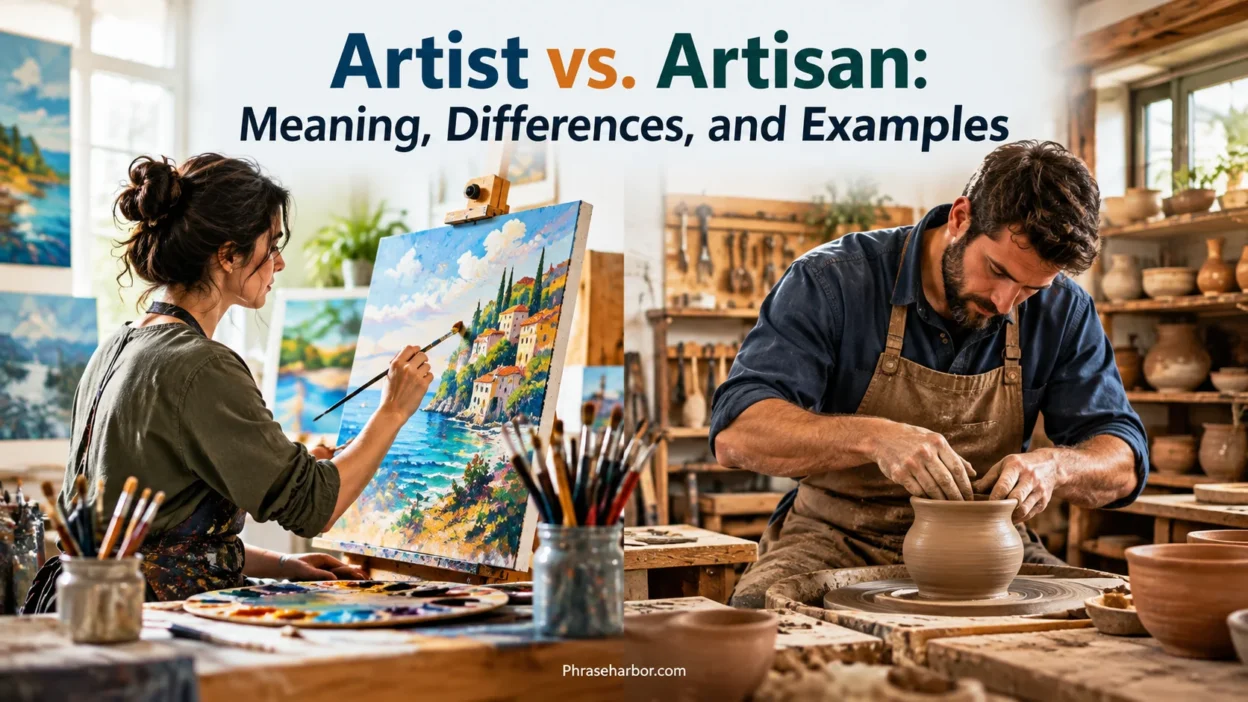
An artist typically creates work to express ideas, emotions, or a unique perspective. An artisan, on the other hand, uses specialized skills and craftsmanship to produce carefully made objects. For example, a painter might create a portrait to capture someone’s personality, while a potter might craft a ceramic bowl for everyday use.
However, these roles aren’t entirely separate. A ceramic artist can create expressive sculptures while using traditional pottery techniques. Similarly, a furniture maker can combine practical woodworking skills with an original artistic vision.
Understanding the difference between artist vs. artisan helps you choose the right word when describing someone’s profession, creative process, or finished work. Let’s explore their meanings, differences, examples, and proper usage.
Quick Answer:
An artist is someone who creates art through imagination, creative expression, and skill. An artisan is a skilled craftsperson who uses specialized techniques to make handcrafted, decorative, or functional objects.
The primary distinction is the emphasis of the work, not the person’s level of talent.
- Artist: Often emphasizes creative expression, originality, and artistic vision.
- Artisan: Often emphasizes craftsmanship, technical expertise, and the careful making of objects.
- Both: Can describe someone who combines artistic creativity with specialized craft skills.
Example: A painter who creates an original landscape is generally called an artist. A woodworker who builds a handcrafted dining table is generally called an artisan. If the woodworker designs the table as a unique sculptural piece, both terms may apply.
Comparison Overview
Although artists and artisans share several qualities, their work may differ in purpose, process, and typical results. The following table highlights the most important distinctions.
| Feature | Artist | Artisan |
| Meaning | Someone who creates art | A skilled craftsperson |
| Primary emphasis | Creative expression and artistic vision | Craftsmanship and specialized techniques |
| Main purpose | To express ideas, explore concepts, communicate, or create aesthetic experiences | To produce carefully crafted objects, often with practical or decorative value |
| Common work | Paintings, photographs, sculptures, music, illustrations | Pottery, furniture, jewelry, textiles, glassware |
| Key skills | Imagination, composition, interpretation, technique | Precision, material knowledge, technique, attention to detail |
| Materials | Paint, canvas, digital tools, stone, sound, and more | Wood, clay, metal, leather, glass, and textiles |
| Learning methods | Formal education, independent practice, mentorship, or experimentation | Apprenticeships, practical training, formal education, or independent practice |
| Typical output | Artwork, performances, visual designs, or creative works | Crafted products, decorative objects, or functional goods |
| Relationship with function | May prioritize expression or function | Often considers function, quality, durability, or appearance |
| Overlap | Can practice traditional crafts | Can create original artwork |
Remember: These are general tendencies rather than strict rules. An artist may produce functional objects, and an artisan may create highly expressive work. The two terms often overlap in contemporary creative fields.
What Does Artist Mean?
Artist Definition
An artist is a person who uses creative ability, imagination, and skill to produce art. The term covers many fields, including visual arts, music, dance, literature, theater, and digital media.
Artists use different methods to communicate ideas, explore emotions, tell stories, or create experiences for an audience. Their work may reflect personal experiences, cultural traditions, social issues, or purely aesthetic interests.
For example, a painter might use color and composition to express loneliness. A photographer might capture an ordinary street scene to highlight its beauty. A musician might compose a song that helps listeners understand a particular experience.
In each case, the person combines creative decisions with technical skills to produce something meaningful.
An artist doesn’t necessarily need to sell artwork or earn a living through creative work. Someone who paints as a hobby can also be described as an artist.
Examples of Artists
Artists work across a wide range of creative fields.
- Painter: Creates images using paint, brushes, and other materials.
- Sculptor: Shapes materials such as stone, wood, clay, or metal into three-dimensional works.
- Illustrator: Creates images to explain ideas, tell stories, or accompany written content.
- Photographer: Uses photography to document events, communicate ideas, or create artistic images.
- Musician: Creates or performs music using instruments, voice, or digital tools.
- Dancer: Uses movement to express ideas, emotions, or stories.
- Writer: Creates literary works, including poems, stories, and novels.
- Digital artist: Uses digital tools to create illustrations, paintings, animations, or other visual works.
These examples demonstrate that artistic work isn’t limited to painting or drawing. The term applies to many forms of creative expression.
What Does an Artist Do?
An artist’s responsibilities depend on the field, project, and intended audience. However, several activities commonly appear in artistic practice.
Develops original ideas: Artists explore subjects, concepts, and themes before deciding how to communicate them.
Experiments with techniques: They may test different colors, materials, compositions, sounds, or methods to achieve a particular result.
Builds technical skills: Creative ideas become more effective when artists understand the tools and techniques of their chosen medium.
Makes creative decisions: Artists choose what to emphasize, what to leave out, and how to guide the audience’s attention.
Shares or presents work: They may exhibit artwork, publish writing, perform music, accept commissions, or sell creative products.
Consider a painter creating a portrait. The painter must understand proportions, lighting, color, and brushwork. At the same time, the artist decides which facial expressions and visual details best communicate the subject’s personality.
That combination of technical ability and creative judgment is central to artistic practice.
Artist in a Sentence
Here are several examples showing how to use artist naturally.
- The artist displayed her latest paintings at a local gallery.
- My brother is a digital artist who creates illustrations for video games.
- The photographer is a talented artist with a distinctive visual style.
- The sculptor used recycled metal to create an impressive public artwork.
- She became a professional artist after years of practice and experimentation.
Each sentence uses artist to describe someone whose work involves creative production or artistic expression.
What Does Artisan Mean?
Artisan Definition
An artisan is a skilled craftsperson who uses specialized knowledge and techniques to make objects. The term often refers to people who work with materials such as wood, clay, metal, leather, glass, or fabric.
Artisans typically develop their abilities through practice, instruction, apprenticeships, or years of experience. Their work often requires careful control, material knowledge, and an understanding of how individual parts contribute to a finished product.
For example, a leatherworker must understand how leather behaves when cut, stitched, shaped, and finished. A furniture maker needs to know how to join pieces of wood securely while maintaining the intended design.
Artisans may create objects for practical use, decoration, cultural traditions, or personal expression. Some produce individual handmade pieces, while others create small batches of goods using specialized equipment.
Although artisanship has strong historical connections to handcrafting, an artisan doesn’t have to make every item entirely by hand. Modern artisans may use power tools, digital design software, kilns, or other equipment while still relying on specialized craftsmanship.
Read More: Arial vs. Ariel: Meaning, Differences, and Correct Usage
Examples of Artisans
Many professions fall within the broad category of artisans.
- Potter: Shapes clay into bowls, cups, vases, and other ceramic objects.
- Woodworker: Uses woodworking techniques to create furniture, decorative pieces, or practical items.
- Blacksmith: Shapes metal through heating, hammering, and other metalworking processes.
- Glassblower: Shapes molten glass into vessels, ornaments, and decorative objects.
- Leatherworker: Cuts, stitches, and shapes leather into bags, belts, wallets, and accessories.
- Jewelry maker: Creates rings, necklaces, bracelets, and other jewelry.
- Textile weaver: Interlaces threads to produce fabric and other woven materials.
- Furniture maker: Designs and constructs tables, chairs, cabinets, and related products.
Some of these professionals may also identify as artists. The most appropriate label depends on their work, professional identity, and the context in which you describe them.
What Does an Artisan Do?
An artisan combines practical knowledge with specialized production skills. The exact tasks vary by craft, but several activities are common.
Selects suitable materials: Artisans consider durability, texture, appearance, cost, and how materials behave during production.
Uses specialized techniques: They apply methods learned through training and experience to shape, assemble, decorate, or finish their work.
Maintains quality: They check measurements, surfaces, joints, finishes, and other details to ensure the final product meets their standards.
Solves practical problems: Materials don’t always behave as expected. Artisans adjust their methods to address cracks, uneven surfaces, fitting problems, or other challenges.
Creates finished products: Their work may result in useful household items, custom furniture, jewelry, decorative objects, or traditional crafts.
Imagine an artisan making a wooden dining table. The process involves selecting suitable timber, measuring the pieces, cutting the components, joining them securely, sanding the surface, and applying a finish.
Every step requires knowledge and judgment. Even a small mistake in measurement can affect the final result.
Artisan in a Sentence
The following examples demonstrate the correct use of artisan.
- The artisan crafted a wooden chair using traditional woodworking techniques.
- We purchased handmade pottery from a local artisan.
- An experienced artisan repaired the antique cabinet without damaging its original details.
- The jewelry artisan used silver and natural stones to create custom necklaces.
- The market featured artisan products made by skilled craftspeople.
In these examples, artisan highlights the person’s specialized craft skills and ability to produce carefully made objects.
Main Differences Between Artist and Artisan
The distinction between an artist and an artisan becomes clearer when you examine their goals, skills, working methods, and finished products. However, these differences describe common patterns rather than rigid boundaries.
Difference in Meaning and Purpose
The most important difference is the emphasis each term places on creative work.
An artist is generally associated with creating art through imagination, interpretation, or personal expression. An artisan is generally associated with producing objects through specialized craftsmanship.
For example, an artist might create an abstract sculpture to explore the relationship between shape and emotion. An artisan might shape clay into durable dinnerware designed for everyday use.
Both people need skill and creativity. Their primary goals simply differ.
However, an artisan can create objects without a practical purpose, and an artist can produce functional items. The words describe overlapping professional roles rather than two completely separate categories.
Difference in Creativity and Craftsmanship
Artists and artisans both need creativity and technical ability, although their work may emphasize these qualities differently.
Artists often make decisions about composition, meaning, style, mood, and originality. They may experiment with unconventional materials or challenge familiar ways of presenting a subject.
Artisans often focus on mastering techniques, understanding materials, maintaining consistency, and producing well-finished objects. Their creativity may appear in a product’s design, construction, decoration, or clever solution to a practical problem.
Consider two people working with glass.
- An artist creates a glass sculpture that explores light, movement, and transparency.
- An artisan produces carefully shaped drinking glasses with balanced proportions and durable rims.
The artist’s work may emphasize visual expression. The artisan’s work may emphasize functional design and technical precision.
Nevertheless, both require imagination and craftsmanship. Neither role is inherently more creative or demanding.
Difference in Process and Techniques
Artists and artisans may approach projects differently because they often work toward different outcomes.
An artist might begin with a concept, sketch, emotion, or question. The final work can change significantly during experimentation. Unexpected results may even become part of the finished piece.
An artisan may begin with a design, a customer’s requirements, or a clearly defined product. Measurements, material properties, construction methods, and quality standards often guide the process.
For example, a painter may change a composition midway through a project because a new arrangement communicates the intended idea more effectively.
A cabinetmaker may need to follow precise measurements so the cabinet doors fit properly and open smoothly.
These approaches aren’t mutually exclusive. A furniture artist might experiment freely with form, while a painter creating commercial illustrations might follow detailed specifications.
Difference in the Products They Create
The objects artists and artisans produce can provide useful clues about which term fits best.
Artists commonly create:
- Paintings and drawings
- Photographic works
- Sculptures and installations
- Illustrations and digital artwork
- Musical compositions and performances
Artisans commonly create:
- Handcrafted furniture
- Ceramic bowls and pottery
- Jewelry and leather accessories
- Woven textiles and decorative fabrics
- Metalwork, glassware, and wooden objects
Still, the type of product doesn’t determine the correct label by itself.
A ceramic bowl may be an artistic statement, a functional kitchen item, or both. Similarly, a wooden sculpture may demonstrate advanced woodworking while expressing a distinct creative vision.
The purpose and nature of the work matter more than the material alone.
FAQs:
Is an Artist the Same as an Artisan?
Not exactly. An artist generally creates work through creative expression, while an artisan specializes in making objects through skilled craftsmanship.
However, one person can fit both descriptions. A ceramic artist who creates original sculptures using traditional pottery techniques may be both an artist and an artisan.
What Is the Main Difference Between an Artist and an Artisan?
The main difference is the emphasis of their work.
An artist is often associated with imagination, expression, and creative ideas. An artisan is often associated with specialized techniques, material knowledge, and carefully made objects.
These are general distinctions rather than strict rules. Both professions require skill and can involve considerable creativity.
Is a Painter an Artist or an Artisan?
A painter is generally called an artist, especially when creating original paintings or expressive artwork.
However, painting can also involve specialized craft skills. A decorative painter who applies intricate finishes to furniture may be described as an artisan, depending on the context.
The type of painting and the person’s role help determine the most appropriate term.
Is a Potter an Artist or an Artisan?
A potter can be either an artist or an artisan, and sometimes both.
Someone who produces functional bowls, cups, and plates using specialized pottery techniques may be described as an artisan. Someone who creates expressive ceramic sculptures may be called an artist.
The distinction depends on the nature and purpose of the work rather than the material alone.
Can an Artisan Be Creative?
Absolutely. Creativity plays an important role in many crafts.
Artisans often develop original designs, experiment with materials, adapt traditional methods, and solve practical problems. Their creativity may appear in the object’s shape, decoration, construction, or function.
A skilled artisan doesn’t simply repeat a process. The person may make countless decisions that influence the final result.
Conclusion:
The difference between artist and artisan comes down to emphasis. An artist is generally associated with creative expression and artistic vision, while an artisan is associated with specialized craftsmanship and the skilled production of objects. Artists may create paintings, photographs, sculptures, music, or digital artwork. Artisans may produce pottery, furniture, jewelry, textiles, and other carefully crafted goods.