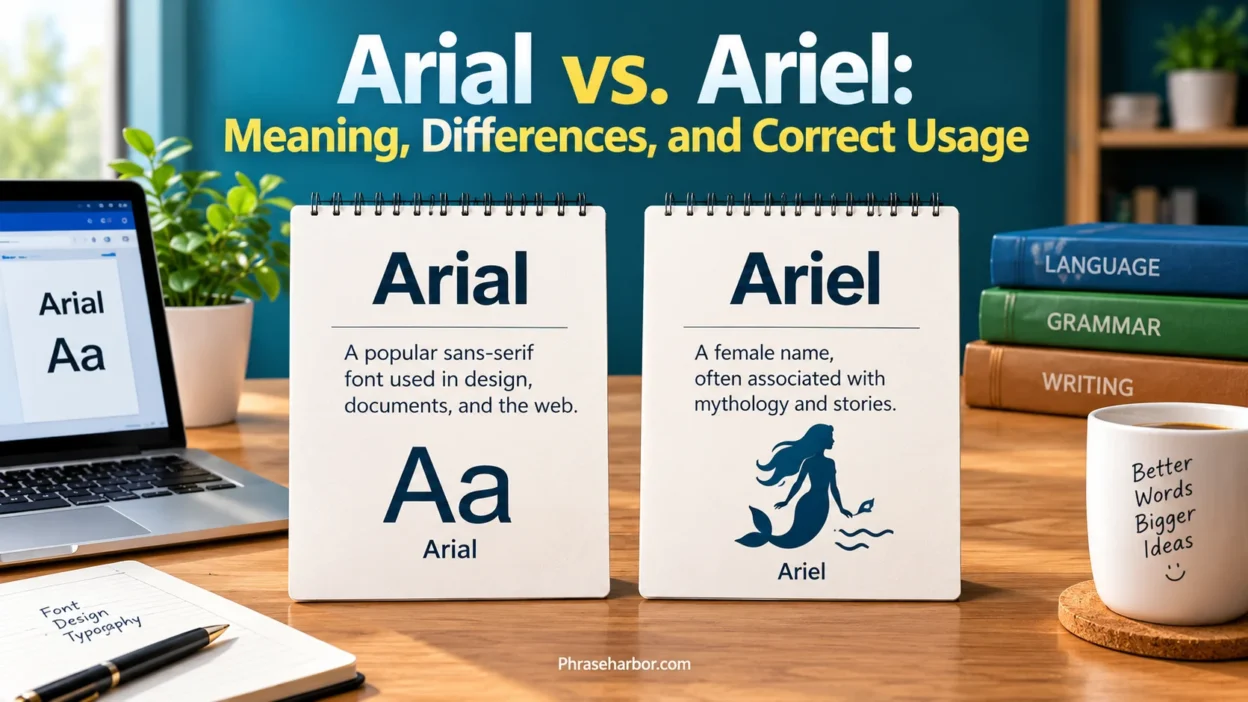
Have you ever typed a word into a document and wondered whether you should write Arial, Ariel, or aerial? You’re not alone. The confusion is surprisingly common because these words look and sound similar, and Arial and Ariel are sometimes treated as homophones because they can be pronounced the same way but are spelled differently.
However, they have completely different meanings. Arial is a popular font style commonly used in documents, websites, and graphic design. It belongs to typography and digital design, so the distinction matters when selecting a font or improving the appearance of your writing.
Ariel, on the other hand, is usually a name. Aerial is an adjective related to the air or sky, or something seen from above. You’ll see it in phrases such as aerial photography and aerial views, which relate to aviation and elevated perspectives.
Quick Answer
Arial is a sans-serif typeface used in documents, presentations, websites, and other forms of written communication. Ariel is a given name with Hebrew roots, commonly associated with the meaning “lion of God.”
Although the words differ by only one letter, they’re not interchangeable.
- Arial: Use this spelling when referring to the font. Example: “Please format the report in Arial, 12-point type.”
- Ariel: Use this spelling when referring to a person or another entity with that name. Example: “Ariel submitted the report yesterday.”
Remember this simple rule: If you’re talking about typography, choose Arial. If you’re talking about someone named Ariel, choose Ariel.
Both spellings are correct in their appropriate contexts. The surrounding sentence determines which one you need.
Comparison Overview
| Feature | Arial | Ariel |
| Meaning | A sans-serif typeface | Commonly a personal name |
| Part of speech | Proper noun | Proper noun |
| Main use | Typography and text formatting | Names of people and other named entities |
| Origin | Developed as a typeface in 1982 | Derived from a Hebrew name |
| Common association | Documents, presentations, and digital text | People, literature, and popular culture |
| Example | The presentation uses Arial. | Ariel prepared the presentation. |
| Common mistake | Writing “Ariel font” when Arial is intended | Writing “Arial” as someone’s name when the correct spelling is Ariel |
The most important distinction is meaning, not correctness. Neither spelling is universally wrong. You simply need to match the word to the subject you’re discussing.
For example, consider these two sentences:
- “Ariel changed the document’s font to Arial.”
- “Arial looks different from the font Ariel selected.”
In the first sentence, Ariel is the person’s name and Arial is the typeface. The second sentence uses both words correctly, too. Once you recognize their separate roles, the distinction becomes straightforward.
What Does Arial Mean?
Arial is a widely used sans-serif typeface designed for clear, practical reading across different formats. You’ll often find it in office documents, business presentations, spreadsheets, and digital interfaces.
A sans-serif typeface uses letterforms without the small decorative strokes called serifs. Compare the letter shapes in Arial with those in Times New Roman. Times New Roman has serifs, while Arial has cleaner, simpler letterforms.
Arial became popular partly because it offered a familiar, straightforward appearance for everyday computing. Its letterforms work well in many practical settings, from short headings to lengthy business documents.
The History and Origin of Arial
Arial was designed by Robin Nicholas and Patricia Saunders and released in 1982. Monotype developed the typeface, which became widely associated with Microsoft software and the Windows operating system.
Its history is closely connected to the growth of desktop publishing and personal computing. As more people began creating documents on computers, software developers needed typefaces that worked reliably across common applications.
Arial helped meet that need. Its familiar appearance and broad software support made it a standard choice for office work.
The typeface also became known for its similarities to Helvetica, an influential Swiss sans-serif typeface. Although the two share visual characteristics, they aren’t identical. Their letterforms, spacing, and individual design details differ.
What Makes Arial a Sans-Serif Typeface?
The easiest way to recognize Arial is to look at the ends of its letters. They generally lack the small finishing strokes associated with serif fonts.
However, Arial isn’t simply a collection of plain letters. Its designers carefully shaped the characters to create a consistent visual style.
Here are some characteristics of Arial:
- Clean letterforms: Its characters have a straightforward appearance suited to everyday text.
- Familiar design: Many readers recognize it from common office applications.
- Versatile use: It works for paragraphs, headings, forms, and presentations.
- Multiple styles: Arial families include styles such as regular, bold, italic, and bold italic.
- Practical readability: Its letterforms are familiar to many readers, although readability still depends on size, spacing, contrast, and the viewing environment.
These qualities make Arial useful in many professional settings. Still, no single font suits every design task.
Where Is Arial Commonly Used?
Arial appears in many situations where people need a familiar, uncomplicated typeface.
For example, you might use it for a business proposal, a school assignment, a résumé, or a presentation. Designers may also use it in interface elements and other digital materials.
Common applications include:
- Business reports and internal documents
- Letters, forms, and administrative paperwork
- PowerPoint presentations and other slides
- Spreadsheets and data tables
- Websites and digital interfaces
- Posters, handouts, and printed materials
Imagine preparing a report for a client. You want the figures, headings, and explanations to look consistent. Arial can provide a simple typographic foundation without drawing attention away from the content.
However, the best font depends on your audience and purpose. A formal publication may require a different typeface, while a brand’s visual identity may call for a distinctive design.
Examples of Arial in Sentences
Use Arial when the sentence refers to the typeface itself.
- The company uses Arial for its standard business documents.
- Please change the heading to Arial Bold.
- I selected Arial, 11-point, for the report.
- The designer compared Arial with Helvetica before choosing a font.
- This spreadsheet uses Arial to keep the labels consistent.
- Our presentation looks cleaner with Arial headings.
- The instructions recommend Arial for the main text.
Notice that Arial remains capitalized in each example. It’s the proper name of a typeface, not a generic term for every sans-serif font.
Read More: Base or Bass: Meaning, Differences, and Correct Usage
What Does Ariel Mean?
Ariel is a given name used for people of different genders, although its use varies across cultures and periods. It also appears in literature, entertainment, and other named entities.
Unlike Arial, Ariel doesn’t primarily identify the familiar office typeface. Its meaning depends on the person or subject being discussed.
For example, Ariel might be the name of a student, a colleague, a fictional character, or a public figure. In each case, the spelling identifies a particular name rather than a font family.
The Origin and Meaning of Ariel
Ariel has Hebrew roots. It is commonly interpreted as “lion of God” and is associated with Hebrew elements referring to a lion and God.
The name also appears in biblical and literary contexts. Its historical use extends beyond its modern popularity as a personal name.
The meaning and associations of a name can vary with context. A name’s traditional interpretation doesn’t necessarily describe the personality, beliefs, or characteristics of the person who carries it.
Ariel has also become familiar through popular culture. One prominent example is Ariel, the mermaid in Disney’s animated film The Little Mermaid. Shakespeare also used Ariel as the name of a spirit in The Tempest.
These examples show why the word can appear in very different contexts. Sometimes it identifies a real person. Elsewhere, it refers to a fictional character or a figure from literature.
How Ariel Is Used as a Personal Name
Ariel functions as a proper noun when it identifies a particular person. Like other personal names, it normally begins with a capital letter.
Consider these examples:
- Ariel joined the design team last month.
- I sent Ariel the updated presentation.
- Ariel is learning how to create digital illustrations.
- The teacher asked Ariel to read the next paragraph.
- Ariel changed the formatting before submitting the report.
In each sentence, Ariel refers to a person. Replacing it with Arial would change the intended meaning or create an incorrect name.
The distinction matters in professional communication. If you send an email to a colleague named Ariel, spelling their name correctly shows care and attention. If you’re giving instructions about document formatting, however, Arial may be the word you need.
Ariel in Literature and Popular Culture
Ariel has several recognizable associations beyond everyday personal names.
Two familiar examples help illustrate the name’s wider use:
- Ariel in The Little Mermaid: Ariel is the mermaid protagonist in Disney’s 1989 animated film. The character has also appeared in later adaptations and related productions.
- Ariel in The Tempest: William Shakespeare’s play features Ariel, a spirit who serves Prospero and helps carry out his plans.
These are different characters in different works. Their shared name doesn’t make them the same entity, and neither use refers to the Arial typeface.
Ariel can also appear as the name of a person, organization, product, or other entity. Context is essential whenever a proper noun has multiple possible references.
Examples of Ariel in Sentences
Here are several natural examples showing how to use Ariel correctly:
- Ariel works as a graphic designer.
- The teacher asked Ariel to review the assignment.
- Ariel is my favorite character in The Little Mermaid.
- We discussed Ariel’s role in The Tempest.
- Ariel prepared the presentation for Monday’s meeting.
- The invitation was addressed to Ariel.
- Ariel chose a different typeface for the brochure.
Each sentence uses Ariel as a name. The surrounding words clarify whether it refers to a real person or a fictional character.
Main Differences Between Arial and Ariel
Arial and Ariel may look similar on the page, but their meanings separate them completely. Understanding the differences helps you choose the right spelling in emails, documents, articles, and everyday conversations.
Meaning and Definition
The most important difference is what each word identifies.
Arial is the name of a typeface. When someone mentions Arial in a document-formatting conversation, they’re usually referring to the appearance of the text.
Ariel is commonly a personal name. When someone uses it in a sentence about a colleague or fictional character, they’re identifying a person or character.
Compare these examples:
| Sentence | Correct word | Reason |
| Please use ___ for the report. | Arial | The sentence refers to a font. |
| ___ will present the report tomorrow. | Ariel | The sentence refers to a person. |
| The designer selected ___ for the headings. | Arial | The designer is choosing a typeface. |
| I spoke with ___ after the meeting. | Ariel | The sentence identifies someone. |
A simple question can help: Am I talking about how text looks or about who someone is? Your answer will usually point you toward the correct spelling.
Part of Speech and Grammatical Usage
Both words are proper nouns, so capitalization alone won’t distinguish them. Instead, pay attention to their grammatical roles and the words around them.
Arial often appears after verbs related to typography, such as use, select, choose, format, and change.
Examples:
- We use Arial for the report.
- She selected Arial for the presentation.
- Please change the font to Arial.
Ariel often appears as the subject or object of a sentence involving a person.
Examples:
- Ariel prepared the report.
- I called Ariel this morning.
- The manager thanked Ariel for the presentation.
These patterns aren’t strict grammatical rules. A sentence could mention a person named Arial or an entity called Ariel. Nevertheless, they offer a useful starting point for ordinary writing.
Pronunciation: Arial vs. Ariel
Arial and Ariel have similar spellings, but their pronunciations can differ slightly depending on the speaker’s accent and the name’s established pronunciation.
In common American English, Arial is generally pronounced AIR-ee-uhl. Ariel is commonly pronounced AIR-ee-uhl or AIR-ee-el, depending on the speaker and naming tradition.
Because these pronunciations can overlap, sound alone may not resolve the confusion. The sentence’s meaning is often a more reliable clue.
For example, if someone says, “Change it to Arial,” they’re probably discussing a font. If they say, “Ask Ariel to change it,” they’re likely referring to a person.
When addressing a particular individual, use their preferred pronunciation rather than assuming every person named Ariel says it the same way.
Origin and History
The words also come from different backgrounds.
Arial originated as a typeface developed by Robin Nicholas and Patricia Saunders for Monotype in 1982. Its history belongs to typography, commercial type design, and the development of computer-based publishing.
Ariel has Hebrew roots and a much older linguistic history. Its meaning is commonly associated with the phrase “lion of God,” and it appears in religious, literary, and personal naming traditions.
This distinction can help you remember the words:
- Arial belongs to the history of type design.
- Ariel belongs to the history of names and their cultural uses.
Although both words are established proper nouns, they didn’t develop as alternative spellings of the same term.
FAQs:
What is the difference between Arial and Ariel?
Arial is a popular font style used in documents, websites, and graphic design. Ariel is usually a personal name. Although they look and sound similar, their meanings and uses are different.
Is Arial a font or a name?
Arial is primarily known as a sans-serif font. It is commonly used in professional writing, academic documents, websites, and digital design because of its clean, readable appearance.
Is Ariel a correct spelling?
Yes, Ariel is a correct spelling when used as a name. However, if you mean the popular font, the correct spelling is Arial. Choosing the right word depends on the context.
Are Arial and Ariel homophones?
Arial and Ariel may be pronounced similarly or identically by some speakers, making them potential homophones. However, pronunciation can vary depending on the speaker and accent. Their meanings and spellings remain different.
What does aerial mean, and how is it different from Arial and Ariel?
Aerial is an adjective related to the air, the sky, or something viewed from above. For example, aerial photography captures images from an elevated position. Remember: Arial is a font, Ariel is usually a name, and aerial relates to the air or an overhead view.
Conclusion:
Understanding Arial vs. Ariel helps you avoid spelling mistakes in professional writing, academic work, and everyday communication. Arial refers to a font, Ariel is generally a name, and aerial describes something connected to the air or viewed from above. Although spell-check and autocorrect tools can help, they may not recognize every word-choice error because all three terms are valid words. Before choosing one, consider what you want to say and check the meaning in context. This simple habit can improve your writing accuracy and help you communicate more clearly.