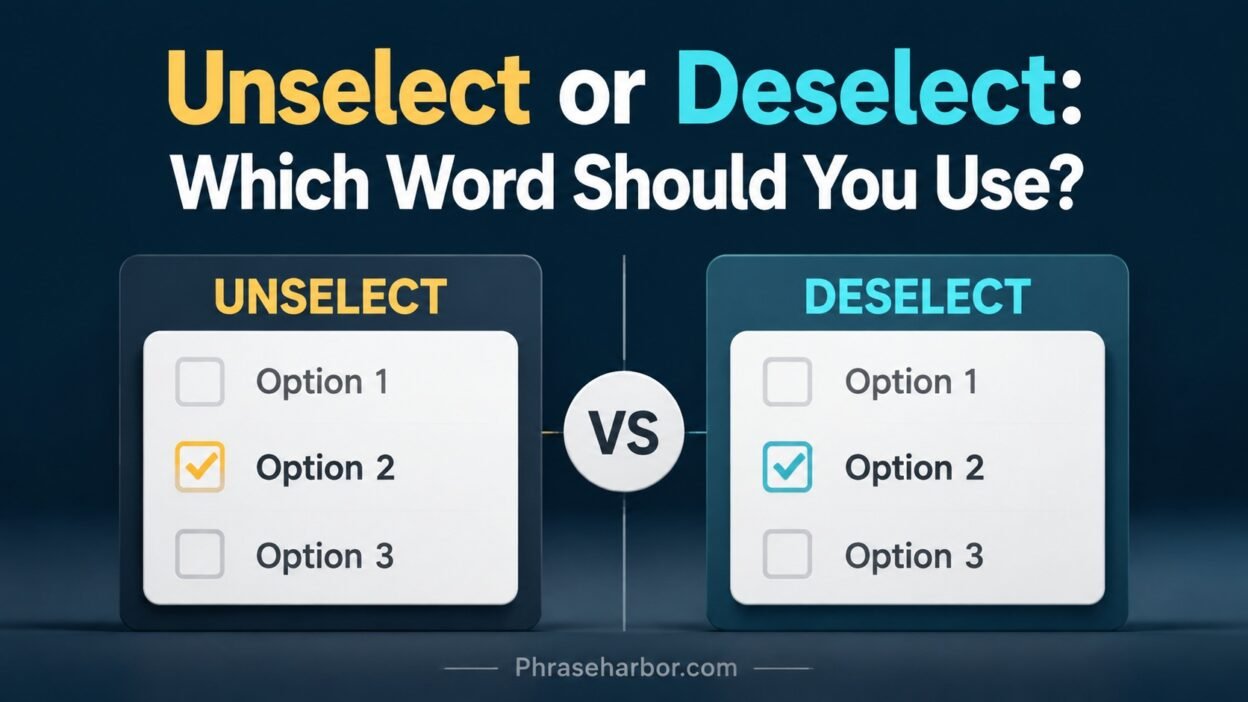
Using Unselect or Deselect in Fast-Paced Tech Environments improves Clarity, Usability, and User Experience across Software, Documentation, and Digital Systems.
From my experience, the right Microcopy, Instructional Copy, and Help Documentation make every User instantly Understand when to Select, create a Selection, Remove Selection, Remove, Removing, mark something as Removed, Undo, Undoing, Undone, Change, Changing, or work with a Selected or Previously Selected item.
A good User Interface, Interface, and Interfaces rely on thoughtful Design, Consistency, Consistent Wording, Precise Wording, Technical Terminology, Technical Vocabulary, Terminology, Vocabulary, Terms, and the correct Context for different Contexts. While the Difference is often used Interchangeably, and Best Practices usually decide which wording fits best.
Quick Answer
Use deselect in most cases.
It is the more common, more accepted, and more natural word in modern English, especially in professional writing, technical documentation, and user interface language.
Use unselect only when:
- a product, app, or system already uses that word
- you want to match existing terminology
- your audience already expects that wording
If you are writing from scratch, deselect is usually the better choice.
Comparison Overview
The easiest way to think about these words is this:
select means to choose something.
deselect means to remove that choice.
unselect tries to mean the same thing, but it is less established.
Here is a simple comparison.
| Feature | Deselect | Unselect |
| Common in modern English | Yes | Much less common |
| Sounds natural | Yes | Sometimes awkward |
| Used in software | Very often | Occasionally |
| Best for professional writing | Yes | Usually no |
| Dictionary acceptance | Widely accepted | Less widely used |
| Best default choice | Yes | Only in specific contexts |
The core issue is not whether people can understand unselect. They can. The issue is whether it sounds like the best word for the job. In most cases, it does not.
Main Differences Between Unselect or Deselect
Meaning
Both words try to express the idea of removing a selection.
If you check a box and then clear it, you are deselecting it.
If you highlight a file and then remove that highlight, you are deselecting it.
If you choose an option and then undo that choice, you are usually deselecting it.
Unselect is used to mean the same thing in some settings, but it does not have the same level of standard acceptance.
Naturalness
This is where the difference becomes obvious.
Deselect sounds clean and normal.
Unselect can sound invented or forced, depending on the sentence.
Compare these two:
- Please deselect the items you do not need.
- Please unselect the items you do not need.
The first sentence feels more natural to most readers.
Common Usage
In modern English, especially in technology, deselect appears far more often than unselect. That matters because common usage helps set reader expectations. When a word is familiar, people process it faster and trust it more.
Register and Tone
Deselect works well in:
- business writing
- software help articles
- technical manuals
- product instructions
- formal explanations
Unselect can feel casual, regional, or inconsistent unless the product already uses it.
Practical Decision
If you are unsure which word to use, choose deselect. That choice usually protects your writing from sounding odd or outdated.
What Does Deselect Mean?
Deselect means to remove a selection, choice, or highlight.
It is the opposite of selecting something. In many contexts, it refers to clicking, tapping, checking, highlighting, or choosing something and then reversing that action.
Here are a few examples:
- Deselect the checkbox.
- Deselect the files you do not want to upload.
- Deselect all options before continuing.
- Deselect the current item and choose a new one.
The word is especially useful in technology because modern interfaces rely on selection behavior all the time. You select a photo, a row in a spreadsheet, a menu item, or a batch of files. Then you deselect what you do not need.
Why Deselect Feels Standard
The prefix de- often signals reversal or removal. That pattern makes deselect easy to understand. It feels like a direct opposite of select, which is exactly what writers want.
That natural word formation is one reason the term has become standard in UI language and professional writing.
What Does Unselect Mean?
Unselect is also used to mean removing a selection, but it is less established in standard English.
You may see it in:
- some apps
- some user interfaces
- informal speech
- older or inconsistent product copy
For example:
- Unselect the option if you do not agree.
- Unselect the image to continue.
People understand those sentences, but many native speakers still prefer deselect.
Why Unselect Feels Less Natural
The prefix un- often means “not” or “reverse,” but not every verb works smoothly with it. English accepts unlock, unfold, and untie because those words sound natural and have long histories of use. Unselect has not reached the same level of everyday acceptance.
That does not make it incorrect in every situation. It just makes it the weaker choice when a cleaner alternative exists.
Is Unselect a Real Word?
Yes, people use it, and some dictionaries and software environments may recognize it. But that does not mean it is the best option for general writing.
A word can exist and still not be the preferred choice.
That is the key point here.
Unselect is understandable.
Deselect is more standard.
This difference matters because good writing is not only about meaning. It is also about convention, tone, and how natural a phrase feels to the reader.
If you are writing for a broad audience, convention usually wins.
Why Deselect Is More Common
There are a few reasons deselect has become the stronger choice.
It matches interface logic
Software often uses pairs like:
- select / deselect
- check / uncheck
- enable / disable
- mark / unmark
These pairs feel balanced and easy to scan.
It sounds cleaner
Three syllables. Clear stress pattern. Straightforward meaning.
That makes deselect easy to read and easy to say.
It fits professional style
Writers, editors, and UX teams usually want language that is predictable and familiar. Deselect fits that goal better than unselect.
It appears in established documentation
When official product language uses deselect, that wording spreads. Readers begin to expect it. Over time, the term becomes the default standard.
When to Use Deselect
Use deselect whenever you are writing general English and want the clearest, most professional option.
It works well for:
- checkboxes
- file selections
- spreadsheet rows
- text highlights
- dropdown options
- multiple-choice forms
- menu items
- app settings
- photo selections
- filters and tags
Examples
- Deselect the extra files before uploading.
- Deselect the checkbox if you do not want alerts.
- Deselect all items and start again.
- Deselect the current option to choose another one.
In each case, the word feels precise and easy to understand.
When Unselect May Appear
There are cases where unselect shows up, even if it is not the best default.
Existing product language
If a software product already uses unselect, consistency matters. You should match the product’s terminology instead of changing it for style alone.
Internal terminology
Some teams adopt a term early and stick with it. If a system, training document, or interface already says unselect, keeping that wording can help users avoid confusion.
Informal usage
In casual speech, people may say unselect without thinking about style rules. That does not automatically make it wrong. It just means the speaker is prioritizing communication over polish.
Still, in formal writing, deselect usually reads better.
Deselect vs. Unselect in Real-World Writing
To see the difference clearly, look at how each word behaves in different settings.
User interface copy
Better:
- Deselect all
- Deselect the checkbox
- Deselect the current item
Less natural:
- Unselect all
- Unselect the checkbox
- Unselect the current item
Help documentation
Better:
- To continue, deselect any option you no longer need.
Less natural:
- To continue, unselect any option you no longer need.
Business writing
Better:
- Please deselect the items before submitting the form.
Less natural:
- Please unselect the items before submitting the form.
Everyday explanation
Better:
- You can deselect a file if you change your mind.
Acceptable but weaker:
- You can unselect a file if you change your mind.
Case Study Examples
Case Study: File Upload Screen
Imagine a file upload page where a user has chosen ten photos but only wants to send six.
A clear interface message would say:
Deselect the photos you do not want to upload.
That instruction feels direct. It uses the exact action the user needs to take.
If the interface said:
Unselect the photos you do not want to upload.
the meaning would still be clear, but the line may feel less polished.
Case Study: Spreadsheet Task
Now imagine a spreadsheet where several rows are highlighted.
A training guide might say:
Deselect the rows before applying the filter.
That sentence sounds like standard office language.
If the guide used unselect, readers might still understand it, but they may notice the wording more than they should. Good writing stays invisible. It helps the user act without drawing attention to itself.
Case Study: Online Form
A registration form may have a pre-checked box for email updates.
A better instruction would be:
Deselect the box if you do not want updates.
That phrasing is short, natural, and easy to follow.
A Simple Rule You Can Trust
Use this rule:
If you are writing something new, choose deselect.
If you are matching an existing product or system, follow the product’s wording.
That rule works because it balances language quality with consistency.
Consistency matters in software and documentation.
Naturalness matters in everything else.
When those two goals conflict, the original interface language may come first. But when you have freedom, deselect is the better word almost every time.
Common Mistakes to Avoid
Using the words interchangeably without checking context
Even though they overlap in meaning, they do not always carry the same tone. That can matter in polished writing.
Forcing unselect into formal writing
If you are writing an article, user guide, help page, or business document, unselect may sound off.
Ignoring interface consistency
If a system already says unselect, changing it halfway through can confuse the reader.
Overexplaining a simple action
Sometimes the best choice is the shortest clear one. For example, Deselect all is better than a longer, clumsier sentence.
Read More: Company-Wide or Companywide: Which Is Correct?
Similar Word Pairs That Follow the Same Logic
The deselect vs. unselect question is similar to other English choices where one word feels more natural than another.
| Pair | Preferred Choice | Why |
| check / uncheck | check / uncheck | Standard in many interfaces |
| enable / disable | enable / disable | Clear opposite pair |
| select / deselect | select / deselect | Strong, natural pairing |
| mark / unmark | depends on context | Works in some forms and lists |
| activate / deactivate | activate / deactivate | Formal and widely understood |
This table shows an important pattern. English often prefers pairs that feel established and balanced. Select / deselect fits that pattern very well.
Why Word Choice Matters in UI and Writing
Small wording choices can change how users feel about your content.
A strong word:
- reduces confusion
- improves speed
- makes instructions easier to follow
- creates a more professional tone
A weak or awkward word:
- slows the reader down
- makes the interface feel inconsistent
- can make your writing feel less trusted
That is why the question is not just academic. It affects usability. It affects clarity. It affects the reader’s confidence.
In a world full of apps, dashboards, forms, and settings screens, tiny words carry real weight.
Grammar and Style Notes
A few style points are worth keeping in mind:
- Deselect is usually treated as a regular verb.
- It follows normal English patterns in commands and instructions.
- It works well in imperative sentences like “Deselect the box.”
- It also works in explanatory sentences like “You can deselect the option later.”
By contrast, unselect may sound less settled in standard style guides, even if some users understand it perfectly well.
That is why many editors prefer deselect automatically. It avoids debate and keeps the writing smooth.
Quotes and Practical Takeaways
Clear writing is often the writing that disappears.
That idea fits this topic well. The best word is not always the flashiest one. It is the one that lets the reader move forward without stopping to wonder whether the phrase sounds right.
Another useful way to think about it:
If a word makes the reader pause for the wrong reason, it is probably not the best choice.
That is one reason deselect wins so often. It does its job quietly.
Quick Reference Table
Here is a fast summary you can use when editing your own work.
| Question | Best Answer |
| Which word is more common? | Deselect |
| Which sounds more natural? | Deselect |
| Which works best in professional writing? | Deselect |
| Is unselect understandable? | Yes |
| Should unselect be your default choice? | No |
| What should you use in new writing? | Deselect |
FAQs
Is Unselect or Deselect the correct term?
Both are correct, but Deselect is more widely used in modern Software, Documentation, and User Interface design. The preferred choice often depends on Context, Standards, and product guidelines.
What is the difference between Unselect and Deselect?
The main Difference is usage rather than meaning. Both describe the action of removing a Selection, but Deselect is generally the preferred term in technical writing and interface design.
Can I use Unselect and Deselect interchangeably?
Yes, they are often used Interchangeably because they have the same basic meaning. However, keeping the wording Consistent throughout your product improves Clarity and the overall User Experience.
Why is Deselect more common in software?
Many developers and technical writers follow Official Specs, Professional Practices, and Technical Terminology that favor Deselect. This creates more consistent Documentation, Microcopy, and interface instructions.
How can I improve interface wording for selection actions?
Use simple, Concise, and Intuitive language, maintain Consistency, follow established Best Practices, and ensure every User can easily Understand actions such as Select, Remove Selection, Undo, and Change without confusion.
Conclusion:
Choosing between Unselect and Deselect may seem like a small decision, but the right choice improves Clarity, Consistency, and the overall User Experience. In most modern Software and User Interface designs, Deselect is the more common term, while Unselect still appears in some products and documentation. The best approach is to follow your project’s Standards, Technical Terminology, and Best Practices so users always receive clear and intuitive instructions.