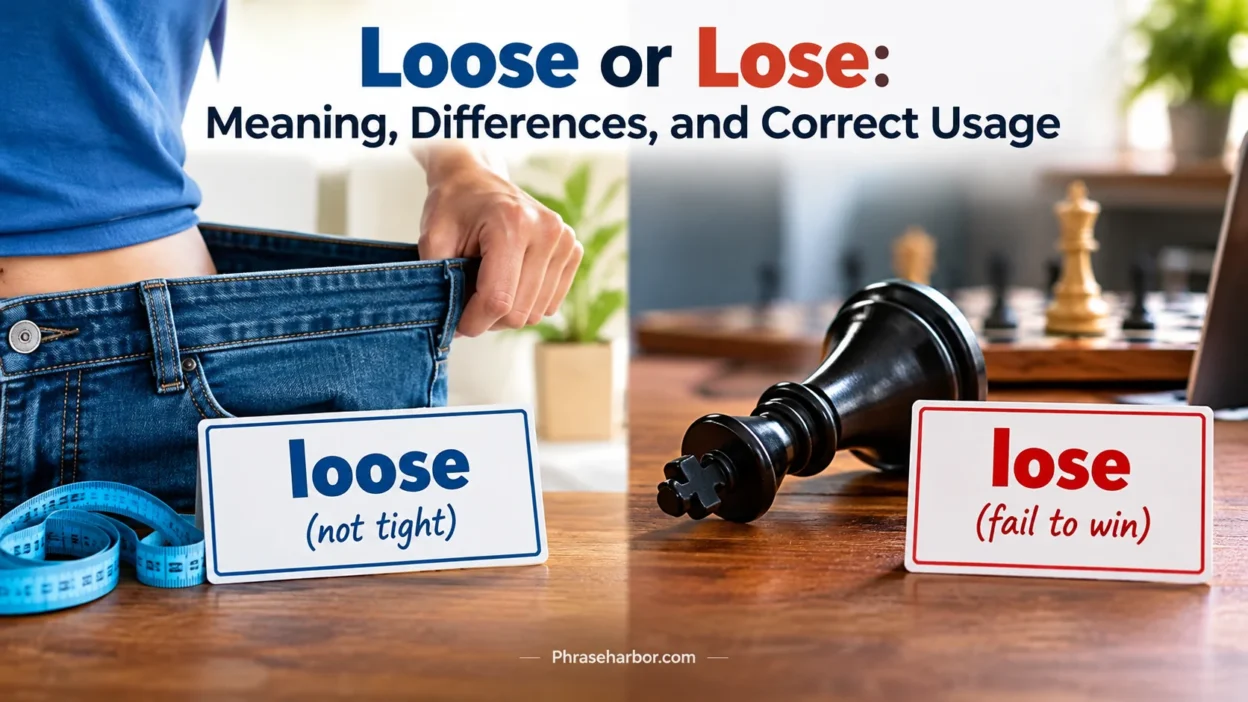
Have you ever wondered whether to write loose or lose? You’re not alone. These two words confuse many English writers because they look similar but carry completely different meanings. A single extra letter can change your sentence from describing something that isn’t tight to explaining that you’ve misplaced something.
For example, you might say, “These shoes are too loose,” when they don’t fit properly. However, if you can’t find your favorite pair, you might say, “I don’t want to lose my shoes.” Both sentences are correct, but switching the words would create a spelling mistake.
The confusion often appears in everyday messages, workplace emails, social media posts, and school assignments. Even experienced writers sometimes type the wrong word when writing quickly.
The good news? You can learn to distinguish loose from lose with a few simple rules. This guide explains their meanings, pronunciations, grammatical forms, common expressions, and correct usage through practical examples.
Quick Answer: Loose vs. Lose
Loose means not tight, not firmly attached, or free from restraint. It’s most commonly an adjective.
- Example: My jacket feels too loose around the shoulders.
- Memory tip: Think of extra room in loose clothing.
Lose is a verb that means to misplace something, fail to win, or no longer have something.
- Example: Be careful not to lose your house keys.
- Memory tip: Think of losing something you want to keep.
Here’s the easiest way to remember the difference:
- Use loose when something isn’t tight or secure.
- Use lose when something goes missing, you fail to win, or you experience a reduction.
For example, a loose shoelace might cause you to lose your balance. The words appear in the same sentence, but each performs a different job.
Comparison Overview: Loose vs. Lose
Although loose and lose share several letters, their meanings, pronunciations, and grammatical roles differ.
| Feature | Loose | Lose |
| Primary part of speech | Adjective | Verb |
| Main meaning | Not tight or securely attached | To misplace, fail to win, or no longer have |
| Pronunciation | /luːs/ | /luːz/ |
| Final sound | Unvoiced /s/, as in snake | Voiced /z/, as in zebra |
| Example | My watch strap is loose. | I don’t want to lose my watch. |
| Related forms | Loosen, looser, loosest | Loses, losing, lost |
| Common expression | Let loose | Lose track of time |
The most important distinction is that loose usually describes a condition, while lose describes an action or outcome. However, loose can also function as a verb meaning to release something, although this use is less common.
Remember that spelling alone doesn’t determine the grammatical role. You should always consider what the sentence means.
What Does Loose Mean?
The word loose most commonly describes something that isn’t tight, firmly attached, restricted, or closely controlled. It can refer to physical objects, clothing, rules, relationships, and even abstract ideas.
For example, a loose button might fall off a shirt. A loose schedule might allow you to change your plans without difficulty.
Loose as an Adjective
An adjective describes a person, place, thing, or condition. When you use loose as an adjective, you’re explaining that something has room to move, lacks a firm connection, or isn’t tightly controlled.
Consider these examples:
- Clothing: These pants are too loose around the waist.
- Physical objects: The handle on this suitcase feels loose.
- Hair: She prefers to wear her hair loose.
- Rules: The organization has loose guidelines for casual events.
- Interpretations: That’s a loose interpretation of the original statement.
- Connections: A loose wire can interrupt an electrical connection.
In each example, loose describes a condition rather than an action of misplacing something.
The word also has comparative and superlative forms. You can say looser when comparing two things and loosest when describing the least tight or most unrestricted option.
For example:
- This shirt is loose.
- That shirt is looser than mine.
- These are the loosest jeans in the store.
Common Uses of Loose
The meaning of loose changes slightly depending on its context. Understanding these common uses will help you choose the word naturally.
Loose clothing
Loose clothing doesn’t fit tightly against your body. It may provide extra room or allow easier movement.
Example: “I prefer loose shirts during hot summer days.”
Loose objects or parts
A loose object isn’t firmly secured. It might move, wobble, or detach.
Example: “The mechanic tightened the loose bolt before returning the car.”
Loose restrictions
Loose restrictions allow more freedom than strict rules. This usage often appears in conversations about policies, schedules, and procedures.
Example: “The teacher gave students loose guidelines for their presentations.”
Loose connections
A loose connection isn’t securely joined. It may describe a physical connection or, figuratively, a weak relationship between ideas.
Example: “There’s a loose connection between the two arguments.”
Loose interpretation
A loose interpretation allows flexibility and may depart from the exact wording or intended meaning.
Example: “Calling that a promise is a loose interpretation of what she said.”
Loose as a Verb
Although loose usually functions as an adjective, it can also serve as a verb meaning to release, set free, or let something go.
This verb form appears less often in everyday American English than the adjective.
Examples:
- The soldiers loosed a volley of arrows.
- The hunter loosed the dogs into the field.
- The sudden impact loosed several stones from the hillside.
In these sentences, loosed means released. It doesn’t mean misplaced or failed to keep something.
This distinction matters because loosed is a legitimate word, but it isn’t the standard past tense of lose.
Read More: Repetition vs. Parallelism: Meaning, Differences, and Examples
Loose in Common Expressions
Several English expressions use loose in ways that extend beyond its basic meaning.
| Expression | Meaning | Example |
| Let loose | Allow yourself to relax or behave freely | We let loose at the celebration. |
| Play fast and loose | Act carelessly or inconsistently | The company played fast and loose with the rules. |
| A loose end | An unresolved detail | We still need to tie up one loose end. |
| Loose tongue | A tendency to reveal secrets or speak carelessly | His loose tongue caused unnecessary trouble. |
| On the loose | Free and not under control | The escaped dog was still on the loose. |
Notice that these expressions don’t all describe physical looseness. Some use the idea of freedom or a lack of control figuratively.
For example, someone who’s on the loose isn’t necessarily wearing loose clothing. The phrase means that the person or animal is free and hasn’t been captured or contained.
What Does Lose Mean?
Lose is a verb that describes failing to keep, find, win, or retain something. It can refer to physical objects, competitions, money, opportunities, relationships, and personal qualities.
Unlike loose, which commonly describes a condition, lose usually communicates an action, change, or result.
Lose as a Verb
You use lose when something disappears from your possession, you fail to win, or you experience a reduction.
Consider these examples:
- Misplacing something: I don’t want to lose my wallet.
- Failing to win: Our team might lose the championship.
- Experiencing a reduction: The company could lose money this quarter.
- Missing an opportunity: You might lose your chance to apply.
- Losing confidence: Don’t lose confidence after one mistake.
- Losing a relationship: They worked hard to avoid losing touch.
The meaning depends on the surrounding words. You can lose something physical, such as a phone, or something abstract, such as patience.
Importantly, lose doesn’t always mean that you misplaced an object. You can lose a game without misplacing anything or lose patience without physically dropping it.
Common Uses of Lose
Understanding the different situations in which lose appears makes the word easier to remember.
Losing or misplacing something
Use lose when you can’t find something or no longer have it.
Example: “I always check my pockets before leaving because I don’t want to lose my keys.”
Losing a competition
Use lose when you fail to win a contest, match, election, or other competition.
Example: “The team trained throughout the summer but still managed to lose the final game.”
Losing weight
The standard expression is lose weight. It refers to a reduction in body weight.
Example: “She changed her eating habits because she wanted to lose weight.”
Writing loose weight would be incorrect in this context because loose doesn’t express the action of reducing weight.
Losing money or time
You can lose money through an unsuccessful investment or lose time by delaying an important task.
Examples:
- “The business could lose money if sales decline.”
- “We don’t want to lose valuable time during the meeting.”
Losing an opportunity
An opportunity can disappear when you fail to act before a deadline or miss a suitable moment.
Example: “Submit your application today so you don’t lose the opportunity.”
Losing emotional qualities
English speakers also use lose with emotions, abilities, and personal qualities.
Examples:
- Don’t lose hope when things become difficult.
- He began to lose interest in the project.
- Try not to lose your temper during disagreements.
- She didn’t lose confidence after the setback.
These expressions show why lose is so common in everyday communication. It describes more than missing objects; it also captures changes in feelings, circumstances, and outcomes.
Lose in Common Expressions
The verb lose appears in many everyday expressions. Learning them can improve both your vocabulary and your writing.
| Expression | Meaning | Example |
| Lose track of time | Stop noticing how much time has passed | I lost track of time while reading. |
| Lose your temper | Become angry | He lost his temper during the argument. |
| Lose your mind | Become irrational or feel overwhelmed, often figuratively | I thought I would lose my mind during the stressful week. |
| Lose touch | Stop communicating regularly | We lost touch after graduation. |
| Lose sight of | Stop seeing or forget the importance of something | Don’t lose sight of your main goal. |
| Lose heart | Become discouraged | She refused to lose heart after the rejection. |
| Lose sleep over | Worry about something | Don’t lose sleep over a minor mistake. |
| Lose your way | Become unable to find the correct route or direction | We lost our way in the unfamiliar neighborhood. |
Some expressions have literal and figurative meanings. For example, lose your way can mean taking the wrong road or drifting away from your original goals.
Main Differences Between Loose and Lose
The difference between loose and lose becomes clearer when you examine their meanings, grammatical roles, sounds, and spelling patterns.
Difference in Meaning
The simplest distinction is that loose describes a lack of tightness or restraint, while lose refers to failing to keep or win something.
Compare these sentences:
- Loose: My bicycle chain is loose.
- Lose: I might lose my bicycle keys.
The first sentence describes the chain’s condition. The second describes the possibility of misplacing the keys.
Consider another pair:
- Loose: The dog broke free because its collar was loose.
- Lose: Hold the leash firmly so you don’t lose the dog.
The words are closely related to the situations, but their meanings remain different. One describes an unsecured condition; the other describes a possible outcome.
Difference in Part of Speech
Grammar offers another reliable way to distinguish the words.
Loose is most commonly an adjective. It modifies a noun by describing its condition.
Examples:
- A loose button
- Loose clothing
- A loose connection
- Looser restrictions
Lose is a verb. It expresses an action, event, or change.
Examples:
- Lose your wallet
- Lose a match
- Lose confidence
- Lose valuable time
You can also recognize lose through its common verb forms: loses, losing, and lost.
However, remember that loose can function as a verb in certain contexts. Grammar helps you identify the intended meaning, but the entire sentence still matters.
Difference in Pronunciation
Although the words look similar, they end with different consonant sounds.
- Loose: /luːs/
- Lose: /luːz/
Both words begin with the same long vowel sound. The main difference occurs at the end.
In loose, the final sound is /s/, as in sun or snake. In lose, the final sound is /z/, as in zoo or zero.
Try saying both words aloud. Keep the vowel sound the same, then compare the ending.
The /s/ sound uses airflow without vocal-cord vibration. The /z/ sound involves vocal-cord vibration, which gives it a buzzing quality.
This pronunciation difference is especially useful when speaking English. However, don’t rely on pronunciation alone when proofreading written text. Check the meaning too
FAQs:
Is It Loose or Lose?
Both words are correct, but they have different meanings. Use loose to describe something that isn’t tight or secure. Use lose when you mean to misplace something, fail to win, or no longer have something.
Examples: “The screw is loose” and “Don’t lose the screw.”
Is It Lose Weight or Loose Weight?
The correct expression is lose weight.
Lose describes the process of reducing body weight. Loose means not tight or firmly secured, so it doesn’t fit this expression.
Example: “He wants to lose weight before the race.”
Is It Loose Change or Lose Change?
The correct expression is loose change.
Loose change refers to coins or small amounts of money carried separately, such as coins in a pocket or purse.
Example: “I found some loose change under the car seat.”
Lose change would mean misplacing money or coins, which expresses a different idea and doesn’t serve as the name for spare coins.
Is It Loosen or Loosen Up?
Loosen is a verb meaning to make something less tight or to become less tight.
Examples:
- “Loosen the screw before removing the panel.”
- “The knot began to loosen.”
Loosen up can also mean to relax or become less tense.
Example: “He loosened up after getting to know his coworkers.”
Don’t confuse loosen with lose. Although their spellings are similar, they have different meanings and grammatical forms.
Is Loose Ever a Verb?
Yes. Loose can function as a verb meaning to release or set free. However, this use is less common than its role as an adjective.
Example: “The archer loosed an arrow.”
Here, loosed means released. It doesn’t mean that the archer misplaced the arrow or failed to win a competition.
Conclusion:
The difference between loose and lose comes down to meaning, spelling, and pronunciation. Although the words look similar, they aren’t interchangeable. Use loose when describing something that isn’t tight, firmly attached, or strictly controlled. Use lose when talking about misplacing something, failing to win, or no longer having something. If you still hesitate, try the substitution test. Replace loose with “not tight” or lose with “misplace” or “fail to win.” The intended meaning will usually reveal the correct choice.