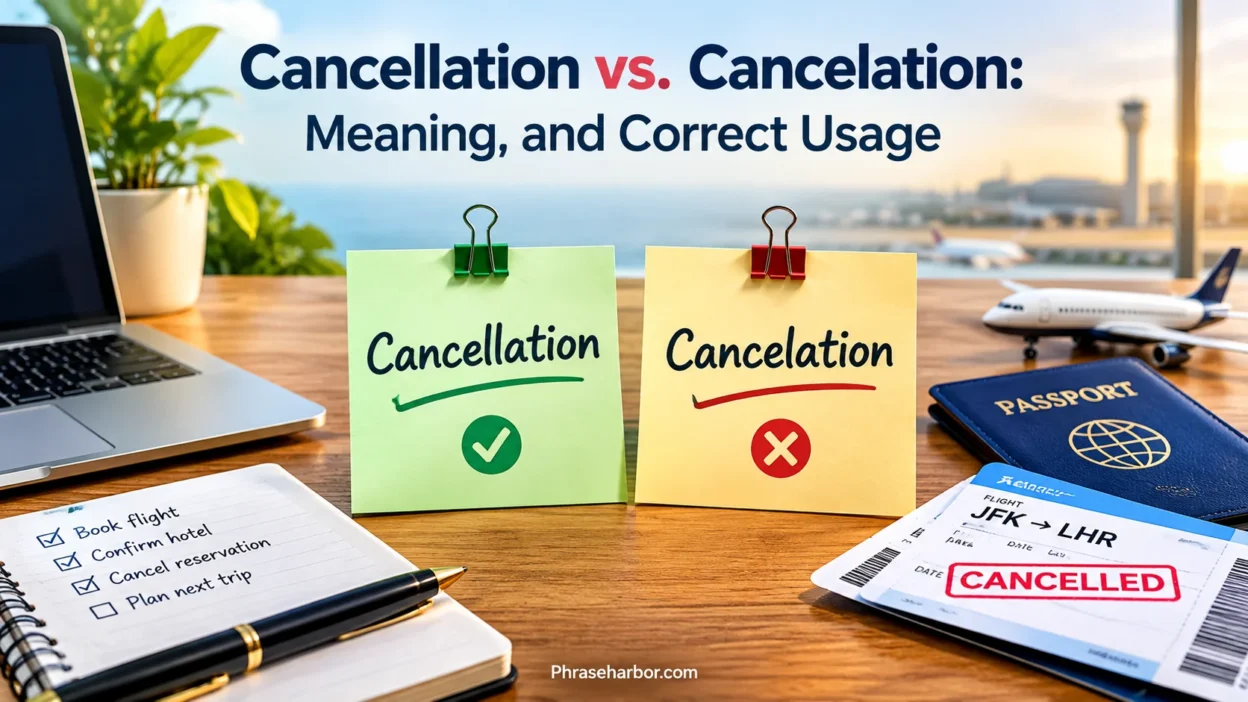
Have you ever wondered whether cancellation or cancelation is the correct spelling? Both forms appear in English writing, which can make the choice confusing. If you’re writing a business email, updating a cancellation policy, or explaining why an event won’t happen, you want to get the spelling right.
The difference is simple: cancellation is the standard and overwhelmingly preferred spelling in American English, while cancelation is a less common accepted variant. Both words have the same meaning. However, they aren’t equally common in everyday writing.
Understanding this spelling difference helps you write more confidently. It also keeps your emails, reports, customer notices, and professional documents consistent. Let’s explore what each word means, why the spellings differ, and how to use them correctly.
Quick Answer:
Cancellation is the preferred spelling in American English. Although cancelation is also an accepted spelling variant, it appears much less frequently.
Both words refer to the act of canceling something, such as an appointment, reservation, subscription, contract, or event. The spelling doesn’t change the meaning.
Consider these examples:
- Correct and preferred: The airline announced the cancellation of several flights.
- Acceptable but uncommon: The airline announced the cancelation of several flights.
Both sentences communicate the same information. However, most American readers will find cancellation more familiar.
Here’s the easiest way to remember the distinction:
- Use cancellation for everyday writing, business communication, academic work, and professional documents.
- Recognize cancelation as a legitimate alternative, not necessarily a spelling mistake.
- Follow your organization’s style guide if it specifies one spelling.
- Remember that cancellation is also the standard spelling in British English.
When in doubt, choose cancellation. It’s the most reliable option for American English readers.
Comparison Overview: Cancellation vs. Cancelation
Although these words look slightly different, their definitions and grammatical functions remain the same. The main distinction concerns spelling and frequency of use.
| Feature | Cancellation | Cancelation |
| Meaning | The act of canceling something | The act of canceling something |
| Spelling | Double L in the middle | Single L in the middle |
| American English | Standard and overwhelmingly preferred | Accepted but uncommon |
| British English | Standard spelling | Uncommon variant |
| Grammatical function | Noun | Noun |
| Common examples | Cancellation policy, cancellation fee | Cancelation policy, cancelation fee |
| Professional writing | Recommended | Usually avoided unless required by a style guide |
| Plural form | Cancellations | Cancelations |
| General recommendation | Use this spelling | Recognize it as a variant |
The most important point is that neither spelling introduces a different meaning. You don’t need to choose between them based on the type of cancellation you’re describing.
For example, canceling a flight doesn’t require one spelling while canceling a subscription requires another. The same principle applies to appointments, contracts, and event bookings.
The difference is conventional usage. Cancellation has become the established spelling that most readers expect.
What Does Cancellation Mean?
Cancellation Definition
Cancellation is a noun that describes the act, process, or result of canceling something. It commonly refers to stopping a planned activity, ending an arrangement, withdrawing an order, or making a reservation or agreement no longer valid.
The word comes from the verb cancel. When you cancel something, you take an action. When you refer to that action as a concept or event, you use the noun cancellation.
For example:
- Verb: The manager will cancel the meeting.
- Noun: The cancellation of the meeting surprised everyone.
The first sentence describes what someone will do. The second identifies the act of canceling the meeting.
Cancellation can also describe the removal or invalidation of something, depending on the context. A company might cancel an order, a customer might cancel a membership, or an authority might cancel a permit.
In each case, the word refers to an action or outcome that stops something from continuing as planned.
Examples of Cancellation in Sentences
Seeing the word in context makes its meaning easier to understand.
- Travel: The airline announced the cancellation of the morning flight.
- Appointments: I received a cancellation notice from the dental office.
- Subscriptions: Your cancellation will take effect at the end of the billing period.
- Business: The supplier requested the cancellation of the original order.
- Events: Heavy rain forced the cancellation of the outdoor concert.
- Education: The school announced the cancellation of afternoon classes.
- Contracts: The agreement explains the conditions for cancellation.
- Reservations: The hotel charges a fee for late cancellation.
Notice that cancellation works naturally with many different nouns. You can describe a cancellation notice, cancellation request, cancellation fee, or cancellation policy without changing the spelling.
These combinations are especially common in customer service, travel, retail, and business communication.
Common Uses of Cancellation
Cancellation appears in several everyday situations. Understanding these contexts can help you recognize the word and use it accurately.
Appointment cancellation
When someone decides not to attend a scheduled appointment, they may cancel it in advance.
Example: “Please notify our office at least 24 hours before your appointment cancellation.”
Flight cancellation
Airlines may cancel flights because of severe weather, operational problems, staffing shortages, or other circumstances.
Example: “Passengers received text messages about the flight cancellation.”
Subscription cancellation
Customers often cancel subscriptions when they no longer need a service or want to avoid future charges.
Example: “Your subscription cancellation has been confirmed.”
Contract cancellation
A contract may contain conditions that allow one or both parties to end the agreement.
Example: “The contract outlines the requirements for cancellation.”
Event cancellation
Organizers may cancel concerts, conferences, sporting events, or community gatherings.
Example: “The cancellation of the annual festival disappointed local residents.”
Across these situations, the spelling remains the same. The surrounding words explain what has been canceled.
What Does Cancelation Mean?
Cancelation Definition
Cancelation is an alternative spelling of cancellation. It refers to the same act of canceling something and functions as a noun.
For example, you might encounter a sentence such as:
“The company issued a cancelation notice after the service provider changed its schedule.”
The sentence is understandable, and the word communicates the intended meaning. However, most American writers would use cancellation instead.
The single-L spelling can appear in dictionaries, publications, or documents that recognize spelling variants. Its existence doesn’t mean that writers should treat it as equally common.
For practical purposes, you can understand cancelation whenever you encounter it. When producing your own writing, however, cancellation is usually the better choice.
Examples of Cancelation in Sentences
The following examples demonstrate how the less common spelling works.
- The airline confirmed the cancelation of the scheduled flight.
- Customers received a cancelation notice by email.
- The website explains its cancelation policy.
- We requested a cancelation of the original order.
- The event organizer announced the cancelation of the workshop.
- A cancelation fee may apply to certain reservations.
Each sentence uses cancelation as a noun. You could replace it with cancellation without changing the basic meaning.
For example:
“The website explains its cancelation policy.”
“The website explains its cancellation policy.”
Both sentences are understandable. The second version follows standard American usage more closely and is the preferred choice for most professional documents.
Is Cancelation a Real Word?
Yes. Cancelation is a recognized spelling variant of cancellation. It isn’t automatically an error simply because it contains one L.
English sometimes preserves multiple spellings for the same word. These alternatives can differ in popularity, regional acceptance, or editorial preference without having different definitions.
However, it’s important to distinguish between a recognized variant and the spelling most readers expect.
The fact that a dictionary includes a word doesn’t mean every spelling has the same frequency or status in everyday writing. Dictionaries often record uncommon forms so readers can understand them when they appear.
For example, a writer might encounter cancelation in an older document or a publication with its own spelling conventions. Recognizing the variant helps explain the text, but it doesn’t make the single-L version the preferred choice.
The practical takeaway: You can recognize cancelation as a valid variant while consistently using cancellation in your own writing.
Read More: Loose or Lose: Meaning, Differences, and Correct Usage
Main Differences Between Cancellation and Cancelation
Difference in Spelling
The most obvious difference is the number of Ls in the middle of each word.
- Cancellation: c-a-n-c-e-l-l-a-t-i-o-n
- Cancelation: c-a-n-c-e-l-a-t-i-o-n
The first spelling contains two consecutive Ls. The second contains one.
This small difference often causes confusion because the base verb cancel contains only one L. Writers may assume that adding a noun-forming ending should preserve the original spelling.
However, English spelling doesn’t always follow a simple one-letter-for-one-letter pattern. Established word forms sometimes preserve spelling conventions that differ from the base verb.
That’s why the standard noun is cancellation, even though the verb is cancel.
Difference in Meaning
There is no meaningful difference between the definitions of cancellation and cancelation.
Both can describe the act of canceling an appointment, ending a subscription, withdrawing an order, or stopping an event from taking place.
Consider these sentences:
- “The cancellation of the meeting disappointed the team.”
- “The cancelation of the meeting disappointed the team.”
The sentences communicate the same idea. Neither spelling indicates a different reason for the cancellation, a different level of formality, or a different outcome.
You shouldn’t use cancelation to suggest a temporary cancellation and cancellation to suggest a permanent one. The spelling doesn’t carry that distinction.
Instead, choose the spelling based on standard usage or the style requirements of the document you’re writing.
Difference in Usage and Popularity
Although both spellings exist, they don’t enjoy equal popularity.
Cancellation is the established spelling in contemporary American English. It’s the form readers commonly encounter in business policies, airline announcements, customer service emails, news reports, and other everyday documents.
Cancelation is much less common. Readers may understand it without difficulty, but some may interpret it as a typographical error because they’re more familiar with the double-L form.
For example, imagine that you’re writing a customer service email:
“Your subscription cancellation has been processed successfully.”
This wording looks familiar and professional. If you replace cancellation with cancelation, the message remains understandable, but the spelling may distract some readers.
That distraction is unnecessary when the standard form is readily available.
For professional communication, consistency and familiarity matter. Using cancellation helps your writing align with ordinary American spelling conventions.
Difference in American and British English
Some spelling differences follow predictable regional patterns. For instance, American English commonly uses color, while British English generally uses colour.
The distinction between cancellation and cancelation doesn’t work in the same way.
Cancellation is the standard spelling in both American and British English. The single-L variant isn’t the usual British alternative.
This matters because writers sometimes assume that any less common spelling must belong to a particular English variety. That assumption doesn’t apply here.
Compare these common regional differences:
| American English | British English |
| Color | Colour |
| Center | Centre |
| Traveling | Travelling |
| Canceled | Cancelled |
| Cancellation | Cancellation |
The final row is the important one. Unlike canceled and cancelled, which follow different regional spelling preferences, cancellation generally retains the double L in both varieties.
If you’re writing for an American audience, use cancellation. If you’re writing for a British audience, use cancellation as well.
Why Does Cancellation Have Two Ls?
The Spelling Rule Behind Cancellation
The spelling of cancellation can seem inconsistent because the related verb cancel contains one L.
However, the established noun form uses two consecutive Ls. The spelling reflects the conventional formation of the noun rather than a universal rule that every related word must follow the same pattern.
Consider these related forms:
| Word | Part of speech | Example |
| Cancel | Verb | Please cancel the reservation. |
| Canceling | Verb form | I’m canceling my membership. |
| Canceled | Past tense or past participle | The company canceled the order. |
| Cancellation | Noun | The cancellation surprised customers. |
The first three forms commonly use one L in American English. The noun uses two.
British English generally prefers cancelling and cancelled, but it also uses cancellation.
This is a useful reminder that related words don’t always share identical spelling patterns. English contains many conventional forms that writers learn through regular exposure and reference works.
Why Cancel Becomes Cancellation
The noun cancellation derives from the verb cancel and refers to the act or result of canceling.
You can understand the relationship through a simple comparison:
- Cancel: The action of stopping something.
- Cancellation: The act or result of stopping something.
For example, a customer may cancel a hotel reservation. The hotel then records the cancellation.
The verb describes the action, while the noun names that action or its outcome.
The double-L spelling is part of the established written form of the noun. Although cancelation follows a simplified spelling pattern, it hasn’t displaced cancellation as the standard form.
Why Cancelation Uses One L
The single-L spelling reflects an alternative way of representing the noun derived from cancel.
Because the verb itself has one L, some writers may find cancelation more intuitive. It appears to preserve the base spelling without adding another consonant.
Nevertheless, English spelling often depends on established usage rather than what seems most logical at first glance.
The word cancellation has a long-standing place in standard written English. Its double-L form is widely recognized and used across different contexts.
You don’t need to memorize a complicated explanation to choose correctly. Simply remember that the noun normally takes two Ls, even though the verb takes one.
FAQs:
Is Cancellation or Cancelation Correct in American English?
Cancellation is the standard and preferred spelling in American English. Cancelation is also a recognized variant, but it’s much less common.
For everyday writing, business communication, and website content, use cancellation.
Is Cancelation Spelled With One L or Two?
Cancelation has one L in the relevant middle position, while cancellation has two consecutive Ls.
Both spellings refer to the same concept. However, cancellation is the standard form most writers should choose.
Is Cancellation British or American English?
Cancellation is standard in both American and British English.
The regional difference appears in related forms such as canceled and cancelled, not usually in the noun cancellation.
Why Is Cancellation Spelled With Two Ls?
The double-L spelling is the established conventional form of the noun derived from cancel.
Although the verb uses one L, the noun has a different accepted spelling pattern. English word formation doesn’t always preserve the exact spelling of the base word.
Is Cancelation Considered a Misspelling?
Not necessarily. Cancelation is a recognized alternative spelling.
However, because cancellation is much more common, the single-L form may look like a typo to readers who aren’t familiar with it. Using cancellation avoids that potential distraction.
Conclusion:
When choosing between cancellation and cancelation, the answer is straightforward. Both spellings refer to the same act of canceling something, but they differ in popularity and conventional usage. Cancellation is the standard and overwhelmingly preferred spelling in American English. It’s also the usual spelling in British English. Although cancelation is a recognized variant, it appears much less frequently and usually isn’t the best choice for new writing.