Have you ever wondered whether word and term mean the same thing? At first glance, they seem interchangeable. Both help us express ideas, describe objects, and communicate information. However, they serve slightly different purposes depending on how people use them.
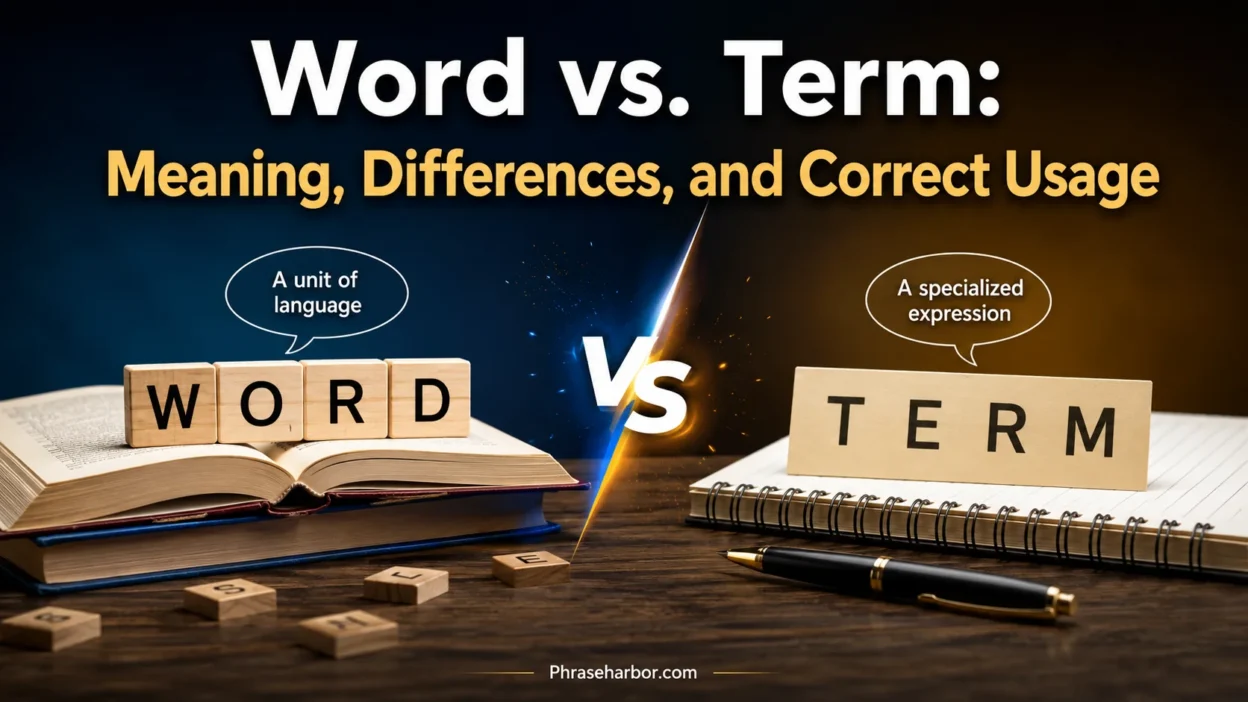
A word is a basic unit of language that people use to communicate meaning. A term, on the other hand, is a word or phrase used to identify a particular concept, especially in a specific subject or field. The distinction becomes clearer when you compare everyday language with specialized vocabulary.
For example, cell is an ordinary word when someone talks about a small room or compartment. In biology, however, cell is also a scientific term referring to the basic structural and functional unit of living organisms. The spelling stays the same, but the context determines how people understand it.
Quick Answer:
A word is a unit of language used in speech or writing, while a term is a word or phrase that represents a particular concept, meaning, or idea within a given context.
Consider these examples:
- Word: Tree — a general word for a woody plant.
- Term: Binary tree — a specific concept in computer science describing a tree-shaped data structure in which each node has at most two children.
- Word and term: Gravity — an ordinary word in conversation and a scientific term when discussing the physical attraction between objects with mass.
The key distinction is that every term is a linguistic expression, but not every word functions as a specialized term. A term can also contain several words, so the difference isn’t simply about length.
Comparison Overview
The following table summarizes the main differences between a word and a term.
| Feature | Word | Term |
| Meaning | A unit of language | A word or phrase representing a particular concept |
| Main purpose | General communication | Identifying or describing a specific concept |
| Common use | Everyday conversation, reading, and writing | Academic, scientific, technical, professional, and other contexts |
| Scope | May have one or several meanings | Often has a context-specific or specialized meaning |
| Length | Usually an individual linguistic unit | Can be one word or a multiword expression |
| Examples | Book, run, bright, freedom | Photosynthesis, natural selection, operating system |
| Dependence on context | Context helps determine meaning | Context often identifies the intended concept |
| Relationship | A general linguistic category | A word or phrase used as a conceptual label |
These distinctions are useful, but they aren’t absolute rules. Words and terms overlap because an ordinary word can also function as a specialized term.
For example, function is a common English word. In mathematics, it also names a relationship between inputs and outputs. The intended meaning depends on the context in which the speaker uses it.
What Is a Word?
A word is a unit of language that carries meaning or performs a grammatical function. People combine words to form phrases, clauses, and sentences. Words help us name things, describe actions, express emotions, and communicate complicated ideas.
Consider the sentence, “The curious student opened the book.” It contains six written words: The, curious, student, opened, the, and book. Each contributes something to the sentence, whether through meaning or grammar.
Words don’t all work the same way. Some identify people or objects, while others describe actions or connect ideas. Together, they create the structure we use to communicate.
Common Types of Words
English words belong to different grammatical categories, often called parts of speech. These categories describe how words function in sentences.
| Word type | Purpose | Examples | Example sentence |
| Noun | Names a person, place, thing, or idea | Teacher, city, freedom | The teacher explained the lesson. |
| Verb | Expresses an action, event, or state | Write, think, seem | They write every day. |
| Adjective | Describes a noun or pronoun | Bright, useful, careful | She gave a useful answer. |
| Adverb | Modifies a verb, adjective, or another adverb | Slowly, clearly, often | He spoke clearly. |
| Pronoun | Replaces or refers to a noun phrase | She, they, it | They arrived early. |
| Preposition | Expresses relationships such as place, time, or direction | Under, beside, during | The keys are under the desk. |
| Conjunction | Connects words, phrases, or clauses | And, but, because | I called because I needed help. |
These categories describe grammatical functions rather than whether a word is specialized. A noun such as algorithm can be an ordinary vocabulary item for a computer scientist and a technical term within computer science.
That distinction matters because a word’s grammatical category doesn’t determine whether it functions as a term. A noun, verb, or adjective can acquire specialized meaning in a particular field.
How Words Work in Everyday Communication
Words allow people to share information without explaining every idea from scratch. Familiar vocabulary makes everyday communication quick and efficient.
For example, the word cold can describe temperature, a person’s physical condition, or an unfriendly manner. Consider these sentences:
- “The water feels cold.”
- “She caught a cold.”
- “His response sounded cold.”
The same spelling appears in all three sentences, but the intended meaning changes. Grammar and context help readers identify the appropriate interpretation.
Words can also have multiple related meanings or meanings that developed separately over time. This feature makes English flexible, although it sometimes creates confusion.
For instance, bright can describe strong light, a vivid color, or an intelligent person. Readers usually understand the intended meaning by examining the surrounding sentence.
Examples of Words in Sentences
A word’s role becomes easier to recognize when you see it in context.
- “Please close the window.” Here, window names an object.
- “She runs before breakfast.” Here, runs expresses an action.
- “The instructions seem clear.” Here, clear describes the instructions.
- “We arrived after lunch.” Here, after expresses a time relationship.
Each highlighted expression is a word. None needs a specialized meaning to perform its role in these sentences.
However, the same words may function differently in specialized contexts. In computing, for example, a window can refer to a particular area of a graphical user interface. It remains a word, but it also functions as a technical term in that context.
Read More: Ill vs. Sick: Meaning, Differences, and Correct Usage
What Is a Term?
A term is a word or phrase used to identify a particular concept, object, process, relationship, or idea. Terms appear in everyday communication, but they become especially important when people need precise language for a subject.
For example, photosynthesis is a term in biology that describes the process through which plants, algae, and certain bacteria convert light energy into chemical energy. The word names a specific biological process rather than simply describing something in general.
Similarly, interest rate is an established expression in finance. It refers to the rate charged on borrowed money or earned on deposited or invested funds, depending on the context.
Terms help people discuss complex subjects efficiently. Instead of explaining an entire concept each time, speakers can use an established label that their audience understands.
Types of Terms
Different fields develop specialized vocabulary to describe their subjects accurately. Some terms use familiar words, while others come from Latin, Greek, or other languages.
| Field | Term | Meaning |
| Science | Gravity | The physical interaction associated with the attraction between objects with mass |
| Biology | Photosynthesis | A process that converts light energy into chemical energy |
| Medicine | Hypertension | Persistently elevated blood pressure |
| Law | Plaintiff | A party who brings a civil case before a court |
| Grammar | Adjective | A word class commonly used to modify nouns or pronouns |
| Mathematics | Function | A relationship that assigns each permitted input exactly one output |
| Computing | Algorithm | A defined procedure for solving a problem or completing a task |
| Economics | Inflation | A sustained increase in the general level of prices |
| Linguistics | Phoneme | A sound category that can distinguish words in a language |
| Psychology | Reinforcement | A consequence that increases the likelihood of a behavior recurring |
The exact meaning of a term may depend on its discipline. For example, consideration has an everyday meaning involving thought or care. In contract law, it refers to something of legal value exchanged as part of a contract, subject to the relevant legal rules.
Likewise, function means a purpose or activity in everyday English. In mathematics, it has a more precise definition. Understanding the subject helps readers interpret the term correctly.
How Terms Communicate Specialized Meanings
Terms reduce ambiguity by giving a concept a recognizable name. They allow professionals, researchers, and students to exchange information without repeatedly explaining the same ideas.
Imagine two software developers discussing an application programming interface, commonly called an API. Once both understand the term, they can discuss how different software components communicate without defining the entire concept in every sentence.
The same principle applies in medicine. A clinician may use hypertension instead of repeatedly describing a condition involving persistently high blood pressure. The specialized term makes communication more concise among people who understand it.
However, technical vocabulary doesn’t automatically make writing clearer. If readers don’t know a term, the expression may create confusion instead of improving understanding.
A good writer therefore considers the audience. In a specialist report, a technical term may be the clearest option. In a public information article, a plain-language explanation may work better.
Examples of Terms in Sentences
Terms often appear naturally in professional and academic writing.
- “The doctor discussed the patient’s diagnosis.” The highlighted word identifies a medical determination about a condition.
- “The engineer optimized the algorithm.” The term refers to a defined computational procedure.
- “The contract addresses liability.” In this legal context, the word concerns legal responsibility.
- “The researcher measured photosynthesis under different light conditions.” The term identifies a biological process.
Notice that each term consists of one word. Yet terms don’t have to be single words. Expressions such as climate change, natural selection, and operating system can also function as terms.
Main Differences Between Word and Term
The difference between word and term becomes clearer when you compare their purpose, meaning, and use. Although the two categories overlap, they emphasize different aspects of language.
General Language vs. Specialized Meaning
A word is a broad unit of language. It can appear in ordinary conversation, literature, academic writing, and technical documents.
A term emphasizes the concept that an expression represents. It often carries a specialized definition within a particular subject.
Consider tree. In everyday conversation, it refers to a woody plant. In computer science, a binary tree is a data structure consisting of nodes arranged hierarchically, with each node having at most two children.
The difference isn’t that tree stops being a word when someone uses it in computing. Instead, the expression binary tree functions as a technical term because it identifies a particular structure.
Meaning Depends on Context
Context influences the meaning of both words and terms. However, it often plays a central role in determining whether an expression refers to a specialized concept.
Take the word cell. Someone might use it to describe a small room in a prison. A biologist might use it to discuss the basic structural and functional unit of living organisms. A mobile phone user might refer to a geographic area served by a cellular network.
The spelling remains unchanged, but the meaning shifts with the subject.
This example also demonstrates why classification isn’t always straightforward. Cell is a word in all three situations. In biology, telecommunications, or another specialized setting, it can also function as a term.
Everyday Use vs. Professional Use
Words appear throughout everyday communication. People use them to tell stories, ask questions, describe experiences, and share opinions.
Terms become particularly useful when a subject requires consistent labels for specific concepts. Medicine, law, engineering, science, and finance all rely on specialized vocabulary.
For example:
- Everyday expression: “The computer program follows a set of instructions.”
- Technical expression: “The algorithm processes the input data.”
Both sentences communicate information. However, algorithm identifies a particular kind of procedure, making it more precise when the context concerns computation.
Terms aren’t limited to professionals, though. People use expressions such as interest rate, credit score, and weather forecast in everyday conversations. Their specialized meanings don’t disappear simply because ordinary speakers use them.
FAQs:
What Is the Main Difference Between a Word and a Term?
A word is a unit of language used in speech or writing. A term is a word or phrase used to identify a particular concept, especially in a specialized context.
For example, cell is a word in everyday English and a biological term when it refers to the basic structural and functional unit of living organisms.
Is a Term Always a Word?
No. A term can consist of a single word or multiple words.
Photosynthesis is a single-word term, while natural selection and operating system are multiword terms. All three identify specific concepts within their respective fields.
Can One Word Have Multiple Terms or Meanings?
Yes. A single word can have multiple meanings and can function as a term in more than one field.
For example, resistance can refer to opposition in everyday language, electrical resistance in physics, or resistance to a treatment in medicine. The intended meaning depends on context.
What Is an Example of a Word That Is Also a Term?
Gravity is a straightforward example. People use it as an ordinary word in conversation, but scientists also use it as a term for a physical phenomenon.
Likewise, function can refer to a purpose in everyday English or a precisely defined relationship in mathematics.
Is Terminology the Same as Terms?
Not exactly. Terms are the individual words or phrases used to identify concepts. Terminology usually refers to the collection or system of terms associated with a particular subject, profession, or activity.
For example, photosynthesis is a term in biology. The specialized vocabulary used to discuss photosynthesis forms part of biological terminology.
Conclusion:
The difference between word and term comes down to their roles in communication. A word is a unit of language, while a term is a word or phrase that identifies a particular concept. The two categories often overlap. Gravity, cell, and function can all serve as ordinary words and specialized terms, depending on how people use them. Terms may also contain several words, as in natural selection or operating system. Their length doesn’t determine their status; their meaning and use do.
- Months or Month’s: Meaning, Difference, and Correct Usage
- I’ll Be Forever Grateful vs. I’ll Forever Be Grateful: Meaning and Correct Usage
- Vagrant vs. Hobo: Meaning, Differences, and Correct Usage
- Align To or Align With: Meaning, and Correct Usage
- Moment vs. Momment: Meaning, Spelling, and Correct Usage