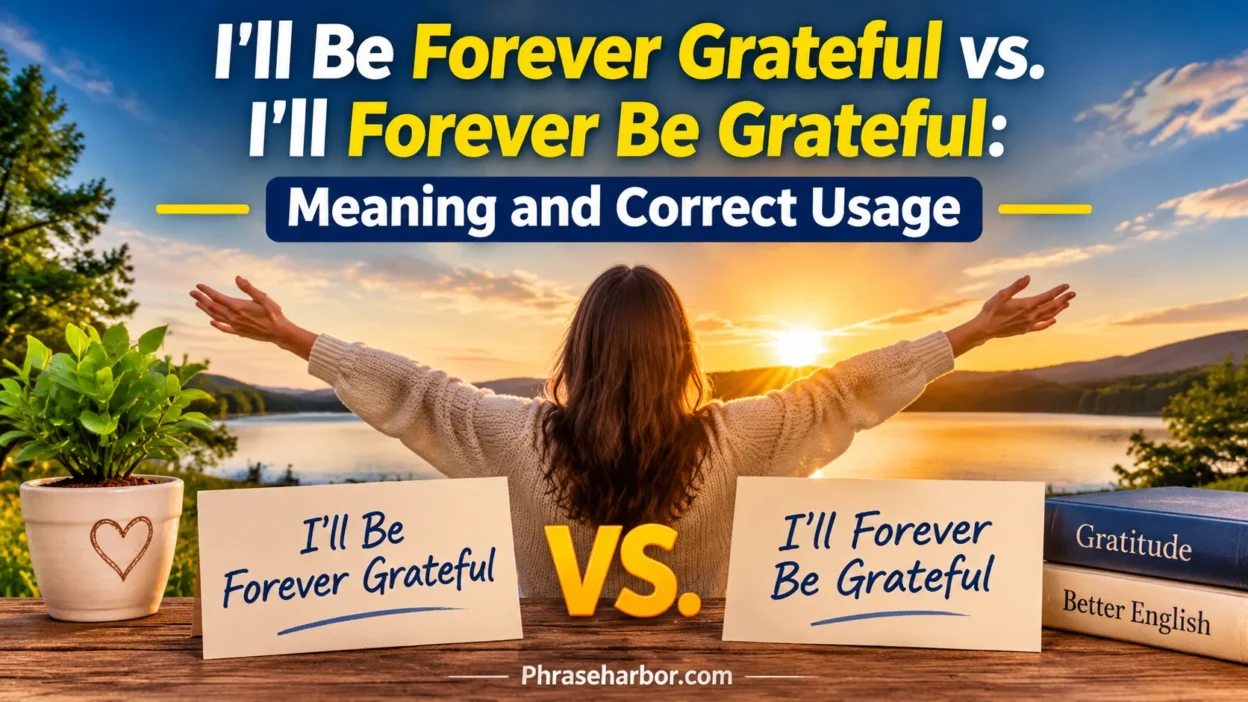
Have you ever wondered whether to write “I’ll be forever grateful” or “I’ll forever be grateful”? Both expressions sound natural and communicate appreciation. However, their slightly different word orders can make you question which version belongs in your sentence.
The good news is that you don’t have to choose between correct and incorrect grammar here. Both expressions are grammatically acceptable. They simply arrange the words differently while expressing essentially the same idea.
Still, understanding how each construction works can help you choose the right wording for a thank-you message, professional email, personal letter, or heartfelt conversation. There’s also one small spelling detail worth remembering: “I’ll” needs an apostrophe because it means “I will.”
Quick Answer:
Both “I’ll be forever grateful” and “I’ll forever be grateful” are grammatically correct expressions. They communicate that you will continue appreciating someone’s kindness, help, or support indefinitely.
The main difference involves word order and emphasis:
- I’ll be forever grateful: Places “forever” after the verb “be” and before the adjective “grateful.” It expresses lasting appreciation in a natural, straightforward way.
- I’ll forever be grateful: Places “forever” before the verb phrase “be grateful.” It gives the duration of your gratitude a slightly more prominent position.
Neither construction is grammatically superior in every situation. Your choice depends on personal preference, sentence rhythm, and the emphasis you want.
Here’s a quick example of each:
- “Thank you for helping me through such a difficult time. I’ll be forever grateful.”
- “You gave me an opportunity that changed my life. I’ll forever be grateful.”
Remember: Write “I’ll,” not “ill.” The apostrophe indicates the contraction of “I will.” Without it, “ill” means sick or unwell.
Comparison Overview
Although these expressions share the same basic meaning, their grammatical arrangements differ. The following table highlights their similarities and distinctions.
| Feature | I’ll Be Forever Grateful | I’ll Forever Be Grateful |
| Grammatical correctness | Correct | Correct |
| Meaning | Lasting appreciation | Lasting appreciation |
| Word order | Forever follows “be” | Forever precedes “be” |
| Main emphasis | The state of being grateful | The continuing duration of gratitude |
| Tone | Natural and heartfelt | Natural and slightly emphatic |
| Formality | Suitable for formal and informal contexts | Suitable for formal and informal contexts |
| Common usage | Thank-you messages and conversations | Personal messages and expressions of deep appreciation |
| Example | I’ll be forever grateful for your kindness. | I’ll forever be grateful for your kindness. |
The distinction is subtle rather than substantial. Both expressions tell someone that their kindness or support will remain meaningful.
For example, imagine a friend helps you find a job after months of unemployment. You might say either expression to acknowledge that their assistance made a lasting difference.
The message remains clear regardless of which word order you choose.
What Does “I’ll Be Forever Grateful” Mean?
“I’ll be forever grateful” means that you will always appreciate someone’s kindness, generosity, assistance, or support.
People use this expression when an action has made a meaningful difference in their lives. It communicates more than ordinary thanks because it suggests that the appreciation will continue long after the original favor.
For example:
“I’ll be forever grateful for the encouragement you gave me when I wanted to give up.”
This sentence expresses lasting appreciation for emotional support during a difficult period.
The speaker isn’t simply thanking someone for one conversation. They’re acknowledging that the person’s encouragement had an impact worth remembering.
Grammatical Structure of “I’ll Be Forever Grateful”
Understanding the individual words makes the sentence easier to recognize and use correctly.
Consider its grammatical components:
- I’ll: A contraction of “I will.” It identifies the speaker and establishes future meaning.
- Be: The base form of the verb “to be.” It connects the subject with a description or state.
- Forever: An adverb that means for all future time or indefinitely.
- Grateful: An adjective describing appreciation or thankfulness.
The complete structure looks like this:
Subject + Future Auxiliary + Linking Verb + Adverb + Adjective
Here’s how those parts work together:
“I’ll be forever grateful for your support.”
- Subject and auxiliary: I’ll
- Linking verb: Be
- Adverb: Forever
- Adjective: Grateful
- Reason for gratitude: Your support
The word “grateful” describes the speaker’s emotional state. Meanwhile, “forever” indicates how long that state will continue.
This arrangement creates a clear and natural sentence. It works particularly well when you want to express sincere appreciation without making your message sound overly dramatic.
Read More: Vagrant vs. Hobo: Meaning, Differences, and Correct Usage
Examples of “I’ll Be Forever Grateful”
You can use this expression in many situations. The examples below demonstrate how it fits different relationships and circumstances.
Personal relationships
- I’ll be forever grateful for everything you’ve done for my family.
- I’ll be forever grateful that you stood beside me during difficult times.
- I’ll be forever grateful for your friendship and unconditional support.
- I’ll be forever grateful for the kindness you showed when I needed it most.
Professional situations
- I’ll be forever grateful for the opportunity to work with such an experienced team.
- I’ll be forever grateful for your guidance throughout my career.
- I’ll be forever grateful for the recommendation that helped me secure this position.
- I’ll be forever grateful for the time you invested in mentoring me.
Education and mentorship
- I’ll be forever grateful for the lessons you taught me.
- I’ll be forever grateful for your patience during my studies.
- I’ll be forever grateful for the scholarship that allowed me to attend college.
- I’ll be forever grateful for your encouragement throughout my academic journey.
Everyday conversations
- I’ll be forever grateful for your help with the move.
- I’ll be forever grateful that you picked me up when my car broke down.
- I’ll be forever grateful for such a thoughtful gift.
- I’ll be forever grateful for everything you did yesterday.
Notice how the expression works across different contexts. The underlying message remains the same, but the reason for appreciation changes.
When Does “I’ll Be Forever Grateful” Work Best?
This construction is particularly useful when you want to express appreciation naturally and sincerely.
Consider using it when:
- Someone helps you overcome a difficult situation.
- A teacher or mentor influences your personal development.
- A friend offers support during an emotional experience.
- A colleague gives you valuable professional guidance.
- Someone makes a meaningful sacrifice on your behalf.
It also works well as the closing sentence of a thank-you message.
For example:
“Thank you for taking the time to explain everything and answer my questions. Your guidance made the entire process easier. I’ll be forever grateful for your support.”
The expression gives the message a warm and appreciative ending.
What Does “I’ll Forever Be Grateful” Mean?
“I’ll forever be grateful” means that you will remain thankful for something indefinitely.
It communicates essentially the same sentiment as “I’ll be forever grateful.” However, placing “forever” before “be grateful” brings the duration of appreciation into focus earlier in the sentence.
For example:
“I’ll forever be grateful for the chance you gave me.”
This sentence expresses lasting appreciation for an opportunity.
The speaker wants the other person to understand that their generosity won’t be forgotten. Even as circumstances change, the appreciation will remain.
The expression often appears in heartfelt messages, personal letters, speeches, and situations involving significant acts of kindness.
Grammatical Structure of “I’ll Forever Be Grateful”
The individual words serve the same grammatical functions as they do in the alternative construction. Only their arrangement changes.
Let’s examine the sentence:
“I’ll forever be grateful for your generosity.”
Its components include:
- I’ll: The contraction of “I will.”
- Forever: An adverb expressing indefinite duration.
- Be: The base form of the linking verb “to be.”
- Grateful: An adjective describing the speaker’s appreciation.
The grammatical arrangement is:
Subject + Future Auxiliary + Adverb + Linking Verb + Adjective
Here, “forever” appears directly after “I’ll” and before “be.”
This placement is grammatically acceptable because adverbs can appear in different positions within a sentence, depending on their function and the intended emphasis.
Importantly, “forever” doesn’t change the basic meaning of “grateful.” It tells the reader that the speaker expects their appreciation to continue.
Examples of “I’ll Forever Be Grateful”
Here are practical examples showing how this construction works in different situations.
Expressing appreciation for significant help
- I’ll forever be grateful for the way you helped me rebuild my life.
- I’ll forever be grateful for your kindness during my darkest days.
- I’ll forever be grateful that you believed in me when nobody else did.
- I’ll forever be grateful for everything you sacrificed to help me.
Acknowledging professional support
- I’ll forever be grateful for the opportunity to learn from you.
- I’ll forever be grateful for your leadership and encouragement.
- I’ll forever be grateful for the experience I gained under your supervision.
- I’ll forever be grateful for your confidence in my abilities.
Thanking friends and family
- I’ll forever be grateful for the love and support of my family.
- I’ll forever be grateful for having you as a friend.
- I’ll forever be grateful for the memories we created together.
- I’ll forever be grateful that you never gave up on me.
Personal messages and heartfelt writing
- I’ll forever be grateful for the beautiful memories you gave me.
- I’ll forever be grateful for the lessons I learned from you.
- I’ll forever be grateful for the opportunity to make a fresh start.
- I’ll forever be grateful for the kindness you showed my family.
These examples demonstrate why the expression works particularly well when the speaker wants to emphasize lasting appreciation.
When Does “I’ll Forever Be Grateful” Work Best?
This construction is suitable when you want to highlight the lasting nature of your appreciation.
For example, consider someone who receives financial assistance that allows them to complete their education. They might write:
“Your generosity gave me the chance to finish my degree. I’ll forever be grateful for the opportunity you provided.”
The second sentence emphasizes that the appreciation will continue beyond the immediate circumstances.
You can use this expression when:
- Someone makes a life-changing contribution to your future.
- A person supports you through an especially challenging experience.
- A mentor helps shape your professional or personal development.
- Someone gives you an opportunity that you deeply value.
- You want to acknowledge a meaningful act of generosity.
However, you don’t need a dramatic life event to use it. A thoughtful favor or meaningful gesture can also inspire lasting gratitude.
Main Differences Between “I’ll Be Forever Grateful” and “I’ll Forever Be Grateful”
Both expressions communicate enduring appreciation, but their word order creates a slight difference in presentation.
Understanding these distinctions helps you choose wording that fits your sentence naturally.
Word Order and Sentence Structure
The clearest difference is where the adverb “forever” appears.
In the first expression, “forever” follows the linking verb “be.”
I’ll be forever grateful.
In the second expression, “forever” comes before the linking verb.
I’ll forever be grateful.
Both arrangements are acceptable in English.
English adverbs don’t always occupy one fixed position. Their placement can depend on the verb, the type of adverb, and the rhythm of the sentence.
Consider these additional examples:
- I’ll always remember your kindness.
- I’ll remember your kindness forever.
- I’ll never forget what you did.
- I’ll be eternally thankful for your support.
Each sentence communicates lasting appreciation or remembrance, although the grammatical structure differs.
The important point is that moving “forever” doesn’t make either original expression incorrect.
Emphasis and Tone
Although the meanings are almost identical, the placement of “forever” can slightly influence how a sentence sounds.
“I’ll be forever grateful” presents gratitude as a lasting emotional state. The phrase flows naturally from the verb “be” to the adjective “grateful.”
“I’ll forever be grateful” brings the idea of duration forward. The reader encounters “forever” before reaching the description of gratitude.
Compare these examples:
Example A:
“I’ll be forever grateful for the advice you gave me.”
This sounds warm, straightforward, and appreciative.
Example B:
“I’ll forever be grateful for the advice you gave me.”
This also sounds warm, but the placement of “forever” gives the duration slightly more prominence.
Neither sentence automatically communicates stronger emotions. The surrounding context and speaker’s intention matter much more.
Frequently Asked Questions
Is “I’ll Be Forever Grateful” Grammatically Correct?
Yes, “I’ll be forever grateful” is grammatically correct. It means you will continue appreciating someone’s kindness, assistance, or generosity indefinitely. You can use it in personal messages, professional emails, thank-you notes, and everyday conversations.
Is “I’ll Forever Be Grateful” Also Correct?
Yes, “I’ll forever be grateful” is also grammatically correct. It communicates lasting appreciation, just like the alternative construction. The only noticeable difference involves the placement of the adverb “forever.”
Which Is More Natural: “I’ll Be Forever Grateful” or “I’ll Forever Be Grateful”?
Both expressions sound natural in English. “I’ll be forever grateful” offers a straightforward construction while “I’ll forever be grateful” places the adverb before the linking verb. Choose whichever version flows better in your sentence.
Does “Ill Be Forever Grateful” Need an Apostrophe?
Yes, it needs an apostrophe when you mean “I will be forever grateful.” The correct spelling is “I’ll be forever grateful.” Without the apostrophe, “ill” means sick or unwell.
Can I Use “I’ll Be Forever Grateful” in a Professional Email?
Yes, you can use this expression in a professional email when thanking someone for meaningful assistance, mentorship, or an important opportunity. However, for routine workplace favors, “I really appreciate your help” may sound more natural and proportionate.
Conclusion:
The difference between “I’ll be forever grateful” and “I’ll forever be grateful” comes down to word order rather than grammatical correctness. Both expressions communicate lasting appreciation for someone’s kindness, generosity, encouragement, or support. The first places “forever” after the linking verb “be” while the second places it before the verb phrase. You can confidently use either construction in personal messages, professional emails, heartfelt letters, and everyday conversations.