Have you ever read a sentence that seemed clear at first but meant something entirely different after learning the circumstances behind it? That’s where the difference between content and context becomes important. Although these words often appear together, they describe two different parts of communication.
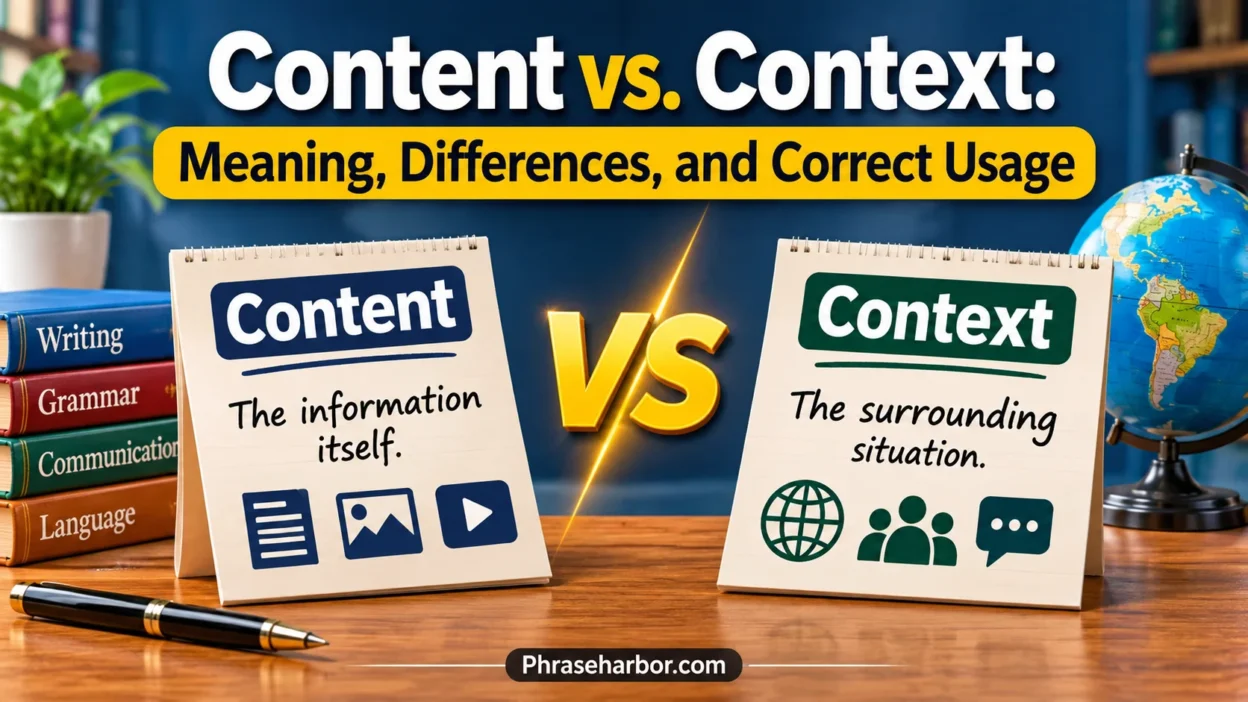
Content refers to the information, ideas, or material being communicated. Context refers to the surrounding circumstances, background information, or situation that helps you understand that material. Both play essential roles in writing, reading, education, business, digital marketing, and everyday conversations.
For example, consider the statement, “That was a brilliant idea.” The content is a compliment about someone’s idea. However, if the speaker says it sarcastically after a serious mistake, the context may reveal criticism instead of praise.
Understanding this distinction helps you interpret messages accurately, express ideas clearly, and avoid common misunderstandings. Whether you’re writing an email, studying a historical event, or creating website content, knowing when to use each word makes your communication more effective.
Quick Answer:
Content is the actual information, message, or material presented. Context is the background, circumstances, or surrounding information that helps explain its meaning.
Here is the simplest way to remember the difference:
- Content = What is being communicated?
- Context = What helps you understand what is being communicated?
Consider a newspaper article about a sudden increase in food prices. The reported prices, statistics, quotations, and explanations form the content. The economic conditions, supply shortages, and events behind the price increase provide context.
Content tells you what the article presents. Context helps you understand why the information matters.
| Content | Context |
| The information or material itself | The circumstances surrounding the information |
| Answers “What is being communicated?” | Answers “What helps explain its meaning?” |
| Includes words, facts, images, and ideas | Includes background, setting, tone, and relevant events |
| Delivers the message | Helps people interpret the message |
| Example: A manager’s written instruction | Example: The workplace situation behind that instruction |
Although content and context serve different purposes, they often work together. Without sufficient context, even accurate information can confuse readers or lead them to incorrect conclusions.
Comparison Overview
Content and context are closely related, but each contributes something different to understanding a message. The following comparison highlights their main characteristics.
| Feature | Content | Context |
| Definition | Information or material being presented | Background or circumstances that help explain something |
| Main question | What does it say? | What does it mean in this situation? |
| Primary role | Communicates information | Helps interpret information |
| Common forms | Text, speech, images, videos, facts, and ideas | Historical events, surrounding words, relationships, tone, and setting |
| In writing | The words and ideas in a document | The surrounding sentences, purpose, audience, and background |
| In conversation | The words someone speaks | Their tone, relationship, intentions, and circumstances |
| In education | Facts and concepts being taught | Background knowledge that explains those facts and concepts |
| In digital marketing | Articles, videos, product descriptions, and other published material | Search intent, audience needs, topic relationships, and page purpose |
| Can it stand alone? | Sometimes, particularly when information is direct and complete | It can exist independently as a situation or background, although its interpretive role depends on what it helps explain |
| Example | A message stating, “The meeting is canceled.” | The reason for the cancellation and the circumstances surrounding it |
One important distinction deserves attention: context does not automatically change the literal content. Instead, it can change how people interpret that content.
For example, the words “You’re early” remain the same whether someone says them happily or irritably. The surrounding situation and tone help determine whether the statement expresses appreciation, surprise, or annoyance.
Main Differences Between Content and Context
The clearest way to understand content vs. context is to examine how each term functions in real situations. Their differences involve meaning, purpose, scope, and interpretation.
Meaning and Definition
Content refers to what something contains or communicates. It includes the actual words, facts, ideas, images, or other material presented to an audience.
For example, a science textbook may contain definitions, diagrams, experiments, and explanations. All these elements contribute to the textbook’s content.
Context refers to the information or circumstances that help explain the material. In the same textbook, context might include the scientific discoveries that led to a theory, the historical period in which researchers developed it, or the previous concepts students need to understand.
The distinction becomes easier to see when you ask two questions:
- What information does the material provide? That is its content.
- What background helps explain the information? That is its context.
Both questions matter, but they serve different purposes.
Purpose and Function
Content primarily communicates information, ideas, instructions, or entertainment. Its purpose depends on the material itself.
A recipe, for example, provides ingredients, measurements, and cooking instructions. Those details constitute its content. A cook’s experience, available equipment, and knowledge of the dish’s cultural background may provide useful context.
Context helps people interpret the information correctly. It can clarify an unfamiliar expression, explain a decision, reveal a speaker’s intention, or show why a particular fact matters.
Imagine receiving an email that says, “Please address this immediately.”
The content communicates a request for prompt action. However, context determines what “immediately” means in practice. A minor formatting issue may allow an hour, while a serious security incident may require action within minutes.
Focus and Scope
Content focuses on the actual material presented. Context focuses on the surrounding information that influences its interpretation.
Suppose a company publishes an annual report. The report’s revenue figures, financial statements, and management explanations belong to its content.
The broader economic environment, industry trends, regulatory changes, and previous financial performance provide context for interpreting those figures.
A revenue increase of 5% may initially appear impressive. However, if competitors grew by 15% during the same period, the broader context changes how readers evaluate the result.
This example demonstrates why information alone doesn’t always tell the complete story. Context helps you understand the significance of what you read.
Role in Communication
Content carries the message, while context helps establish how that message should be understood.
Consider the statement, “You really helped us out.”
In one situation, a colleague may say this sincerely after you finish an urgent assignment. In another, someone may use the same words sarcastically after you accidentally create additional work.
The words remain unchanged, but the intended meaning differs.
Contextual clues may include:
- The speaker’s tone of voice.
- Facial expressions and body language.
- The relationship between the people involved.
- Previous statements in the conversation.
- The circumstances surrounding the remark.
Written communication also depends on context, although readers may have fewer clues available. That’s why clear wording, relevant background, and careful explanations matter in professional emails and online discussions.
Content vs. Context in Relation to Meaning
Content and meaning are closely connected, but meaning doesn’t always depend on words alone.
The content of a statement provides its linguistic material. Context helps readers determine how to interpret that material in a particular situation.
For example, the word cold can describe a low temperature, an unfriendly attitude, or an illness in everyday language. The surrounding words help identify the intended sense.
Consider these sentences:
- “The water feels cold.” The context concerns temperature.
- “Her response was cold.” The context concerns someone’s manner or attitude.
- “He caught a cold.” The context concerns an illness.
The word changes meaning according to its linguistic context. This process is especially important when reading unfamiliar vocabulary or interpreting sentences containing ambiguous words.
Read More: Letter or Alphabet: Meaning, Differences, and Correct Usage
Can Content Exist Without Context?
Yes. Content can communicate a clear message without extensive background information.
For example, a sign reading “Exit” provides a straightforward instruction. Most readers can understand it without knowing the building’s history or the circumstances in which the sign was installed.
However, some content becomes difficult to interpret when important context is missing.
Consider a text message that reads, “Fine. Do whatever you want.”
The literal content expresses permission or acceptance. Depending on the preceding conversation, however, it might communicate frustration, resignation, or genuine agreement.
Content can stand alone when its meaning is clear, but complex messages often need context for accurate interpretation.
Can Context Exist Without Content?
Context can exist before anyone communicates a particular message.
For instance, a classroom has a particular educational setting, students have different levels of background knowledge, and a historical event has circumstances surrounding it. These conditions exist independently of any specific explanation.
However, context becomes relevant to interpretation when it helps explain a statement, event, decision, or other subject.
Imagine a teacher preparing students to study the American Civil War. The political tensions, economic differences, and debates over slavery provide historical context before the teacher introduces a particular document.
Once students examine the document, they can use that background to interpret its language and significance.
What Does Content Mean?
Content is a noun that generally refers to the information, ideas, or material contained in or communicated through something.
You encounter content almost everywhere: in books, conversations, websites, presentations, advertisements, videos, and educational materials.
The exact meaning depends on the situation, but the central idea remains consistent. Content is the material being presented or contained.
Definition of Content
In communication, content includes the actual message that a person or organization conveys.
It may take several forms:
- Written content: Articles, essays, emails, reports, and letters.
- Spoken content: Conversations, speeches, interviews, and lectures.
- Visual content: Photographs, diagrams, illustrations, and infographics.
- Digital content: Website pages, social media posts, podcasts, and videos.
- Educational content: Lessons, definitions, exercises, and explanations.
- Commercial content: Product descriptions, advertisements, brochures, and sales materials.
Content doesn’t have to consist of words. A photograph can communicate information through visual details, while a video can combine images, dialogue, sound, and movement.
The term also appears in other settings. For example, a container’s contents are the things inside it. In a book, the table of contents lists its chapters and major sections.
One grammatical detail is worth remembering: content can also function as an adjective meaning satisfied, as in “She felt content with her decision.” That meaning differs from the noun discussed throughout this article.
Examples of Content in Everyday Life
Content appears in familiar situations, even when people don’t consciously think about the term.
Example: A news article
The headline, reported facts, interviews, quotations, and explanations make up the article’s content.
Example: A school lesson
A lesson’s definitions, worked examples, diagrams, and practice questions form its content.
Example: A conversation
When two friends discuss their weekend plans, the activities and arrangements they talk about constitute the conversation’s content.
Example: An online store
A product page may include a product name, price, specifications, photographs, and customer reviews. These elements form much of the page’s content.
Example: A presentation
A business presentation may contain sales figures, charts, recommendations, and proposed strategies. These materials are its content.
In each case, content refers to the information or material being presented, not necessarily the circumstances surrounding it.
How to Use Content in a Sentence
The word content appears in many common expressions.
- “The website publishes educational content for English learners.”
- “The teacher updated the course content before the semester began.”
- “Please review the content of the report before Friday.”
- “The video contains useful content about workplace communication.”
- “The editor removed repetitive content from the article.”
Notice how each sentence identifies the material being created, reviewed, updated, or removed.
Common phrases include website content, course content, content creator, content quality, and table of contents.
When writing, use content when you mean the actual information or material. If you mean the circumstances that help explain that material, context is usually the better choice.
What Does Context Mean?
Context refers to the background information, circumstances, or surrounding details that help someone understand a statement, event, or piece of information.
It explains how a message relates to its situation. Sometimes context comes from nearby words. In other cases, it comes from history, relationships, social expectations, or previous events.
FAQs:
What Is the Main Difference Between Content and Context?
Content is the information, material, or message being communicated. Context is the background or circumstances that help explain that information.
For example, the words in a text message are its content. The relationship between the sender and recipient, along with their previous conversation, provides context.
Are Content and Context the Same Thing?
No. Content and context are related, but they serve different purposes.
Content communicates information, while context helps people interpret it. A report’s statistics are content, whereas the economic conditions surrounding those statistics provide context.
What Is an Example of Content and Context?
Suppose a teacher says, “You need to revise this assignment.”
The content is the instruction to revise the assignment. The context includes the teacher’s feedback, the assignment requirements, and the deadline.
The instruction tells the student what to do. The context explains what needs attention and why.
Why Is Context Important for Understanding Content?
Context helps readers and listeners interpret information accurately. It can clarify ambiguous words, explain a speaker’s intention, and reveal why an event matters.
Without relevant context, people may misunderstand a message even when the words themselves are accurate.
Can the Same Content Have Different Meanings in Different Contexts?
Yes. The same words can communicate different intentions depending on tone, circumstances, relationships, and previous events.
For example, “That’s interesting” may express genuine curiosity, polite acknowledgment, or skepticism. The surrounding conversation helps listeners determine the likely meaning.
However, context doesn’t necessarily change the literal definition of every word. It often changes the intended meaning or significance of the statement.
Conclusion:
The difference between content and context comes down to two related questions: What is being communicated, and what helps explain it? Content includes the words, facts, ideas, images, and other material presented in a message. Context includes the surrounding circumstances, background information, and details that help people interpret that message.