The words and and or may look simple, but choosing between them can change the entire meaning of a sentence. One connects ideas, while the other usually presents alternatives. Using the wrong conjunction can turn a choice into a requirement or make instructions confusing.
For example, consider these two sentences: “Bring a notebook and a pen” and “Bring a notebook or a pen.” The first sentence asks you to bring both items. The second generally allows you to choose either one, although the exact interpretation depends on context.
Understanding the difference between and vs. or helps you write clearer emails, follow instructions correctly, and express your ideas with greater precision. These conjunctions also play important roles in grammar, mathematics, computer programming, and formal rules.
Whether you’re writing a school assignment, preparing workplace instructions, or having an everyday conversation, knowing when to use each word makes your meaning easier to understand.
Quick Answer:
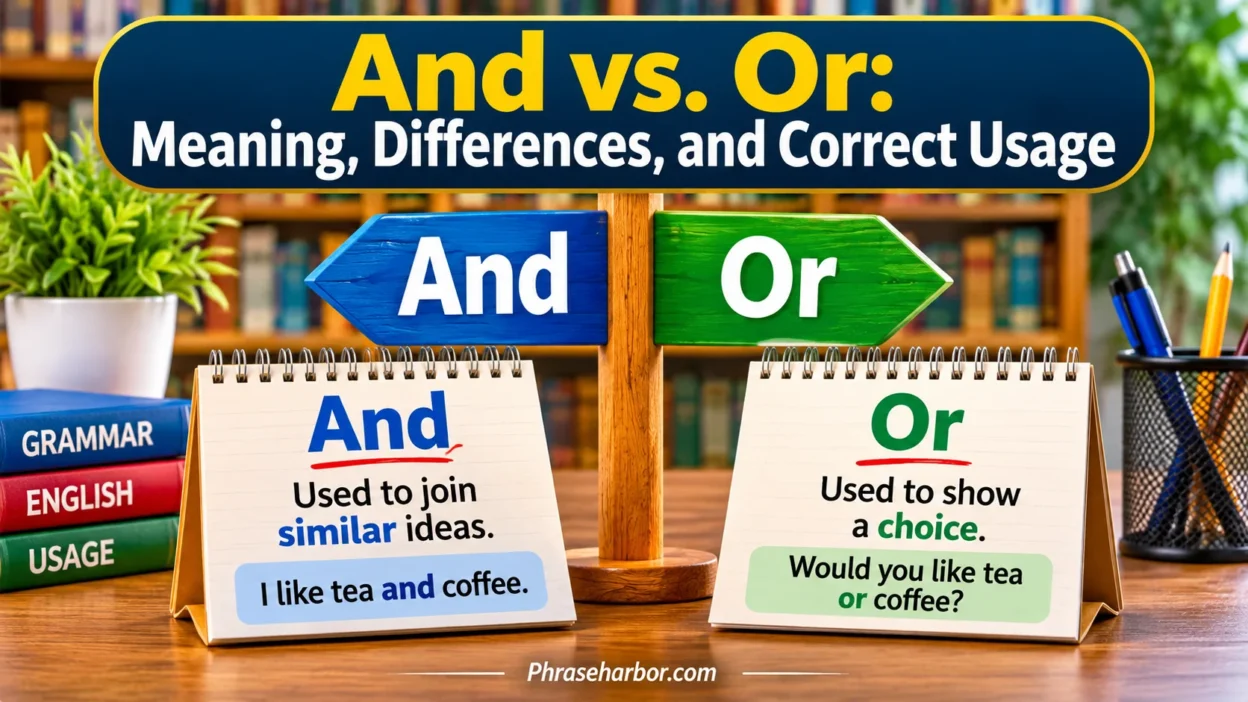
And connects words, phrases, or clauses to express addition or combination. Or connects alternatives, choices, or possibilities.
- And: Use it when you want to combine items, actions, people, or ideas. Example: Mia bought bread and milk.
- Or: Use it when you want to present alternatives or possibilities. Example: Would you like bread or milk?
The essential difference is that and generally combines things, while or generally presents alternatives. However, or doesn’t always mean that only one option can apply. Depending on the context, it can include one option, the other, or both.
Comparison Overview
The following table summarizes the main differences between and and or.
| Feature | And | Or |
| Part of speech | Coordinating conjunction | Coordinating conjunction |
| Main meaning | Addition or combination | Alternative or choice |
| Primary purpose | Connects related items or ideas | Presents options or possibilities |
| Typical interpretation | Both items are included | One or more alternatives may apply |
| Common use | Lists, combined requirements, connected actions | Questions, instructions, alternative outcomes |
| Example | She ordered soup and salad. | She ordered soup or salad. |
| Subject–verb agreement | Compound subjects generally take plural verbs | Verb agreement often depends on the nearer subject |
| Logical meaning | Both conditions must be true | At least one condition must be true in inclusive logic |
Consider how one small word changes the message:
- With and: You need a passport and a visa. Both documents are required.
- With or: You need a passport or a visa. At least one document is indicated, although the actual requirement depends on the surrounding instructions.
The second example illustrates why context matters. In real-world policies, or can have a specific meaning that readers shouldn’t guess without checking the full requirement.
Main Differences Between And and Or
The most important difference between and and or concerns the relationship between the elements they connect. Understanding that relationship helps you select the correct conjunction.
Addition vs. Alternatives
And adds information or combines elements into a group. It tells readers that the connected items belong together in the sentence.
For example:
- Liam and Noah play soccer.
- The recipe requires flour and sugar.
- She opened the window and turned on the fan.
In the first example, both people play soccer. In the second, both ingredients belong in the recipe. In the third, the sentence connects two actions performed by the same person.
Or, by contrast, introduces alternatives. It tells readers that different options or possibilities are available.
For example:
- Liam or Noah will lead the team.
- The recipe requires flour or almond flour.
- She will travel by train or bus.
These sentences present alternatives rather than automatically combining everything mentioned. The precise interpretation still depends on the situation.
How And and Or Change Sentence Meaning
Replacing one conjunction with the other can change a sentence’s practical meaning.
| With and | With or | Difference |
| Bring a jacket and an umbrella. | Bring a jacket or an umbrella. | The first calls for both items; the second presents alternatives. |
| You can read and write. | You can read or write. | The first describes both abilities; the second may indicate either ability. |
| Pay by cash and card. | Pay by cash or card. | The first suggests both payment methods; the second offers a choice. |
| Call your manager and email the report. | Call your manager or email the report. | The first calls for both actions; the second presents alternatives. |
Notice that the conjunction doesn’t change the meaning of the individual words. Instead, it changes how the reader understands their relationship.
This distinction becomes especially important in workplace policies, application forms, and instructions. A single conjunction can determine whether someone must complete two tasks or may choose between them.
Inclusive Or vs. Exclusive Or
One common misunderstanding is that or always means one option but never both. That interpretation isn’t always correct.
English uses or in both inclusive and exclusive ways.
Inclusive or means that at least one option applies. Both options may also apply.
For example:
Students who study biology or chemistry may apply.
Depending on the admission rules, students who study both subjects may qualify. The sentence doesn’t automatically exclude them.
Exclusive or means that exactly one option applies, not both.
For example:
Choose either the morning session or the afternoon session, but not both.
The phrase but not both makes the exclusive meaning explicit.
Here are additional examples:
- Inclusive: You can pay with cash or a credit card. Both methods may be used if the situation permits.
- Exclusive: Select one answer: true or false. The test expects one selection.
- Unclear without context: You can choose tea or coffee. The speaker may expect one drink, but the sentence alone doesn’t always establish that restriction.
When the distinction matters, use clarifying phrases such as either one, one or both, exactly one, or but not both.
Singular and Plural Agreement With And and Or
The conjunction you choose can also affect subject–verb agreement.
When and connects two separate subjects, the resulting compound subject generally takes a plural verb.
Examples:
- Emma and Olivia are classmates.
- The manager and the assistant have arrived.
- A notebook and two pencils were on the desk.
The verb agrees with the combined subject rather than just the nearest noun.
However, when two words joined by and refer to one combined idea or a single unit, a singular verb may be appropriate.
For example:
Macaroni and cheese is my favorite comfort food.
Here, the phrase can describe one dish. Agreement depends on the intended meaning.
With subjects joined by or, standard English often uses a verb that agrees with the subject closest to it.
- The teacher or the students are responsible for the display.
- The students or the teacher is responsible for the display.
These examples illustrate the proximity principle. When the subjects differ in number, rewriting the sentence can make it sound more natural.
For example:
Either the teacher is responsible, or the students are.
This structure avoids an awkward combination of singular and plural subjects.
Punctuation With And and Or
Both conjunctions follow similar punctuation rules. The correct choice depends on the sentence structure rather than the conjunction alone.
Use a comma before and or or when joining two independent clauses if the standard compound-sentence structure calls for one.
An independent clause contains a subject and a verb and can stand alone as a sentence.
Correct examples:
- I finished the assignment, and my partner reviewed it.
- You can take the bus, or you can walk to the station.
Each side contains a complete clause.
However, a comma is generally unnecessary when the conjunction connects two short words or phrases.
- She bought apples and oranges.
- Would you prefer tea or coffee?
- He washed and dried the dishes.
In a list of three or more items, the serial comma appears before the final conjunction in American English when using the standard serial-comma style.
For example:
We packed shirts, trousers, and shoes.
The serial comma helps distinguish the final item from the preceding items. Some publications omit it in certain contexts, but consistency and clarity matter most.
Avoid joining two independent clauses with only a comma.
Incorrect: I wanted to leave, but the meeting continued.
Correct: I wanted to leave, but the meeting continued.
The corrected version includes the conjunction but, which makes the sentence grammatically acceptable. The comma alone wouldn’t have been sufficient.
Read More: Word vs. Term: Meaning, Differences, and Correct Usage
What Does And Mean?
Definition of And
And is a coordinating conjunction that connects words, phrases, and clauses of equal grammatical importance. It commonly expresses addition, combination, or a relationship between related ideas.
For example, in the sentence Daniel reads novels and writes short stories, the conjunction connects two verb phrases that describe Daniel’s activities.
Similarly, The house is spacious and bright connects two adjectives that describe the same house.
The word also connects independent clauses, allowing writers to combine related thoughts into one sentence. For example:
The rain stopped, and the children went outside.
Both clauses express complete ideas. The conjunction shows that the events are connected, while the context suggests that one followed the other.
Examples of And in Sentences
You can use and in several grammatical structures.
| Function | Example | Explanation |
| Connecting nouns | Jack and Olivia arrived. | Includes two people. |
| Connecting verbs | She laughed and waved. | Connects two actions. |
| Connecting adjectives | The meal was warm and delicious. | Adds two descriptions. |
| Connecting phrases | He works in the morning and studies at night. | Connects two activities with different time frames. |
| Connecting clauses | I called the office, and someone answered. | Joins two complete thoughts. |
| Connecting list items | We bought bread, cheese, and fruit. | Combines several items into one list. |
The key is grammatical balance. When and connects equivalent elements, the sentence often feels smoother and easier to follow.
Common Uses of And
The word and serves several useful purposes in everyday English.
- Adding information: The hotel offers free breakfast and parking.
- Combining people or things: My brother and sister live nearby.
- Connecting actions: She unlocked the door and entered the room.
- Showing a sequence: Mix the ingredients and bake the cake.
- Extending an idea: The proposal is affordable and practical.
- Building a list: Bring your notebook, calculator, and textbook.
Although and often connects things that occur together, it doesn’t always indicate that they happen simultaneously.
For example, He woke up and brushed his teeth describes two actions that generally occur in sequence. Their order comes from the sentence and the situation, not from a special time meaning built into and.
What Does Or Mean?
Definition of Or
Or is a coordinating conjunction that connects words, phrases, or clauses to present alternatives, choices, or possibilities.
It helps readers understand that different options may satisfy a particular need or describe a possible situation.
Consider this example:
You can submit your assignment online or deliver it in person.
The sentence presents two methods of submission. Depending on the instructions, either method may be acceptable.
The word or can also connect possible explanations:
The noise came from the air conditioner or the refrigerator.
The speaker identifies two possible sources without claiming that either one is definitely responsible.
Examples of Or in Sentences
Here are several common uses of or.
| Function | Example | Explanation |
| Offering a choice | Would you like juice or water? | Presents two drink options. |
| Giving alternatives | We can drive or take the train. | Offers two travel methods. |
| Expressing uncertainty | She may arrive today or tomorrow. | Identifies two possible dates. |
| Connecting clauses | You can stay here, or you can come with us. | Presents two possible actions. |
| Giving instructions | Save the file or print a copy. | Offers alternative actions, depending on the intended instructions. |
| Clarifying a term | A semicolon, or the punctuation mark (;), separates related clauses. | Introduces an explanation of the term. |
The last example illustrates a related use: or can introduce a clarification or alternative name. Writers should make sure the second expression actually clarifies the first rather than introducing an unrelated choice.
Common Uses of Or
You will commonly encounter or in these situations:
- Making a choice: Would you prefer a window seat or an aisle seat?
- Providing alternative methods: Send the document by email or upload it to the portal.
- Expressing uncertainty: The package may arrive on Friday or Saturday.
- Presenting possible explanations: The error may come from a missing file or an incorrect setting.
- Giving a warning: Leave now, or you may miss the train.
- Offering alternative wording: The event is postponed, or delayed, until further notice.
In the warning example, or connects an action with a possible consequence. The sentence implies that leaving now may prevent the unwanted outcome.
This use differs slightly from a simple choice between two items. The relationship between the clauses gives the conjunction its full meaning.
FAQs:
What Is the Main Difference Between And and Or?
And generally connects items or ideas that belong together. Or generally presents alternatives, choices, or possibilities.
For example, bread and butter refers to both items, while bread or butter presents alternatives. The precise meaning of or depends on context.
Does And Mean Both?
In most ordinary sentences, and indicates that the connected elements are included together.
For example, Bring your passport and ticket normally means you should bring both documents.
However, the conjunction’s exact meaning depends on the sentence. In a sentence describing a sequence, and may connect actions that occur one after another rather than simultaneously.
Does Or Mean One or the Other?
Not always. English or can be inclusive or exclusive.
Inclusive or allows one option or both options. Exclusive or means exactly one option applies.
For example, You can choose tea or coffee often suggests a choice between drinks. Adding but not both makes the restriction explicit.
Can And and Or Be Used in the Same Sentence?
Yes. Both conjunctions can appear in one sentence when they connect different elements.
For example:
You can bring pens and pencils or bring a laptop.
The sentence presents two alternatives: bringing writing supplies or bringing a laptop. The first alternative contains two items connected by and.
If the intended meaning isn’t obvious, rewrite the sentence to show exactly which items belong to each option.
Should You Use a Comma Before And or Or?
Use a comma before and or or when joining two independent clauses in a standard compound sentence.
Example: I wanted to stay, but my friends wanted to leave.
In lists, American English commonly uses a serial comma before the final conjunction: We bought apples, pears, and peaches.
You generally don’t need a comma between two short items joined by and or or.
Conclusion:
Understanding and vs. or helps you write more accurate sentences and communicate your intentions clearly. Use and when you want to combine items, connect related ideas, or indicate that multiple requirements apply. Use or when presenting alternatives, expressing possibilities, or offering choices. Remember that or doesn’t always exclude the possibility of both options. Context determines whether the conjunction is inclusive, exclusive, or simply expresses uncertainty.