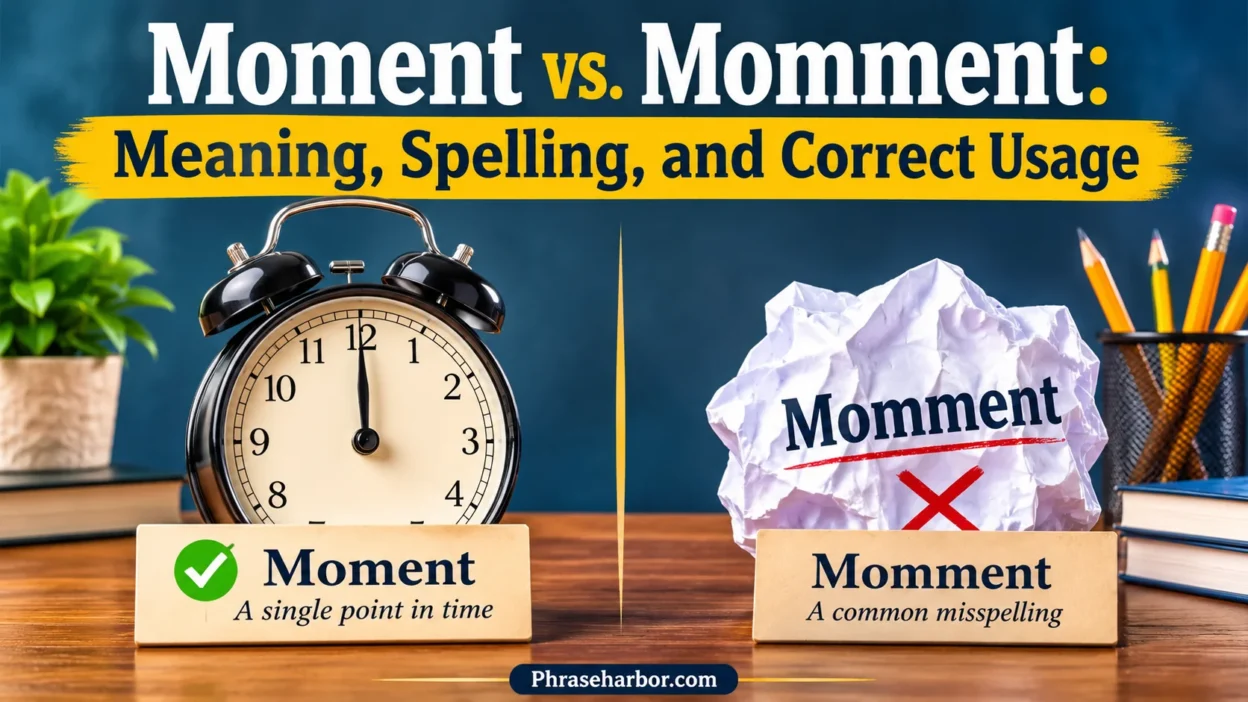
Have you ever typed momment instead of moment and wondered whether both spellings were correct? You’re not alone. This small spelling mistake happens because English contains many words with doubled consonants, making it easy to add an extra letter accidentally.
However, there’s a clear answer when comparing moment vs. momment: moment is the correct spelling, while momment is a misspelling in standard English.
The word moment appears in everyday conversations, professional emails, academic writing, and even scientific discussions. It can describe a brief period, a particular point in time, or a meaningful experience. Understanding its spelling and different uses will help you communicate more confidently.
Quick Answer:
Moment is the correct spelling in standard English. Momment is an incorrect spelling and should not be used in formal or informal writing when you mean the word moment.
The correct spelling contains six letters:
- M
- O
- M
- E
- N
- T
Notice that the word has two M letters overall, but they aren’t written together. The first M starts the word, while the second M follows the letter O.
Correct: Please wait a moment while I check the information.
Incorrect: Please wait a momment while I check the information.
The word moment is a noun that commonly refers to a short period or a specific point in time.
If you’re writing an email, school assignment, business document, or social media post, always choose moment.
Comparison Overview
Although moment and momment look similar, they don’t have the same spelling status. One is a recognized English word, while the other is simply a spelling error.
| Feature | Moment | Momment |
| Spelling status | Correct | Incorrect |
| Part of speech | Noun | No standard grammatical role |
| Meaning | A brief period or point in time | No established standard meaning |
| Total letters | 6 | 7 |
| Double M together | No | Yes |
| Pronunciation | MOH-mənt | Intended meaning usually remains moment |
| Dictionary recognition | Standard English word | Not a standard English word |
| Formal writing | Acceptable | Incorrect |
| Everyday usage | Common | Usually a typo |
The main distinction is straightforward: moment follows the accepted English spelling, whereas momment contains an unnecessary extra M.
For example, you might write, “Give me a moment to finish this task.” Adding another M doesn’t create a different word or change its meaning. It simply makes the spelling incorrect.
What Does Moment Mean?
Moment is a noun that generally describes a short period of time or a particular point in time. However, its meaning can change slightly depending on the sentence and situation.
People use this word when discussing everyday activities, important experiences, personal memories, and specific events.
Here are its main meanings.
Moment as a Brief Period of Time
One common meaning of moment is a short or relatively brief period. It often refers to an amount of time that doesn’t need an exact measurement.
For instance, when someone says, “Wait a moment,” they’re asking another person to pause briefly.
The exact duration depends on the situation. A moment might last a few seconds or several minutes. Unlike a precisely measured unit, it doesn’t have one fixed length in everyday English.
Consider these examples:
- Please give me a moment to organize my notes.
- She paused for a moment before answering.
- I’ll be back in a moment.
- He needed a moment to understand the instructions.
- Let’s take a moment to appreciate this achievement.
In each sentence, moment describes a short period rather than a specific measurement.
Important distinction: A moment isn’t always equal to 60 seconds. Although people sometimes use it informally to suggest a brief wait, its duration depends on context.
Moment as a Particular Point in Time
The word moment can also identify a particular point or occasion when something happens.
This meaning often appears when people discuss important decisions, unexpected events, personal achievements, and memorable experiences.
For example, consider the sentence:
“Winning the championship was the proudest moment of her life.”
Here, moment doesn’t describe a few seconds of waiting. Instead, it identifies a significant experience that the person remembers.
Other examples include:
- That was the happiest moment of my childhood.
- The moment he arrived, everyone started cheering.
- She realized her mistake at that exact moment.
- This is the perfect moment to begin.
- Their wedding day became a memorable moment for the entire family.
This use gives the word an emotional or descriptive quality. A moment can represent something exciting, meaningful, surprising, or even heartbreaking.
Moment in Mathematics and Physics
Beyond everyday conversation, moment has important technical meanings in mathematics, physics, and engineering.
These meanings are more specific than the ordinary definition of a brief period.
1. Moment of a force
In physics, the moment of a force describes its tendency to rotate an object around a particular point or axis. It’s closely related to torque.
For a perpendicular force, the basic relationship is:
=Fd
Where:
- represents the moment of force or torque.
- F represents the applied force.
- d represents the perpendicular distance from the pivot.
For example, pushing a door near its handle creates more turning effect than pushing it close to the hinges with the same perpendicular force.
2. Moments in probability and statistics
In statistics, moments describe numerical properties of a probability distribution.
Some important examples include:
- First moment: Related to the mean or expected value.
- Second central moment: Represents variance.
- Third central moment: Helps describe skewness.
- Fourth central moment: Helps describe kurtosis.
These concepts help statisticians understand how data values are distributed.
Although these technical definitions differ from everyday usage, they all use the same correctly spelled word: moment.
What Does Momment Mean?
Momment isn’t an accepted standard English word. In ordinary writing, it usually appears when someone accidentally adds an extra M to moment.
It doesn’t have an established independent meaning in standard English dictionaries. Therefore, you shouldn’t use it as an alternative spelling.
Is Momment a Real English Word?
No. Momment isn’t a recognized standard spelling of the English noun moment.
You might encounter it in online comments, social media posts, informal messages, or user-generated content. However, its appearance doesn’t make it grammatically correct.
For example:
- Incorrect: Give me a momment to think.
- Correct: Give me a moment to think.
The corrected version uses the established English spelling.
It’s also important to understand that unusual spellings sometimes appear as usernames, brand names, fictional names, or deliberate wordplay. Someone might intentionally choose Momment as a creative name.
That doesn’t make it a standard English word or a valid substitute for moment.
Read More: Thank You Both vs. Thanks to Both of You: Meaning, and Correct Usage
Why Do People Spell Moment as Momment?
Several factors can explain why people accidentally write momment.
1. Confusion with double-consonant words
English contains many familiar words with doubled consonants. Examples include:
- Common
- Summer
- Hammer
- Committee
- Mammal
- Beginning
Because people regularly encounter these spellings, they sometimes apply the same pattern to words that don’t require doubled consonants.
However, moment doesn’t follow that pattern.
2. Typing mistakes
Fast typing can produce accidental repetitions. Someone might press the M key twice without noticing, especially when writing quickly.
This happens frequently in informal digital communication.
3. Uncertainty about English spelling patterns
English spelling doesn’t always follow simple rules. Some words double consonants when adding suffixes, while others retain their original spelling.
For example, run becomes running, but open becomes opening.
Someone unfamiliar with these patterns might assume that moment requires another M.
4. Visual familiarity
When you repeatedly see an incorrect spelling, it can start looking familiar. This doesn’t make it correct.
The best way to avoid this mistake is to remember the standard six-letter spelling: M-O-M-E-N-T.
Main Differences Between Moment and Momment
The difference between moment vs. momment isn’t complicated, but understanding the details can help you avoid repeating the mistake.
The correct form has an established meaning, grammatical function, and spelling. The incorrect form doesn’t.
Let’s examine their differences more closely.
Spelling Difference
The most obvious difference is the number and arrangement of letters.
Moment contains six letters:
M + O + M + E + N + T
Momment contains seven letters:
M + O + M + M + E + N + T
The incorrect version adds another M immediately after the existing M.
This extra letter doesn’t belong in the word. The standard spelling has one M at the beginning and another after O.
A useful way to remember the difference is to break the word into two parts:
- Mom: The first three letters.
- Ent: The final three letters.
Together, they form moment.
Don’t let the familiar word mom trick you into adding another M!
Meaning Difference
Another important distinction concerns meaning.
Moment has several established meanings in English. It can describe a brief period, a particular point in time, or a significant experience.
For example:
“That was an unforgettable moment.”
The sentence describes an important experience.
On the other hand, momment doesn’t have an established standard English meaning. It’s generally an accidental misspelling of moment.
Therefore, you can’t use these two forms interchangeably.
Grammatical Difference
The word moment functions as a noun. It can appear as a subject, direct object, or object of a preposition.
Consider these examples:
| Grammatical role | Example |
| Subject | The moment passed quickly. |
| Direct object | I’ll remember this moment forever. |
| Object of a preposition | We arrived at the right moment. |
| Part of a noun phrase | It was a special moment. |
The word momment doesn’t have a recognized grammatical function in standard English.
You shouldn’t treat it as another noun or use it to create a different grammatical form.
Dictionary Recognition and Standard Usage
Moment is an established English word used in dictionaries, literature, education, journalism, and professional communication.
You’ll find it in expressions such as:
- A moment of truth
- A defining moment
- A moment of silence
- At the moment
- In a moment
These expressions have recognizable meanings and established usage patterns.
By comparison, momment isn’t a standard alternative. Its appearance in a search result, social media post, or personal message doesn’t establish it as a legitimate spelling.
For school assignments, professional documents, and published articles, always use moment.
How to Use Moment Correctly in a Sentence
Knowing the correct spelling is only part of the picture. You should also understand how to use moment naturally.
The word appears in many everyday situations. Its meaning depends on the surrounding words and the context of the sentence.
Moment as a Noun
A noun names a person, place, thing, or idea. Since moment refers to a period or point in time, it belongs to this category.
Here are several examples:
- I need a moment to collect my thoughts.
- Every moment with my family feels special.
- The moment arrived sooner than expected.
- She enjoyed the peaceful moment.
- We waited for the right moment to speak.
- He captured the moment with his camera.
Notice how the word describes either a period or an identifiable occasion.
You can also use its plural form, moments, when referring to multiple periods or experiences.
For example:
“Some moments in life stay with you forever.”
Here, the plural form refers to several memorable experiences.
Common Expressions With Moment
English speakers use moment in many familiar expressions. Learning these phrases will help you understand the word beyond its basic definition.
| Expression | Meaning | Example |
| A moment ago | A short time before now | She called a moment ago. |
| Just a moment | Wait briefly | Just a moment, please. |
| At the moment | Currently or right now | I’m busy at the moment. |
| In a moment | Very soon | I’ll join you in a moment. |
| For the moment | Temporarily or for now | This solution will work for the moment. |
| Every moment | Each point or period of time | She enjoyed every moment of the trip. |
| A defining moment | An experience that shapes something important | Graduation was a defining moment in his life. |
| A moment of silence | A short period of quiet reflection | Everyone observed a moment of silence. |
Although these expressions contain the same noun, their meanings aren’t identical.
For example, at the moment generally means currently. However, in a moment suggests something will happen shortly.
Compare these sentences:
- I’m working on the report at the moment.
- I’ll send you the report in a moment.
The first describes what’s happening now. The second describes something expected soon.
Moment in Professional and Academic Writing
The word moment works well in professional communication and academic writing. However, its meaning should remain clear within the sentence.
In workplace communication, people often use it to request a short delay or identify a suitable time.
Professional examples:
- Please give me a moment to review the document.
- We’ll discuss this matter at the appropriate moment.
- The presentation will begin in a moment.
- This meeting provides an important moment to review our progress.
In academic writing, moment can describe a significant event, a point in an argument, or a technical concept.
Academic examples:
- This moment marked a major change in the country’s history.
- The researcher examined the second moment of the distribution.
- At that moment, the experimental conditions changed.
- The turning moment increased as the applied force increased.
One useful writing tip: don’t replace moment with unnecessarily complicated expressions. If you mean a short period, the word moment is usually clear and effective.
Frequently Asked Questions
Is Momment or Moment the Correct Spelling?
Moment is the correct spelling in standard English. It contains six letters, with one M at the beginning and another after O. Momment is an incorrect spelling that adds an unnecessary extra M.
Why Do People Commonly Misspell Moment as Momment?
People often write momment because they accidentally double the M while typing or confuse the word with other English words containing double consonants. Fast typing and unfamiliarity with spelling patterns can also contribute to this mistake.
Does Momment Have a Meaning in English?
No. Momment doesn’t have an established meaning in standard English. It’s generally considered a misspelling of moment. Although someone might use it as a creative name or username, it isn’t a recognized alternative spelling.
Is Moment a Noun or an Adjective?
Moment is a noun. It describes a brief period, a particular point in time, or an important experience.
For example:
“That was a memorable moment.”
Here, moment functions as the noun in the sentence. The adjective form appears in related expressions such as momentary, which describes something lasting for a short time.
What Is the Plural of Moment?
The plural of moment is moments. You simply add an S to the singular form.
Examples:
- Singular: I remember that moment.
- Plural: I remember those moments.
Both spellings are correct, but they refer to different quantities.
Conclusion:
The difference between moment vs. momment is simple: moment is the correct English spelling, while momment is a misspelling. The word moment functions as a noun and describes a brief period, a specific point in time, or a meaningful experience. It also appears in technical fields such as physics and statistics. Whenever you’re writing an email, article, school assignment, or everyday message, choose moment instead of momment.