Have you ever paused while writing the word tying and wondered whether it should be spelled tieing instead? The confusion makes sense. When you look at the word tie, adding -ing seems like the most natural way to form the next version. However, English spelling rules don’t always follow that simple pattern.
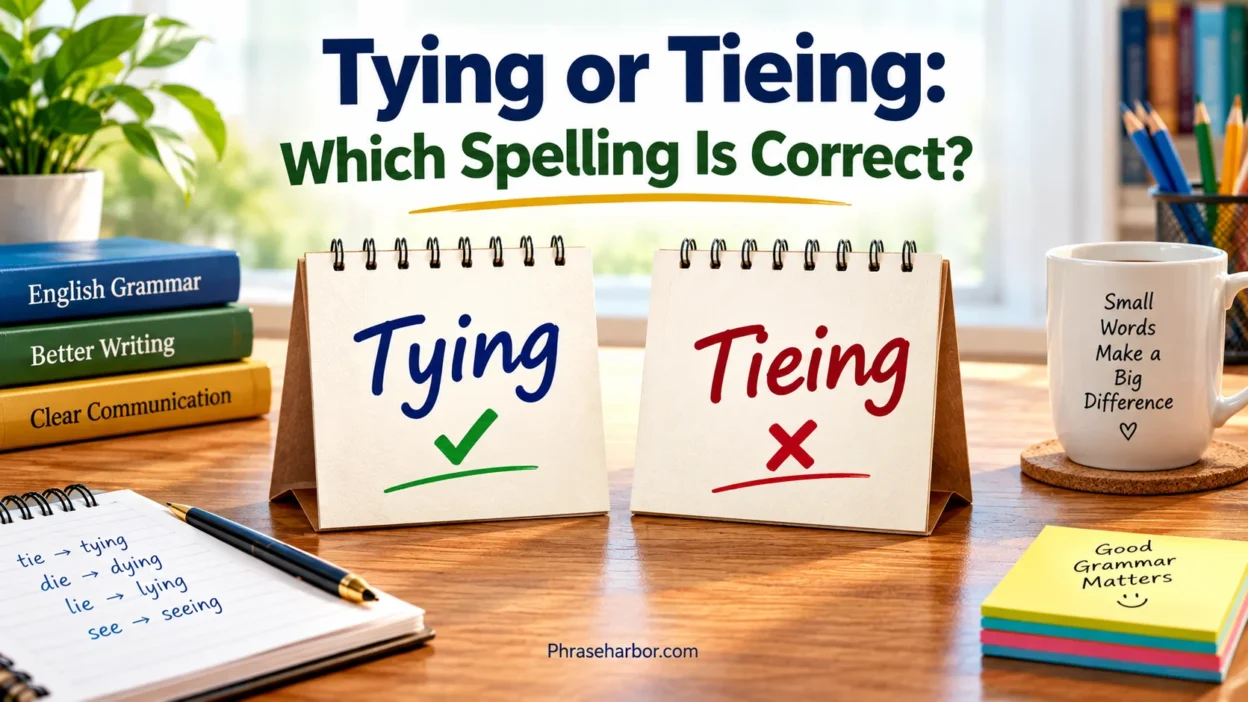
The correct spelling is tying, not tieing. Whether you’re writing about tying your shoes, tying a ribbon, tying a knot, or tying the score in a game, the same spelling applies. The word follows a common English spelling rule that changes the ending -ie to -y before adding -ing.
Understanding this rule will help you avoid similar mistakes with words such as lying, dying, and vying. You’ll also learn how to use tying as a verb form and a noun, recognize common spelling errors, and choose the correct form confidently in everyday and professional writing.
Quick Answer:
Tying is the correct standard spelling in modern English. Tieing is generally considered a misspelling and should be avoided in ordinary writing.
The spelling changes because English replaces the final -ie in tie with -y before adding -ing.
- Correct: She is tying her shoelaces.
- Incorrect: She is tieing her shoelaces.
- Correct: He is tying a ribbon around the box.
- Incorrect: He is tieing a ribbon around the box.
Remember this simple pattern: tie → tying. You don’t keep the original ie when forming the -ing version.
Comparison Overview
The difference between tying and tieing comes down to standard spelling, not meaning. Both forms may be understood in context, but only tying is the form you should normally use.
| Feature | Tying | Tieing |
| Spelling status | Standard and correct | Nonstandard in ordinary modern English |
| Base word | Tie | Tie |
| Word formation | Tie → tying | Tie → tieing |
| Meaning | Fastening, connecting, or bringing things together | Intended to express the same meaning |
| Use in formal writing | Recommended | Avoid |
| Use in everyday writing | Correct | Generally incorrect |
| Example | She is tying her shoes. | She is tieing her shoes. |
For school assignments, business emails, articles, reports, and other polished writing, choose tying every time. Although readers can usually understand tieing, using the standard spelling makes your writing more accurate and professional.
Main Differences Between Tying and Tieing
The main difference is that tying follows the accepted English spelling rule for verbs ending in -ie, while tieing does not follow the standard pattern.
Tying Is the Standard Spelling
Tying is the accepted present participle and gerund of the verb tie. It appears in many everyday situations, from fastening shoelaces to connecting ideas.
For example:
- Mia is tying her hair with a ribbon.
- The sailor is tying the boat to the dock.
- The team is tying the score in the final minutes.
- Tying a secure knot requires practice.
In each sentence, tying communicates a clear action or activity. Its spelling remains the same regardless of the subject, tense construction, or context.
Tieing Is Generally a Spelling Error
Tieing may look logical because it preserves the entire base word tie. However, English spelling conventions require a change when certain verbs ending in -ie take the -ing suffix.
For example, writers don’t normally form the words lieing or dieing. They write lying and dying instead. The same principle applies to tie.
Consider these examples:
- Incorrect: Mark is tieing the package.
- Correct: Mark is tying the package.
- Incorrect: They are tieing the two records together.
- Correct: They are tying the two records together.
The mistake usually comes from applying the familiar idea of adding -ing without changing the base word. Once you learn the pattern, the correct spelling becomes easier to remember.
Why Is Tying the Correct Spelling?
English uses several spelling rules when writers add endings to verbs. One important rule affects verbs that end in -ie. Instead of retaining those two letters, the spelling changes to -y before the -ing suffix.
This rule helps produce familiar forms such as tying, lying, and dying. It isn’t an arbitrary change unique to the word tie. It’s part of a broader spelling pattern.
The Spelling Rule for Verbs Ending in -ie
When a verb ends in -ie, change ie to y before adding -ing.
The process looks like this:
Tie + ing → tying
First, identify the base verb: tie. Next, replace its final ie with y. Finally, add ing to form tying.
| Base Verb | Correct -ing Form | Incorrect Form |
| Tie | Tying | Tieing |
| Lie | Lying | Lieing |
| Die | Dying | Dieing |
| Vie | Vying | Vieing |
This pattern is particularly useful because the base words already contain a final ie. Rather than adding another ending directly, you change the spelling first.
However, don’t assume that every verb ending in a vowel follows this exact rule. English has several different spelling patterns, so it’s important to identify the base word before applying a rule.
Similar Words That Follow the Same Pattern
Looking at related words makes the spelling rule easier to understand. Three common examples are lying, dying, and vying.
Lying: This is the -ing form of lie when it means reclining or making a false statement.
- She is lying on the sofa.
- He is lying about what happened.
Dying: This is the -ing form of die, meaning to stop living or, in informal expressions, to want something intensely.
- The flowers are dying without water.
- I’m dying to see the new movie.
Vying: This is the -ing form of vie, meaning to compete or strive for something.
- Several candidates are vying for the position.
- Two companies are vying for the contract.
These words demonstrate the same spelling change. If you remember lie → lying, you’ll have a useful clue for spelling tie → tying correctly.
What Does Tying Mean?
Tying is the -ing form of the verb tie. The verb has several related meanings, depending on the situation. Most commonly, it describes fastening something, connecting separate things, or bringing two competitors to the same score.
The exact meaning depends on the words surrounding it. A person tying a shoelace performs a physical action, while a player tying a game brings the score level.
Tying Means Fastening Something
The most familiar meaning of tying involves securing something with a knot, string, rope, cord, or similar material.
For example:
- She is tying her shoelaces before leaving the house.
- Dad is tying the trash bag tightly.
- The gardener is tying the plant to a wooden stake.
- He spent several minutes tying the ribbon around the gift.
In these examples, tying describes a physical action that holds something in place. The object being secured may be flexible, lightweight, or relatively heavy.
Tying Means Connecting Two Things
Tying can also describe joining separate objects, facts, ideas, or events. The connection doesn’t always involve a physical knot.
For example:
- The investigator is tying the evidence to the suspect.
- The report is tying recent sales growth to the new marketing strategy.
- The teacher is tying the lesson to real-life situations.
- The study is tying poor sleep to reduced concentration.
In this sense, tying means establishing a relationship or connection. Writers often use it when discussing research, reasoning, business decisions, and explanations.
Be careful when using this meaning in factual or scientific writing. Saying that evidence ties one event to another suggests a connection, but the strength of that connection depends on the evidence itself.
Tying Means Making a Score Equal
In sports and competitions, tying means bringing two opponents to the same score.
For example:
- The home team is tying the game with a late goal.
- She scored twice, tying the match in the final minute.
- The runner’s performance is tying the existing record.
Notice that this meaning doesn’t involve a physical knot. Instead, the word describes an equal result or score.
For instance, if one basketball team trails 82–80 and scores a basket worth two points, it ties the game at 82–82.
Tying Means Linking Ideas or Circumstances
Writers also use tying to describe relationships between ideas, events, responsibilities, or conditions.
Examples include:
- The manager is tying bonuses to employee performance.
- The author is tying the final chapter to the opening scene.
- The contract is tying payment to the completion of specific tasks.
- The speaker is tying the proposal to the company’s long-term goals.
Here, tying often suggests that one thing depends on, relates to, or connects with another.
This usage is especially common in business, education, research, and storytelling. It allows writers to describe relationships without repeating longer phrases such as making a connection between or linking one thing with another.
Read More: Best Regards vs. Warm Regards: Meaning, and When to Use Each
How to Use Tying in a Sentence
Understanding the spelling is only part of the picture. You should also know how tying functions grammatically so you can use it naturally in different types of sentences.
Tying can function as a present participle in verb phrases or as a gerund when it acts like a noun. It can also appear in expressions and phrases that carry specific meanings.
Tying as a Present Participle
A present participle is a verb form ending in -ing. It often appears with a form of be to create a continuous verb tense.
Examples:
- I am tying my shoes.
- She is tying the ribbon.
- They were tying the ropes when the rain started.
- We will be tying the final packages tomorrow.
In these sentences, tying forms part of a verb phrase. The auxiliary verb helps indicate the time of the action.
For example, is tying describes an action happening now, while was tying describes an action that was in progress in the past.
You can also use tying after certain verbs and expressions:
- He kept tying and untying the knot.
- She started tying the decorations to the railing.
- They finished tying the boxes together.
These constructions show how naturally tying fits into everyday English.
Tying as a Gerund
A gerund is a verb form ending in -ing that functions as a noun. It describes an activity, process, or action as a concept.
Consider these examples:
- Tying complicated knots takes patience.
- I enjoy tying fishing flies.
- Tying the packages correctly is essential.
- She learned tying techniques from her grandfather.
In the first example, tying complicated knots acts as the subject of the sentence. In the second, tying fishing flies functions as the activity the speaker enjoys.
The form doesn’t change when tying functions as a gerund. It retains the same correct spelling used in continuous verb phrases.
Tying in Figurative Expressions
Some expressions use tying in ways that extend beyond fastening physical objects. Learning these expressions can help you recognize the word in conversations, books, and professional writing.
Tying the knot: This expression means getting married.
Example: “After dating for five years, they are tying the knot this summer.”
Tying up loose ends: This means completing unfinished tasks or resolving remaining details.
Example: “Before the project closes, we need to tie up a few loose ends.”
Tying something to a condition: This means making one thing dependent on another.
Example: “The company is tying the bonus to the employee’s results.”
Tying things together: This means showing how separate elements relate to each other.
Example: “The final paragraph does an excellent job of tying the main ideas together.”
These expressions illustrate how the basic meaning of connecting or fastening extends into relationships, responsibilities, and ideas.
Is Tieing Ever Correct?
In ordinary modern English, tying is the standard spelling, and tieing should generally be treated as an error. If you’re writing an essay, article, email, report, or social media post, choose tying.
The form tieing can occasionally appear in older texts, unusual spellings, or informal writing. However, seeing a spelling in print doesn’t automatically make it the recommended form today.
English has many examples of spellings that look reasonable but don’t match modern standard usage. A reader may understand what tieing means, yet that doesn’t make it the best choice.
When accuracy matters, follow the standard form:
- Write tying your shoes, not tieing your shoes.
- Write tying a knot, not tieing a knot.
- Write tying the score, not tieing the score.
- Write tying ideas together, not tieing ideas together.
If you’re editing someone else’s writing, correct tieing to tying unless you’re preserving a historical quotation or reproducing a source exactly.
Tying vs. Tieing in American and British English
American and British English sometimes use different spellings for the same word. Examples include color and colour, organize and organise in varieties that prefer different conventions, and traveling and travelling.
However, tying is standard in both American and British English. This isn’t a case in which you should select a spelling based on your audience’s location.
| English Variety | Standard Spelling | Nonstandard Form |
| American English | Tying | Tieing |
| British English | Tying | Tieing |
| Canadian English | Tying | Tieing |
| Australian English | Tying | Tieing |
For example, an American writer might say, “I’m tying my shoes before the game.” A British writer would use the same spelling in the same situation.
The surrounding vocabulary, punctuation, and other spelling choices may differ across English varieties. The spelling of tying, however, remains consistent.
This makes the rule especially easy to remember. You don’t need to switch between tying and tieing when writing for different English-speaking audiences.
FAQs:
Is It Tying or Tieing?
Tying is correct. It’s the standard -ing form of tie. The form tieing is generally considered nonstandard in modern English.
Example: “I’m tying my shoes before I leave.”
How Do You Spell Tying?
Spell it t-y-i-n-g: tying. The word begins with t and uses y before ing. Don’t retain the original ie from tie.
Why Is Tying Not Spelled Tieing?
English spelling conventions change the final -ie of certain verbs to y before adding -ing. Therefore, tie becomes tying, just as lie becomes lying and die becomes dying.
Is Tieing a Real Word?
Tieing appears occasionally in writing, but it’s not the standard spelling recommended for ordinary modern English. Use tying in formal, academic, professional, and everyday writing.
What Is the Past Tense of Tie?
The simple past tense and past participle are both tied.
Examples:
- Simple past: “She tied the ribbon yesterday.”
- Past participle: “She has tied the ribbon securely.”
Don’t write tieed.
Conclusion:
When choosing between tying and tieing, the correct choice is tying. It’s the standard spelling in American, British, and other major varieties of English. The reason comes down to one useful spelling rule: change the final -ie to y before adding -ing. That gives you tie → tying, just as lie → lying, die → dying, and vie → vying. Use tying when writing about fastening shoelaces, securing packages, connecting ideas, or bringing a game’s score level. Use tied for the past tense and past participle.