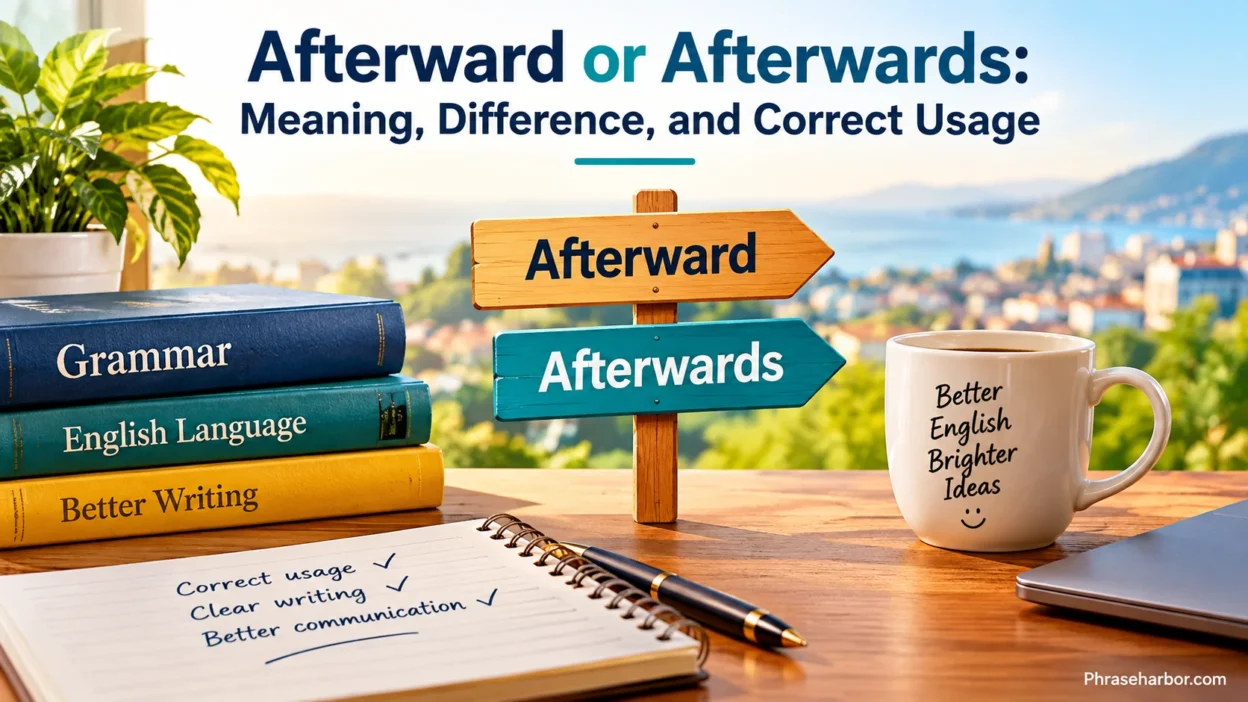
Have you ever wondered whether to write afterward or afterwards? Both words appear in books, articles, conversations, and professional writing. Although they look slightly different, they share the same basic meaning. The main difference comes down to regional preference rather than grammar.
Choosing between these words can feel confusing, especially when you read American and British English side by side. One writer might say, “We discussed the problem afterward,” while another writes, “We discussed the problem afterwards.” Both sentences are correct.
However, understanding the difference helps you make better choices when writing emails, academic assignments, blog posts, and business documents. Your audience matters, too. American readers generally encounter afterward more often, while British readers tend to see afterwards more frequently.
This guide explains the meanings, grammatical functions, regional differences, and practical uses of both forms. You’ll also find examples, comparisons, common mistakes, and answers to frequently asked questions.
Quick Answer:
Both afterward and afterwards are correct English words. They function as adverbs and mean “at a later time” or “after something has happened.”
- Afterward: More common in American English.
- Afterwards: More common in British English.
- Meaning: Essentially the same.
- Grammar: Both forms are grammatically correct.
- Usage: Choose the spelling that suits your audience and remain consistent throughout your writing.
Examples:
- American English: We had dinner and watched a movie afterward.
- British English: We had dinner and watched a movie afterwards.
Neither sentence is wrong. The difference lies in spelling preference, not meaning.
Comparison Overview
The easiest way to understand afterward and afterwards is to compare their main features. Both words describe an event that takes place following another event, action, or period.
| Feature | Afterward | Afterwards |
| Part of speech | Adverb | Adverb |
| Meaning | At a later time | At a later time |
| American English | More common | Less common |
| British English | Less common | More common |
| Grammatical correctness | Correct | Correct |
| Formal writing | Acceptable | Acceptable |
| Informal writing | Acceptable | Acceptable |
| Can refer to a past event? | Yes | Yes |
| Can appear at the end of a sentence? | Yes | Yes |
The central point is simple: neither spelling is universally better or more grammatically correct than the other. Regional convention usually determines which form sounds more familiar to readers.
If you’re writing for an American audience, afterward is generally the natural choice. If you’re writing for a British audience, afterwards may sound more familiar. In either case, the meaning stays the same.
Main Differences Between Afterward and Afterwards
Although these words have nearly identical meanings, a few practical differences are worth understanding. Their spelling, regional distribution, and frequency of use can influence which form you choose.
Meaning and Definition
Afterward means at a later time or following a particular event. Writers use it to show that one action happens after another.
For example:
- We finished the meeting and went for lunch afterward.
- She apologized afterward for her rude comment.
- The team reviewed the results afterward.
In each sentence, afterward refers to a time following an earlier action or event.
Afterwards carries the same meaning. Consider these examples:
- We finished the meeting and went for lunch afterwards.
- She apologized afterwards for her rude comment.
- The team reviewed the results afterwards.
The meaning remains unchanged. You can generally replace one word with the other without altering the sentence’s message.
Regional Usage in American and British English
The most noticeable difference between afterward and afterwards is regional preference.
American English favors afterward. You’ll commonly encounter this spelling in American newspapers, business writing, educational materials, and everyday communication.
For example:
“Let’s discuss the budget afterward.”
British English favors afterwards. This form is common in British books, articles, conversations, and professional correspondence.
For example:
“Let’s discuss the budget afterwards.”
These are general patterns, not strict rules. American writers can use afterwards, and British writers can use afterward. Neither form belongs exclusively to one country.
Other English-speaking regions, including Canada and Australia, may show different preferences depending on local conventions and the publication. When a style guide specifies a preferred form, follow that guidance.
Spelling and Grammatical Function
The spelling difference is small: afterwards contains an additional s at the end. That extra letter doesn’t change the word’s basic meaning or grammatical role.
Both words function as adverbs. They modify an action or describe when something happens relative to an earlier event.
Consider this sentence:
“We visited the museum and ate dinner afterward.”
Here, afterward indicates when dinner occurred in relation to the museum visit.
Now consider the alternative:
“We visited the museum and ate dinner afterwards.”
The grammatical structure and meaning remain the same.
Neither spelling is a comparative or superlative form. The final s in afterwards doesn’t indicate a plural, possession, or a separate tense.
Which Form Is More Common?
In everyday usage, American English tends to favor afterward, whereas British English tends to favor afterwards. This difference reflects established language conventions rather than a difference in grammatical rules.
However, frequency alone doesn’t determine correctness. A word can be less common in a particular region and still be perfectly acceptable.
For practical writing, think about your readers. If your article targets American readers, use afterward unless a specific style guide suggests otherwise. If your audience is primarily British, afterwards is a natural option.
For a website serving international readers, either form works. Consistency matters more than choosing one spelling for every English-speaking audience.
What Does Afterward Mean?
Definition of Afterward
Afterward is an adverb that means at a later time, following an event, or after something else has happened. It helps readers understand the order in which events occur.
You can use it when describing a past experience, explaining a sequence of actions, or discussing what someone plans to do after an activity.
For example:
- I completed my assignment and checked my answers afterward.
- The doctor examined the patient and spoke with the family afterward.
- We can review the proposal afterward if there’s enough time.
Notice that the word doesn’t tell readers exactly how much time passes between events. The second action might happen immediately or several hours later. The surrounding context provides that information.
Examples of Afterward in Sentences
The following examples demonstrate how afterward works in different situations.
Everyday activities
- I went grocery shopping and called my sister afterward.
- We cleaned the kitchen and relaxed afterward.
- He took a shower afterward because the weather was hot.
School and education
- The students discussed the lesson afterward.
- I reviewed my notes afterward to prepare for the exam.
- The teacher answered questions afterward.
Work and professional settings
- We reviewed the presentation and sent the final version afterward.
- The manager spoke with the employees afterward.
- I’ll share the meeting notes afterward.
Events and experiences
- They attended the wedding and visited the newlyweds afterward.
- The audience asked several questions afterward.
- She felt relieved afterward because the interview had gone well.
In every example, afterward connects a later action to an earlier event. This makes it useful when you want to avoid repeating a longer phrase such as “after the meeting was over.”
When to Use Afterward
Use afterward when it fits your intended audience and the sentence calls for an adverb indicating a later time.
It’s particularly natural in American English, although writers in other regions can use it as well.
For instance, compare these sentences:
- “We discussed the contract afterward.”
- “We discussed the contract after the meeting.”
The first sentence uses afterward without naming the earlier event again. The second identifies the event explicitly.
Both are correct, but the first may be more concise when the context already makes the sequence clear.
Read More; Tying or Tieing: Which Spelling Is Correct?
What Does Afterwards Mean?
Definition of Afterwards
Afterwards is an adverb meaning “at a later time” or “after an event.” It serves the same grammatical purpose as afterward.
The additional s is part of the conventional spelling. It doesn’t create a new meaning or make the word more formal.
For example:
“Emma finished her presentation and answered questions afterwards.”
This sentence tells readers that Emma answered the questions after finishing her presentation.
You can also use afterwards when the interval between events is longer.
For example:
“James graduated in May and moved to another state a few months afterwards.”
Here, the word refers to a later period rather than an immediate next action.
Examples of Afterwards in Sentences
Here are practical examples showing how afterwards appears in different contexts.
Daily life
- We ate breakfast and went for a walk afterwards.
- She called her parents afterwards to tell them the news.
- They watched a film and talked about it afterwards.
Education
- The students completed the experiment and recorded their findings afterwards.
- I asked the professor a question afterwards.
- The class went to the library afterwards.
Professional communication
- We reviewed the proposal and scheduled another meeting afterwards.
- The director explained the changes afterwards.
- Please send the revised document afterwards.
Personal experiences
- He regretted his decision afterwards.
- They laughed about the misunderstanding afterwards.
- She realized afterwards that she’d left her phone at home.
These examples show that afterwards works in ordinary conversation, storytelling, and professional writing. The word doesn’t require a particular sentence structure or level of formality.
When to Use Afterwards
Choose afterwards when you’re writing for a British audience or following a publication’s preferred spelling.
For example, a British writer might naturally write:
“We visited the exhibition and had coffee afterwards.”
An American writer might express the same idea as:
“We visited the exhibition and had coffee afterward.”
Neither sentence needs correction. The choice reflects regional convention.
You can also use afterwards in formal writing. It isn’t restricted to conversation, informal emails, or personal stories. What matters is whether it fits your intended meaning and the style of your document.
How to Use Afterward and Afterwards in Sentences
Both words are flexible. They can appear in different positions depending on what you want to emphasize and how you structure your sentence.
Using Afterward or Afterwards at the Beginning of a Sentence
You can begin a sentence with either word when you want to establish what happened next.
Examples:
- Afterward, we discussed the results with the entire team.
- Afterwards, the guests gathered in the garden.
- Afterward, she realized that she had misunderstood the instructions.
- Afterwards, we decided to take a different route.
When either word begins a sentence, a comma commonly follows it. The comma separates the introductory adverb from the main statement.
This position is especially useful in narratives and explanations because it helps readers follow a sequence of events.
For example:
“The committee reviewed all the applications. Afterward, it selected five candidates for interviews.”
The introductory word signals the next stage of the process.
Using Afterward or Afterwards in the Middle of a Sentence
You can also place either word in the middle of a sentence when it fits the sentence’s rhythm and structure.
Examples:
- We afterward discovered that the original figures were incorrect.
- She was afterwards offered a permanent position.
- The researchers afterward published their findings.
- He was afterwards invited to join the committee.
These constructions are grammatically possible, although some may sound less natural in everyday American English than placing the adverb at the end.
For clearer, more conversational writing, you could say:
- We discovered afterward that the original figures were incorrect.
- She was offered a permanent position afterward.
Practical tip: Don’t force the adverb into the middle of a sentence just to vary your writing. Choose the position that makes the sentence easiest to read.
Using Afterward or Afterwards at the End of a Sentence
The end of a sentence is one of the most natural positions for either word.
Examples:
- We went out for dinner afterward.
- She explained the situation afterwards.
- I’ll call you afterward.
- The team reviewed the report afterwards.
This structure works particularly well when the earlier event has already been mentioned.
For example:
“Daniel finished his training session. He stretched afterward.”
The reader understands that stretching took place after training. There’s no need to repeat “after his training session” unless the extra detail matters.
Using Afterward and Afterwards in Complex Sentences
You can use either word in a sentence containing multiple clauses. The key is to make the order of events clear.
Examples:
- Although the meeting lasted longer than expected, we discussed the budget afterward.
- She finished the exam and realized afterward that she’d skipped a question.
- After the guests left, we cleaned the house and rested afterward.
In the third example, the phrase “after the guests left” already establishes a time relationship. The final afterward then refers to resting after cleaning the house. Depending on the intended meaning, this repetition may be unnecessary.
A cleaner version might be:
“After the guests left, we cleaned the house and rested.”
Good writing doesn’t require an adverb in every sentence. Use afterward or afterwards when it adds useful information or improves the flow.
FAQs:
Is Afterward or Afterwards Grammatically Correct?
Both afterward and afterwards are grammatically correct. They function as adverbs and generally mean “at a later time.” The main difference is regional preference, with afterward more common in American English and afterwards more common in British English.
Is Afterward American or British English?
Afterward is more strongly associated with American English. American writers commonly use it in everyday communication, professional documents, news articles, and academic writing. However, the word isn’t exclusive to the United States.
Is Afterwards British or American English?
Afterwards is more strongly associated with British English. It’s common in the United Kingdom and appears in other varieties of English as well. American writers can use it, too, although afterward is generally more common in the United States.
Does Afterwards Mean the Same as Afterward?
Yes. Both words usually have the same meaning: at a later time or following an event. For example, “We went for lunch afterward” and “We went for lunch afterwards” communicate the same basic idea.
Should I Use Afterward or Afterwards in Academic Writing?
Use the form preferred by your institution, instructor, publisher, or style guide. If no specific rule applies, consider your intended audience. American academic writing generally favors afterward, while British academic writing often favors afterwards. Either spelling is grammatically acceptable.
Conclusion:
The choice between afterward and afterwards is simpler than it first appears. Both spellings are correct, both function as adverbs, and both describe something that happens at a later time. The main difference is regional preference. American English generally favors afterward, while British English generally favors afterwards. Neither form is inherently more formal or more grammatically correct.