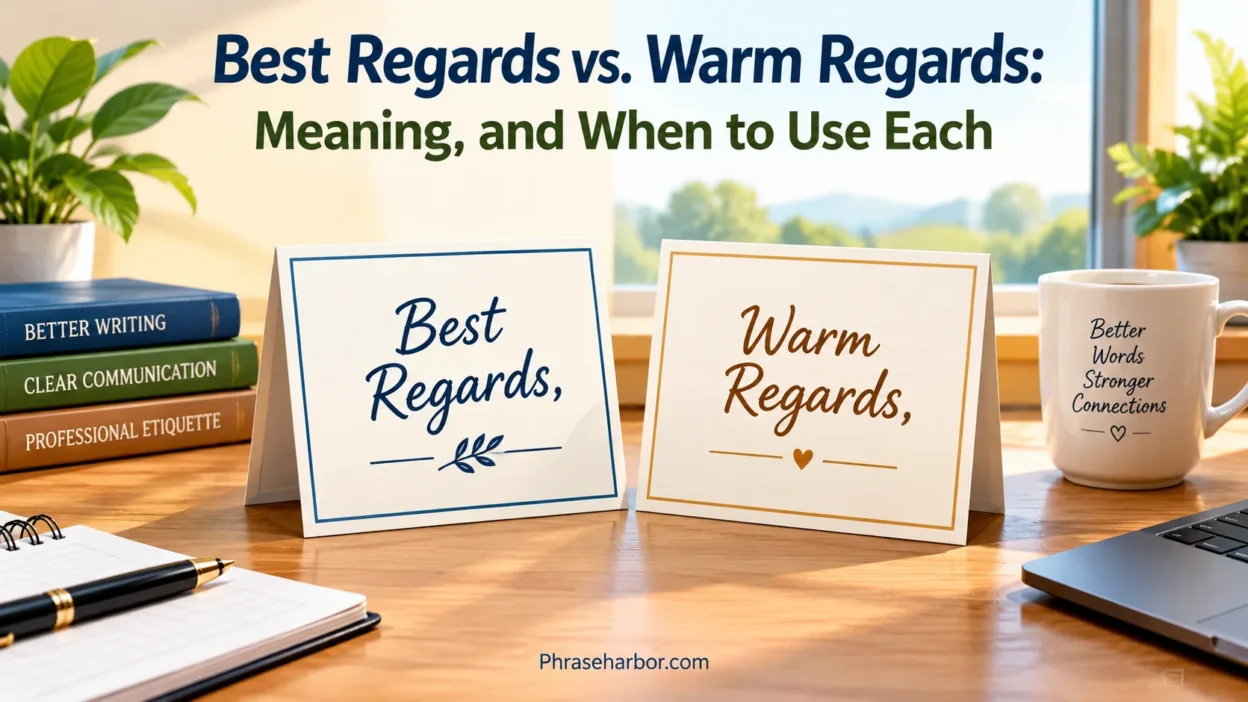
Choosing between “Best regards” and “Warm regards” might seem like a small detail, but your email sign-off can influence how a message feels to the person reading it. Both expressions are polite, professional, and widely used in workplace communication. However, they carry slightly different tones.
If you’re emailing a hiring manager, contacting a new client, thanking a colleague, or following up on a business proposal, the right closing helps you leave a positive impression. You don’t need to overthink every email, though. Understanding the subtle difference between these expressions makes the choice much easier.
In this guide, you’ll learn what “Best regards” and “Warm regards” mean, how they differ, when to use each one, and how to format them correctly. You’ll also find practical email examples to help you choose the most suitable closing for different situations.
Quick Answer:
Best regards is a polite, professional email closing that works well in most business situations. Warm regards is also professional but adds a friendlier, more personal touch.
Use Best regards when writing to someone you don’t know well, such as a recruiter, new client, or business contact. Choose Warm regards when you want to express friendliness and goodwill, especially when you already have a positive working relationship with the recipient.
Both expressions are correct. Neither is universally better, and your choice should reflect the relationship, purpose, and tone of your message.
Comparison Overview
Although “Best regards” and “Warm regards” serve the same basic purpose, they can create slightly different impressions. The following table highlights their usual differences.
| Feature | Best Regards | Warm Regards |
| Meaning | A polite expression of goodwill and respect | A friendly expression of goodwill and personal warmth |
| Tone | Neutral, courteous, and professional | Friendly, cordial, and professional |
| Formality | Suitable for formal and general business emails | Suitable for professional and semi-formal emails |
| Emotional warmth | Relatively restrained | Slightly more personal |
| First-time emails | An excellent default choice | Appropriate when a friendly tone fits the message |
| Established relationships | Appropriate | Particularly suitable when warmth feels natural |
| Job applications | A reliable choice | Acceptable, though often less neutral |
| Client communication | Works for new and existing clients | Works well with established clients |
| Thank-you emails | Appropriate | Often a natural fit for a warm, appreciative message |
| Overall impression | Professional and dependable | Professional and personable |
The distinction isn’t absolute. A thoughtful email ending with “Best regards” can feel warmer than a brief, impersonal message ending with “Warm regards.” The words matter, but the rest of your message matters, too.
What Does “Best Regards” Mean?
Definition and Meaning of Best Regards
“Best regards” is a conventional email and letter closing that expresses goodwill, respect, and courtesy toward the recipient. It signals that you’re ending the message on a polite note without becoming overly personal.
The word best conveys a positive wish or sentiment. Regards refers to good wishes or expressions of respect. Together, the words create a professional closing that fits a wide range of situations.
For example, imagine you’re emailing a hiring manager to ask about the status of your application. You want to sound respectful and interested without assuming a close relationship. “Best regards” fits that situation because it maintains a professional tone.
The expression also works when you’re contacting a new supplier, requesting a meeting, or sending an update to a business partner. Its versatility makes it a dependable option when you’re unsure which sign-off to choose.
When to Use Best Regards
“Best regards” works especially well when you want your email to sound professional, courteous, and straightforward.
Consider using it in these situations:
- Job applications: End a message to a recruiter or hiring manager professionally.
- First-time business emails: Maintain a respectful tone when contacting someone for the first time.
- Client communication: Close proposals, project updates, and service-related messages politely.
- Workplace correspondence: Use it when emailing managers, colleagues, or people in other departments.
- Professional follow-ups: Finish messages about appointments, deadlines, requests, or pending decisions.
- Business inquiries: Maintain a neutral tone when asking about products, services, or partnerships.
One major advantage of “Best regards” is its flexibility. You can use it with someone you’ve never met or a colleague you’ve worked with for years. It doesn’t depend on a particular level of familiarity.
However, it may sound slightly distant if the rest of your conversation is very personal or celebratory. That doesn’t make it incorrect. It simply means another closing might better match the moment.
Best Regards Examples
Here are three realistic situations where “Best regards” works naturally.
Example: Job application
Dear Ms. Carter,
I’m writing to express my interest in the marketing coordinator position. I’ve attached my résumé and would appreciate the opportunity to discuss how my experience fits the role.
Best regards, Jordan Lee
Why it works: The message is formal and direct. The closing maintains a professional tone without sounding stiff.
Example: Business inquiry
Hello Mr. Davis,
Could you please share your current pricing and estimated delivery schedule for the items listed in my previous email? This information will help us plan our next order.
Best regards, Taylor Morgan
Why it works: The writer requests specific information from a business contact. A neutral, courteous sign-off suits the purpose.
Example: Workplace follow-up
Hi Alex,
I’m following up on the revised project timeline. Please let me know if you’ve had a chance to review it or if you’d like to discuss any changes.
Best regards, Sam
Why it works: The message is professional and practical. The closing keeps the tone polite without adding unnecessary emotion.
What Does “Warm Regards” Mean?
Definition and Meaning of Warm Regards
“Warm regards” is a polite email closing that expresses goodwill with a little extra friendliness. It communicates respect while making the message feel more personal and approachable.
The word warm suggests kindness, friendliness, and a positive connection. When you add it to “regards,” the phrase carries a more personable tone than a neutral professional closing might convey.
For example, imagine you’ve worked with a client for several months. You’ve exchanged ideas, solved problems together, and developed a comfortable working relationship. After sending an update about a successful project, you might end your email with “Warm regards” to express goodwill beyond the basic business exchange.
That doesn’t mean you must know someone personally to use the phrase. You can also use it in a first-time email if the message itself calls for a friendly tone. The important point is to make sure the closing feels natural rather than overly familiar.
When to Use Warm Regards
“Warm regards” works best when you want to combine professionalism with a friendly, considerate tone. It can help your message feel less transactional without making it casual.
Here are some situations where it may be appropriate:
- Thank-you emails: Express appreciation after someone helps you, offers advice, or provides support.
- Established client relationships: Maintain a personable tone when communicating with a client you know well.
- Friendly workplace communication: Close emails to colleagues with whom you have a positive working relationship.
- Project updates: Celebrate progress or share good news with collaborators.
- Mentor correspondence: Communicate respect and warmth when thanking a mentor for guidance.
- Positive professional follow-ups: Follow up on a productive conversation or a successful meeting.
Consider this example:
Hi Maria,
Thank you for taking the time to review the proposal. Your feedback helped us clarify the project goals, and we’re looking forward to moving ahead with the next phase.
Warm regards, Daniel
The closing fits because the email expresses appreciation and describes a positive working relationship. It adds a friendly touch without sacrificing professionalism.
However, warmth shouldn’t replace clarity. If you’re writing a complaint, delivering difficult news, or addressing a serious business issue, focus on the message itself. A polite sign-off can help, but it won’t make an insensitive or unclear email sound considerate.
Read More: Aunty or Auntie: Which One Is Correct?
Warm Regards Examples
The following examples show how “Warm regards” works in different professional settings.
Example: Thanking a colleague
Hi Rachel,
Thank you for stepping in during yesterday’s meeting. Your suggestions helped us address the client’s concerns, and I really appreciate your support.
Warm regards, Emily
Why it works: The writer expresses genuine appreciation. The closing reinforces the friendly tone of the message.
Example: Communicating with an established client
Hello Mr. Thompson,
We’ve completed the latest revisions and incorporated the feedback from our last discussion. The updated version is ready for your review.
Please let me know if you’d like any further adjustments.
Warm regards, Olivia
Why it works: The exchange is professional, but the existing relationship makes a personable sign-off appropriate.
Example: Thanking a mentor
Dear Professor Williams,
Thank you for your thoughtful advice and encouragement. Your suggestions have given me a clearer direction for my research, and I’m grateful for your time.
Warm regards, Michael
Why it works: The email expresses respect and appreciation. “Warm regards” supports that positive tone without becoming overly casual.
Main Differences Between Best Regards and Warm Regards
The main difference between “Best regards” and “Warm regards” lies in their tone, not their grammatical correctness. Both expressions are accepted email closings, but each can communicate a slightly different feeling.
Difference in Tone and Emotional Warmth
“Best regards” usually sounds neutral, courteous, and professional. It conveys goodwill without placing much emphasis on personal connection.
“Warm regards,” on the other hand, adds a touch of friendliness. It can make an email feel more personal, especially when the message includes thanks, encouragement, congratulations, or a positive update.
Think of the difference as choosing between a firm handshake and a friendly handshake. Both show respect, but one may feel a little more personable.
For example:
- Best regards: “I’ve attached the requested report for your review.”
- Warm regards: “Thank you again for your help. I’ve attached the revised report for your review.”
Either closing can work with either message. However, the second email expresses appreciation, so “Warm regards” may feel like a more natural match.
Remember that these are tendencies rather than fixed rules. The recipient’s expectations, workplace culture, and your existing relationship can all affect how a sign-off comes across.
Difference in Formality
Both expressions work in professional correspondence. Neither is automatically inappropriate for a formal email.
Still, “Best regards” is often the safer default when you’re unsure about the recipient’s preferences. It fits formal requests, initial business contacts, job applications, and routine professional exchanges.
“Warm regards” is also suitable for business communication, especially when the message calls for a little more friendliness. It doesn’t automatically make an email informal or unprofessional.
Here’s a practical comparison:
| Situation | Best Regards | Warm Regards |
| Emailing a senior executive for the first time | Excellent choice | Acceptable if the message’s tone supports it |
| Sending a job application | Excellent choice | Acceptable, though less neutral |
| Thanking a supportive colleague | Appropriate | Often a natural choice |
| Updating a long-term client | Appropriate | Often a good choice |
| Sending a routine business document | Excellent choice | Also acceptable |
| Sharing positive personal news with a colleague | Appropriate | Often feels more personable |
The goal isn’t to make every email as formal as possible. Instead, choose a closing that suits the situation and helps you communicate naturally.
Difference in Professional Context
Your relationship with the recipient often matters more than the phrase itself.
When you contact someone for the first time, you usually have limited information about their communication style. “Best regards” helps you maintain a respectful, professional tone without making assumptions about familiarity.
Once you’ve developed a positive working relationship, “Warm regards” may feel more natural. For instance, an ongoing client relationship may involve regular discussions, shared successes, and mutual appreciation. A friendly sign-off can reflect that established rapport.
However, don’t treat this as a strict rule. A first-time email can still use “Warm regards” if the message is friendly and the context supports it. Similarly, “Best regards” remains appropriate even after years of working with someone.
The best choice reflects the tone you want to convey, not simply how long you’ve known the recipient.
Difference in Personal Relationships
Both expressions can appear in messages to friends, acquaintances, mentors, and professional contacts. Their suitability depends on the relationship and the way you normally communicate.
“Best regards” can sound courteous but somewhat formal in a personal email. “Warm regards” may feel more affectionate or thoughtful, especially when you’re thanking someone or wishing them well.
For example, you might use “Warm regards” when writing to a former teacher who helped you professionally. If you’re emailing a close friend about weekend plans, however, either phrase might feel unnecessarily formal. A simple “Take care” or “Talk soon” would probably sound more natural.
In other words, don’t confuse warmth with intimacy. “Warm regards” expresses goodwill, but it doesn’t automatically suggest romance, a close friendship, or a special personal attachment.
Best Regards vs. Warm Regards: Which Is More Professional?
Neither expression is inherently more professional in every situation. Both can close a business email effectively when you choose them thoughtfully.
If you’re unsure which one to use, “Best regards” is a dependable default because it works across many professional settings. It suits first-time correspondence, formal requests, job applications, and routine workplace communication.
Choose “Warm regards” when you want to sound professional while adding a little friendliness. It often works well in thank-you messages, ongoing client relationships, and conversations with colleagues who appreciate a personable tone.
Consider the entire email before making your decision. A concise message about a deadline may call for a neutral closing. An appreciative message after a productive meeting may benefit from a warmer one.
Here are three simple rules to remember:
- Use Best regards when you want a safe, neutral, professional closing.
- Use Warm regards when a friendly, positive tone suits the message.
- When in doubt, follow the communication style established by the recipient or your workplace.
You don’t need to search for a hidden rule that makes one phrase universally superior. Professionalism comes from clarity, respect, reliability, and appropriate communication. Your sign-off is just one small part of that picture.
FAQs:
Is Best Regards Better Than Warm Regards?
Neither is universally better. “Best regards” is a versatile option for professional correspondence, especially when you’re unfamiliar with the recipient. “Warm regards” is useful when you want to add friendliness to a message. Choose the one that best matches the context.
Is Warm Regards Too Informal for a Professional Email?
No. “Warm regards” is appropriate in many professional settings. It can work well in emails to colleagues, established clients, mentors, and business partners. However, if your workplace expects highly formal communication, a more neutral closing may be the safer option.
Can I Use Warm Regards in a First Email?
Yes. You can use “Warm regards” in a first email if the message calls for a friendly, approachable tone. However, “Best regards” is often a safer default when you don’t know the recipient’s preferences or communication style.
Is Best Regards Appropriate for a Job Application?
Yes. “Best regards” is an excellent choice for a job application email, a message to a recruiter, or a follow-up after an interview. It communicates professionalism without sounding excessively formal.
Which Is Friendlier: Best Regards or Warm Regards?
“Warm regards” generally sounds friendlier because the word warm emphasizes goodwill and personal connection. “Best regards” remains polite, but it usually conveys a more neutral professional tone.
Conclusion:
The difference between “Best regards” and “Warm regards” comes down to tone. Both are correct, polite, and suitable for many professional emails, but they can leave slightly different impressions. Use Best regards when you want a dependable, neutral, and professional closing. It works particularly well for job applications, first-time emails, business inquiries, and routine workplace correspondence.