Have you ever paused while writing because you couldn’t decide between than and then? You’re not alone. These two words look almost identical and sound similar in everyday speech. However, they serve different purposes in English, and choosing the wrong one can change the meaning of your sentence.
The good news is that distinguishing than from then becomes much easier once you understand what each word does. One helps you compare things, while the other usually tells you when something happens, what happens next, or what follows from a condition.
For example, consider these two sentences: “My brother is taller than me” and “My brother finished dinner, then went outside.” The first sentence compares height. The second describes a sequence of events.
This guide explains the meaning of than vs. then, their grammatical functions, common expressions, frequent mistakes, and practical ways to remember the difference. You’ll also find plenty of examples, a comparison table, and a short quiz to test your understanding.
Quick Answer:
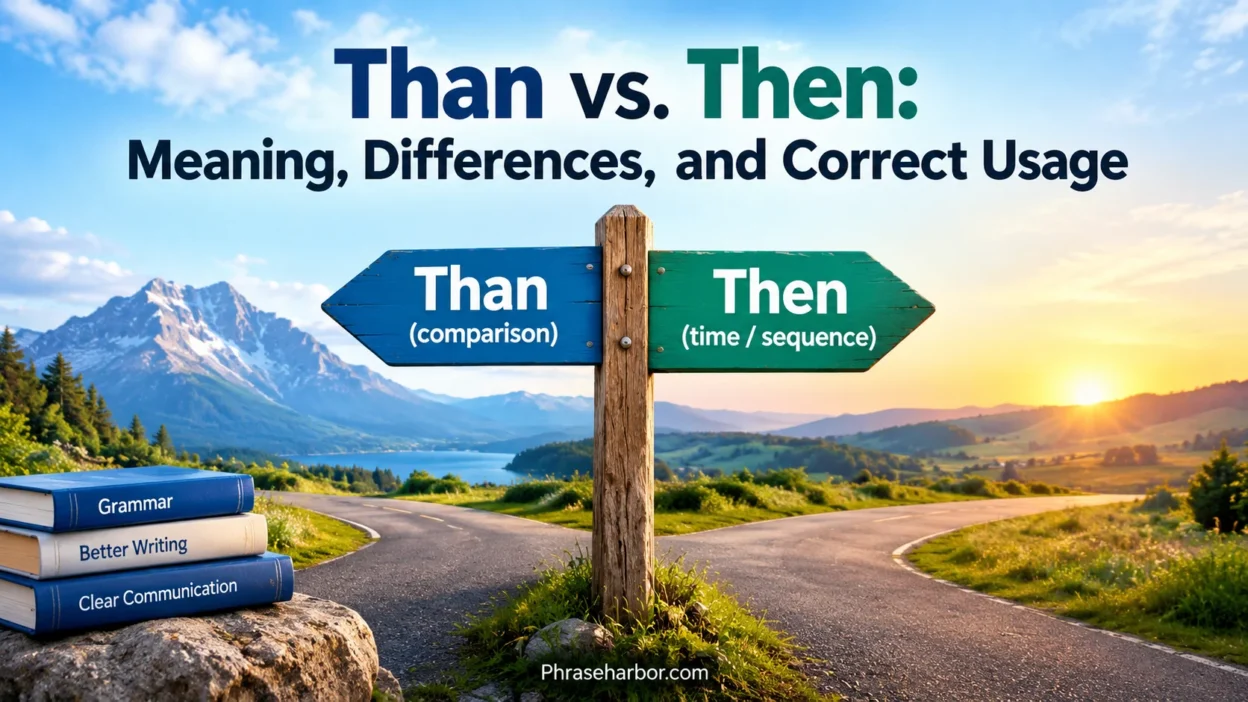
Than is used to compare people, objects, quantities, choices, and situations. Then usually refers to time, sequence, or a consequence.
- Than: Use it when comparing two things or expressing a difference in degree or amount.
- Example: This restaurant is cheaper than the one downtown.
- Then: Use it when referring to a time, describing what happens next, or expressing a result.
- Example: We ate dinner, then watched a movie.
Here’s a simple way to remember the distinction:
Than = comparison. Then = time, sequence, or result.
If your sentence compares two things, than is usually the correct choice. If it explains when something happened or what follows, then is generally the word you need.
Comparison Overview
Although than and then differ by only one letter, their meanings and grammatical roles aren’t interchangeable. Understanding their functions helps you choose the right word without second-guessing yourself.
| Feature | Than | Then |
| Main meaning | Comparison | Time, sequence, or consequence |
| Common grammatical role | Conjunction or preposition, depending on the construction | Adverb |
| Used with comparisons | Yes | No |
| Used to describe the next event | No | Yes |
| Used in time expressions | No | Yes |
| Used in conditional statements | Not to introduce the result | Often, but not always |
| Common expressions | More than, less than, rather than | Since then, back then, every now and then |
| Example | Today is warmer than yesterday. | We finished work, then went home. |
The easiest way to distinguish the words is to focus on meaning rather than spelling. Ask yourself whether you’re comparing something or describing time, order, or a result.
For example, “She is younger than her sister” compares ages. In contrast, “She called her sister, then went to bed” describes two actions in sequence.
What Does Than Mean?
Than is a word used mainly to introduce the second part of a comparison. It helps explain how one person, object, quantity, or situation differs from another.
You commonly see than after comparative words such as better, faster, taller, smaller, more, and less.
Consider this example:
The blue jacket is cheaper than the black jacket.
The sentence compares the prices of two jackets. The word than introduces the second item in that comparison.
Without than, the relationship between the two jackets would be less clear. The word tells the reader exactly what the first item is being compared against.
When to Use Than
The word than appears in several common grammatical patterns. Recognizing these patterns makes it easier to use the word correctly in everyday writing.
Than for Comparisons Involving Adjectives
Comparative adjectives describe differences between people, objects, places, or situations. Many short adjectives form their comparative versions by adding -er, while longer adjectives often use more or less.
Use than to introduce the second part of the comparison.
Examples:
- My new phone is faster than my old one.
- This road is narrower than the highway.
- Her explanation was more detailed than mine.
- The second assignment was less difficult than the first.
- Winter mornings are colder than summer mornings.
Notice that each sentence compares two qualities. The word than connects the comparative expression to the person or thing being compared.
A useful rule is to look for comparative forms such as better, stronger, more useful, or less expensive. These often signal that than belongs in the sentence.
Than for Comparisons Involving Adverbs
Adverbs describe how, when, or to what degree an action occurs. Comparative adverbs allow you to compare the way two people perform an action.
Examples:
- Sarah speaks more clearly than I do.
- My dog runs faster than yours.
- He arrived earlier than expected.
- The new computer processes data more efficiently than the old model.
- She handled the difficult conversation better than I anticipated.
In each example, than introduces the person, action, or expectation used for comparison.
You may also encounter informal sentences such as “Sarah speaks more clearly than me.” In everyday American English, this construction is common. In more formal writing, “Sarah speaks more clearly than I do” makes the comparison explicit.
Both forms are widely understood, but the second can be clearer when the intended comparison might otherwise seem incomplete.
Than for Quantities and Amounts
You don’t need an adjective to use than. The word also appears when comparing quantities, measurements, prices, ages, and numbers.
Examples:
- More than 100 people attended the meeting.
- The package weighs less than five pounds.
- This project will take longer than two weeks.
- She spent more than $50 on groceries.
- Fewer than 20 students registered for the course.
These sentences express amounts or numerical limits. The word than introduces the point of comparison.
Pay attention to the difference between fewer than and less than. Standard American English generally uses fewer for countable items and less for amounts or quantities treated as a whole.
For example, “fewer than ten books” refers to countable objects. “Less than ten dollars” refers to an amount of money.
Than for Preferences and Choices
Sometimes, than helps you express a preference between two actions or options. It commonly follows phrases such as rather than, would rather, and prefer … to in their appropriate grammatical patterns.
Examples:
- I’d rather cook at home than order takeout.
- She chose to walk rather than wait for the bus.
- He would rather save money than buy another gadget.
- They decided to repair the table rather than replace it.
These examples show how than connects two alternatives. It doesn’t necessarily compare physical characteristics; it can also distinguish between choices.
One grammatical detail deserves attention: the construction prefer … to … normally uses to, not than.
For example:
- Correct: I prefer tea to coffee.
- Correct: I’d rather drink tea than coffee.
Both sentences express a preference, but they follow different grammatical patterns.
Than for Comparing Nouns and Pronouns
You can also use than when comparing people, objects, ideas, or experiences.
Examples:
- She has more experience than her colleague.
- I have fewer responsibilities than my manager.
- The company hired more designers than developers.
- He knows more about history than I do.
When a pronoun follows than, the most suitable form can depend on the sentence’s structure and level of formality.
For example, “She is taller than I am” clearly compares two people’s heights. “She is taller than me” is also standard in everyday American English.
The key point is that than introduces the comparison. The surrounding sentence determines how that comparison should be expressed.
Read More: Axle or Axel: Meaning, Differences, and Correct Usage
What Does Then Mean?
Then usually refers to time, order, or a consequence. It helps readers understand when something happened, what occurred next, or what follows from a particular condition.
Unlike than, then doesn’t introduce the second part of a comparison.
Consider this sentence:
I finished my homework, then played video games.
The word then tells you which action followed the other. First, the homework was completed. Afterward, the speaker played video games.
The word can also refer to a particular period in the past or future.
For example, “I lived in Boston back then” refers to an earlier period. In “We’ll discuss the budget then,” it points to a time already established by the conversation.
When to Use Then
Although then most often refers to time or sequence, it has several related uses. Understanding these uses will help you recognize the word in different contexts.
Then for Time References
Use then when referring to a particular time, whether that time belongs to the past, present, or future.
Examples:
- Life was different then.
- I was living with my parents back then.
- We can discuss the details then.
- The store was smaller then than it is today.
- She was the manager then.
The fourth example contains both words, and that’s perfectly correct. Then refers to an earlier time, while than introduces a comparison between the store’s size at two different times.
This distinction shows why you must examine each word’s role rather than assume a sentence can contain only one of them.
Then for Showing Sequence
Use then when describing events in the order they happen. This usage appears frequently in instructions, recipes, schedules, stories, and everyday conversations.
Examples:
- First, wash the vegetables. Then, chop them.
- She packed her suitcase, then called a taxi.
- Add the flour and then pour in the milk.
- We visited the museum, then stopped for lunch.
- Check the address, then submit the application.
In these sentences, then helps organize actions into a clear sequence. It tells readers what comes after the preceding step.
For instructions, this small word can make a big difference. Without clear sequencing, a reader might misunderstand the order of steps or complete a task incorrectly.
Then for Consequences and Results
The word then can also introduce a consequence or indicate what follows logically from a condition.
Examples:
- If you’re feeling sick, then you should rest.
- If the store is closed, then we’ll come back tomorrow.
- If you already have a ticket, then you can enter the building.
- If everyone agrees, then we’ll move forward with the plan.
In conditional sentences, then is often optional when the meaning remains clear.
For example:
- If it rains, we’ll stay inside.
- If it rains, then we’ll stay inside.
Both sentences are correct. The second makes the relationship between the condition and its result more explicit.
However, then doesn’t automatically mean therefore in every sentence. Its precise meaning depends on context.
Then for Referring to a Future Point
You can use then to refer to a time that will arrive later, especially when the conversation already establishes when that time will be.
Examples:
- I’ll finish this report by noon and meet you then.
- We have a meeting at three. I’ll see you then.
- Let’s review the results next week and make a decision then.
In each case, then points to a time mentioned or understood elsewhere in the conversation.
This usage is particularly helpful when you want to avoid repeating a date, time, or event.
Then for Logical Conclusions
In some sentences, then signals a conclusion drawn from the information available. It can mean something close to in that case or therefore.
Examples:
- You don’t have enough evidence? Then, we should investigate further.
- If that’s your final decision, then I’ll respect it.
- The restaurant has no available tables. Then, let’s try another place.
Here, then links the situation to the next decision or conclusion. It doesn’t compare two things, so than wouldn’t fit the same role.
Main Differences Between Than and Then
The main difference between than and then lies in the relationship each word expresses. Than introduces a comparison, while then usually establishes a time, sequence, or consequence.
The spelling difference is small, but the grammatical distinction is important.
Than vs. Then: Side-by-Side Examples
Compare the following sentences to see how each word works in context.
| Sentence with Than | Sentence with Then |
| My sister is older than me. | My sister arrived, then called me. |
| This laptop is cheaper than that one. | I bought a laptop and then installed the software. |
| I’d rather read than watch television. | I’ll read for an hour and then watch television. |
| The journey took longer than expected. | We reached the station and then boarded the train. |
| More than 50 guests attended. | Back then, the venue could hold only 50 guests. |
The left column compares people, actions, durations, or quantities. The right column refers to order or time.
Notice that then can appear in a sentence that also contains a comparison. For example, “The store was cheaper then than it is now” uses both words correctly because they perform different jobs.
FAQs:
Is Than or Then Used for Comparisons?
Than is the correct word for comparisons. It commonly follows comparative expressions such as taller than, more expensive than, better than, and less than.
For example, “This route is shorter than the other route” compares the lengths of two routes.
Does Then Mean Next?
Yes, then often means next when describing a sequence of events or steps.
For example, “Finish the report, then send it to your manager” tells you to complete the report before sending it.
However, then can also refer to a time in the past or future. Its meaning depends on the sentence.
Can Then Mean Therefore?
Yes, then can express a conclusion or consequence. In these contexts, it often means something like in that case.
For example, “If the meeting is canceled, then we’ll work from home.” The second clause explains what follows from the condition.
Although then and therefore sometimes convey similar ideas, they aren’t interchangeable in every sentence.
Is It Better Than Me or Better Then Me?
Better than me is correct in ordinary American English when comparing two people or things.
For example, “She plays tennis better than me” is a common, natural construction. In more formal writing, you can write, “She plays tennis better than I do.”
Better then me is incorrect when you intend to make a comparison.
Is It More Than or More Then?
More than is correct when expressing a greater quantity, amount, or degree.
For example, “The repair cost more than $200” means the repair cost exceeded $200.
Use then when referring to time, sequence, or a consequence instead.
Conclusion:
Although than and then look and sound similar, they serve different purposes. Than introduces comparisons involving people, objects, quantities, preferences, and degrees. Then usually refers to time, describes the order of events, or introduces a consequence.
The simplest way to remember the difference is to focus on what your sentence communicates. If you’re comparing two things, choose than. If you’re describing what happened next, when something occurred, or what follows from a condition, choose then.