When you read a novel, watch a movie, or study a poem, you may notice certain images, objects, or ideas appearing repeatedly. A character might keep looking at a clock, a particular color may appear in important scenes, or the story may repeatedly explore the struggle between right and wrong. These details aren’t always accidental. Writers often use them to develop meaning and help readers understand the story on a deeper level.
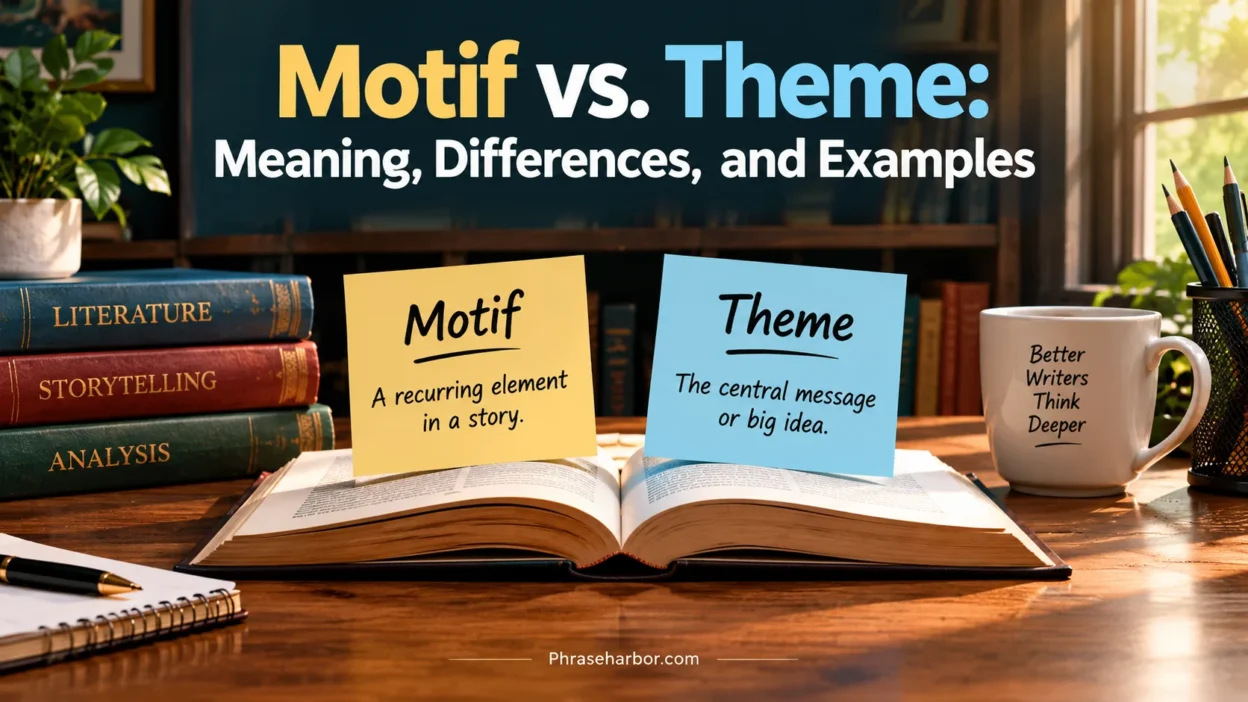
However, recognizing these patterns can raise an important question: What’s the difference between a motif and a theme? Although the two literary terms often work together, they serve different purposes. A motif is a recurring element that helps build meaning, while a theme is a central idea that a literary work explores.
Understanding motif vs. theme makes literary analysis easier. It also helps you explain not just what happens in a story but what the author may be communicating through its events, characters, and recurring details.
Quick Answer:
A motif is a recurring element in a literary work, such as an image, object, phrase, color, or situation. Its repetition helps create patterns and reinforce meaning.
A theme is a central idea or insight that a story explores. Themes often concern human behavior, relationships, society, morality, or the consequences of people’s choices.
For example, in a story about a character who struggles to escape a controlling family, locked doors might serve as a motif. If the story explores the importance of personal freedom, freedom may be one of its themes.
The difference is simple: a motif is something that repeatedly appears, while a theme is an idea the story develops. A motif can support one or more themes, and a theme can emerge through several different motifs.
Comparison Overview
Motif and theme are closely related, but they aren’t interchangeable. The following table highlights their main differences.
| Feature | Motif | Theme |
| Definition | A recurring element that contributes to a work’s meaning | A central idea explored throughout a work |
| Main purpose | Creates patterns and reinforces meaning | Develops insight about a subject or experience |
| Typical form | Images, objects, colors, phrases, sounds, or situations | Ideas about life, society, relationships, or human nature |
| How it develops | Through repetition and changes in context | Through plot, characters, conflict, and resolution |
| Visibility | Often recognizable through repeated appearances | Usually requires interpretation |
| Example | Repeated references to blood in Macbeth | Ambition can lead to destruction |
| Relationship | Can reinforce or complicate a theme | Can be developed through several motifs |
| Literary function | Connects scenes and creates symbolic associations | Helps readers understand the work’s broader meaning |
Consider a story that repeatedly describes a storm whenever its main character faces a difficult decision. The storm may function as a motif because it appears at meaningful moments. If the story explores the struggle between personal desire and moral responsibility, that conflict may form part of its theme.
The storm is the recurring element. The moral struggle is the broader idea. Recognizing that distinction is the key to understanding motif vs. theme.
What Is a Motif?
A motif is a recurring element in a literary work that gains significance through repetition. It may appear in a novel, short story, poem, play, or film. Each appearance can remind readers of an earlier event, highlight a character’s feelings, or strengthen an idea that runs throughout the work.
A motif doesn’t have to be an object. It can be a color, sound, phrase, action, setting, or recurring situation. What matters is that the element appears meaningfully more than once and contributes to the work’s overall effect.
For example, imagine a novel in which a character repeatedly watches the sun rise after experiencing a personal setback. At first, the sunrise might seem like a simple detail about the setting. As it recurs after difficult moments, however, it may suggest renewal, resilience, or the possibility of a fresh start.
That pattern makes the sunrise a potential motif. Its significance depends on how the writer uses it and how it relates to the surrounding events.
Common Types of Motifs
Motifs take different forms depending on the author’s purpose and the kind of story being told. Recognizing these forms can help you identify recurring patterns during reading.
Visual motifs: These include repeated colors, shapes, images, and visual patterns. A writer might repeatedly describe shadows when a character feels threatened or use bright colors during moments of hope.
Object motifs: An ordinary object can become meaningful when it repeatedly appears in important scenes. Mirrors, clocks, keys, photographs, and letters can all serve this purpose.
Nature motifs: Weather, seasons, flowers, animals, and landscapes often recur in literature. Winter might accompany periods of isolation, while spring might coincide with renewal or change.
Verbal motifs: A word, phrase, question, or expression can become a motif when it appears repeatedly. The repeated language may reveal a character’s obsession, emphasize a conflict, or connect events across the story.
Situational motifs: These involve recurring circumstances or patterns of action. Examples include characters repeatedly facing difficult choices, returning home after periods of separation, or encountering authority figures who challenge their independence.
A single literary work may use several types of motifs at once. For instance, a story about grief might repeatedly feature empty rooms, falling leaves, and conversations about the past. Together, these patterns can reinforce the character’s sense of loss.
Read More: Than vs. Then: Meaning, Differences, and Correct Usage
Examples of Motifs in Literature
Examining well-known literary works makes the concept easier to understand. The following examples show how recurring elements contribute to meaning.
Blood Imagery in Macbeth
In William Shakespeare’s Macbeth, blood appears repeatedly in connection with murder, guilt, and violence. After Macbeth kills King Duncan, blood becomes more than a physical consequence of the crime. It also connects the murder to the characters’ growing psychological distress.
Lady Macbeth famously attempts to remove imagined blood from her hands, even after the physical evidence has disappeared. Her obsession reveals how guilt continues to affect her.
Blood therefore functions as a motif because Shakespeare returns to the image at significant moments. It reinforces themes involving guilt, ambition, violence, and the moral consequences of wrongdoing.
The Green Light in The Great Gatsby
F. Scott Fitzgerald’s The Great Gatsby features a green light associated with Daisy Buchanan’s home. Gatsby watches it from across the water, connecting the light to his longing for Daisy and the future he hopes to achieve.
The green light becomes especially meaningful because Gatsby’s desire extends beyond a romantic reunion. It also reflects his attachment to an imagined future and his belief that he can recover an idealized past.
The recurring green light functions as a motif, while the novel’s exploration of aspiration, wealth, illusion, and the American Dream contributes to its broader themes.
Light and Darkness in Literature
Writers often repeat images of light and darkness to develop contrasts between knowledge and ignorance, safety and danger, or hope and despair.
For example, a character might repeatedly enter dark rooms when hiding the truth. Later, the character might step into bright sunlight after admitting a secret. If these details recur meaningfully, darkness and light can form a visual motif.
However, light doesn’t always represent goodness, and darkness doesn’t automatically represent evil. An author may reverse these associations to challenge readers’ expectations. Context matters more than a fixed symbolic meaning.
How to Identify a Motif
Identifying a motif requires more than spotting a repeated object. You must consider whether the repetition contributes to the story’s meaning.
Use these steps when analyzing a literary work:
- Notice repetition: Look for recurring images, objects, words, sounds, settings, or situations.
- Record important appearances: Pay attention to when the element appears and what happens around it.
- Compare the context: Ask whether the element means something different in later scenes.
- Examine its emotional effect: Consider whether the recurring detail creates fear, comfort, tension, hope, or another response.
- Connect it to larger ideas: Determine whether the pattern supports a theme, reveals character development, or reinforces a conflict.
- Check the evidence: Make sure your interpretation fits the text rather than relying on an assumption about what an object usually symbolizes.
For example, a clock that appears several times in a novel might simply establish the time of day. However, if it repeatedly appears when a character worries about aging or missed opportunities, it may function as a motif related to time, mortality, or regret.
The essential test is meaningful repetition. An element becomes a useful motif when its recurrence helps readers notice a pattern or understand something important about the work.
What Is a Theme?
A theme is a central idea, concern, or insight that a literary work explores. It helps readers understand what a story suggests about human experiences, relationships, society, or the consequences of people’s decisions.
Unlike a motif, a theme doesn’t need to take the form of a repeated object or image. It emerges through the story as a whole, including its characters, conflicts, dialogue, plot developments, and ending.
For example, a novel might follow a young person who pursues wealth to gain social acceptance. The character may achieve financial success but lose meaningful relationships along the way. Through these events, the novel might explore the idea that material success doesn’t guarantee happiness.
That idea is a theme. The story develops it through the character’s experiences rather than through one recurring object alone.
Theme vs. Topic: Understanding the Difference
Readers sometimes confuse a theme with a topic. Although these concepts are related, they serve different purposes.
A topic is the general subject a story addresses. A theme expresses an idea or insight about that subject.
| Topic | Possible Theme |
| Love | Love requires trust and mutual respect. |
| Ambition | Unchecked ambition can destroy the very things people hope to gain. |
| Friendship | Genuine friendship often requires loyalty during difficult times. |
| Wealth | Material wealth cannot replace meaningful relationships. |
| Freedom | Personal freedom sometimes requires the courage to challenge authority. |
| Revenge | Seeking revenge can prolong suffering rather than resolve it. |
| Identity | Accepting yourself may require resisting other people’s expectations. |
| Power | Power without accountability can lead to corruption. |
Notice the difference between writing ambition and writing unchecked ambition can destroy a person’s life. The first identifies a topic, while the second expresses a claim about that topic.
When you write a literary analysis, state the theme as a complete idea whenever possible. Doing so makes your interpretation clearer and easier to support with evidence.
Common Themes in Literature
Although every literary work has its own concerns, certain themes appear across many cultures, historical periods, and genres.
Love and relationships: Stories may explore romantic love, family bonds, friendship, loyalty, sacrifice, or the difficulty of maintaining trust.
Good versus evil: These works examine moral choices, justice, temptation, and the struggle between competing values. Some stories present a clear distinction between good and evil, while others explore morally complicated characters.
Power and corruption: Authors often examine how authority affects people’s behavior. A character who begins with good intentions may become cruel when no one challenges their decisions.
Identity and belonging: These stories explore questions about personal identity, cultural expectations, acceptance, and the desire to fit in.
Death and mortality: Literature frequently examines grief, the limits of human life, the fear of death, and the ways people find meaning in their time.
Freedom and oppression: These works consider the cost of resisting control and the challenges people face when seeking independence.
Ambition and its consequences: Stories about ambitious characters may examine the difference between healthy determination and a destructive desire for success.
Appearance versus reality: These narratives explore deception, false impressions, self-delusion, and the gap between what people believe and what is true.
A literary work can explore multiple themes simultaneously. A story about a ruler who becomes obsessed with power, for example, might examine ambition, corruption, loyalty, and the consequences of fear.
FAQs:
Can a Motif Be a Theme?
Not in the strict literary sense because the terms describe different things. A motif is a recurring element, while a theme is an idea explored by the work.
However, a motif can express or reinforce a theme. Repeated images of imprisonment, for instance, might support a theme about the human desire for freedom.
Can a Story Have More Than One Motif?
Yes. A story can contain several motifs that contribute to its meaning.
A novel might repeatedly feature clocks, storms, and photographs. Each pattern may develop a different aspect of the story, while the motifs may also work together to reinforce related themes.
Can a Story Have More Than One Theme?
Yes. Many literary works explore several themes simultaneously.
A novel might examine ambition, loyalty, identity, and the consequences of deception. These themes can overlap, contradict one another, or become more prominent as the story develops.
Is a Motif Always a Symbol?
No. A motif doesn’t always carry a distinct symbolic meaning. It may create a pattern, establish atmosphere, or connect separate scenes.
When a symbol recurs meaningfully throughout a work, it can function as a motif as well.
What Is the Difference Between a Motif and a Topic?
A topic is the general subject a work addresses, such as love, power, or identity. A motif is a recurring element that contributes to the work’s meaning.
A theme goes further by expressing an idea about the topic. For example, love is a topic, recurring rose imagery may be a motif, and the idea that love requires trust may be a theme.
Conclusion:
The difference between motif vs. theme comes down to repetition and meaning. A motif is a recurring element that helps establish patterns, while a theme is a central idea that a literary work explores. Motifs may include objects, images, colors, phrases, or situations. Themes often concern ambition, love, identity, power, freedom, and other aspects of human experience. Although these concepts serve different purposes, they frequently work together.