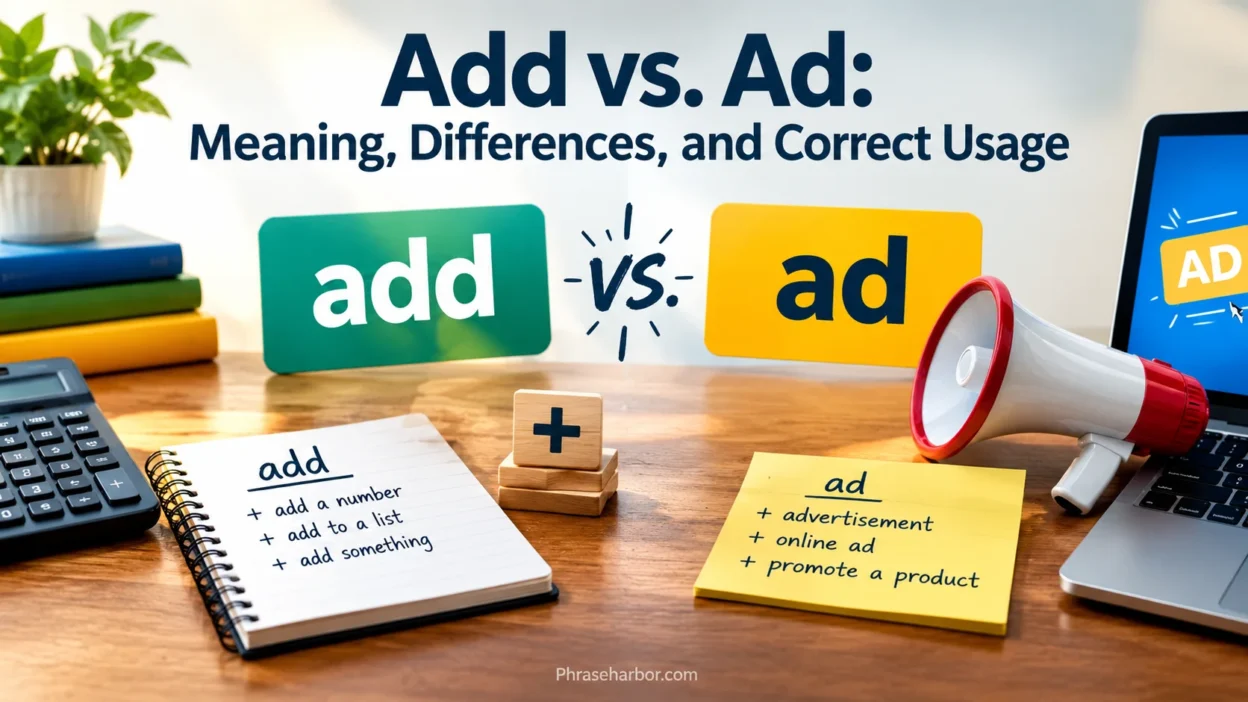
Have you ever wondered whether to write add or ad? These two words sound almost identical in American English, yet they have completely different meanings. Choosing the wrong one can change your sentence and confuse your reader.
The good news is that distinguishing between them is simple once you understand their meanings and grammatical roles. Add usually describes an action, such as combining numbers, including information, or increasing an amount. Ad, on the other hand, refers to an advertisement that promotes a product, service, event, or idea.
For example, you might add a product to your shopping cart after seeing an ad for it. Both words fit naturally into the same situation, but you cannot swap them without changing the meaning.
This guide explains the definitions, differences, grammatical rules, common expressions, and practical examples of add vs. ad. You’ll also learn a few simple tricks to remember which spelling belongs in your sentence.
Quick Answer
Add is a verb meaning to combine, include, or increase something. Ad is a noun and a shortened form of advertisement, meaning promotional content designed to attract attention or encourage a response.
| Word | Part of Speech | Meaning | Example |
| Add | Verb | To combine, include, or increase something | Please add your name to the list. |
| Ad | Noun | An advertisement promoting something | I saw an ad for a new phone. |
The easiest way to remember the difference: Use add when something is being included or increased. Use ad when you’re talking about an advertisement.
Comparison Overview
Although add and ad sound alike, their meanings, grammatical functions, and uses differ. Understanding these distinctions helps you choose the right word in emails, school assignments, business documents, social media posts, and everyday conversations.
| Feature | Add | Ad |
| Part of speech | Verb | Noun |
| Primary meaning | To combine, include, or increase | An advertisement |
| Number of letters | Three | Two |
| Spelling pattern | Two d’s | One d |
| Pronunciation | /æd/ | /æd/ |
| Common contexts | Mathematics, writing, shopping, conversations | Marketing, media, promotions, recruitment |
| Example | Add another paragraph to the report. | The company published an ad. |
| Related word | Addition | Advertisement |
The key distinction is meaning rather than sound. When you need to describe an action, add is generally the correct choice. When you mean a promotional message, use ad.
What Does Add Mean?
Definition and Meaning of Add
Add is a verb that means to put something together with something else, include an additional item, or increase an existing amount. It can describe mathematical operations as well as everyday actions.
For instance, when you combine five dollars with three dollars, you add the amounts to get eight dollars. When you include another paragraph in an essay, you also add something, even though no mathematical calculation takes place.
The word appears in countless situations because people regularly combine items, share information, increase quantities, and expand existing things.
Consider these examples:
- Please add two tablespoons of sugar to the mixture.
- Could you add my phone number to your contacts?
- The teacher asked us to add more details to our essays.
- If you add five and seven, you get twelve.
- The company plans to add three new positions this year.
In each sentence, add describes an action involving something extra or an increase in what already exists.
Common Uses of Add
The meaning of add can shift slightly depending on the situation. However, its central idea remains consistent: something joins, supplements, or increases something else.
Adding Numbers in Mathematics
In mathematics, add means to combine quantities to calculate their total. It describes one of the four basic arithmetic operations, alongside subtraction, multiplication, and division.
For example:
- Add 8 and 6 to get 14.
- Add $25 to $40 to calculate a total of $65.
- Add the scores from both rounds to determine the final result.
The noun addition describes the mathematical operation itself. For example, a student might say, “I’m learning addition,” while a teacher might instruct the student to “add these numbers.”
Adding Items or People
In everyday life, add often means including another person or item in an existing group, collection, or arrangement.
Examples include:
- We decided to add another chair to the dining room.
- Please add your sister to the invitation list.
- The store will add several new products next month.
- I need to add a few groceries to my shopping list.
Notice that adding something doesn’t always mean increasing a numerical total. It can also mean making a group more complete or useful.
Adding Information to Writing
Writers frequently use add when they include details, evidence, explanations, or new sections in a document.
For example, a student might add supporting evidence to strengthen an argument. A manager might add a paragraph to clarify a company policy. An editor might add a sentence that helps readers understand a difficult concept.
Here are a few natural examples:
- Please add a conclusion to your report.
- The author added a useful example to the second chapter.
- You should add your sources before submitting the assignment.
- The editor asked me to add more context to the introduction.
In these situations, add helps communicate that a piece of information becomes part of a larger work.
Adding Features in Business and Technology
Businesses and digital platforms also use add to describe new features, products, users, or information.
For example:
- Add the item to your shopping cart.
- The application lets users add profile pictures.
- The company plans to add a customer support feature.
- You can add a new payment method in your account settings.
These examples demonstrate why add appears so often in website instructions and software interfaces. It tells users to include something in an existing system.
Example Sentences With Add
The following examples show how to use add correctly across different situations.
| Sentence | Meaning of Add |
| Add another cup of water to the soup. | Increase the amount of water. |
| I need to add your email address to the form. | Include new information. |
| The teacher added two questions to the test. | Included extra questions. |
| Add the expenses to calculate the total. | Combine amounts mathematically. |
| The hotel will add more rooms next year. | Increase the available number of rooms. |
| She added a thoughtful comment during the meeting. | Contributed an additional remark. |
Grammar tip: The verb changes according to tense and grammatical context. Common forms include add, adds, added, and adding.
- Present: I add the information.
- Third-person singular: She adds the information.
- Past: She added the information.
- Continuous: She is adding the information.
The spelling doubles the final consonant in added and adding. This is a normal English spelling pattern for certain short verbs.
Common Expressions With Add
The word add appears in several common expressions. Although these phrases share the same root word, each has a slightly different meaning.
| Expression | Meaning | Example |
| Add up | Calculate a total; also, make sense | These numbers add up to 50. |
| Add to | Increase or contribute to something | Her comments added to the confusion. |
| Add in | Include something as part of a group or calculation | Add in the delivery fee. |
| Add on | Attach or include something extra | We can add on another service. |
| Add that | Introduce additional information or a statement | He added that the meeting would start early. |
Let’s look at these expressions more closely.
Add up often refers to calculating a sum. It can also mean that information seems logical. For example, “His explanation doesn’t add up” suggests that something about his explanation seems inconsistent.
Add to emphasizes the effect of an additional thing. If extra costs add to your expenses, they increase the total. If a new detail adds to a story, it contributes to its overall effect.
Add in usually means including something that might otherwise be left out. You might add taxes into a budget calculation or add another ingredient to a recipe.
Add on commonly describes an extra feature, service, or item attached to an existing purchase or arrangement. A hotel might offer an optional breakfast add-on, for example.
Add that introduces additional information, especially when reporting what someone said. For example, “The manager explained the new policy and added that all employees must attend training.”
These expressions all use add because they involve including information, combining things, or contributing something extra.
Read More: Motif vs. Theme: Meaning, Differences, and Examples
What Does Ad Mean?
Definition and Meaning of Ad
Ad is a noun that serves as a shortened form of advertisement. It refers to a message designed to promote a product, service, business, event, job opportunity, or idea.
Advertisements appear in many places, including websites, newspapers, television programs, social media platforms, and public spaces. Their purpose varies. Some encourage people to purchase products, while others provide information or invite people to participate in an activity.
For example, a clothing company might publish an ad announcing a seasonal sale. A restaurant might display an ad promoting a new menu. An employer might post an ad to attract qualified applicants.
Consider these sentences:
- I saw an ad for a new laptop yesterday.
- The company created an ad to promote its latest product.
- She found a job ad in the local newspaper.
- That ad encouraged customers to try the restaurant’s new menu.
- The website displays an ad before the video begins.
In each sentence, ad refers to promotional content rather than an action.
Although ad is shorter and more informal than advertisement, it’s widely accepted in everyday writing, business communication, journalism, and marketing.
Common Types of Ads
Advertisements come in different formats. The word ad can describe many of them, regardless of where they appear or what they promote.
Online Ads
Online ads appear on websites, search engines, mobile applications, and other digital platforms. They might contain text, images, animations, or videos.
For example, a shopper searching for running shoes might see an ad featuring a particular brand. Clicking the ad may take the shopper to a product page.
Common examples include search ads, display ads, video ads, and sponsored placements.
Social Media Ads
Social media ads appear within platforms where users share posts, watch videos, and interact with other people or businesses.
A bakery might run an ad featuring its latest cake designs. A clothing store might promote a discount through a sponsored post. These ads often use images or videos to capture attention quickly.
For example: “I discovered the new restaurant through an ad on social media.”
Newspaper and Magazine Ads
Print ads appear in newspapers, magazines, brochures, and other printed materials. They can promote businesses, announce events, advertise products, or communicate public notices.
A newspaper might contain an ad for a used car, while a magazine might feature an ad for a skincare product.
Although digital advertising has become common, print ads remain useful in certain markets and publications.
Television and Radio Ads
Television ads use video and sound to promote products or ideas. Radio ads rely primarily on spoken messages, music, and sound effects.
For example, a television ad might demonstrate how a cleaning product works. A radio ad might announce a local store’s weekend sale.
Both formats are forms of advertising, so either can be called an ad.
Classified Ads
Classified ads are short notices grouped by subject or purpose. They commonly advertise job openings, rental properties, items for sale, and services.
Examples include:
- An ad seeking an experienced accountant.
- An ad offering an apartment for rent.
- An ad selling a used bicycle.
- An ad promoting a local tutoring service.
Classified ads often focus on practical details, such as price, location, requirements, and contact information.
Example Sentences With Ad
The table below demonstrates how ad works in everyday writing.
| Sentence | What Ad Refers To |
| I clicked an ad for discounted headphones. | A promotional message for a product. |
| The company launched a new ad yesterday. | A newly released advertisement. |
| My brother found a job ad online. | A notice advertising a job opening. |
| The ad appeared during the television program. | A television advertisement. |
| We designed an ad for the school fundraiser. | Promotional material for an event. |
| The website showed me an ad for travel insurance. | An online advertisement. |
Grammar tip: Because ad is a noun, it can function as the subject or object of a sentence. It can also follow an article or appear before another noun to describe its type.
- Subject: The ad attracted many customers.
- Object: I watched an ad before the video.
- Descriptive use: We created an ad campaign for the launch.
The plural form is ads. For example, “The website displays several ads.”
FAQs:
Is Add or Ad Correct?
Both add and ad are correct English words, but they have different meanings.
Use add when you mean to combine, include, or increase something. Use ad when you mean an advertisement.
For example, “Add your name to the list” is correct, while “I saw an ad for a new car” uses the other word correctly.
Is Ad Short for Advertisement?
Yes. Ad is a common shortened form of advertisement. It’s widely used in everyday conversation, online writing, journalism, and business communication.
For example, “The company published an ad” means the company published an advertisement.
The shorter form is convenient when discussing promotional content. However, advertisement may suit more formal writing when you want a less abbreviated tone.
Are Add and Ad Pronounced the Same?
Yes. In standard American English, add and ad are generally pronounced identically, using the short a sound.
Their pronunciation is represented as /æd/ in the International Phonetic Alphabet.
Because they sound alike, you must rely on context to determine which word someone means. Their pronunciation doesn’t make them interchangeable in writing.
Is Ad a Verb or a Noun?
Ad is a noun in standard usage. It refers to an advertisement that promotes a product, service, event, or idea.
For example:
- The ad appeared on the website.
- I created an ad for my business.
- Several ads appeared during the program.
By contrast, add is primarily a verb that describes an action.
What Is the Difference Between Add and Advertisement?
Add is a verb meaning to combine, include, or increase something. Advertisement is a noun referring to promotional content.
For example, a business might add a product to its website and publish an advertisement to attract customers.
The two words can relate to the same activity, but they perform different grammatical roles and communicate different meanings.
Conclusion:
The difference between add and ad comes down to meaning and grammatical function. Although these words sound alike in American English, they serve different purposes in writing. Use add when you want to combine things, include information, or increase an amount. Use ad when referring to an advertisement that promotes a product, service, event, or idea.