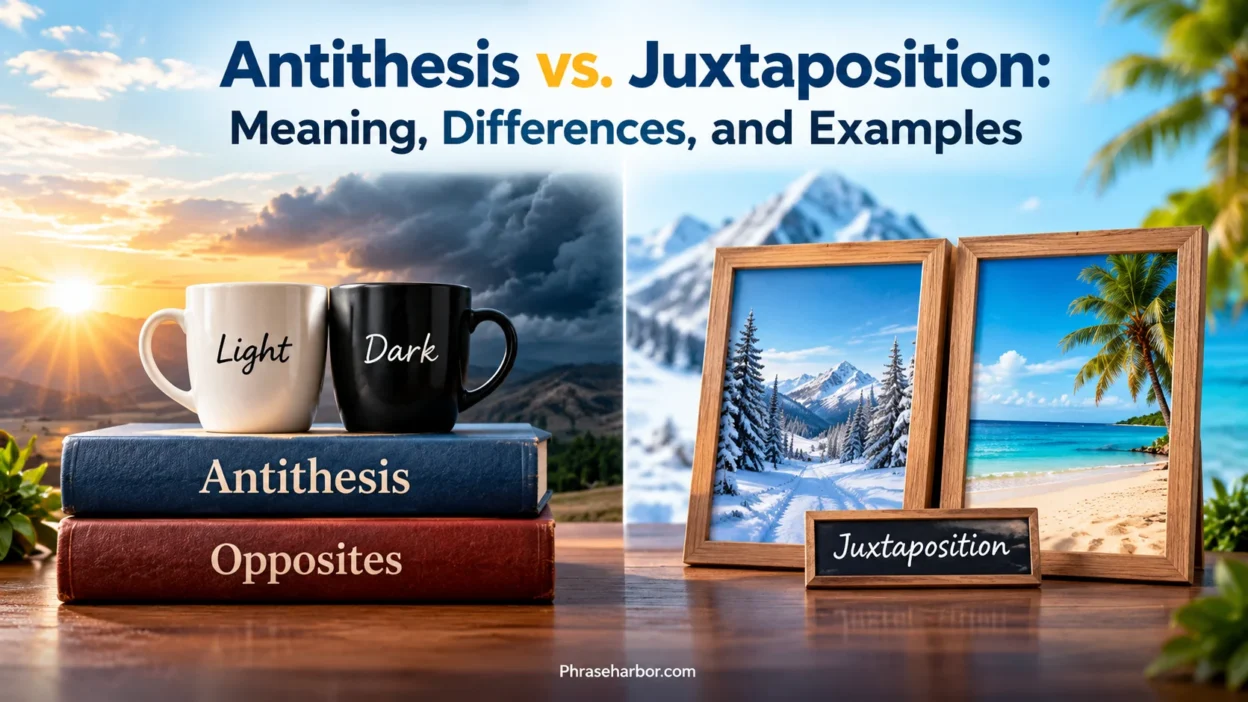
Antithesis vs. Juxtaposition explains how writers use opposing ideas and contrasting elements to make their writing clearer, stronger, and more memorable for readers. In English literature, antithesis and juxtaposition are common literary devices that help writers create contrast. Antithesis is a rhetorical device that presents opposing ideas in a balanced sentence structure.
For example, “Life is short, but art is long” uses parallel construction to highlight strongly contrasting ideas. Juxtaposition is a broader literary technique that places two or more elements side by side. These elements may include words, images, or characters. For instance, placing a wealthy character beside a poor character can highlight social inequality.
While antithesis focuses on direct opposition, juxtaposition can show contrast, similarity, tension, or an unexpected relationship anywhere in a text.Understanding the difference between antithesis and juxtaposition makes literary analysis easier. Consider the sentence “He had wealth but lacked happiness.” It creates an antithetical contrast by placing wealth and happiness in opposition.
Quick Answer
Antithesis is a rhetorical or literary device that expresses contrasting or opposing ideas, often through parallel grammatical structures. It makes differences clear, memorable, and sometimes persuasive.
Juxtaposition is the placement of two or more elements close together to encourage comparison. Those elements may contrast sharply, share similarities, or create an unexpected relationship.
Consider these examples:
- Antithesis: “It was the best of times, it was the worst of times.” The balanced wording emphasizes two opposing descriptions of the same period.
- Juxtaposition: A story describes a lavish mansion standing beside a crowded, run-down apartment building. Their proximity highlights the gap between wealth and poverty.
The key distinction is that antithesis focuses on contrasting ideas, while juxtaposition focuses on the placement of elements to create meaning through comparison. Antithesis can create juxtaposition, but juxtaposition doesn’t always involve antithesis.
Comparison Overview
Antithesis and juxtaposition both help writers draw attention to relationships between ideas. However, they differ in structure, scope, and purpose.
| Feature | Antithesis | Juxtaposition |
| Definition | Expresses opposing ideas, often in a balanced structure | Places elements together to invite comparison |
| Main purpose | Emphasizes a contrast between ideas | Reveals differences, similarities, or meaningful relationships |
| Structure | Often uses parallel phrases or clauses | Has no fixed grammatical structure |
| Elements | Usually involves opposing or sharply contrasting ideas | May involve contrasting, complementary, or similar elements |
| Scope | A specific rhetorical or literary device | A broader technique used in writing and visual arts |
| Common forms | Speeches, quotations, slogans, essays, and poetry | Novels, short stories, films, photography, poetry, and descriptive writing |
| Example | “Speech is silver, but silence is golden.” | A cheerful wedding scene followed by a lonely character sitting alone |
| Reader’s experience | Recognizes a deliberate opposition | Compares elements and interprets their relationship |
One useful way to remember the difference is to think about expression versus arrangement. Antithesis presents opposing ideas in a deliberate way. Juxtaposition arranges elements so their relationship becomes noticeable.
For example, an author might describe a city as both beautiful and dangerous. That contrast could become antithesis in a balanced sentence. The author could also juxtapose peaceful gardens with violent streets to communicate the same underlying conflict through setting.
What Is Antithesis?
Antithesis is a literary and rhetorical device that places opposing ideas in a clear, deliberate relationship. Writers use it to emphasize differences, strengthen arguments, and make statements easier to remember.
The word antithesis comes from a Greek term meaning “opposition” or “setting against.” In writing, it commonly describes a contrast between ideas expressed within a sentence, phrase, or passage.
A strong antithesis often brings two opposing concepts into balance. This balance helps readers recognize the contrast without needing a lengthy explanation.
For example:
“Many are called, but few are chosen.”
The sentence contrasts many with few and called with chosen. Its balanced structure makes the difference between the two groups immediately clear.
Antithesis frequently appears in speeches, literature, political arguments, advertisements, and everyday expressions. Whenever a writer wants opposing ideas to stand out, this device can help deliver the message.
Characteristics of Antithesis
Antithesis has several recognizable features that distinguish it from other literary devices.
- Opposing ideas: It presents contrasting concepts, viewpoints, conditions, or outcomes.
- Balanced structure: It often uses parallel phrases or clauses to make the contrast easier to recognize.
- Emphasis: It draws attention to the difference between two ideas.
- Memorability: Its compact, balanced phrasing often makes a statement easier to recall.
- Rhetorical impact: It can strengthen persuasion, reveal conflict, or communicate a complex idea efficiently.
However, antithesis doesn’t always require perfectly matched grammatical structures. The essential feature is the deliberate contrast between ideas. Parallelism simply makes that contrast more effective in many examples.
Examples of Antithesis
The following examples show how antithesis works in different contexts.
Example: “It was the best of times, it was the worst of times.”
Charles Dickens opens A Tale of Two Cities with this famous contrast. The opposing descriptions capture the contradictory experiences of an era marked by both hope and suffering.
The phrase works because the same period can be viewed through two sharply different perspectives. Its repeated structure reinforces that tension.
Example: “Speech is silver, but silence is golden.”
This familiar proverb contrasts speaking with remaining silent. It suggests that silence can sometimes offer greater value than words.
The sentence uses balanced phrasing to make its central message memorable. The comparison also encourages readers to consider when speaking helps and when listening matters more.
Example: “One small step for man, one giant leap for mankind.”
Neil Armstrong spoke these words during the Apollo 11 Moon landing in 1969. The statement contrasts an individual step with a monumental achievement for humanity.
The contrast between small and giant highlights the difference between the physical action and its historical significance.
Example: “Give me liberty, or give me death!”
Patrick Henry delivered this famous declaration during a speech in 1775. The statement contrasts freedom with death to emphasize the speaker’s determination.
Its force comes from presenting two extreme outcomes as alternatives. The wording communicates urgency rather than leaving the audience to guess how strongly the speaker feels.
Read More: Coach vs. Couch: Meaning, Differences, and Correct Usage
Common Uses of Antithesis
Antithesis serves several practical purposes in writing and speech.
Persuasive speeches: Speakers use opposing ideas to make arguments sharper. Contrasting freedom with oppression, for example, can help an audience understand the stakes of a decision.
Literary writing: Novelists and poets use antithesis to explore conflicting emotions, moral choices, and competing values.
Essays and arguments: Writers can clarify a position by contrasting what they support with what they oppose.
Advertising and slogans: Short, balanced statements can communicate a product’s promise or a brand’s central message. A slogan contrasting less effort with better results illustrates this approach.
Everyday communication: Expressions such as “Better late than never” use contrast to communicate a practical lesson.
Antithesis works best when the opposing ideas matter to the message. Simply placing unrelated opposites together doesn’t automatically produce a meaningful rhetorical effect.
What Is Juxtaposition?
Juxtaposition is a literary and artistic technique that places two or more elements close together so their relationship becomes noticeable. The elements may differ sharply, share important qualities, or create an unexpected connection.
Unlike antithesis, juxtaposition doesn’t require a balanced sentence or even a sentence at all. Writers can create it through characters, settings, objects, events, descriptions, and entire scenes.
For example, imagine a story that describes a luxurious restaurant across the street from a crowded food bank. The writer doesn’t need to explain the economic inequality directly. The contrasting locations encourage readers to notice it themselves.
Juxtaposition can also reveal similarities. A writer might describe a soldier and a doctor performing different jobs under equally dangerous conditions. Placing their experiences together could emphasize their shared courage.
The technique therefore depends on placement and context, not simply opposition.
Characteristics of Juxtaposition
Juxtaposition can take several forms, but a few features commonly define its use.
- Close placement: Two or more elements appear near each other in a sentence, scene, passage, or composition.
- Meaningful comparison: Their relationship encourages readers to notice similarities, differences, or contradictions.
- Flexible structure: Juxtaposition can occur across a few words or an entire narrative.
- Contextual meaning: The surrounding details help readers interpret the relationship.
- Multiple effects: It can create irony, tension, humor, sympathy, surprise, or social criticism.
Juxtaposition doesn’t automatically make a scene meaningful. The selected elements need a relationship that helps communicate something worth noticing.
For instance, describing a blue chair beside a yellow chair doesn’t necessarily create an important literary effect. However, placing a child’s colorful toy beside the remains of a destroyed home can communicate a much deeper contrast.
Examples of Juxtaposition
Juxtaposition becomes easier to recognize when you examine how writers use it in different situations.
Example: Wealth beside poverty
Imagine a novel describing a wealthy family’s grand estate next to a neighborhood where residents struggle to afford basic necessities.
The writer places contrasting living conditions within the same setting. This arrangement highlights inequality without requiring a direct statement about economic injustice.
The reader sees the gap and begins to consider its causes and consequences.
Example: Light beside darkness
A story might describe a brightly lit kitchen while a frightening storm gathers outside. The warm interior contrasts with the threatening landscape.
This arrangement can create suspense by placing safety and danger close together. The effect depends on the context rather than the physical contrast alone.
Example: Childhood beside war
Imagine a photograph showing a child holding a teddy bear amid damaged buildings. The familiar symbol of childhood appears alongside evidence of destruction.
The juxtaposition emphasizes the vulnerability of ordinary life during conflict. It may also create a strong emotional response because the two elements carry very different associations.
Example: A cheerful character in a tragic setting
A novelist might introduce an optimistic character into a community suffering from grief. The character’s hopeful attitude contrasts with the surrounding sadness.
This juxtaposition can make the character seem resilient, naïve, or disconnected from reality. The reader’s interpretation depends on how the author develops the situation.
Example: Silence after a celebration
A story might describe a lively wedding reception followed by a silent, empty hall. The change from noise to quiet creates a striking comparison between activity and absence.
The contrast could suggest loneliness, the passage of time, or the end of an important chapter in someone’s life.
Common Uses of Juxtaposition
Writers and artists use juxtaposition whenever placing elements together can communicate more than describing them separately.
Novels and short stories: Authors contrast characters, locations, events, or viewpoints to develop themes and reveal personality traits.
Poetry: Poets place images, emotions, and ideas together to create layered meanings. A description of spring beside a reference to death, for example, can highlight the tension between renewal and mortality.
Film and photography: Directors and photographers arrange images or scenes to encourage comparisons. Editing a lavish celebration beside images of hardship can create social commentary.
Social commentary: Writers use juxtaposition to expose contradictions between public claims and actual conditions.
Humor and irony: A serious situation involving an unexpectedly trivial response can create comedy through the mismatch between the elements.
In each case, juxtaposition invites the audience to participate in interpreting the meaning. Instead of explaining every contrast, the creator allows the arrangement to do some of the work.
Main Differences Between Antithesis and Juxtaposition
Antithesis and juxtaposition overlap because both can highlight contrast. The difference becomes clearer when you examine their meaning, structure, purpose, and range of application.
Difference in Meaning
The main difference concerns what each device emphasizes.
Antithesis emphasizes opposing ideas. A writer deliberately expresses contrasting concepts so their differences become clear.
For example:
“To err is human; to forgive, divine.”
This famous statement by Alexander Pope contrasts human fallibility with the elevated act of forgiveness. The balanced structure makes the opposition memorable.
Juxtaposition emphasizes the relationship between placed elements. The elements may oppose each other, but their relationship can also reveal similarities or unexpected connections.
For example, a novel might describe a wealthy business owner and a struggling employee during the same company crisis. Their contrasting experiences could reveal how differently people experience the same event.
The distinction is simple: antithesis emphasizes opposition in ideas, while juxtaposition creates meaning by bringing elements together.
Difference in Structure
Antithesis often appears within a sentence or short expression. Writers commonly use parallel grammar, balanced clauses, or contrasting words to establish the relationship.
Consider this example:
“United we stand, divided we fall.”
The two clauses share a similar structure. The words united and divided establish the opposition, while stand and fall reinforce it.
Juxtaposition has no comparable structural requirement. It may involve two clauses, but it can also extend across multiple paragraphs, scenes, or visual images.
For example, a novel might alternate between a politician delivering a speech about prosperity and a family struggling to pay rent. The arrangement juxtaposes public optimism with private hardship.
Antithesis often depends on how opposing ideas are expressed. Juxtaposition depends on how elements are arranged in relation to one another.
FAQs:
What is the main difference between antithesis and juxtaposition?
Antithesis presents opposing ideas, usually in a balanced sentence structure. Juxtaposition places two or more elements close together to highlight contrast, similarity, or tension. Antithesis focuses on opposition, while juxtaposition uses placement to create meaning.
Can antithesis and juxtaposition be used together?
Yes, both literary devices can appear in the same piece of writing. For example, a writer might place a wealthy character beside a poor character and use the sentence, “One had everything, while the other had nothing.” The characters create juxtaposition, while the balanced opposing ideas create antithesis.
What is an example of antithesis?
A common example is “Life is short, but art is long.” The sentence places contrasting ideas in a balanced structure. This parallel construction emphasizes the difference between the limited length of life and the lasting value of art.
What is an example of juxtaposition?
A simple example is a bright, luxurious mansion standing beside a small, neglected house. Placing these contrasting images together encourages readers to notice differences in wealth, living conditions, and social inequality. The contrast comes from their placement rather than a specific sentence pattern.
Why do writers use antithesis and juxtaposition?
Writers use these techniques to make ideas clearer, emphasize differences, and create memorable writing. Antithesis strengthens arguments through direct opposition, while juxtaposition encourages readers to compare characters, images, or situations. Both techniques can add depth and meaning to literature.
Conclusion:
Understanding antithesis vs. juxtaposition helps you recognize how writers create contrast and communicate ideas effectively. Antithesis places opposing ideas in a balanced structure, while juxtaposition brings elements together so readers can discover meaningful relationships. Once you understand this difference, you can identify both techniques more confidently and use them to make your own writing clearer, stronger, and more engaging.