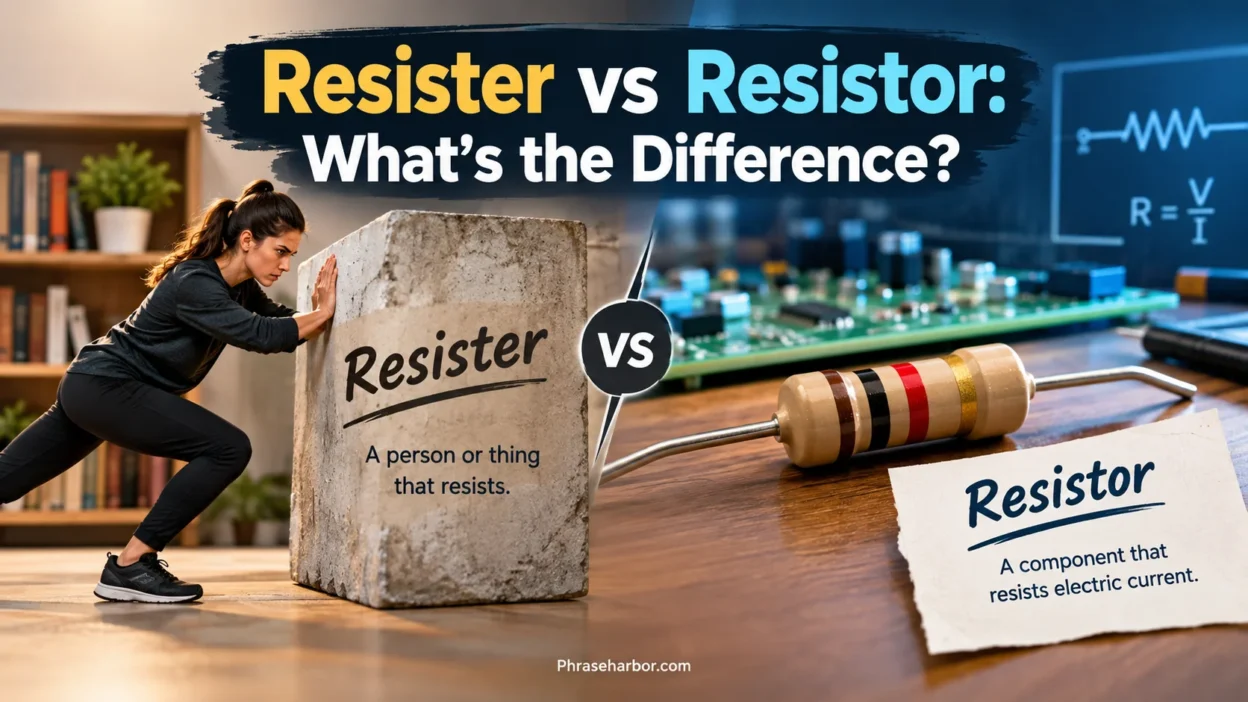
Resister vs Resistor explains a spelling contrast: one names someone who resists, while the other is an electrical component that controls current. The resister and resistor meaning and spelling create a clear contrast, although the words look almost the same and sound somewhat similar.
A resister can be a person, group, protest leader, or thing that resists, pushes back, or can resist a force. A resistor, however, is an electrical component, electronic part, or component that limits current and controls the flow of electric current.
In electronics, circuits, circuit diagrams, a circuit board, and engineering text, resistor, resistance, current, electrical, electronic, and component are the usual terms. In history writing, protest, leader, group, person, and force can describe a resister.
Quick Answer
Resister vs Resistor at a Glance
| Word | Meaning | Typical Context | Example |
| Resister | Someone or something that resists | People, opposition, general resistance | “She was a strong resister of the new policy.” |
| Resistor | An electronic component that limits current | Electrical engineering and electronics | “The circuit needs a 220-ohm resistor.” |
Give the direct answer: Use “resistor” when referring to the electronic component.- Explain that resister isn’t the standard technical term for that component.
Comparison Overview
| Feature | Resister | Resistor |
| Part of speech | Usually noun | Noun |
| Basic meaning | One that resists | Electrical component that provides resistance |
| Related verb | Resist | Resist |
| Main field | General English | Electronics and electrical engineering |
| Refers to a person | Yes | No |
| Refers to a circuit component | No | Yes |
| Example | “The resister opposed the proposal.” | “Replace the damaged resistor.” |
| Common confusion | Mistaken for the electronic term | Sometimes misspelled as “resister” |
What Does “Resister” Mean?
Definition of Resister
- Define resister as a noun formed from the verb resist.
- Explain that it can describe a person who resists something.
- Note that it can also describe something that resists in a broader or less common sense depending on context.
Examples of Resister in a Sentence
- “He became a vocal resister of the proposed changes.”
- “The movement attracted thousands of resisters.”
- Explain why these examples describe people who oppose or resist, rather than electronic components.
Resister as a General English Formation
- Explain the relationship between:
- resist → resister
- act → actor
- teach → teacher
- Clarify that English doesn’t always form nouns from verbs in exactly the same way.
- Explain why resister is grammatically possible even though resistor is the established electronics term.
What Does “Resistor” Mean?
Definition of Resistor
- Define a resistor as a passive electrical component that introduces resistance into a circuit.
- Explain its primary function: controlling or limiting current and producing voltage drops.
- Introduce the unit of resistance, the ohm (Ω).
How a Resistor Works
- Explain the basic relationship between voltage, current, and resistance using Ohm’s law:
V = I × R - Explain what each symbol represents:
- V = voltage
- I = current
- R = resistance
- Give a simple numerical example showing how resistance affects current.
Why Resistors Are Used
Cover practical applications such as:
- Limiting current through an LED
- Dividing voltage
- Setting bias conditions in circuits
- Pull-up and pull-down circuits
- Controlling signal levels
- Providing feedback in electronic circuits
- Discharging capacitors
- Protecting sensitive components
Main Differences Between Resister and Resistor
Meaning
- Resister describes someone or something that resists.
- Resistor names a specific electronic component.
Context
- Explain the difference between general language and technical language.
- Show how surrounding words can reveal which term belongs in a sentence.
Pronunciation
- Compare common pronunciations and explain why pronunciation alone may not help readers distinguish the words.
- Note that spelling and context provide the clearer distinction.
Word Formation
- Explain how resister derives naturally from resist.
- Explain that resistor became the established technical term in electrical terminology.
Usage Frequency
- Explain that resistor is overwhelmingly the expected term in electronics.
- Clarify that seeing resister in an electronics context usually indicates a spelling or word-choice error.
Resister vs Resistor in Electronics
Is “Resister” Ever Correct for an Electrical Component?
- Answer directly: No, “resistor” is the standard term for the component.
- Explain why technical writing should use established terminology.
- Show examples of incorrect and correct usage.
| Incorrect | Correct |
| “Add a 1K resister to the circuit.” | “Add a 1-kΩ resistor to the circuit.” |
| “The resister burned out.” | “The resistor burned out.” |
| “Choose the right resister value.” | “Choose the right resistor value.” |
Why the Mistake Happens
- Similar spelling.
- Both words relate to resistance.
- The suffix -er commonly forms nouns for people or things that perform an action.
- Explain why resistor can seem less intuitive to someone unfamiliar with electronics.
Resistor Types You Should Know
Fixed Resistors
- Explain that fixed resistors have a predetermined resistance value.
- Mention common forms such as:
- Carbon film
- Metal film
- Thick-film
- Wirewound
Variable Resistors
- Explain components whose resistance can be adjusted.
- Cover:
- Potentiometers
- Rheostats
- Trimmer potentiometers
Specialized Resistors
Briefly explain:
- Thermistors — resistance changes with temperature.
- Photoresistors/LDRs — resistance changes with light.
- Varistors — resistance changes with applied voltage.
Common Resistor Specifications
Resistance Value
- Explain resistance in ohms, kilo-ohms, and mega-ohms.
Power Rating
- Explain wattage and why a resistor can overheat when it dissipates too much power.
Tolerance
- Explain what tolerance means and why a labeled resistance isn’t always exact.
Temperature Coefficient
- Explain how temperature can affect resistance.
- Mention why this specification matters in precision circuits.
Read More: Afterward or Afterwards: Which Is Correct? Meaning, and Examples
How to Read Resistor Color Codes
Four-Band Resistors
- Explain the basic four-band system:
- First digit
- Second digit
- Multiplier
- Tolerance
Five-Band Resistors
- Explain the additional significant digit and how the reading differs from four-band resistors.
Example
- Walk through a simple color-code example step by step.
- Include a compact reference table for common color values.
Resistor vs Resistance vs Resistivity
Resistance
- Define resistance as opposition to electric current within a component or material.
- Give the unit: ohm (Ω).
Resistivity
- Explain resistivity as an intrinsic property of a material.
- Give the relationship:
R = ρL/A - Explain the meaning of:
- R = resistance
- ρ = resistivity
- L = length
- A = cross-sectional area
Resistor
- Clarify that a resistor is the physical component designed to provide a particular amount of resistance.
Resister
- Contrast the technical meaning with the ordinary noun describing someone who resists.
Resister vs Resistor: Common Sentence Examples
Correct Uses of Resister
- Provide several natural examples involving people or groups resisting something.
Correct Uses of Resistor
- Provide examples from:
- Basic circuits
- LED projects
- Circuit troubleshooting
- Electronics repair
- Engineering documentation
Incorrect Uses to Avoid
- Show common sentences where resister incorrectly replaces resistor.
- Correct each example and explain the reason briefly.
Common Confusions Related to “Resistor”
Resistor vs Resistance
- Component vs electrical property.
Resistor vs Rheostat
- Explain that a rheostat is a type of variable resistor used to control current.
Resistor vs Potentiometer
- Explain the difference between a general resistor and a three-terminal adjustable component.
Resistor vs Fuse
- Explain that both can affect current but serve very different purposes.
- A resistor normally remains part of the circuit while a fuse is designed to open the circuit when excessive current occurs.
How to Remember Resister vs Resistor
Simple Memory Trick
- Resister = a resister resists.
- Resistor = an electronic component.
Context Test
Ask:
Are you talking about a person who resists or a component in a circuit?
- Person or opponent → resister
- Circuit component → resistor
Visual Reminder
- Create a simple conceptual diagram:
RESIST → RESISTER → person who resists
ELECTRONIC COMPONENT → RESISTOR → controls resistance/current
Real-World Examples
Example: An LED Circuit
- Explain why a resistor commonly sits in series with an LED.
- Show what can happen when the current-limiting resistor is omitted.
Example: A Voltage Divider
- Explain how two resistors can produce a lower output voltage from a higher input voltage.
- Include the voltage-divider equation:
Vout = Vin × R₂ / (R₁ + R₂)
Example: A Person Resisting a Policy
- Demonstrate the correct use of resister in ordinary English.
- Contrast it directly with the electronics examples.
Quick Decision Guide
| If you’re talking about… | Use |
| A person who opposes something | Resister |
| Someone who refuses to comply | Resister |
| An electronic component | Resistor |
| A component measured in ohms | Resistor |
| A component with a power rating | Resistor |
| Current-limiting circuitry | Resistor |
FAQs:
1. What is the difference between resister and resistor?
A resister is a person, group, or thing that resists something. A resistor is an electrical component used in a circuit to limit or control electric current.
2. Is resister a correct English word?
Yes. Resister is a valid English noun. It generally describes someone or something that resists. However, it should not be used when you mean the electronic component.
3. Is resistor an electrical component?
Yes. A resistor is an electronic component found in electrical and electronic circuits. Its main role is to provide resistance and control the flow of current.
4. Why do people confuse resister and resistor?
The two words have very similar spellings and differ by only one letter. Because they look and sound similar, writers may choose the wrong word at a quick glance.
5. Can resister and resistor be used interchangeably?
No. Their meanings are different. Resister relates to resisting, while resistor belongs mainly to electronics, engineering, and electrical circuits.
6. How can I remember which word means an electronic component?
Think of resistor as the word connected with resistance in a circuit. If you are talking about a person or group that pushes back against something, resister is usually the appropriate term.
7. What does a resistor do in a circuit?
A resistor provides resistance and helps control the amount of current flowing through a circuit. It is commonly shown in circuit diagrams and used in many electronic devices.
8. Does a spell-checker identify the difference?
Not always. Both resister and resistor are valid English words, so a spell-checker may not identify a mistake when the wrong word is used in an otherwise correctly spelled sentence.
9. Which word should I use in technical writing?
Use resistor when discussing an electronic or electrical component. In technical writing, engineering text, and electronics-related content, using the correct term is important for clear communication.
10. What is the easiest way to choose between resister and resistor?
Ask yourself whether you mean a person or thing that resists something, or an electronic component. Person or resistance action usually points to resister; electronic circuit component points to resistor.
Conclusion:
Resister and resistor may look almost identical, but their meanings are clearly different. Resister refers to someone or something that resists, while resistor refers to an electrical component that provides resistance and controls current in a circuit.
The easiest way to avoid the common spelling mistake is to focus on the context. When writing about electronics, circuits, or engineering, choose resistor. When describing someone who resists or pushes back, resister is the relevant noun. Remembering this simple distinction can make your writing more accurate and your technical communication clearer.