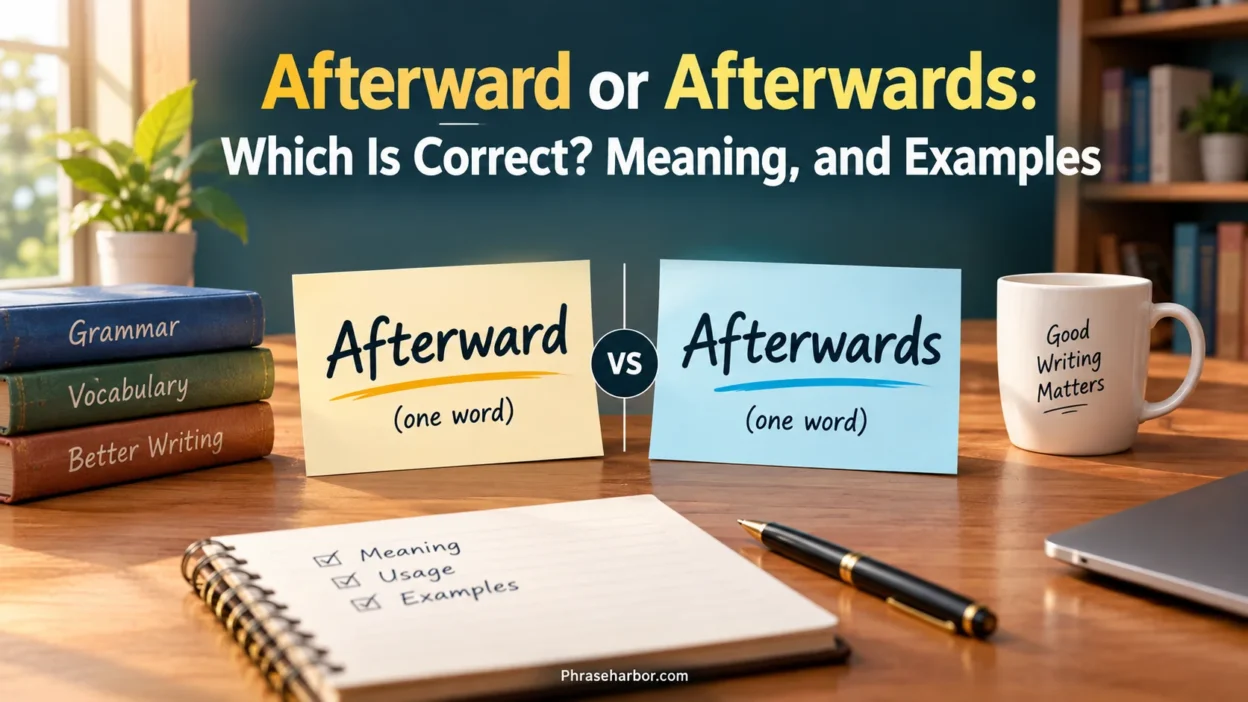
Afterward or Afterwards can confuse learners, but both words mean later or after that, while regional usage guides the right choice. When people paused while writing or talking, they may have wondered about the meaning and basic meaning of these words. Both word forms describe what happens following an earlier event, event, or action in a sequence of time, referring to a subsequent or later event.
The first source of confusion is that the forms look different, yet they carry the same meaning and usually have the same grammatical function. Their usage depends on regional preference, regional variation, linguistic preference, language, and writing context, rather than a strict rule about a wrong form. In American English, afterward appears more often, while British English commonly favors afterwards.
This preference can vary by audience, regional audience, writing style, American usage, British usage, standard English, written English, spoken English, dialect, and audience preference. The main difference is therefore a regional difference and a matter of word choice, not a basic grammar error.
Quick Answer
Afterward and afterwards are both correct. They function as adverbs and mean at a later time or after something has happened.
The main distinction is regional:
- Afterward is the more common form in American English.
- Afterwards is especially common in British English.
- Both forms have the same basic meaning.
- Both can appear at the beginning or end of a sentence.
- Shortly afterward and shortly afterwards are both correct.
- Soon afterward and soon afterwards are also both correct.
If you’re writing for a US audience, afterward is usually the natural choice. If you’re writing for a British audience, afterwards may sound more familiar.
The important point is simple: neither word is inherently wrong.
Comparison Overview
| Feature | Afterward | Afterwards |
| Part of speech | Adverb | Adverb |
| Basic meaning | At a later time | At a later time |
| American English | Very common | Used but less typical |
| British English | Used | Especially common |
| Meaning difference | None | None |
| Can begin a sentence? | Yes | Yes |
| Can end a sentence? | Yes | Yes |
| Works with “shortly”? | Yes | Yes |
| Works with “soon”? | Yes | Yes |
| Formal writing | Correct | Correct |
| Informal writing | Correct | Correct |
Think of afterward and afterwards as two regional versions of the same word. The extra s doesn’t create a new meaning.
For instance, compare these sentences:
We talked about the problem afterward.
We talked about the problem afterwards.
Both sentences tell you that the conversation happened at a later point. The difference lies mainly in regional preference.
Main Differences Between Afterward and Afterwards
The biggest difference between afterward and afterwards isn’t meaning. It’s usage by region.
American English tends to favor the shorter afterward. British English frequently uses afterwards. This pattern resembles other English words that have slightly different regional preferences without changing their underlying meaning.
Consider these examples:
- US English: “We went home afterward.”
- UK English: “We went home afterwards.”
- US English: “She called me shortly afterward.”
- UK English: “She called me shortly afterwards.”
Nothing about the event itself changes. The person still called after something happened. Only the preferred form changes.
Afterward in American English
If you’re writing for readers in the United States, afterward is generally the safer and more familiar choice.
You’ll often see it in everyday conversation, journalism, business writing, academic prose, and online content.
For example:
- “We discussed the contract afterward.”
- “He apologized afterward.”
- “She felt better afterward.”
- “The students stayed behind afterward.”
- “I realized my mistake afterward.”
Notice how naturally afterward fits at the end of each sentence. It doesn’t need an additional preposition or special construction.
American writers may still use afterwards. However, afterward is generally the more characteristic US form.
Afterwards in British English
In British English, afterwards is especially common.
A British writer might naturally say:
- “We went for coffee afterwards.”
- “She spoke to her manager afterwards.”
- “They returned home afterwards.”
- “I felt much better afterwards.”
- “What happened afterwards?”
The extra s doesn’t make the word more formal, more precise, or more grammatical. It’s simply part of the preferred form in this variety of English.
This distinction matters when you’re trying to maintain a consistent regional style. A website aimed primarily at American readers will often use afterward, while British publications may favor afterwards.
What Does Afterward Mean?
Afterward means at a later time or after an event that has already been mentioned.
It works as an adverb because it modifies an action by telling you when that action happens.
Consider this sentence:
We finished the meeting and went to lunch afterward.
The word afterward tells you that lunch happened after the meeting.
The earlier event doesn’t always need to appear in the same sentence. Context can provide it.
For example:
The movie was surprisingly emotional. I thought about it for days afterward.
Here, afterward refers back to the movie experience.
The word can describe something that happens immediately later or something that occurs after a longer interval. Context determines the exact timing.
Examples of Afterward
Here are several natural examples:
- “We talked about the decision afterward.”
- “She regretted the comment afterward.”
- “The team celebrated afterward.”
- “I understood what he meant only afterward.”
- “They went home shortly afterward.”
- “He called me the next morning afterward.”
The final example is grammatically possible but somewhat awkward because the next morning already establishes the later time. Good writing avoids unnecessary repetition when a clearer expression is available.
A stronger version would be:
He called me the next morning.
That’s an important writing lesson. Correct grammar doesn’t automatically produce the clearest sentence.
What Does Afterwards Mean?
Afterwards carries the same basic meaning as afterward. It refers to a time following an event or situation.
For example:
We had dinner and went for a walk afterwards.
The word tells the reader that the walk happened after dinner.
It can also appear after a phrase that establishes a particular event:
She finished the interview and spoke with her family afterwards.
Again, afterwards points backward to the event that came before it.
Examples of Afterwards
- “We went home afterwards.”
- “She called me afterwards.”
- “They discussed the results afterwards.”
- “He apologized afterwards.”
- “The children played outside afterwards.”
- “We met again shortly afterwards.”
The sentences are structurally no different from sentences containing afterward.
Is Afterward or Afterwards Correct?
Yes. Both are correct.
This is one of those cases where a simple grammar question has a slightly more interesting answer. The issue isn’t correctness versus incorrectness. It’s regional preference.
If someone says that afterwards is always wrong, that claim doesn’t account for standard British English usage.
Likewise, saying that afterward is wrong because British English often prefers afterwards would also be misleading.
A better rule is:
Use the form that fits your variety of English and remain consistent.
For American English, that usually means afterward.
For British English, afterwards is especially common.
How to Use Afterward in a Sentence
Afterward can appear in several positions, although its placement should always make the time relationship easy to understand.
Afterward at the Beginning
When afterward begins a sentence, a comma commonly follows it.
Afterward, we went back to the hotel.
Afterward, she called her parents.
This placement puts emphasis on what happened next.
It can work particularly well when you’re describing a sequence of events.
Afterward at the End
The ending position is extremely natural:
We went back to the hotel afterward.
She called her parents afterward.
This construction works well in everyday writing because the main action comes first. The time reference then arrives naturally at the end.
Afterward After a Specific Event
You can also use afterward to connect two events:
The meeting ended, and everyone left afterward.
He finished the exam and felt relieved afterward.
The reader can easily identify the earlier event because afterward points back to it.
How to Use Afterwards in a Sentence
Afterwards follows the same grammatical patterns.
Afterwards at the Beginning
For example:
Afterwards, we went to a nearby restaurant.
Afterwards, they discussed what had happened.
The opening position works especially well when you’re moving from one stage of a story to another.
Afterwards at the End
This is perhaps the most common everyday placement:
We went to a nearby restaurant afterwards.
They discussed the situation afterwards.
The word functions as a simple time marker.
Afterwards After a Specific Event
You can make the relationship between events especially clear:
She completed the presentation and answered questions afterwards.
The reader immediately understands the sequence: presentation first, questions later.
Read More: Tying or Tieing: Which Spelling Is Correct?
Shortly Afterward or Shortly Afterwards?
Both shortly afterward and shortly afterwards are correct.
They mean that something happened soon after an earlier event.
For example:
The meeting ended, and shortly afterward, everyone left.
Or:
The meeting ended, and shortly afterwards, everyone left.
The difference is regional rather than semantic.
Shortly adds an important detail. It suggests that only a short amount of time passed between the two events.
Compare:
She called me afterward.
She called me shortly afterward.
The second sentence specifically suggests that she called soon after the earlier event.
Soon Afterward or Soon Afterwards?
The same pattern applies to soon afterward and soon afterwards.
Examples include:
They moved to the city and married soon afterward.
They moved to the city and married soon afterwards.
Both versions communicate the same basic sequence.
The combination works because soon modifies the time relationship. It tells you that the later event didn’t occur after a long delay.
Immediately Afterward or Immediately Afterwards?
You can also use immediately with either form.
The alarm sounded. Everyone left immediately afterward.
The alarm sounded. Everyone left immediately afterwards.
Here, immediately makes the sequence stronger. The second action followed with little or no delay.
This construction often appears when timing matters. You might see it in instructions, reports, narratives, or explanations of a process.
For example:
Turn off the machine and disconnect the power supply immediately afterward.
The word afterward identifies the sequence. Immediately emphasizes the speed of that sequence.
Afterward vs. After: What’s the Difference?
Although afterward contains the idea of after, the two words don’t always perform the same grammatical job.
After can function as a preposition, conjunction, or adverb.
For example:
We left after dinner.
Here, after introduces the noun phrase dinner.
It can also introduce a clause:
We left after we finished dinner.
But afterward works differently:
We finished dinner and left afterward.
In that sentence, afterward stands alone as an adverb.
This distinction becomes easier when you focus on what comes next.
| Word | Example | Function |
| After | after dinner | Preposition |
| After | after we ate | Conjunction |
| Afterward | We left afterward. | Adverb |
| Afterwards | We left afterwards. | Adverb |
So don’t automatically replace after with afterward. They aren’t interchangeable in every sentence.
Afterward vs. Later vs. Subsequently
These three words can all refer to time. However, they don’t always create the same impression.
Afterward
Afterward usually points directly back to an event that has already been mentioned.
We finished the meeting and went out afterward.
The relationship is clear and immediate.
Later
Later has a broader meaning. It can refer to any subsequent time without strongly tying the action to one specific previous event.
I’ll call you later.
You don’t necessarily know exactly which event the speaker is referring back to.
Subsequently
Subsequently means something happened afterward. It often sounds more formal and appears frequently in formal reports, academic writing, legal writing, and professional contexts.
The company reviewed the complaint and subsequently changed its policy.
In everyday conversation, afterward or later will usually sound more natural.
Common Mistakes With Afterward and Afterwards
The biggest mistakes usually come from treating regional preferences as absolute grammar laws.
Treating Afterwards as Incorrect American English
Some writers assume that afterwards must be wrong in American English.
That’s too strict.
Afterward is the usual American preference. However, afterwards is also an established English form.
The practical choice for US-focused writing is still straightforward: afterward will generally feel more natural.
Treating Afterward as Incorrect British English
The reverse mistake happens too.
British English often favors afterwards, but that doesn’t make afterward an impossible or meaningless form.
Regional preference isn’t the same thing as grammatical prohibition.
Switching Between Both Forms Randomly
Consistency matters.
Imagine an article that begins with:
We discussed the results afterward.
Later, it says:
The team celebrated afterwards.
Neither sentence is grammatically wrong. Still, the unexplained switch can make the writing feel inconsistent.
Choose the form that matches your target audience and stick with it unless there’s a specific reason to change.
Confusing Afterwards With After
Another common mistake is using afterwards where after needs an object or clause.
Incorrect:
We went afterwards dinner.
Correct:
We went after dinner.
Or:
We went home afterwards.
The difference is grammatical, not merely stylistic.
Afterward or Afterwards in Formal Writing
Neither word is inherently too informal for professional writing.
You can use afterward in:
- Business reports
- Academic writing
- Professional emails
- News articles
- Instructions
- General web content
- Essays
- Personal writing
You can also use afterwards in these settings.
The important consideration is regional consistency and house style.
For example, an American business report might naturally say:
The committee reviewed the proposal and issued a statement afterward.
A British publication could use:
The committee reviewed the proposal and issued a statement afterwards.
Both sentences work.
There’s no need to replace either word with an unnecessarily formal alternative simply to make the writing sound professional.
FAQs:
1. Is afterward or afterwards correct?
Both afterward and afterwards are correct. They have the same basic meaning: later or after that. The main difference is regional preference. Afterward is more common in American English, while afterwards is more common in British English.
2. What does afterward mean?
Afterward means something happens later or after a previous event. For example, you might finish your work and go for a walk afterward. It refers to a later time or subsequent action.
3. What does afterwards mean?
Afterwards also means later or after that. It works in the same way as afterward. The choice usually depends on your regional English, writing style, and audience.
4. Is afterward more formal than afterwards?
Neither word is automatically more formal. Afterward is simply more common in American English, while afterwards is widely used in British English. Both can appear in formal and informal writing.
5. What is the difference between afterword and afterward?
Afterward and afterwards refer to a later time. An afterword, however, is a section at the end of a book, usually containing comments or explanations about the work. These words look similar but have different meanings and functions.
Conclusion:
Afterward and afterwards have the same basic meaning, so choosing between them is usually a matter of regional preference rather than correctness. American English tends to favor afterward, while British English commonly uses afterwards. Both forms can work naturally in everyday communication, formal writing, academic writing, and other contexts.
The important thing is to understand your audience and maintain a consistent writing style. If you remember that both words mean later or after that, the choice becomes much easier. Just be careful not to confuse either form with afterword, which refers to a section at the end of a book.