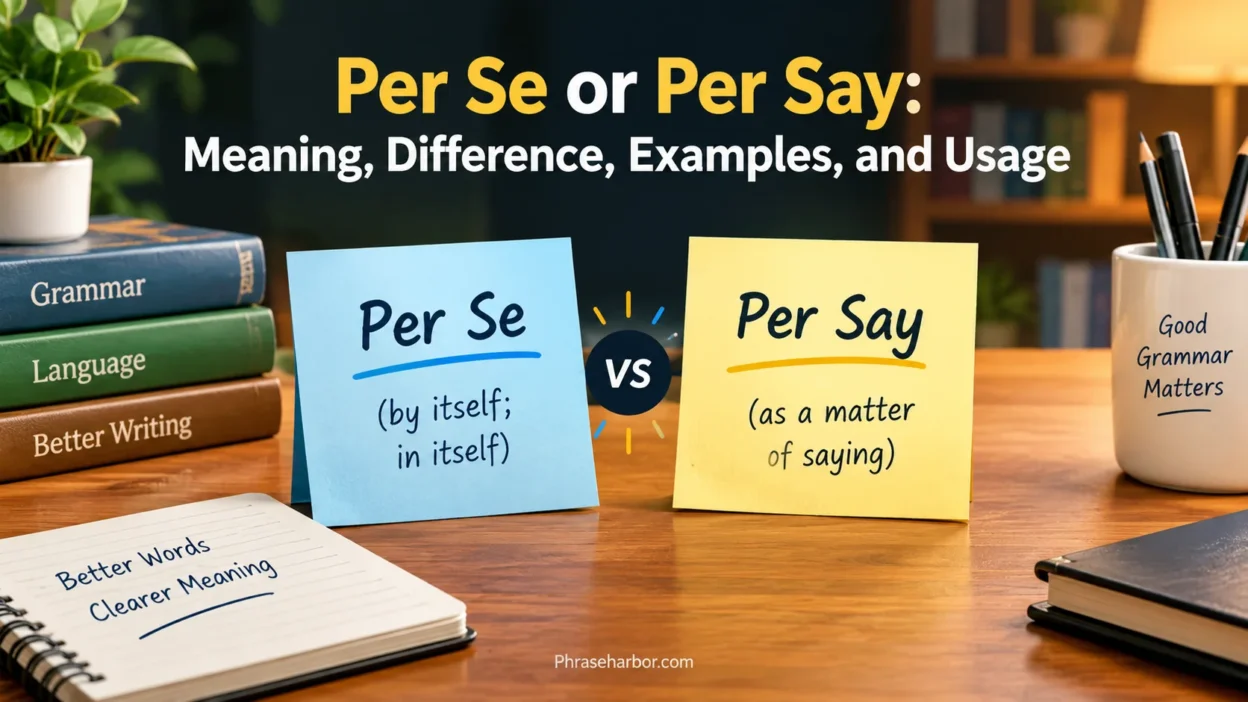
Per Se or Per Say can confuse writers because the two forms sound similar, but per se is the correct phrase in clear, standard English writing. When you pause mid-sentence, wondering which form to choose, the confusion usually comes from phonetic similarity.
Both may sounds right when you hear them, so people sometimes make a phonetic guess and write per say. However, per se has a clear origin in Latin and means in itself or by itself, giving it a specific meaning in English.
This is a common example of grammar traps, where a tiny spelling issue can create an error in otherwise strong writing. The incorrect version, spelled wrong as per say, is a common English mistake and a commonly misheard phrase, not a valid alternative.
Quick Answer
Per se is correct. Per say is incorrect.
The phrase per se means “by itself,” “in itself,” or “intrinsically.” It comes from Latin and has been used in English for centuries.
The spelling can be confusing because per se is commonly pronounced roughly like “per SAY.” However, you should still write per se, not per say.
| Form | Correct? | Meaning | Example |
| per se | Yes | By itself; in itself | “The plan isn’t bad per se.” |
| per say | No | Misspelling | “The plan isn’t bad per say.” |
| persay | No | Misspelling | “The plan isn’t bad persay.” |
| per-say | No | Nonstandard spelling | “The plan isn’t bad per-say.” |
A simple rule can settle the question:
If you mean “in itself,” use “per se.”
So if you’re wondering “per se or per say?”, choose per se every time in standard English.
Comparison Overview
The quickest way to understand per se vs. per say is to compare their spelling, meaning, pronunciation, and grammatical role.
| Feature | Per Se | Per Say |
| Standard English expression | Yes | No |
| Spelling | per se | Incorrect |
| Number of words | Two | Two when written this way |
| Origin | Latin | No standard origin as this expression |
| Basic meaning | By itself; in itself | No established meaning |
| Common pronunciation | “per SAY” | Same sound people hear in per se |
| Appropriate in formal writing | Yes | No |
| Appropriate in academic writing | Yes | No |
| Appropriate in professional writing | Yes | No |
| Hyphenated form | Not normally | Incorrect |
| Main problem | Sometimes overused | Misspelling |
The biggest trap is pronunciation. Per se sounds like “per say,” but English spelling doesn’t always follow pronunciation.
That explains why the incorrect version appears so often.
Main Differences Between Per Se or Per Say
There isn’t really a difference in meaning between the two forms because per say isn’t a standard version of the expression. Instead, the real distinction is between the correct phrase and a common misspelling.
Per Se Is the Correct Expression
Per se is the established expression in English.
Consider this sentence:
“The movie wasn’t bad per se, but it was far too long.”
The speaker isn’t saying the movie was good. Instead, the speaker is making a more precise point. The movie itself wasn’t necessarily bad. Its excessive length created the problem.
That’s the central idea behind per se.
Per Say Is a Misspelling
Per say is not the standard spelling of this expression.
People usually write it because they hear per se pronounced as “per SAY.” The ear catches the sound and the brain supplies the familiar English word say.
There’s just one problem: se and say have completely different origins and functions here.
The correct phrase is the Latin expression per se. Writing per say changes an established expression into a spelling error.
Why Per Se and Per Say Sound Alike
The confusion makes perfect sense when you hear the phrase aloud.
Imagine hearing someone say:
“The product isn’t harmful per say.”
If you’ve never seen the expression written down, per say seems perfectly reasonable.
That’s why this error often survives unnoticed. It sounds right.
Writing, however, requires the established spelling: per se.
What Does Per Se Mean?
At its heart, per se means “by itself” or “in itself.”
It asks you to consider something independently from other circumstances.
For example:
“Money isn’t bad per se.”
This doesn’t mean money is always good. It means money itself isn’t inherently bad.
Perhaps the speaker objects to greed, dishonesty, or the way money gets used. Those are different issues.
Here’s another example:
“Technology isn’t dangerous per se.”
Again, the statement doesn’t claim that technology can never cause harm. It separates the technology itself from the ways people might use it.
Per Se Means “In Itself”
The phrase can often be replaced with “in itself” without changing the basic meaning.
“The proposal isn’t unreasonable per se.”
can become:
“The proposal isn’t unreasonable in itself.”
Both sentences suggest that something else—not the proposal’s basic nature—is creating the concern.
Per Se Can Mean “Intrinsically”
In some contexts, per se means intrinsically or inherently.
For example:
“There is nothing immoral about competition per se.”
Here, the speaker means competition isn’t inherently immoral. Particular forms of competition might become unfair or destructive, but competition itself isn’t automatically immoral.
This distinction gives per se much of its usefulness.
It lets you make a narrower claim instead of making a sweeping statement.
Where Does Per Se Come From?
Per se is a Latin phrase.
Its literal sense is roughly “by itself” or “through itself.” The Latin word se functions as a reflexive pronoun referring to oneself, itself, or themselves depending on context. Etymological sources trace the English expression back to Latin usage and document its long history in English.
Breaking Down Per Se
The phrase consists of two Latin elements:
- per — broadly conveying ideas such as “by” or “through”
- se — a reflexive pronoun meaning “itself,” “himself,” “herself,” or “themselves” depending on context
Together, per se developed the sense of “by itself” or “in itself.”
That Latin origin explains why the spelling isn’t per say.
The word say has no role in the original phrase.
How Long Has English Used Per Se?
Per se isn’t a modern business buzzword or internet expression. English has used it for centuries.
So although the phrase may sound sophisticated, it has a long history in English.
Why the Latin Origin Helps You Remember the Spelling
The easiest way to remember per se is to remember its meaning.
Think:
per se → by itself → in itself
Once you connect the phrase with its Latin origin and meaning, per say becomes easier to reject.
How Do You Pronounce Per Se?
In American English, per se is commonly pronounced approximately:
“per SAY”
Why Pronunciation Causes the Spelling Mistake
Here’s the problem in miniature:
You hear: per SAY
You write: per SAY
The standard spelling: per SE
English has plenty of spelling patterns that don’t perfectly match pronunciation. Per se adds another example.
So don’t let your ears dictate the spelling.
An Easy Pronunciation Memory Trick
Think of it this way:
It sounds like “per say,” but it means “in itself.”
That gives you two anchors: pronunciation and meaning.
If you remember the meaning, the spelling follows.
How to Use Per Se in a Sentence
The most common construction places per se after the noun or adjective being qualified.
For example:
“The rule isn’t unfair per se.”
The phrase modifies the idea of unfairness. It says the rule isn’t unfair in itself.
Another common pattern uses per se to contrast something with its consequences.
“The design isn’t ugly per se, but it doesn’t fit the room.”
The design isn’t being condemned on its own. The speaker objects to how it works in a particular setting.
Use Per Se to Separate a Thing From Its Effects
This is perhaps the most useful way to understand the phrase.
Consider:
“I don’t dislike exercise per se. I dislike exercising at five in the morning.”
The person isn’t opposed to exercise itself.
The real complaint involves time.
Similarly:
“The job isn’t difficult per se. The workload is unreasonable.”
The job may be manageable under normal conditions. The excessive workload creates the difficulty.
Use Per Se to Make a Precise Distinction
Good writing often depends on making distinctions.
Compare:
“Social media is bad.”
with:
“Social media isn’t bad per se, but excessive use can create problems.”
The second statement is more qualified and precise.
It doesn’t automatically make the claim true. However, it makes the speaker’s intended distinction much clearer.
Use Per Se in Academic and Professional Writing
You’ll commonly encounter per se in:
- Academic essays
- Research discussions
- Business writing
- Journalism
- Legal writing
- Philosophy
- Economics
- Social science
- Formal correspondence
- Analytical articles
It works especially well when you need to distinguish an object or concept from its particular application, effect, or context.
Per Se Sentence Examples
Seeing the phrase in different situations makes its meaning much easier to recognize.
Everyday Examples
- “I don’t hate coffee per se. I just don’t like bitter coffee.”
- “The neighborhood isn’t dangerous per se, but it gets quiet late at night.”
- “I’m not against the idea per se.”
- “The trip wasn’t expensive per se, but all the extra fees added up.”
- “I don’t dislike winter per se. I dislike scraping ice off my car.”
Workplace Examples
- “The proposal isn’t unrealistic per se, but the deadline is too short.”
- “The software isn’t difficult per se. The training process takes time.”
- “The meeting wasn’t pointless per se, although it could’ve been shorter.”
- “The strategy isn’t wrong per se, but it doesn’t fit this market.”
- “Working remotely isn’t a problem per se. Communication becomes harder when expectations aren’t clear.”
Academic Examples
- “The theory isn’t flawed per se, but the available evidence remains limited.”
- “The issue isn’t technology per se. It’s how people use it.”
- “Competition isn’t harmful per se, although extreme competition can produce negative effects.”
- “The method isn’t unreliable per se, but the sample size limits the conclusions.”
Formal Examples
- “The regulation isn’t unreasonable per se, but its application may create difficulties.”
- “The policy isn’t discriminatory per se, although certain outcomes deserve further review.”
Notice the recurring structure. Per se often appears when a writer wants to narrow or qualify a statement.
Per Se Punctuation: Should You Use Commas?
Punctuation around per se depends on how the phrase functions in the sentence.
You don’t automatically need commas simply because per se is a Latin expression.
Per Se at the End of a Clause
When per se naturally follows the word or phrase it qualifies, commas usually aren’t necessary.
“The idea isn’t unreasonable per se.”
“I don’t object to the policy per se.”
“The product isn’t harmful per se.”
These sentences flow naturally without commas.
Per Se as a Parenthetical Phrase
When per se interrupts a sentence as a parenthetical expression, commas may make sense.
“The proposal, per se, isn’t unreasonable.”
Here, the phrase sits between the subject and predicate as an interruption.
However, don’t sprinkle commas around per se mechanically. Read the sentence aloud and consider whether the phrase genuinely functions as an aside.
Why Punctuation Matters
Compare:
“The policy isn’t unfair per se.”
with:
“The policy, per se, isn’t unfair.”
The first sentence directly qualifies unfair.
The second places emphasis on the policy itself.
The difference is subtle, but punctuation can influence rhythm and emphasis.
Common Mistakes With Per Se
The spelling mistake is only one problem. Writers sometimes misunderstand how the phrase works as well.
Mistake: Writing Per Say
Incorrect:
“The idea isn’t bad per say.”
Correct:
“The idea isn’t bad per se.”
This is the most common error.
Mistake: Writing Persay
Some writers combine the two words:
“The idea isn’t bad persay.”
That’s incorrect too.
The standard expression contains two separate words:
per se
Mistake: Writing Per-Say
The hyphenated version is also unnecessary:
“The idea isn’t bad per-say.”
Use:
“The idea isn’t bad per se.”
Mistake: Treating Per Se as “Specifically”
One subtle mistake involves using per se as if it simply meant “specifically.”
It doesn’t.
For example:
“I don’t like sports per se.”
This doesn’t mean:
“I don’t like sports specifically.”
Instead, it means:
“I don’t like sports in themselves.”
Those meanings aren’t interchangeable.
Mistake: Using Per Se Instead of “For Example”
Per se also doesn’t mean “for example.”
Compare these sentences:
“Some fruits can cause allergies. For example, kiwi can cause reactions.”
Here, for example introduces a specific instance.
Now compare:
“The fruit isn’t dangerous per se.”
Here, per se means the fruit isn’t dangerous in itself.
They’re doing completely different jobs.
Per Se vs. In Itself vs. By Itself
English has several expressions that overlap with per se. However, they’re not always interchangeable.
| Expression | Main idea | Example |
| per se | In itself; intrinsically | “The rule isn’t unfair per se.” |
| in itself | Considered independently | “The idea is reasonable in itself.” |
| by itself | Alone or independently | “The machine can operate by itself.” |
Per Se vs. In Itself
These are often the closest substitutes.
“The plan isn’t bad per se.”
and:
“The plan isn’t bad in itself.”
Both suggest that the plan itself isn’t the problem.
The main difference lies in tone. Per se often sounds more formal or analytical.
Per Se vs. By Itself
By itself can describe physical or practical independence.
“The machine can operate by itself.”
Here, the machine literally functions without assistance.
Per se usually deals with the inherent nature or character of something:
“The machine isn’t dangerous per se.”
The machine isn’t being described as dangerous in itself.
That distinction is useful when choosing the clearest expression.
FAQs:
1. Is “per se” or “per say” correct?
Per se is the correct spelling. It is a Latin phrase meaning “in itself” or “by itself.” Per say is a common spelling mistake caused by the way the phrase sounds when spoken.
2. What does “per se” mean?
Per se means in itself, by itself, or considered separately from other factors. For example, “The idea isn’t bad per se, but it needs some improvement.”
3. Why do people write “per say”?
People often write per say because of phonetic similarity. When they hear per se, they may assume the final sound is spelled “say.” However, per se is the standard written form.
4. Is “per se” formal English?
Yes. Per se is widely used in formal writing, including academic writing, professional communication, and legal contexts. It can also appear in everyday conversation when someone wants to make a precise distinction.
5. How can I remember the correct spelling?
A simple trick is to connect per se with its Latin meaning, “in itself.” Remember that the correct phrase ends with “se,” not “say.” Checking the spelling before submitting an essay, email, or report can also prevent this common mistake.
Conclusion:
The difference between per se and per say is simple once you understand the phrase’s meaning and origin. Per se is the correct expression, while per say is an incorrect spelling created mainly by phonetic confusion.
Whenever you mean “in itself” or “by itself,” choose per se. Remembering its spelling, meaning, and pronunciation together makes this small grammar point much easier to use correctly in professional, academic, and everyday writing.