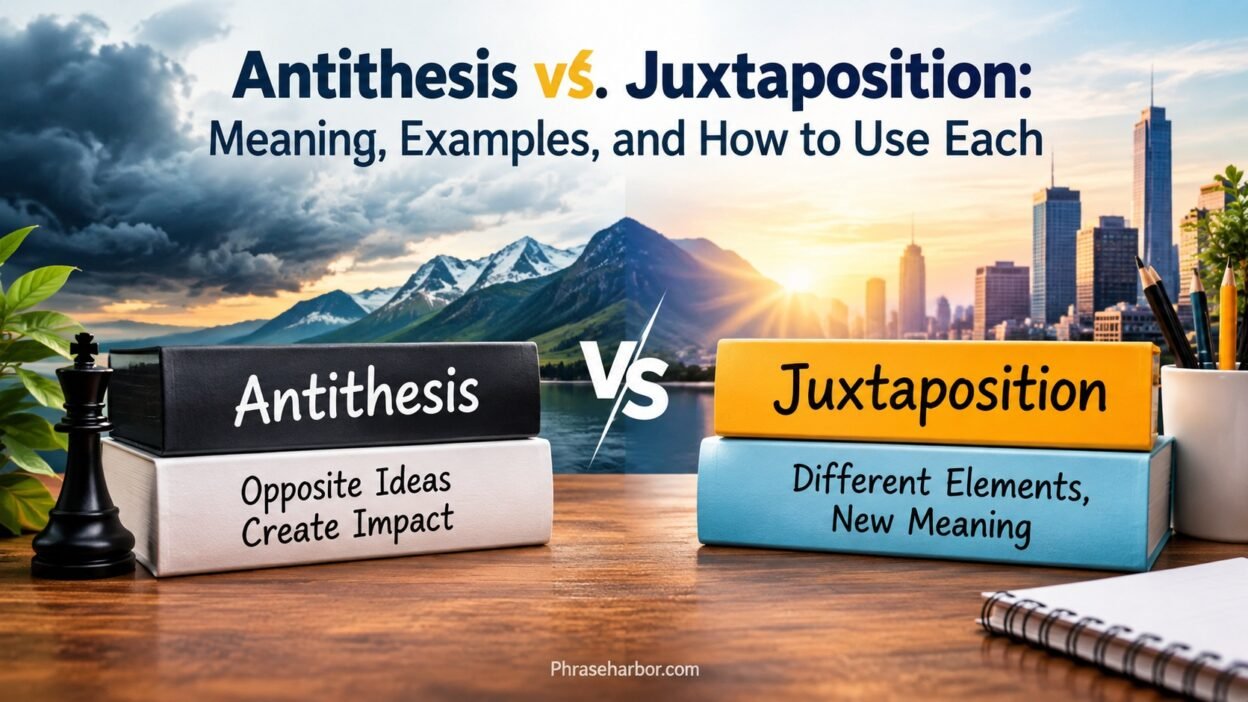
Antithesis vs. juxtaposition can seem like a distinction without much difference. Both techniques bring contrasting ideas or elements together. Both can make writing sharper, more memorable, and more meaningful.
The confusion comes from their overlap. Antithesis specifically presents opposing or strongly contrasting ideas, often in a balanced grammatical structure. Juxtaposition is broader. It places two or more elements close together so readers can notice a contrast, similarity, tension, or unexpected relationship.
Think of it this way: juxtaposition is about placement, while antithesis is about opposition. A writer might place a wealthy character beside a poor character to create juxtaposition. Another writer might say, “He had wealth but lacked happiness” to create a direct antithetical contrast.
Quick Answer
Antithesis and juxtaposition both involve bringing different ideas or elements into relation, but they aren’t interchangeable.
- Antithesis presents opposing or contrasting ideas, often using balanced or parallel wording.
- Juxtaposition places two or more elements side by side to reveal contrast, similarity, irony, tension, or another meaningful relationship.
- Antithesis usually requires contrast.
- Juxtaposition doesn’t always require direct opposition.
- Antithesis often appears within a sentence or closely connected passage.
- Juxtaposition can operate across characters, settings, scenes, images, time periods, or entire storylines.
- Antithesis is narrower. Juxtaposition is broader.
For example, “She speaks with confidence, while he speaks with doubt” can function as antithesis because it directly contrasts two related ideas in a balanced structure.
By contrast, placing a wealthy neighborhood beside a struggling neighborhood creates juxtaposition. The writer doesn’t have to state the contrast directly. The physical placement lets the reader notice it.
The easiest distinction
Antithesis emphasizes opposing ideas. Juxtaposition emphasizes the relationship created by placing elements together.
That simple distinction will solve most antithesis vs. juxtaposition questions.
Comparison Overview
| Feature | Antithesis | Juxtaposition |
| Core meaning | Contrasting or opposing ideas | Placing elements side by side |
| Main focus | Opposition | Relationship through proximity |
| Requires contrast? | Yes | No |
| Requires opposition? | Usually | No |
| Parallel structure | Common | Not required |
| Typical elements | Ideas, phrases, clauses, statements | Characters, settings, objects, scenes, images, ideas |
| Scope | More specific | Broader |
| Common effect | Emphasis, balance, persuasion | Contrast, irony, tension, comparison, surprise |
| Common settings | Rhetoric, speeches, literature | Literature, film, art, photography, advertising |
| Example | “Easy come, easy go.” | A luxurious mansion beside a rundown home |
The distinction becomes clearer when you look at how the technique works. Antithesis depends on a meaningful opposition. Juxtaposition depends on deliberate proximity.
A writer can therefore create juxtaposition without creating antithesis. However, a writer can also use juxtaposition to create antithesis. That overlap explains why the two terms often appear together in literary analysis.
Main Differences Between Antithesis vs. Juxtaposition
Antithesis Focuses on Opposition
Antithesis puts contrasting ideas into direct relationship. The two sides usually share a grammatical, thematic, or rhetorical connection.
Consider:
“Some people work to live; others live to work.”
The sentence places two opposing approaches to life into a balanced structure. The parallel wording makes the contrast especially noticeable.
That balance matters. Antithesis isn’t simply about mentioning two different things. The writer deliberately shapes the language so the contrast carries weight.
The Poetry Foundation describes antithesis as contrasting or combining terms, phrases, or clauses with opposite meanings. Classical rhetoric also gave the device a long-standing role in persuasive and memorable expression.
Juxtaposition Focuses on Placement
Juxtaposition works differently. Instead of requiring a balanced statement, it places elements near one another so their relationship becomes meaningful.
Imagine a novel that describes a lavish party in one scene and then immediately shifts to people struggling with poverty nearby. The author doesn’t need to write, “The wealthy are comfortable while the poor suffer.”
The placement itself creates the comparison.
Juxtaposition can therefore operate through space, time, characters, images, themes, or ideas. A story might place childhood memories beside adult experiences. A film might place laughter beside tragedy. A photograph might show luxury beside deprivation.
The contrast can be obvious. It can also be subtle.
Antithesis Often Uses Parallel Structure
One of the strongest clues that you’re looking at antithesis is parallelism.
Parallel structure gives both sides similar grammatical weight:
- “One seeks freedom; another seeks security.”
- “She wanted peace; he wanted power.”
- “He spoke softly; she answered loudly.”
The syntax creates a verbal seesaw. One side rises as the other falls.
Parallelism isn’t an absolute requirement for every use of antithesis. Still, it appears frequently because balanced structure makes opposing ideas easier to recognize and remember.
Juxtaposition Does Not Need Parallel Grammar
Juxtaposition can be much looser.
For example:
A child runs through a bright summer garden while a funeral procession passes beyond the gate.
Nothing about the sentence requires parallel grammar. The power comes from placing two emotionally different images within the same scene.
That is juxtaposition.
The reader notices the relationship between joy and grief. The writer doesn’t need to spell out every implication.
Antithesis Is Usually More Direct
Antithesis tends to tell you, through structure, that two ideas oppose each other.
For example:
“He chose comfort; she chose adventure.”
The opposition is obvious.
Juxtaposition can be more indirect:
A character returns from an extravagant celebration to a tiny apartment with an empty refrigerator.
The reader has to interpret the relationship between the two settings.
That’s one reason juxtaposition can feel more subtle. It often lets the arrangement do the talking.
What Is Antithesis?
Antithesis is a rhetorical and literary device that places contrasting or opposing ideas together, often through balanced phrasing.
The word comes from Greek and carries the basic sense of setting one thing against another. In practical writing, the technique gives two ideas enough structural similarity that their differences become more striking.
The basic pattern often looks like this:
Idea A + contrast + Idea B
For example:
“She valued freedom; he valued security.”
Both clauses discuss values. Both use the same basic grammatical pattern. Yet the values point in different directions.
That’s the engine behind antithesis.
Common Features of Antithesis
Strong examples often contain several of these characteristics:
- Opposing ideas
- Balanced phrasing
- Parallel grammatical structure
- Clear contrast
- Equal or near-equal emphasis
- A deliberate rhetorical effect
- Memorable wording
Antithesis works particularly well when a writer wants readers to notice a choice, conflict, contradiction, or competing principle.
Antithesis Examples
Consider these original examples:
“We planned for comfort; they prepared for adventure.”
The two clauses have similar construction. Their priorities differ.
“He wanted to be remembered; she wanted to be understood.”
Again, the sentence balances two desires.
“The city offered opportunity; the countryside offered peace.”
The writer contrasts two settings through the values associated with them.
A famous example appears in Shakespeare’s Hamlet:
“To be, or not to be”
The compact structure directly sets existence against nonexistence. Its parallel form makes the opposition unmistakable. Antithesis commonly gains power from exactly this kind of structural balance.
Another famous example comes from Alexander Pope:
“To err is human; to forgive, divine.”
The two clauses balance human weakness against a higher ideal. The contrast creates rhythm as well as meaning.
What Is Juxtaposition?
Juxtaposition means placing two or more elements close enough that readers notice their relationship.
That relationship might involve contrast, but it doesn’t have to.
For instance, an author could place an old family photograph beside a current photograph of the same people. The two images may reveal changes in age, relationships, fashion, or circumstances.
Nothing needs to be directly opposite.
The meaning emerges because the elements sit beside one another.
Common Forms of Juxtaposition
Juxtaposition can take many forms.
Character Juxtaposition
Two characters may possess sharply different personalities.
A cautious accountant and an impulsive adventurer might travel together. Their different reactions to the same situation reveal both personalities more clearly.
The contrast helps readers understand each character.
Setting Juxtaposition
A writer might place a luxurious hotel beside a neglected neighborhood.
The two settings become more meaningful because readers encounter them together.
Temporal Juxtaposition
A story may move between a character’s childhood and adulthood.
The reader compares the two periods and notices what changed.
Conceptual Juxtaposition
Writers can place abstract ideas beside each other.
Examples include:
- Freedom and control
- Youth and age
- Hope and despair
- Tradition and innovation
- Wealth and poverty
- War and peace
Visual Juxtaposition
Artists and filmmakers frequently rely on visual juxtaposition.
A bright room beside a dark room can suggest emotional or thematic differences. A crowded city scene beside an empty landscape can create a completely different effect.
Antithesis vs. Juxtaposition Examples
The best way to understand the difference is to put examples side by side.
| Example | Technique | Why |
| “She wanted freedom; he wanted security.” | Antithesis | Opposing ideas use balanced structure |
| A mansion beside a homeless shelter | Juxtaposition | Two contrasting settings appear together |
| “He spoke with confidence; she answered with doubt.” | Antithesis | Parallel clauses emphasize opposing qualities |
| A wedding scene followed by a funeral scene | Juxtaposition | Different emotional settings are placed together |
| “The road was difficult, but the goal was worthwhile.” | Contrast | The sentence contrasts difficulty and value without necessarily forming antithesis |
| A young character paired with an elderly mentor | Juxtaposition | Their differences create a meaningful relationship |
| “Small in size, great in ambition.” | Antithesis | Compact parallel opposition creates emphasis |
Notice the pattern.
Antithesis lives in the construction of the contrast. Juxtaposition lives in the arrangement of the elements.
Read More: Per Se or Per Say: Meaning, Difference, Examples, and Usage
Antithesis vs. Contrast
Contrast is the broader concept behind many examples.
When two things differ, you have contrast. When a writer deliberately places those differences into a striking rhetorical structure, the result may become antithesis.
For example:
“The room was quiet, but the street outside was loud.”
That’s contrast.
Now consider:
“The room offered silence; the street offered noise.”
The second sentence has greater balance and rhetorical symmetry. That makes it a stronger example of antithesis.
So the relationship can be simplified like this:
Contrast = difference
Antithesis = deliberate rhetorical opposition
Juxtaposition = deliberate placement that makes a relationship noticeable
These categories can overlap. A single passage may contain all three.
Juxtaposition vs. Contrast
Juxtaposition also differs from simple contrast.
Suppose a novel describes a modern smartphone sitting beside an antique pocket watch.
The objects differ in age, technology, and design. Their physical placement creates juxtaposition.
However, the author might use that arrangement to suggest something deeper, such as the tension between tradition and modern life.
Juxtaposition therefore creates a relationship. Contrast describes the difference within that relationship.
This distinction matters in literary analysis because saying “these elements contrast” doesn’t necessarily explain how the author creates that contrast.
Saying that the author juxtaposes them identifies the structural technique.
Antithesis vs. Juxtaposition in Literature
Literature provides some of the clearest examples because authors can control language, characters, settings, and narrative structure.
Antithesis in Literature
Antithesis can sharpen a central conflict.
A character might say:
“I feared losing everything, yet I feared keeping nothing.”
The two fears oppose each other. The parallel structure makes the character’s dilemma feel tighter.
Shakespeare frequently used balanced oppositions. His language often turns conflicts into memorable verbal patterns.
Antithesis also works well with themes. A story about ambition might repeatedly contrast success with sacrifice. A story about freedom might contrast independence with security.
Juxtaposition in Literature
Juxtaposition can operate across an entire story.
Consider F. Scott Fitzgerald’s The Great Gatsby. The novel places wealth, luxury, social status, and the bleak Valley of Ashes within the same fictional world. That arrangement creates a sharp relationship between prosperity and deprivation.
The technique doesn’t require Fitzgerald to write a simple sentence saying, “The rich are rich and the poor are poor.”
Instead, the settings themselves establish the relationship.
That is the strength of juxtaposition. The reader sees the meaning emerge from the arrangement.
Antithesis vs. Juxtaposition in Speeches and Rhetoric
Speeches often benefit from antithesis because audiences remember balanced phrases.
A speaker might say:
“We can choose fear, or we can choose courage.”
The structure creates a clear rhetorical choice.
Another example:
“We don’t need more promises; we need more action.”
The opposition between promises and action gives the statement force.
Antithesis works especially well in speeches because rhythm matters. A balanced sentence can be easier to hear, repeat, and remember.
Juxtaposition can also support rhetoric. A speaker might describe two neighborhoods, two generations, or two different outcomes side by side. The audience then compares the situations.
The key difference remains the same: antithesis directly structures opposing ideas, while juxtaposition creates meaning through placement.
Antithesis vs. Juxtaposition in Film and Visual Media
Film makes juxtaposition particularly powerful because editors can place images directly beside one another.
Imagine this sequence:
Shot 1: Children laughing at a birthday party.
Shot 2: An empty hospital hallway.
Shot 3: The children continue laughing.
The emotional relationship between the scenes creates meaning without requiring dialogue.
That’s visual juxtaposition.
Filmmakers can juxtapose:
- Light and darkness
- Wealth and poverty
- Silence and noise
- Youth and age
- Nature and technology
- Celebration and grief
- Freedom and confinement
Antithesis can appear in dialogue or narration within the same film.
For example:
“You built this place to protect people. Now it keeps them trapped.”
The statement directly opposes protection and confinement.
That makes it antithetical as well as contrasting.
Antithesis vs. Juxtaposition in Everyday Writing
You don’t need to write poetry or fiction to use these techniques.
Antithesis can strengthen essays, speeches, opinion pieces, presentations, and other forms of persuasive writing.
For example:
“The goal isn’t to work harder; it’s to work smarter.”
The two approaches oppose each other while sharing a balanced structure.
Juxtaposition can strengthen descriptive writing:
The office was packed with expensive equipment, yet the waiting room had no comfortable chairs.
The writer places two details together to reveal a larger issue.
In everyday writing, restraint matters. You don’t need a dramatic contrast in every paragraph. One well-chosen comparison can do more work than five forced ones.
How to Identify Antithesis
When analyzing a sentence or passage, ask these questions:
- Are two ideas clearly opposed?
- Does the writer deliberately emphasize their difference?
- Do the two parts have similar grammatical structures?
- Does each side receive roughly equal attention?
- Would the sentence lose much of its effect if the opposition disappeared?
If most answers are yes, you’re probably looking at antithesis.
A Simple Antithesis Test
Take this sentence:
“She chose patience; he chose speed.”
Now remove the contrast:
“She chose patience.”
The sentence loses its rhetorical point.
The opposition between patience and speed creates the effect. That’s a strong sign of antithesis.
FAQs:
Is antithesis the same as juxtaposition?
No. Antithesis specifically emphasizes opposing or contrasting ideas, often through balanced language. Juxtaposition broadly involves placing elements together so their relationship becomes noticeable.
Is antithesis a type of juxtaposition?
Antithesis can be understood as a specialized form of juxtaposition when opposing ideas are deliberately placed together. However, juxtaposition covers many arrangements that aren’t antithetical.
Does juxtaposition always involve opposites?
No. Juxtaposed elements can contrast, resemble each other, or create an unexpected relationship. Direct opposition isn’t required.
What is an easy example of antithesis?
“She wanted freedom; he wanted security.” The sentence balances two competing values and emphasizes their opposition.
What is an easy example of juxtaposition?
A writer might place a wealthy neighborhood beside a poor neighborhood. Their physical proximity highlights the difference between the two environments.
Conclusion:
The difference between antithesis vs. juxtaposition becomes much easier once you focus on the central action of each technique. Antithesis sets opposing ideas against each other. Juxtaposition places elements together so their relationship becomes meaningful. The two techniques overlap, but they aren’t synonyms. Antithesis is more specific and usually depends on meaningful opposition. Juxtaposition is broader and can reveal contrast, similarity, irony, tension, or thematic connections.