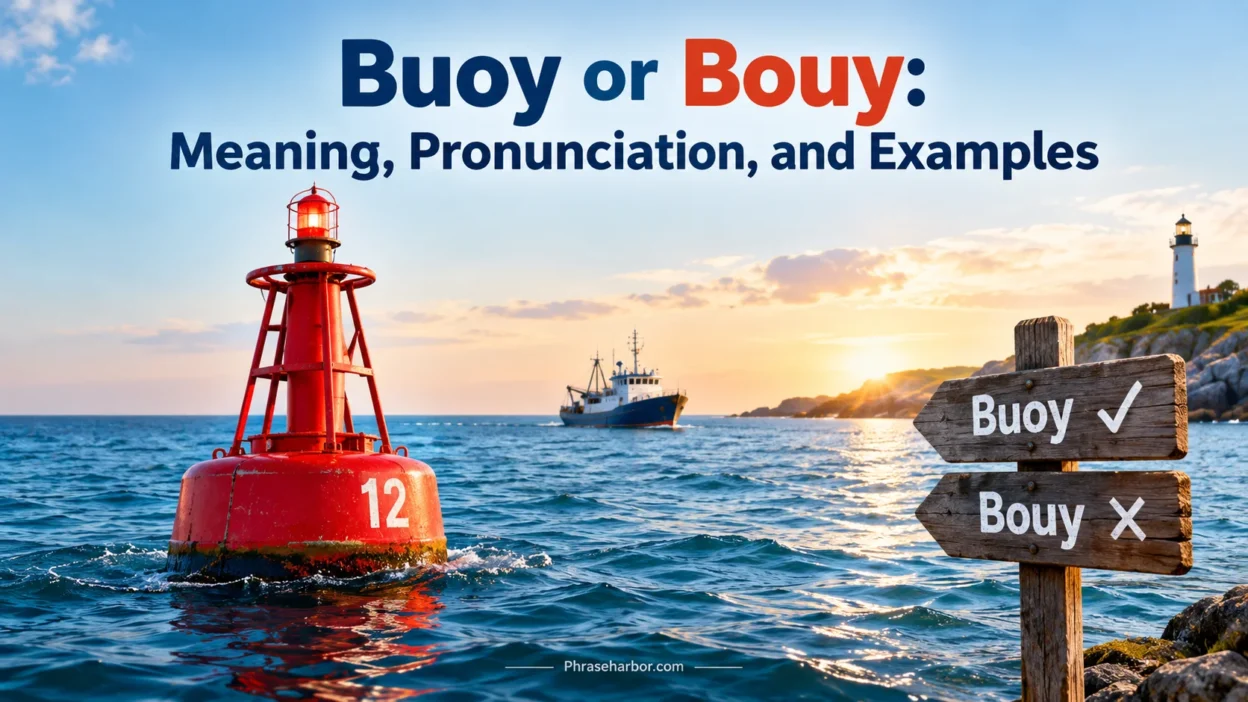
If you wonder about Buoy or Bouy, remember that Buoy is the correct spelling, while Bouy is a common spelling mistake in everyday English writing. The main issue is spelling, not meaning. Buoy is the standard English word, whereas Bouy is a misspelling that often causes spelling confusion and common spelling confusion.
Its unusual spelling and pronunciation can make the incorrect form look natural to both native speakers and learners. When the word is typed, the sound may not immediately suggest its written form. In formal writing, a report, social media post, maritime document, or another document, using the correct word and proper spelling is important.
From my experience with professional writing and academic writing, connecting the English word with its meaning makes the correct form easier to remember and prevents a common error and spelling error.A buoy is a floating object or floating marker placed on water for several practical purposes. It can mark a location, mark areas, mark locations, guide boats, indicate hazards, and warn about danger.
Quick Answer
Buoy is the correct spelling. Bouy is incorrect in standard English.
A buoy is generally a floating object placed in water to provide information, guidance, warnings, or a mooring point. For example:
The captain steered the boat around the red buoy.
The word can also function as a verb:
The encouraging news buoyed her spirits.
So, whenever you mean the floating marker or the related verb, use buoy, not bouy.
| Spelling | Correct? | Meaning |
| Buoy | Yes | A floating marker or something that supports or encourages |
| Bouy | No | Common misspelling of buoy |
The easiest spelling to memorize is simply B-U-O-Y.
Comparison Overview
The difference between buoy or bouy isn’t a difference in meaning. Only one of these spellings is standard English.
| Feature | Buoy | Bouy |
| Standard spelling | Yes | No |
| Standard English word | Yes | No |
| Can be a noun | Yes | No |
| Can be a verb | Yes | No |
| Refers to a floating marker | Yes | No |
| Can mean to encourage or support | Yes | No |
| Common spelling mistake | No | Yes |
| Correct plural | Buoys | — |
The important point is that bouy doesn’t represent a second version of the word. You shouldn’t use it in formal writing, schoolwork, professional communication, or technical writing.
Main Differences Between Buoy or Bouy
The main difference is straightforward: buoy is correct, while bouy is a misspelling. However, understanding the word itself makes the distinction much easier to remember.
A buoy usually refers to a floating object that serves a particular purpose in water. It may identify a navigation channel, warn boaters about an underwater hazard, mark a swimming area, or provide a place for a vessel to attach.
The word also has a figurative meaning. When buoy works as a verb, it can describe something that lifts someone’s mood or strengthens their confidence.
Buoy as a Noun
As a noun, a buoy is a floating object anchored or otherwise positioned in water. Its job depends on its design and location.
You might see a buoy in a harbor, lake, river, coastal area, or open sea. Some are relatively small markers. Others are substantial structures designed to remain visible in rough water.
For example:
The sailor spotted a buoy marking the edge of the channel.
Here, buoy identifies the physical floating marker.
Buoys can provide several kinds of information:
- Navigation: They can mark safe channels and navigational routes.
- Warnings: They can identify hazards such as rocks or shallow water.
- Boundaries: They can indicate swimming or restricted areas.
- Mooring: Some buoys provide attachment points for boats.
- Information: Certain buoys display signs, symbols, numbers, or lights.
- Scientific monitoring: Specialized buoys can collect information about ocean and weather conditions.
The word therefore has a broad practical use. A buoy isn’t merely something that floats. Its position and purpose usually communicate useful information.
Buoy as a Verb
Buoy also works as a verb. In its literal sense, it can mean to keep something afloat or help support it in water.
However, its figurative use is particularly common.
When something buoys a person, it lifts their spirits, increases their confidence, or gives them encouragement.
For example:
Her team’s support buoyed her confidence before the competition.
Another example is:
The unexpected praise buoyed his spirits.
In these sentences, nobody is physically floating. The word uses the image of something being kept above water as a metaphor for emotional support.
Think of it this way: a physical buoy keeps something afloat, while encouragement can metaphorically keep someone’s spirits afloat.
What Does Bouy Mean?
Bouy is a misspelling of buoy. It doesn’t function as a standard English word with its own established meaning.
People commonly write bouy because the sequence of letters can seem more intuitive. When someone knows the pronunciation but hasn’t seen the word written often, they may naturally rearrange the vowels.
For example:
Incorrect: The boat passed the bouy.
Correct: The boat passed the buoy.
The mistake doesn’t usually come from misunderstanding the meaning. It comes from remembering the sound but not the exact spelling.
This is similar to many English words whose pronunciations don’t clearly reveal their written forms. English contains numerous unusual spelling patterns because its vocabulary developed from several languages and historical sound changes.
Why Is Bouy a Common Mistake?
The spelling bouy looks plausible at first glance. That’s the trap.
The letters ou occur frequently in English words, so writers may instinctively place them together. However, buoy uses the sequence uo after the initial b.
Correct:
B-U-O-Y
Incorrect:
B-O-U-Y
That tiny difference changes a correctly spelled word into a misspelling.
How to Spell Buoy Correctly
The correct spelling is:
B-U-O-Y
The unusual part is the middle sequence U-O.
A useful way to remember it is to picture the word as something that floats. The letters themselves don’t provide a perfect mnemonic, but repeated exposure to the correct spelling makes the unusual sequence easier to recognize.
Try writing these forms:
- buoy
- buoys
- buoyed
- buoying
Notice that the spelling keeps the same basic buoy pattern.
For example:
The red buoy marked the channel.
Several buoys floated near the harbor entrance.
The positive response buoyed the team’s confidence.
The device was designed for buoying equipment in the water.
A Simple Memory Trick
Think of the word as:
BU + OY = BUOY
The important point is to remember that the U comes before the O.
If you remember BUOY, you can then build its other forms:
buoy → buoys → buoyed → buoying
That pattern is much safer than trying to reconstruct the spelling from pronunciation.
How Do You Pronounce Buoy?
The pronunciation of buoy can seem just as confusing as its spelling.
In standard American English, buoy is commonly pronounced like “BOO-ee,” with two syllables.
The spelling doesn’t look like it should produce that sound. That’s one reason people who hear the word before seeing it written may have difficulty spelling it correctly.
The pronunciation can also vary by English variety and speaker. In American English, the two-syllable pronunciation is widely recognized.
For example:
The boat moved slowly toward the buoy.
When you’re learning the word, don’t rely on pronunciation alone to reconstruct its spelling. English spelling often contains patterns that aren’t obvious from sound.
Why Do People Spell Buoy as Bouy?
The spelling mistake bouy usually results from letter-order confusion.
Letter-Order Confusion
The correct sequence is:
B-U-O-Y
The mistaken sequence is:
B-O-U-Y
Only two vowels have switched positions. Yet that small change makes a significant difference.
Because the word’s pronunciation doesn’t clearly announce the order of the letters, writers may remember the sounds correctly while reconstructing the spelling incorrectly.
Familiar Spelling Patterns
English has many words containing ou, such as:
- sound
- round
- found
- cloud
- ground
That familiar pattern can make bouy look reasonable to someone who hasn’t memorized the spelling of buoy.
However, English doesn’t always follow the spelling pattern that seems most intuitive.
Typing and Spelling Mistakes
Fast typing can make the problem worse. When people know what they want to say but type quickly, they may accidentally reverse adjacent letters.
That’s especially easy with unusual words.
If you’re writing about boating, navigation, marine science, or another technical subject, it’s worth checking the spelling carefully. A spell-checker may catch bouy, but you shouldn’t rely entirely on automatic correction.
Buoy in Different Contexts
The word buoy appears in several real-world settings. Understanding those contexts helps you understand why the word matters beyond a simple spelling question.
Maritime Navigation
Navigation is one of the most important uses of buoys.
A buoy can mark a channel, hazard, safe-water area, or other navigational feature. Depending on the system and location, buoys may have particular colors, shapes, numbers, or lights.
A sailor doesn’t necessarily see a buoy as decoration. It can communicate important information about where a vessel should or shouldn’t travel.
For example:
The captain followed the channel markers and passed each buoy carefully.
In busy waterways, these markers help organize movement and reduce confusion.
Swimming and Recreation
Buoys also appear in recreational waters.
A beach or swimming area may use floating markers to establish a boundary. The markers can help separate swimmers from boats or identify areas intended for particular activities.
For example:
Swimmers stayed inside the area marked by the buoys.
Here, the buoys function as visible boundaries.
Fishing and Mooring
Some buoys have specialized purposes.
A mooring buoy can provide a point where a vessel can attach rather than dropping an anchor directly onto the seabed. This arrangement can be especially useful in areas where anchoring could damage sensitive environments or where designated mooring systems exist.
Fishing operations may also use buoys to mark equipment or locations.
For example:
The crew returned to the buoy marking their equipment.
The exact purpose depends on the type of buoy and the environment.
Scientific Monitoring
Modern buoys can do much more than mark locations.
Specialized oceanographic and weather buoys can collect measurements such as:
- Water temperature
- Air temperature
- Wind speed
- Wind direction
- Wave conditions
- Atmospheric pressure
- Ocean conditions
These systems can provide valuable environmental data. Some transmit information electronically so researchers and forecasting systems can monitor changing conditions.
That makes the word buoy relevant not only to sailors but also to meteorology, oceanography, environmental science, and marine research.
Read More: For Who or For Whom: A Complete Grammar Guide
Buoy Examples in Sentences
Seeing the word in context makes the spelling easier to remember.
Buoy as a Noun
The sailor noticed a yellow buoy ahead.
A red buoy marked the edge of the channel.
The swimmers stayed inside the line of buoys.
The boat approached the mooring buoy slowly.
The navigation system identified the nearby buoy.
Buoy as a Verb
The good news buoyed her spirits.
His team’s support buoyed his confidence.
The strong sales figures buoyed investor optimism.
Her encouraging words buoyed him during a difficult week.
The last examples demonstrate the figurative meaning. The word creates an image of something being lifted or kept afloat.
Incorrect vs. Correct Examples
| Incorrect | Correct |
| The boat passed the bouy. | The boat passed the buoy. |
| We saw three bouys offshore. | We saw three buoys offshore. |
| The bouy marked the channel. | The buoy marked the channel. |
| They tied the boat to the bouy. | They tied the boat to the buoy. |
One detail deserves special attention: the plural of buoy is buoys, not bouys.
Common Mistakes With Buoy
The spelling itself isn’t the only possible source of confusion. Several related mistakes appear when people encounter this word.
Writing Bouy Instead of Buoy
This is the most obvious error.
Wrong: The fishing boat approached the bouy.
Right: The fishing boat approached the buoy.
Remember the middle letters: U-O, not O-U.
Confusing Spelling With Pronunciation
English pronunciation doesn’t always provide a reliable spelling guide.
Buoy is a good example. Someone can pronounce the word correctly yet still spell it incorrectly.
That’s why visual familiarity matters. The more often you read buoy, the more natural the correct spelling becomes.
Assuming Bouy Is an Alternative Spelling
Some spelling variations are legitimate because American and British English use different forms. Bouy, however, isn’t a standard American-versus-British variation of buoy.
The standard spelling remains buoy.
Buoy Synonyms and Related Terms
Several words are connected with buoy, but they aren’t always exact substitutes.
Float
Float is a broad term for something that remains on or near the surface of water.
A buoy can be a type of floating object, but not every float serves the specific marking or mooring function associated with a buoy.
Marker
A marker identifies a location, boundary, or feature.
A buoy can serve as a marker, especially in water. However, a marker doesn’t necessarily float.
Beacon
A beacon is generally a visible or signaling object used to identify a location or provide guidance.
Some navigation systems use both floating buoys and fixed beacons. They can serve related purposes, but they’re physically different types of markers.
Navigation Marker
A navigation marker is a broader term for something that helps vessels determine where they are or where they should travel.
A buoy may serve as a navigation marker, but the broader category can include other structures and systems.
Buoy vs. Similar Maritime Terms
Understanding related terms prevents another kind of confusion: treating every navigation object as the same thing.
Buoy vs. Beacon
A buoy normally floats in water. A beacon is generally fixed to a structure or location and provides a visible or other navigational signal.
For example, a floating marker in a harbor may be a buoy, while a light mounted on a fixed structure may serve as a beacon.
Their functions can overlap, but their physical forms differ.
Buoy vs. Float
The word float has a much broader meaning.
Anything designed to remain on the surface can potentially be described as a float. Buoy is more specific when the object serves a defined navigational, warning, boundary, mooring, or related purpose.
Compare these sentences:
The children played with a float in the pool.
The captain watched for the navigation buoy.
Both objects can float. Their functions are quite different.
Buoy vs. Marker
A marker identifies or indicates something.
A buoy can be a marker, but a marker doesn’t have to be a buoy. Road signs, posts, flags, painted lines, and other objects can all function as markers.
So, buoy describes a particular kind of floating object, while marker describes a broader function.
FAQs:
1. Is it Buoy or Bouy?
Buoy is the correct spelling. Bouy is a common misspelling and should not be used in standard English writing.
2. What does buoy mean?
A buoy is a floating object placed on water to mark locations, guide boats, identify hazards, or provide navigation information.
3. How do you pronounce buoy?
Buoy has a pronunciation that can vary by variety of English. The spelling may look unusual, which is one reason people sometimes write bouy incorrectly.
4. Why do people spell buoy as bouy?
The mistake usually happens because the pronunciation does not clearly match the unusual spelling. When people write the word from memory or sound, bouy can seem like a logical spelling.
5. How can I remember the spelling of buoy?
A simple memory trick is to remember that the correct form is buoy, with the u before the o. Repeatedly seeing and using the correct spelling can also help.
Conclusion:
Buoy is the correct spelling, while bouy is a misspelling. A buoy is a floating marker used on water for navigation, safety, location marking, and warning about hazards. If you remember the correct letter order in buoy, you can avoid this common spelling mistake in everyday, professional, and academic writing.