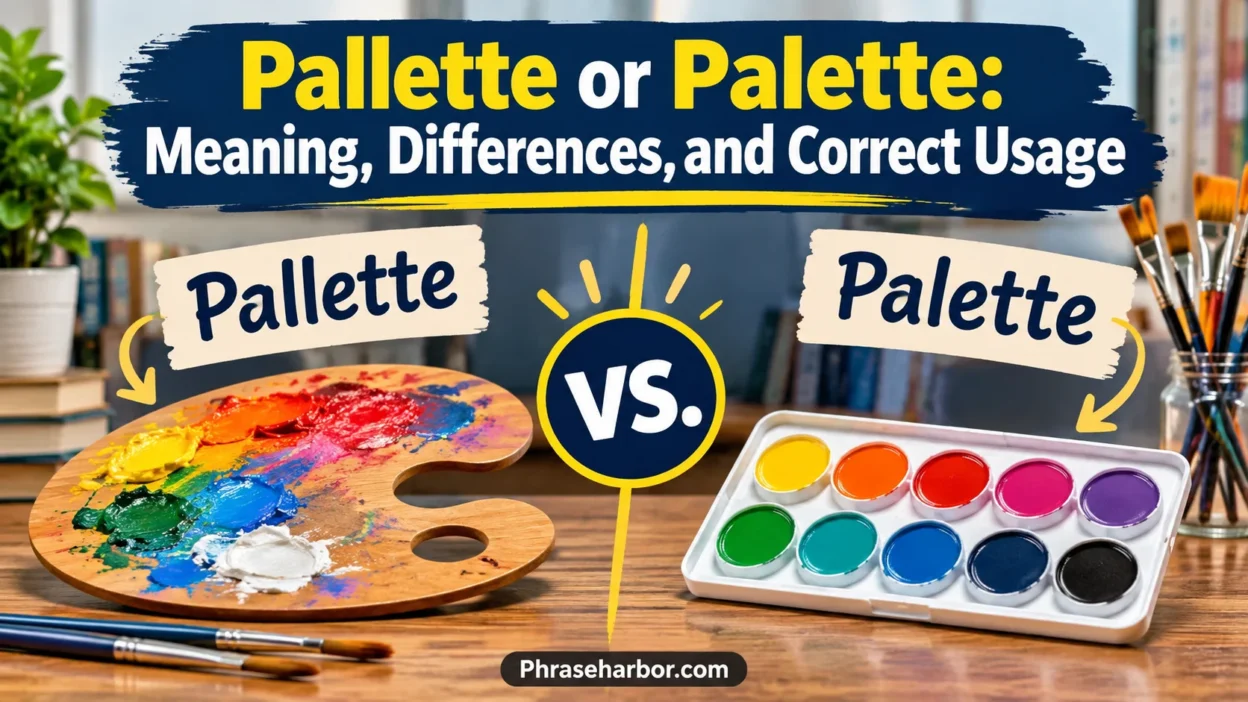
Have you ever wondered whether the correct spelling is pallette or palette? You’re not alone. These words look almost identical, and adding one extra letter can turn a correct spelling into a mistake. If you’re writing about painting, graphic design, makeup, or colors, choosing the right word matters.
The confusion becomes even more understandable when you consider another similar word: pallet. Although palette and pallet are both correct English words, they have entirely different meanings. Meanwhile, pallette is generally a misspelling of palette in standard English.
Understanding these differences will help you write more confidently, avoid spelling errors, and choose the right word for your intended meaning. Whether you’re a student, designer, artist, or professional writer, learning the distinction is easier than you might think.
Quick Answer:
Palette is the correct standard English spelling when referring to a range of colors, an artist’s surface for mixing paints, or a selection of creative options. Pallette is generally a misspelling of palette.
Here’s the simplest way to understand the difference:
- Palette: A selection of colors, an artist’s mixing surface, or a range of options.
- Pallette: A nonstandard spelling that is usually incorrect when you mean palette.
- Pallet: A platform used to store, stack, or transport goods.
Consider these examples:
- Correct: The artist chose a bright palette for her painting.
- Incorrect: The artist chose a bright pallette for her painting.
- Correct: The warehouse employee moved the boxes onto a wooden pallet.
Remember this simple rule: A palette relates to paint and colors, while a pallet helps move goods. In standard English, avoid pallette when you mean either of these words.
Comparison Overview
The quickest way to understand pallette versus palette is to compare their spelling, meaning, and usage.
| Feature | Palette | Pallette | Pallet |
| Standard English spelling | Yes | No, not for the usual intended meaning | Yes |
| Main meaning | Colors, mixing surface, or range of choices | Usually a misspelling of palette | Platform for storing or moving goods |
| Common contexts | Art, design, makeup, cooking | Usually a spelling error | Warehousing, shipping, logistics |
| Example | She selected a blue palette. | Nonstandard: She selected a blue pallette. | The boxes sat on a wooden pallet. |
| Related forms | Palettes | No standard plural for the intended meaning | Pallets |
The main distinction is straightforward. Palette refers to colors or selections, whereas pallet refers to a physical platform used to handle goods.
The spelling pallette usually appears when someone accidentally adds an extra letter to palette. It isn’t an accepted alternative spelling in standard American English.
Main Differences Between Pallette and Palette
Although pallette and palette differ by only one letter, their status in standard English isn’t the same. Understanding the correct spelling will help you avoid mistakes in everyday writing and professional content.
Palette Is the Correct Standard Spelling
Palette is the accepted spelling when you mean an artist’s mixing surface, a collection of colors, or a range of creative choices.
The word appears in many fields. Painters use palettes to mix paint, graphic designers select color palettes for websites, and makeup artists work with palettes containing different shades.
Writers also use palette figuratively to describe a range of options. For example, a chef might offer a palette of flavors, while a musician might explore a broad palette of sounds.
Here are several correct examples:
- The painter cleaned her palette after finishing the portrait.
- Our design team selected a neutral color palette for the website.
- The makeup artist opened a palette containing twelve eyeshadow shades.
- The restaurant offers a diverse palette of flavors.
- The composer used a rich palette of musical textures.
Notice that the spelling remains the same regardless of the context. Whether you’re discussing art, technology, food, or music, use palette when you mean a range of colors or options.
Pallette Is Generally a Misspelling
Pallette is generally considered a spelling error when the intended word is palette. Standard American English doesn’t recognize it as an alternative spelling for an artist’s palette or a color selection.
The mistake often happens because English contains several words with similar letter patterns. People may confuse palette with pallet or assume that both words need the same spelling structure.
For example:
- Incorrect: The designer created a modern pallette for the brand.
- Correct: The designer created a modern palette for the brand.
Another example:
- Incorrect: She mixed the red and yellow paint on her pallette.
- Correct: She mixed the red and yellow paint on her palette.
The correction is simple: remove the extra t that appears before the final e in the incorrect spelling.
The correct letter sequence is p-a-l-e-t-t-e.
If you encounter pallette in an article, email, assignment, or design brief, check whether the writer intended palette. In most ordinary contexts, that will be the correct replacement.
One qualification matters: a business, product, or person might use Pallette as a proper name. That doesn’t make it a standard alternative spelling of the English word palette.
Palette vs. Pallet: Understanding the Third Word
The confusion doesn’t stop with pallette. The correctly spelled word pallet creates another common source of mistakes.
A pallet is a flat structure that supports goods during storage, handling, and transportation. Warehouses, factories, distribution centers, and shipping companies commonly use pallets to move products efficiently.
A palette, by contrast, relates to color or a range of choices.
Compare these examples:
- The warehouse worker stacked cartons on a wooden pallet.
- The artist selected a warm palette of orange, red, and gold.
- The makeup artist organized her brushes beside a colorful palette.
- The delivery driver secured the loaded pallet before transportation.
The words can appear in similar-looking sentences, but their meanings remain distinct.
| Sentence | Correct word | Why |
| The artist mixed the paint. | Palette | It refers to an artist’s mixing surface. |
| The warehouse stored the boxes. | Pallet | It supports goods during storage. |
| The designer selected five brand colors. | Palette | It describes a set of colors. |
| The forklift moved the shipment. | Pallet | It refers to the platform carrying the goods. |
When choosing between these words, focus on the subject. If you’re discussing colors or creative choices, use palette. If you’re discussing shipping or warehouse equipment, use pallet.
What Does Palette Mean?
The word palette has several related meanings. Its original association with painting has expanded into design, beauty, cooking, music, and other fields.
Understanding these meanings will help you recognize when the word fits naturally into a sentence.
Palette as an Artist’s Mixing Surface
In traditional painting, a palette is a surface on which an artist places and mixes paints. Artists use it to combine pigments, adjust shades, and prepare colors before applying them to a canvas or another surface.
Traditional palettes may be made of wood, plastic, glass, or other materials. Some have a thumb hole that allows the painter to hold the palette while working.
Digital art uses the same concept in a different form. A painting application may display a digital palette containing color swatches, sliders, and tools that help artists select or mix colors.
For example:
- The painter squeezed several colors onto her palette.
- He mixed a little white paint into the blue on his palette.
- The digital artist saved a custom palette for the illustration.
Although these examples describe different tools, they share the same basic idea: a palette helps an artist select and organize colors.
Palette as a Range of Colors
In modern English, palette frequently describes a collection of colors chosen for a particular purpose. This meaning is especially common in graphic design, branding, photography, fashion, and interior decoration.
A color palette might contain three colors or dozens of shades. The number depends on the project and the visual effect the designer wants to create.
For instance, a website might use navy blue, white, and light gray to create a clean, professional appearance. A children’s book might feature bright yellow, turquoise, and coral to create a lively atmosphere.
Common types of color palettes include:
- Monochromatic palette: Uses variations of one color, including lighter tints and darker shades.
- Complementary palette: Combines colors positioned opposite each other on the traditional color wheel.
- Analogous palette: Uses neighboring colors on the color wheel.
- Neutral palette: Relies heavily on colors such as white, gray, beige, and brown.
- Warm palette: Emphasizes colors such as red, orange, and yellow.
- Cool palette: Emphasizes colors such as blue, green, and violet.
These labels describe common design approaches rather than rigid rules. A designer can adapt a palette to match a brand’s identity, a room’s lighting, or an image’s intended mood.
Consider this example:
“The designer chose a muted color palette of sage green, cream, and charcoal for the company’s website.”
Here, palette means the coordinated set of colors used throughout the design.
Palette as a Range of Choices or Options
The word palette can also describe a broader range of available elements. This figurative meaning extends beyond visual art.
When someone describes a palette of choices, they mean a selection of different possibilities that can be combined or explored.
For example:
- The software gives editors a broad palette of creative tools.
- The restaurant offers a varied palette of flavors.
- The composer explored a rich palette of sounds.
- The author used a wide palette of storytelling techniques.
This usage works because a collection of options resembles an artist’s selection of colors. Each option contributes something different, and the available range influences the final result.
However, palette doesn’t fit every list of choices. In ordinary writing, range, selection, or variety may sound more natural when no creative or sensory meaning is intended.
For example, “The store offers a wide range of office supplies” sounds more direct than “The store offers a wide palette of office supplies.”
Choose the word that best matches the context.
Palette in Makeup and Beauty
In the beauty industry, a palette is a collection of makeup colors grouped together in one product or set.
Eyeshadow palettes are a familiar example. They often contain multiple shades designed to work together, making it easier to create different looks without purchasing each color separately.
Other products may include contour palettes, blush palettes, and face palettes that combine several makeup shades or finishes.
Examples include:
- She bought a neutral eyeshadow palette for everyday makeup.
- The makeup artist selected a warm palette for the photoshoot.
- This contour palette contains several shades for different makeup effects.
The term can also describe the overall color choices used in a beauty campaign. A cosmetics brand might feature a soft pink and peach palette in its advertising to create a consistent visual identity.
In each case, palette refers to a collection of colors or shades, not a spelling variation such as pallette.
Palette in Cooking and Food Writing
Food writers sometimes use palette to describe a range of flavors, particularly when discussing a chef’s creative approach or the sensory qualities of a dish.
For example, a dish might combine smoky paprika, fresh citrus, aromatic herbs, and mild sweetness. A writer could describe the result as a complex palette of flavors.
Here are a few examples:
- The chef developed a bold palette of flavors using herbs and spices.
- The tasting menu offered a varied palette of seasonal ingredients.
- Citrus and fresh mint added new dimensions to the dish’s flavor palette.
It’s worth distinguishing palette from palate, another correctly spelled word associated with food.
Palate refers to the roof of the mouth and, by extension, a person’s sense of taste or flavor preferences.
Compare these sentences:
- The chef created a colorful palette of ingredients.
- The spicy dish appealed to her adventurous palate.
The first sentence refers to a range of ingredients. The second describes someone’s taste or appreciation of flavors.
This distinction is useful because palette and palate can appear in similar food-related contexts while expressing different ideas.
Read More: Full Time or Full-Time: Meaning, Differences, and Correct Usage
What Does Pallette Mean?
In standard English, pallette generally has no separate established meaning when used as a common noun in place of palette. Most writers who use this spelling intend to refer to colors, painting, or a collection of creative options.
Nevertheless, seeing the spelling in a particular context doesn’t automatically mean someone intended an ordinary English word. It could be a name, a brand, or a product label.
Is Pallette a Real English Word?
For everyday writing, treat pallette as a misspelling of palette unless the context clearly establishes it as a proper name.
A proper name follows the spelling chosen by the person or organization using it. For example, a fictional business could call itself “Pallette Studio.” That name would retain its chosen spelling even though pallette isn’t the standard spelling of the ordinary word palette.
The distinction is important:
- Common noun: Use palette when referring to a range of colors.
- Proper name: Preserve the established spelling of a person’s name, brand, or business.
- Spelling correction: Replace pallette with palette when the writer intended the standard English word.
Don’t assume every occurrence of pallette has the same explanation. Context determines whether you’re correcting a spelling mistake or reproducing a proper name accurately.
Why Do People Spell Palette as Pallette?
Several factors can contribute to this mistake.
Confusion with similar words: The words palette, pallet, and palate share similar letter patterns. Remembering which word contains which letters can be difficult, especially when writing quickly.
Uncertainty about double consonants: English spelling contains many words with doubled consonants. A writer may remember the double t in palette but place an additional letter in the wrong position.
Typing errors: When someone types quickly, a familiar-looking spelling may pass unnoticed. The writer may recognize the word’s intended meaning without noticing the incorrect letter sequence.
Limited proofreading: A sentence can make perfect sense even when it contains a spelling mistake. Readers often understand the intended meaning from context, which makes errors easier to overlook.
For example, “The artist chose a colorful pallette” remains understandable. However, the correct spelling is still palette.
A reliable way to prevent the mistake is to memorize the spelling and connect it with a familiar example, such as an artist’s paint palette.
How to Use Palette Correctly in a Sentence
Knowing the definition is useful, but examples show how palette works in everyday writing. The following sentences cover common situations in which the word appears.
Examples of Palette in Art and Design
Use palette when referring to an artist’s mixing surface or a selected group of colors.
- The artist arranged her paints on a wooden palette.
- The illustrator created a bright palette for the children’s book.
- The design team chose a restrained color palette for the company logo.
- Warm earth tones dominate the interior designer’s palette.
- The photographer adjusted the image’s palette to emphasize the sunset.
- The painter used a limited palette to keep the composition visually consistent.
These examples show how the same word works across traditional art and modern visual communication.
Examples of Palette in Everyday and Figurative Language
The figurative meaning allows writers to describe collections of sounds, flavors, ideas, and creative techniques.
- The chef introduced a new palette of seasonal flavors.
- The composer used an unusual palette of musical sounds.
- The filmmaker explored a darker visual palette in the sequel.
- The workshop introduced students to a broader palette of writing techniques.
- The software provides a flexible palette of design tools.
These uses are appropriate when the writer wants to emphasize variety, creative selection, or the combination of different elements.
However, avoid forcing the word into sentences where simpler alternatives communicate the idea more clearly. Good writing depends on context, not on using elaborate vocabulary whenever possible.
Incorrect Usage of Pallette
The following examples demonstrate common spelling errors and their corrections.
| Incorrect sentence | Correct sentence | Explanation |
| The artist cleaned her pallette. | The artist cleaned her palette. | Use palette for an artist’s mixing surface. |
| We need a new color pallette. | We need a new color palette. | The standard phrase is color palette. |
| She purchased an eyeshadow pallette. | She purchased an eyeshadow palette. | Use palette for a collection of makeup shades. |
| The website uses a blue and gray pallette. | The website uses a blue and gray palette. | A palette is a selected group of colors. |
| The chef created a varied pallette of flavors. | The chef created a varied palette of flavors. | Use palette for a range of flavors. |
The correction doesn’t change the meaning of any sentence. It simply replaces a nonstandard spelling with the accepted form.
FAQs:
Is Pallette or Palette Correct?
Palette is the correct standard spelling when referring to an artist’s mixing surface, a group of colors, or a range of creative options.
Pallette is generally a misspelling of palette. Use the standard spelling in essays, emails, website content, design briefs, and other ordinary writing.
Is Pallette Ever Correct?
The spelling pallette may appear in a proper name, business name, brand, or product label. In those cases, preserve the established spelling when referring to that specific entity.
However, it isn’t a standard alternative spelling of palette in ordinary American English.
If you’re writing about colors or painting, choose palette.
What Is the Difference Between Palette and Pallet?
A palette relates to colors, painting, or a range of options. A pallet is a platform used to store, stack, and transport goods.
For example, a painter mixes colors on a palette, while a warehouse worker loads boxes onto a pallet.
Although their spellings are similar, their meanings are different.
How Do You Spell Color Palette?
The correct American English spelling is color palette.
Use this phrase when referring to a group of colors selected for a design, artwork, website, photograph, or another creative project.
Example: “The designer chose a soft color palette for the new website.”
Remember that American English uses color, not the British spelling colour.
Is Palette Used Outside Art?
Yes. Although palette is strongly associated with painting, it also appears in graphic design, photography, makeup, cooking, music, and figurative writing.
For example, a makeup palette contains cosmetic shades, while a palette of flavors describes a range of tastes.
In each case, the word conveys a collection or selection of elements.
Conclusion:
When deciding between pallette or palette, the correct choice is usually straightforward. Palette is the standard spelling for an artist’s mixing surface, a coordinated set of colors, or a range of creative options. Pallette is generally a misspelling of that word.
Don’t confuse palette with pallet, either. A pallet supports goods during storage and transportation, while a palette relates to colors and creative selections. Remember palate as well, since it refers to taste or the roof of the mouth.
- Months or Month’s: Meaning, Difference, and Correct Usage
- I’ll Be Forever Grateful vs. I’ll Forever Be Grateful: Meaning and Correct Usage
- Vagrant vs. Hobo: Meaning, Differences, and Correct Usage
- Align To or Align With: Meaning, and Correct Usage
- Moment vs. Momment: Meaning, Spelling, and Correct Usage