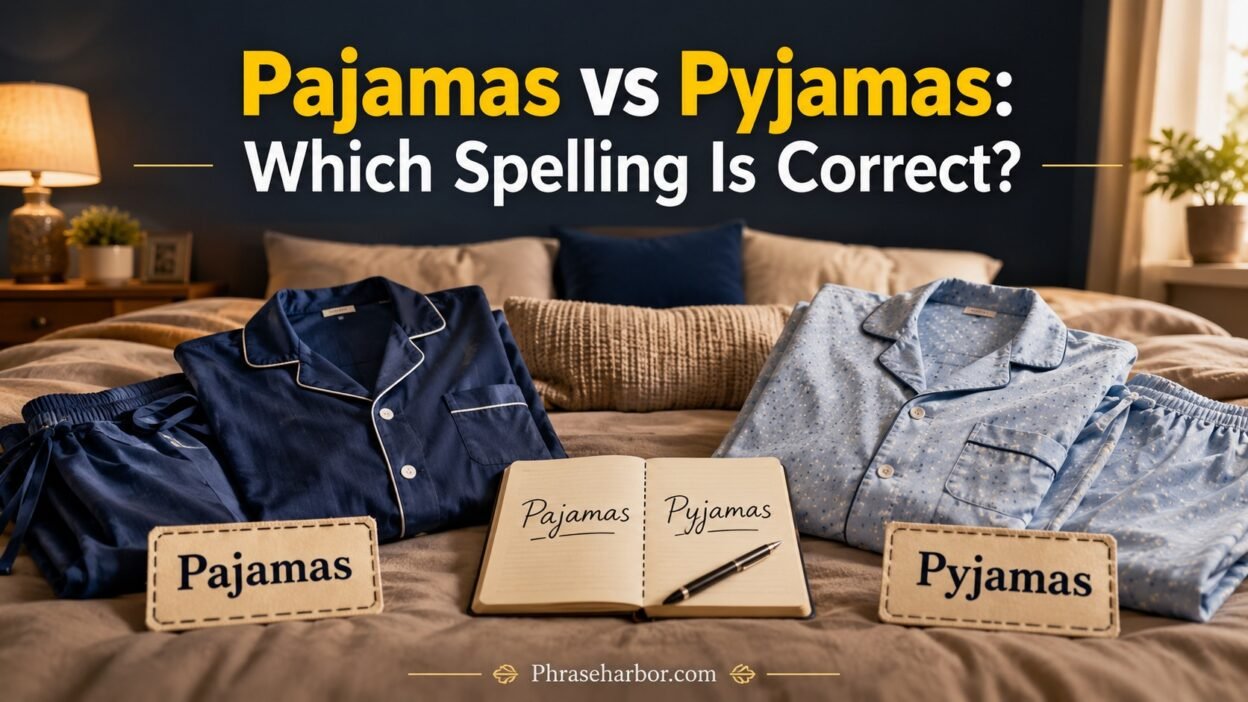
Pajamas vs Pyjamas shows a simple spelling difference shaped by usage, regional insights, and how language evolves in English. This classic example highlights how spelling differences can remain as language evolution continues, while the real difference is in spelling, not meaning.
In American English spelling, pajamas is the common American form, whereas pyjamas appears more often in British-style English and British English. These regional spelling choices matter when writing bedtime stories, crafting a blog post, shopping online, or preparing a children’s article. Your audience, location, reading habits, and preferred version can affect how natural your writing feels.
In English, American and British forms can influence tone, trust, and writing style, especially across websites, blogging pages, and online shopping. From my experience, readers often notice this spelling choice, as American reading habits, British preferences, and regional variation can shape reader trust.
Quick Answer
Here’s the short answer if you’re in a hurry.
| Question | Answer |
| Are pajamas and pyjamas the same word? | Yes. |
| Do they have different meanings? | No. |
| Which spelling is American English? | Pajamas |
| Which spelling is British English? | Pyjamas |
| Is either spelling wrong? | No. Both are correct. |
| Do they have different pronunciations? | No. They are pronounced the same way. |
Rule of thumb:
- Use pajamas if you’re writing in US English.
- Use pyjamas if you’re writing in UK English.
- Stay consistent throughout your document.
Comparison Overview
At first glance, the only difference between pajamas and pyjamas is a single letter. However, that small spelling change reflects one of the most recognizable differences between American and British English.
| Feature | Pajamas | Pyjamas |
| Meaning | Clothes worn for sleeping | Clothes worn for sleeping |
| American English | Standard spelling | Rare |
| British English | Less common | Standard spelling |
| Australian English | Sometimes used | More common |
| New Zealand English | Occasionally used | Preferred |
| Canadian English | Both accepted | Both accepted depending on style guide |
| Pronunciation | Same | Same |
| Grammar | Noun | Noun |
| Formality | Standard | Standard |
Key Facts
- Both words refer to sleepwear.
- Neither spelling is more formal than the other.
- Dictionaries recognize both spellings.
- The difference is purely regional.
- Pronunciation remains identical regardless of spelling.
Main Differences Between Pajamas vs Pyjamas
Although pajamas and pyjamas have identical meanings, several subtle differences matter when writing professionally.
Spelling
The most obvious distinction is the spelling.
- Pajamas uses the letter a after the p.
- Pyjamas uses the letter y after the p.
That single letter tells readers which variety of English you’re using.
Regional Preference
Location determines which spelling readers expect.
| Country | Preferred Spelling |
| United States | Pajamas |
| United Kingdom | Pyjamas |
| Ireland | Pyjamas |
| Australia | Pyjamas |
| New Zealand | Pyjamas |
| Canada | Both |
If your audience lives in the United States, pajamas feels natural. Readers in Britain usually expect pyjamas.
Style Guides
Many publishers follow established style guides.
For example:
- American newspapers almost always use pajamas.
- British newspapers consistently use pyjamas.
- International companies often adapt their spelling based on the market they’re targeting.
Consistency matters more than the spelling itself.
Search Engine Optimization
If you’re writing online, keyword selection becomes important.
Generally speaking:
- Pajamas receives significantly more global searches because American English dominates online content.
- Pyjamas attracts readers searching from the United Kingdom, Australia, and other Commonwealth countries.
Many international websites naturally include both spellings to improve visibility across different regions.
Reader Expectations
Imagine visiting a British clothing website that advertises “Kids Pajamas.”
British readers may notice the American spelling immediately.
Likewise, an American shopper might think “Kids Pyjamas” looks unfamiliar.
Neither spelling is incorrect. You’re simply matching your audience’s expectations.
What Are Pajamas (or Pyjamas)?
Pajamas, also spelled pyjamas, are garments designed specifically for sleeping or relaxing at home. Modern pajamas come in countless styles, fabrics, and designs, making them one of the most versatile types of clothing.
Traditionally, pajamas consist of:
- A loose-fitting shirt or top
- Comfortable pants or shorts
- Soft, breathable fabric
However, today’s sleepwear market includes many variations beyond the traditional two-piece set.
Common Types of Pajamas
Different people prefer different styles depending on comfort and climate.
Popular options include:
- Cotton pajama sets
- Satin pajamas
- Silk pajamas
- Flannel pajamas
- Thermal pajamas
- Bamboo pajamas
- Linen sleepwear
- Knit sleep sets
- Short pajama sets
- Long-sleeve winter pajamas
Each fabric offers unique benefits.
For example:
| Material | Best For |
| Cotton | Everyday comfort |
| Silk | Luxury and temperature regulation |
| Flannel | Cold weather |
| Bamboo | Moisture control |
| Satin | Smooth feel |
| Linen | Hot climates |
Why People Wear Pajamas
Sleepwear isn’t only about tradition.
Wearing dedicated pajamas can improve comfort and support better sleep habits.
Benefits include:
- Better temperature regulation
- Increased comfort
- Cleaner bedding
- Healthier bedtime routines
- Relaxation after work
- Reduced skin irritation from tight clothing
Many sleep experts recommend changing into clean sleepwear before bed because it creates a mental signal that it’s time to rest.
Pajamas vs Other Nightwear
People often confuse pajamas with other sleep garments.
Here’s a simple comparison.
| Clothing | Description |
| Pajamas | Matching top and bottoms |
| Nightgown | Loose one-piece sleep dress |
| Robe | Outer garment worn over sleepwear |
| Loungewear | Comfortable clothing for relaxing |
| Onesie | One-piece garment covering the body |
Although these garments overlap, they’re not identical.
Modern Pajamas Are More Than Sleepwear
Today’s fashion industry has blurred the line between pajamas and casual clothing.
Many people now wear pajama-inspired outfits:
- Working from home
- Long flights
- Relaxing weekends
- Hotel stays
- Casual mornings
Luxury fashion brands have even introduced pajama-inspired collections that appear on runways around the world.
Comfort has become fashionable.
Origin and History of the Word
One of the most fascinating facts about pajamas is that the word didn’t originate in English.
Instead, it traveled across continents and languages before becoming part of everyday vocabulary.
Understanding this history also explains why two spellings exist today.
Persian Roots
The earliest known form comes from the Persian phrase:
پای جامه (pāy-jāmeh)
The phrase literally means:
Leg garment
Originally, it referred to loose-fitting trousers worn throughout Persia.
Adoption into Hindi and Urdu
As Persian influenced languages across South Asia, the word entered both Hindi and Urdu.
In these languages, it became:
Pajama / Pyjama
These garments were lightweight trousers tied with a drawstring and commonly worn by both men and women.
They were practical in warm climates because they allowed airflow while remaining modest.
British Colonial Influence
During British rule in India in the eighteenth and nineteenth centuries, British officials encountered these loose trousers daily.
Many adopted the comfortable clothing for evenings and relaxation.
Eventually, they carried both the garment and its name back to Britain.
That’s how pyjamas entered English.
How the Meaning Changed
Interestingly, the original word referred only to loose trousers.
Over time, English speakers expanded its meaning.
Instead of describing just the pants, pyjamas eventually referred to the complete sleep outfit.
Today, the word generally means:
- Pajama pants
- Pajama shirt
- Matching sleepwear set
Language naturally evolves, and this is a perfect example.
Why American English Uses “Pajamas”
When American English developed its own spelling conventions, many words became simplified.
The spelling pajamas fit those reforms.
American English tends to favor shorter, more phonetic spellings.
Other examples include:
| American English | British English |
| Color | Colour |
| Honor | Honour |
| Favor | Favour |
| Theater | Theatre |
| Center | Centre |
| Traveler | Traveller |
| Pajamas | Pyjamas |
This doesn’t mean American spelling is newer or more correct.
It simply reflects a different approach to standardizing English.
Timeline of the Word
| Period | Development |
| Ancient Persia | Pāy-jāmeh refers to loose leg garments. |
| Medieval South Asia | The word becomes part of Hindi and Urdu. |
| 1700s | British officials encounter the garment in India. |
| Early 1800s | Pyjamas enters British English. |
| Late 1800s | Americans begin favoring pajamas. |
| Modern English | Both spellings coexist as accepted regional variants. |
An Interesting Language Journey
Few everyday words have traveled such a remarkable path.
A Persian term became part of South Asian languages, crossed continents during the British colonial era, entered British English, evolved into American English, and eventually spread worldwide.
Today, whether you write pajamas or pyjamas, you’re using a word with centuries of linguistic history and global cultural influence.
Pronunciation of Pajamas vs Pyjamas
One of the biggest misconceptions about pajamas vs pyjamas is that the different spellings change the pronunciation. They don’t. Whether you’re reading an American novel or a British newspaper, the word sounds the same.
Standard Pronunciation
IPA (International Phonetic Alphabet):
- American English: /pəˈdʒɑː.məz/
- British English: /pəˈdʒɑː.məz/
Although regional accents may slightly affect the vowel sounds, the pronunciation remains essentially identical.
Easy Phonetic Spelling
You can pronounce both words as:
“puh-JAH-muhz”
The stress falls on the second syllable.
Why the Pronunciation Didn’t Change
Unlike many spelling differences between American and British English, the pronunciation of pajamas and pyjamas stayed the same because both spellings originated from the same borrowed word. The written form evolved differently, but the spoken form remained stable.
Common Pronunciation Mistakes
Avoid these common errors:
- Saying “pay-jamas.”
- Pronouncing the “j” like the French sound in Jacques.
- Emphasizing the first syllable instead of the second.
Listening to native speakers quickly shows that the pronunciation stays consistent regardless of spelling.
Pajamas vs Pyjamas: Side-by-Side Comparison
If you only remember one section from this guide, let it be this one. The table below summarizes the key differences between pajamas and pyjamas.
| Feature | Pajamas | Pyjamas |
| Meaning | Sleepwear | Sleepwear |
| Pronunciation | Same | Same |
| Grammar | Noun | Noun |
| American English | Preferred | Rare |
| British English | Less common | Preferred |
| Australian English | Occasionally used | Common |
| New Zealand English | Occasionally used | Common |
| Canadian English | Both accepted | Both accepted |
| Dictionaries | Merriam-Webster | Oxford & Cambridge |
| SEO Usage | Higher global search volume | Strong UK search volume |
Similarities
Both words:
- Mean exactly the same thing.
- Refer to clothing worn for sleeping.
- Function as nouns.
- Have identical pronunciation.
- Are accepted by major English dictionaries.
- Are grammatically interchangeable.
Differences
The differences are surprisingly small:
- Spelling
- Regional preference
- Publishing style guides
- Target audience expectations
Everything else stays the same.
Read More: Wonder vs. Wander: What’s the Difference?
Why American and British English Use Different Spellings
Many English learners wonder why the language contains two accepted spellings for so many words. The answer lies in history rather than grammar.
When American English developed independently after the United States gained independence, spelling gradually became more standardized. American lexicographer Noah Webster believed English spelling should be simpler and more consistent.
His dictionaries encouraged spellings such as:
- Color instead of colour
- Honor instead of honour
- Center instead of centre
- Pajamas instead of pyjamas
Meanwhile, British English retained many traditional spellings that reflected older writing conventions.
As a result, both versions became standard in their respective regions.
Other Common American vs British Spelling Differences
| American English | British English |
| Pajamas | Pyjamas |
| Color | Colour |
| Favorite | Favourite |
| Honor | Honour |
| Center | Centre |
| Theater | Theatre |
| Jewelry | Jewellery |
| Traveling | Travelling |
| Catalog | Catalogue |
| Program | Programme (certain contexts) |
Notice a pattern?
American English often favors shorter spellings, while British English preserves historical forms.
Examples of Using “Pajamas” in Sentences
If you’re writing for an American audience, these examples demonstrate the correct usage.
- I bought a new pair of pajamas before winter arrived.
- The children wore matching Christmas pajamas.
- She packed two sets of pajamas for the vacation.
- My favorite cotton pajamas feel incredibly soft.
- He forgot his pajamas at the hotel.
- The store sells organic bamboo pajamas.
- Comfortable pajamas help me sleep better.
- Everyone arrived at the party wearing festive pajamas.
- My grandmother gave me silk pajamas for my birthday.
- These pajamas fit perfectly.
Example Paragraph
After a long day, Emma changed into her favorite pajamas, made a cup of herbal tea, and curled up with a good book. The comfortable cotton fabric helped her relax before bedtime.
Examples of Using “Pyjamas” in Sentences
These examples follow standard British English.
- He folded his pyjamas neatly before breakfast.
- The children wore matching Christmas pyjamas.
- She bought new silk pyjamas during the holiday sale.
- My winter pyjamas keep me warm.
- Everyone changed into comfortable pyjamas before the movie.
- Her blue pyjamas were made from soft cotton.
- I packed my pyjamas for the weekend trip.
- The hotel provided clean pyjamas for every guest.
- His striped pyjamas looked very comfortable.
- She prefers lightweight pyjamas during summer.
Example Paragraph
Before going to bed, Oliver slipped into his warm pyjamas and sat by the fireplace reading a mystery novel. It had become part of his nightly routine.
Pajamas vs Pyjamas in Major Dictionaries
One reason this spelling debate continues is that respected dictionaries don’t all use the same preferred spelling.
Fortunately, they agree on one important point: both spellings are correct.
| Dictionary | Preferred Entry | Notes |
| Merriam-Webster | Pajamas | Standard American spelling |
| American Heritage Dictionary | Pajamas | Preferred in US English |
| Oxford English Dictionary | Pyjamas | Recognizes pajamas as a variant |
| Cambridge Dictionary | Pyjamas (UK), Pajamas (US) | Lists both regional spellings |
| Collins Dictionary | Both | Labels each according to region |
What This Means for Writers
The dictionary you choose often depends on the variety of English you’re using.
For example:
- Writing for an American university? Use Merriam-Webster conventions.
- Writing for a British publication? Follow Oxford or Cambridge style.
Professional editors care more about consistency than which regional spelling you choose.
FAQs:
Is pajamas or pyjamas correct?
Both pajamas and pyjamas are correct. Pajamas is the standard spelling in American English, while pyjamas is more common in British English and many regions influenced by British usage.
What is the main difference between pajamas and pyjamas?
The main difference is spelling, not meaning. Both words describe comfortable clothing worn for sleeping or lounging. Your choice usually depends on your audience and regional English.
Is pajamas American or British?
Pajamas is the preferred spelling in American English. If you’re writing for readers in the United States, pajamas will usually look more natural and familiar.
Is pyjamas British English?
Yes. Pyjamas is the common British English spelling. It’s also widely used in countries and regions where British English has influenced local language and spelling standards.
Can I use both pajamas and pyjamas in the same article?
You can, but it’s better to choose one spelling and use it consistently. If your article targets American English readers, use pajamas. For a British English audience, use pyjamas.
Conclusion:
Pajamas vs Pyjamas is a straightforward regional spelling difference. Both words have the same meaning and refer to clothing worn for sleeping or relaxing. The best choice depends mainly on your audience, location, and preferred English standard.
If you’re writing for an international audience, either spelling is understandable. However, keeping your spelling consistent throughout your writing makes your content clearer, more natural, and more professional.