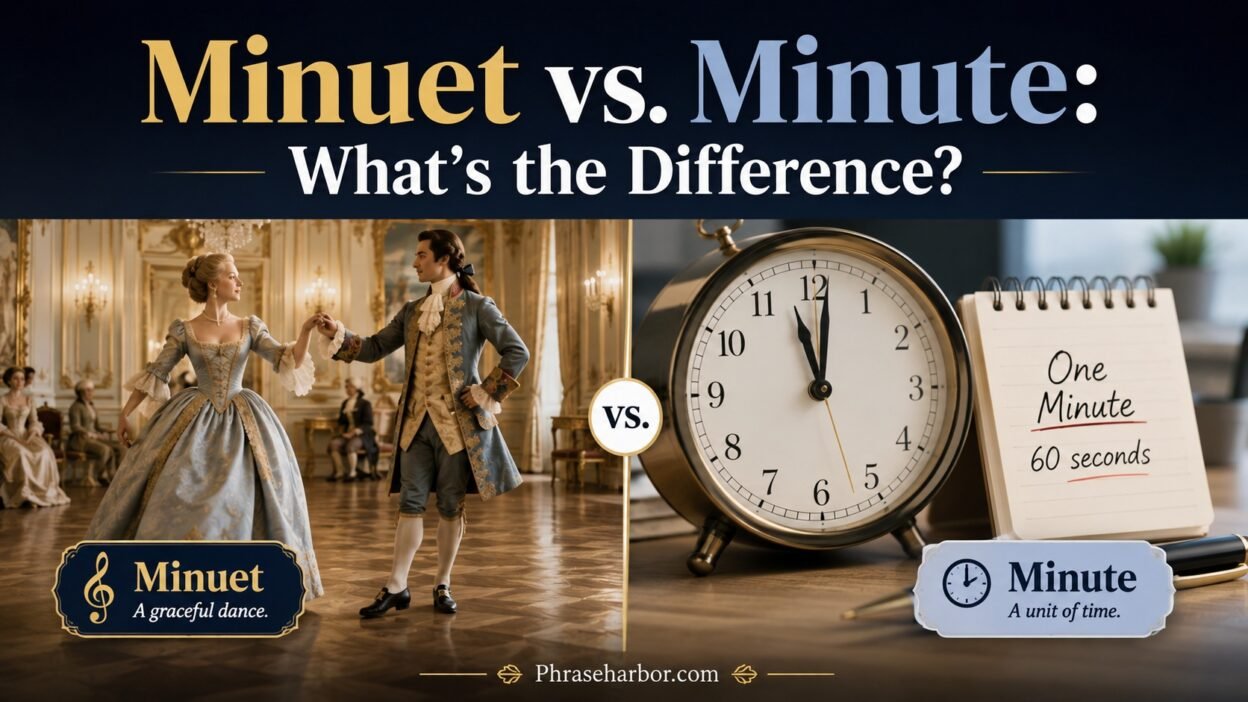
Minuet vs. Minute helps learners separate similar-sounding words that can cause confusion when their meaning and usage differ. A minute is a unit of time equal to sixty seconds, useful for daily communication, daily writing, and academic work when you track schedules and tasks.
In practical situations, managing and tracking time precisely with a clock helps users know how long activities take. From my experience helping students, writers, and learners, clarity improves when you study the definition, meaning, meanings, uses, and examples together.
This approach helps you avoid misuse, spelling mistakes, typos, and small mistakes in spoken English, written English, writing, reading, and speaking. Recognizing the differences, distinction, spelling, pronunciation, and each small detail, helping your sentences look natural and accurate.
Quick Answer
The difference between minuet and minute is simple:
- Minuet is a noun that refers to a graceful ballroom dance and a type of classical music popular during the 17th and 18th centuries.
- Minute is usually a noun meaning 60 seconds. It can also refer to written meeting records or serve as an adjective meaning extremely small.
Although they look alike, they are not interchangeable because they have different meanings, pronunciations, and grammatical functions.
Comparison Overview
| Feature | Minuet | Minute |
| Primary Meaning | A formal ballroom dance | A unit of time |
| Other Meanings | Musical composition | Meeting notes, extremely small |
| Part of Speech | Noun | Noun, adjective |
| Pronunciation | min-yoo-ET | MIN-it or my-NOOT |
| Common Usage | Music, dance, history | Daily conversation, business, science |
| Frequency | Rare | Extremely common |
| Origin | French | Latin |
Main Differences Between Minuet vs. Minute
Although these words differ by only one letter, they belong to entirely different contexts.
Meaning
A minuet is a formal dance accompanied by classical music.
A minute usually measures time. Depending on context, it can also mean meeting notes or something extremely tiny.
Pronunciation
Their pronunciation is one of the biggest differences.
- Minuet → min-yoo-ET
- Minute (time) → MIN-it
- Minute (tiny) → my-NOOT
Many learners incorrectly pronounce minuet like minute, but doing so changes the word completely.
Usage
You’ll encounter minute almost every day because people constantly talk about time.
In contrast, minuet appears mainly in discussions about:
- Classical music
- European history
- Ballroom dancing
- Music education
- Literature
Grammar
Minuet functions only as a noun.
Minute has multiple grammatical roles.
- Noun (time)
- Noun (meeting notes)
- Adjective (extremely small)
Popularity
The word minute ranks among the most frequently used English words.
Minuet is much less common and usually appears in educational, musical, or historical writing.
What Does “Minuet” Mean?
Definition of Minuet
A minuet is a slow, elegant ballroom dance that became fashionable in France during the 1600s. Couples performed it with graceful, carefully planned movements, making it one of the defining dances of European royal courts.
The word also refers to the music composed specifically for this dance.
The History of the Minuet
The minuet originated in western France before gaining popularity in the royal court of King Louis XIV. As French culture spread throughout Europe, the dance became a symbol of sophistication and good manners.
Soon afterward, famous composers began writing minuets as part of larger musical works.
Some of the most celebrated composers who wrote minuets include:
- Johann Sebastian Bach
- Wolfgang Amadeus Mozart
- Joseph Haydn
- Ludwig van Beethoven
Their compositions helped transform the minuet from a social dance into an important musical form.
Characteristics of a Minuet
A traditional minuet has several recognizable features.
- Graceful movements
- Moderate tempo
- Triple meter (3/4 time)
- Formal choreography
- Elegant posture
- Courtly style
Unlike energetic modern dances, the minuet emphasizes precision, balance, and refinement.
Where You May Encounter the Word “Minuet”
Although it isn’t common in everyday conversation, you’ll still find minuet in several settings.
Classical Music
Many orchestral works contain a minuet movement.
Example:
Mozart included beautiful minuets in several of his symphonies.
Dance History
Dance instructors often teach the minuet when discussing historical ballroom traditions.
Example:
Students practiced the minuet before learning other Renaissance dances.
Literature
Historical novels frequently describe aristocrats dancing the minuet during formal gatherings.
Example:
The guests performed a graceful minuet beneath crystal chandeliers.
Example Sentences Using “Minuet”
- The orchestra performed a beautiful minuet by Mozart.
- Every couple learned the traditional minuet before the royal celebration.
- She studied the minuet in her classical dance class.
- The music teacher explained why the minuet became popular during the Baroque era.
- The concert concluded with an elegant minuet.
What Does “Minute” Mean?
Unlike minuet, the word minute has several meanings.
Understanding the context makes it easy to determine which meaning applies.
Minute as a Unit of Time
This is the meaning most people know.
A minute equals 60 seconds.
There are:
- 60 seconds in one minute
- 60 minutes in one hour
- 1,440 minutes in one day
Because time is part of daily life, this meaning appears constantly.
Examples:
- I’ll be ready in five minutes.
- The meeting lasted thirty minutes.
- She finished the test in under twenty minutes.
- Please wait one minute.
Everyday Situations
You’ll hear this version when discussing:
- Travel
- Sports
- Cooking
- School
- Movies
- Work schedules
Examples include:
- Bake for 25 minutes.
- The train arrives in ten minutes.
- Our lunch break lasts thirty minutes.
Minute as Meeting Minutes
In business and government, minutes are the official written record of a meeting.
These notes summarize:
- Attendance
- Discussions
- Decisions
- Votes
- Action items
Example sentences:
- Sarah recorded the meeting minutes.
- Please review yesterday’s minutes.
- The board approved the minutes unanimously.
Meeting minutes create a permanent record for future reference.
Minute as an Adjective
When pronounced my-NOOT, the adjective minute means extremely small.
It often appears in scientific, technical, or formal writing.
Examples:
- Scientists detected minute particles in the sample.
- The engineer examined minute cracks in the bridge.
- There was only a minute difference between the two results.
- Astronomers measured minute changes in brightness.
Common Synonyms
Depending on context, minute can mean:
- Tiny
- Minuscule
- Microscopic
- Slight
- Negligible
- Infinitesimal
How Context Changes the Meaning of “Minute”
One interesting aspect of English is that identical spellings sometimes have different pronunciations and meanings.
Consider these examples.
| Sentence | Meaning |
| Wait a minute. | Sixty seconds |
| The committee approved the minutes. | Meeting record |
| There was a minute crack in the wall. | Extremely small |
Notice how context immediately tells readers which definition applies
Why People Confuse Minuet and Minute
Several factors contribute to this common confusion.
Similar Spelling
Both words begin with minu-.
Readers often assume they share related meanings.
Different Pronunciations
Although they look alike, they sound different.
| Word | Pronunciation |
| Minuet | min-yoo-ET |
| Minute (time) | MIN-it |
| Minute (tiny) | my-NOOT |
Learning these pronunciations early prevents future mistakes.
Rare Usage of “Minuet”
Because most people rarely encounter minuet, they often replace it with the more familiar minute without realizing the error.
Spellcheck Doesn’t Always Help
Most spellcheck programs verify spelling rather than meaning.
If you accidentally write:
The dancers performed a minute.
your software may not flag it because minute is spelled correctly—even though the sentence is incorrect.
Real-Life Examples Comparing Minuet and Minute
Reading both words side by side makes the distinction much clearer.
| Minuet | Minute |
| The orchestra played a beautiful minuet. | The concert lasted ninety minutes. |
| The dancers practiced the minuet every afternoon. | Wait one minute before leaving. |
| Mozart composed several famous minuets. | The secretary wrote the meeting minutes. |
| The royal guests enjoyed a formal minuet. | Scientists found minute traces of gold. |
| The ballet included a traditional minuet. | The difference was minute but important. |
Key Facts About Minuet vs. Minute
- Minuet always refers to a dance or musical composition.
- Minute most often refers to time.
- Minute has three primary meanings.
- Minuet has only one grammatical function.
- Minute is among the most common English words.
- Minuet mainly appears in historical and musical contexts.
- The adjective minute has a completely different pronunciation from the noun referring to time.
- Despite similar spelling, these words are unrelated in everyday usage.
A Simple Memory Trick
If you struggle to remember the difference, try this association:
- Minuet → Music + Dance
- Minute → Minutes on a Clock
Think of it this way:
If you can dance it, it’s a minuet. If you can measure it with a clock, it’s a minute.
That simple rule helps eliminate confusion almost every time.
How to Pronounce Minuet and Minute Correctly
One of the biggest reasons people confuse minuet and minute is their spelling. They look almost identical. However, their pronunciations are quite different.
Learning the correct pronunciation not only improves your speaking skills but also helps you remember each word’s meaning.
Pronunciation Chart
| Word | IPA Pronunciation | Easy Pronunciation | Meaning |
| Minuet | /ˌmɪn.juˈet/ | min-yoo-ET | A classical dance or musical piece |
| Minute (time) | /ˈmɪn.ɪt/ | MIN-it | 60 seconds |
| Minute (small) | /maɪˈnjuːt/ | my-NOOT | Extremely small |
Read More: Pajamas vs Pyjamas: Which Spelling Is Correct?
Pronouncing “Minuet”
The stress falls on the last syllable.
Correct: min-yoo-ET
Examples:
- The orchestra performed a graceful minuet.
- Every music student learned the famous minuet.
Pronouncing “Minute” (Time)
When referring to time, the stress falls on the first syllable.
Correct: MIN-it
Examples:
- Wait a minute.
- The class starts in five minutes.
Pronouncing “Minute” (Tiny)
When minute means extremely small, the pronunciation changes completely.
Correct: my-NOOT
Examples:
- Scientists observed minute particles.
- There was only a minute difference between the two measurements.
Common Pronunciation Mistakes
Many English learners make these errors:
| Incorrect | Correct |
| Saying MIN-it for minuet | min-yoo-ET |
| Saying my-NOOT for time | MIN-it |
| Reading every “minute” the same way | Pronounce it according to the meaning |
Tips to Remember the Pronunciation
- Minuet ends with “ET,” so stress the last syllable.
- Minute (time) is short and quick, just like a minute itself.
- Minute (tiny) sounds longer because it often appears in formal or scientific language.
When Should You Use Minuet?
Use minuet only when talking about the historical dance or the music written for that dance.
Although uncommon in everyday conversation, it’s still widely used in music, education, and history.
Use “Minuet” When Discussing Classical Music
Many famous composers included minuets in their compositions.
Examples:
- Mozart wrote several memorable minuets.
- The orchestra opened the concert with a lively minuet.
Use “Minuet” in Dance History
The minuet played an important role in European social life during the 17th and 18th centuries.
Example:
- The museum demonstrated how nobles danced the minuet.
Use “Minuet” in Literature
Historical novels often describe aristocratic balls where guests danced the minuet.
Example:
- The duke invited everyone to join the minuet.
Use “Minuet” in Music Education
Music teachers frequently explain the structure of a minuet when introducing classical compositions.
Example:
- Students analyzed the rhythm of Bach’s minuet.
Situations Where “Minuet” Fits
- Classical concerts
- Ballet performances
- Music textbooks
- History lessons
- Dance academies
- Museums
- Historical fiction
When Should You Use Minute?
Unlike minuet, the word minute appears in everyday English.
Its meaning depends on the surrounding context.
Use “Minute” for Time
This is by far the most common use.
Examples:
- I’ll call you in ten minutes.
- The movie starts in one minute.
- It only takes a minute.
Use “Minute” for Meeting Records
Businesses, schools, charities, and government organizations all keep meeting minutes.
Examples:
- The secretary prepared the meeting minutes.
- Please review last week’s minutes before the next meeting.
Use “Minute” as an Adjective
Use minute when describing something extremely small.
Examples:
- Engineers inspected minute cracks.
- Scientists measured minute changes in temperature.
Everyday Uses of “Minute”
You’ll see the word in:
- Phone conversations
- Emails
- Recipes
- Sports
- Travel
- Science
- Business
- Education
- News reports
FAQs:
What is the difference between minuet and minute?
Minuet refers to a traditional dance or a piece of classical music, while minute usually means a unit of time equal to sixty seconds. They sound similar, but their meanings and uses are completely different.
Is minuet related to time?
No. A minuet is connected to music, dance, rhythm, and choreographed movement. A minute, on the other hand, is a measurement of time used for schedules, tasks, and daily activities.
How do you use minute in a sentence?
You can use minute when talking about time. For example: “The meeting will start in five minutes.” It can also describe something very small, depending on pronunciation and context.
How do you remember the spelling of minuet?
Think of minuet as the word connected with music and dance. It contains the letters “-uet,” which can help you separate it from minute, the word commonly used for time.
Are minuet and minute pronounced the same?
They are very similar in pronunciation, which is why they can cause confusion. However, their meanings, spelling, and contexts are different, so paying attention to the surrounding words can help you choose correctly.
Conclusion:
Understanding Minuet vs. Minute becomes easier when you connect each word with its main meaning. Minuet belongs to classical music and dance, while minute commonly refers to a unit of time. Remembering this simple distinction can help you avoid spelling mistakes and use both words accurately in writing and conversation.