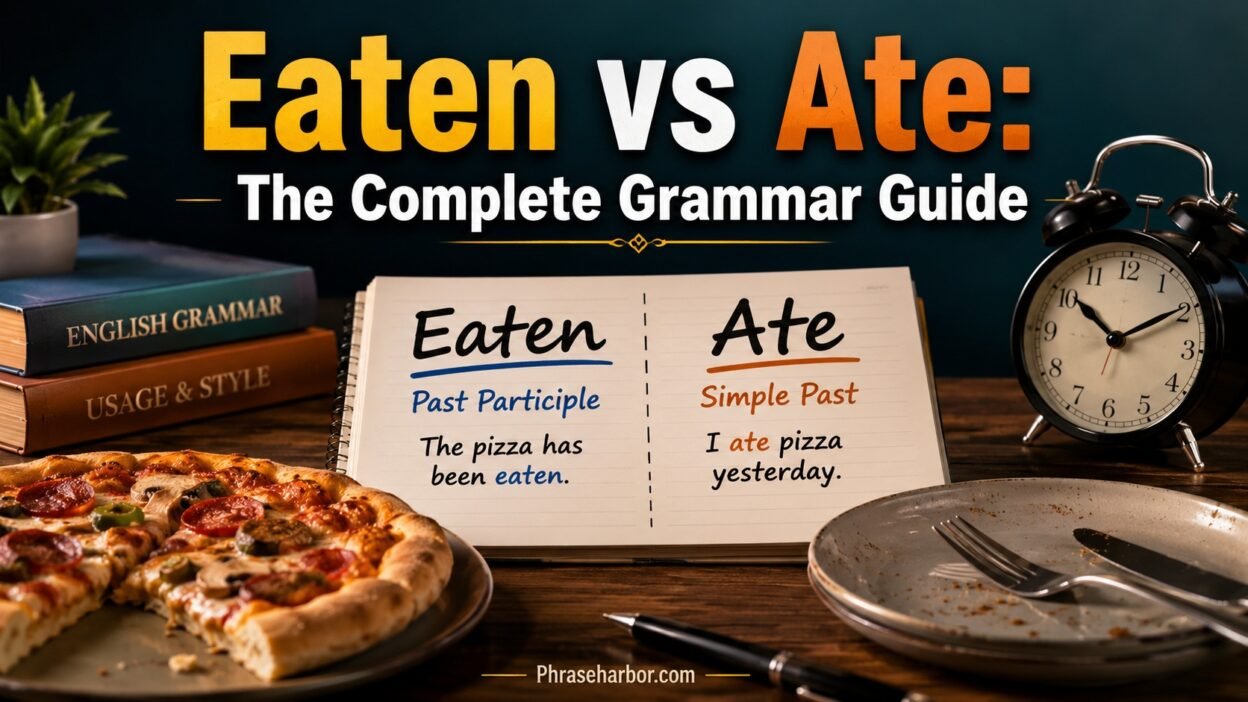
Eaten vs Ate becomes easier when learners see that ate is the simple past, while eaten needs a helping verb in perfect tenses for completed actions. Ate describes an action at a specific time in the past, while eaten is a past participle used with have, has, or had. The grammar structure, verb tense, sentence structure, and sentence patterns make the difference clear.
For example, “I ate pasta yesterday” describes a finished event, while “I have eaten pasta” uses the present perfect tense. The key is to see whether ate stands alone or eaten follows an auxiliary verb or helping verb. This makes the correct use easier to identify quickly, even when the contextual meaning, sentence meaning, phrase meaning, or text interpretation changes.
Quick Answer
Ate is the simple past tense of the verb eat, while eaten is the past participle. Use ate when describing a completed action in the past without a helping verb. Use eaten only with a helping verb such as have, has, had, is, was, or been.
Examples:
- I ate breakfast at 8 a.m.
- I have eaten breakfast already.
- I have ate breakfast.
- She has ate lunch.
The easiest rule to remember is this:
If there’s a helping verb, use “eaten.” If there isn’t, use “ate.”
Comparison Overview
| Feature | Ate | Eaten |
| Verb Form | Simple past | Past participle |
| Used Alone? | Yes | No |
| Needs Helping Verb? | No | Yes |
| Common Helping Verbs | None | Have, Has, Had, Is, Was, Were, Be, Been |
| Indicates | Completed past action | Perfect tenses and passive voice |
| Example | We ate pizza. | We have eaten pizza. |
Main Differences Between Eaten vs Ate
Understanding the difference between ate and eaten starts with recognizing their role in English grammar.
Ate Is the Simple Past Tense
Use ate to describe something that happened and finished in the past.
Examples:
- I ate dinner at six.
- They ate all the cookies.
- She ate lunch before class.
These sentences don’t require a helping verb because ate already shows past time.
Eaten Is the Past Participle
The word eaten cannot normally stand alone. It must appear with a helping verb.
Examples:
- I have eaten already.
- She had eaten before we arrived.
- The cake was eaten quickly.
Notice how every sentence includes a helping verb.
One Simple Rule
Ask yourself this question:
Does the sentence contain “have,” “has,” “had,” “is,” “was,” or another helping verb?
- Yes → Use eaten.
- No → Use ate.
That single question prevents most grammar mistakes.
What Does “Ate” Mean?
Ate is the simple past tense of the verb eat. It describes an action that started and finished in the past. The action is complete, and the sentence doesn’t need a helping verb.
Unlike eaten, ate can stand alone because it already shows that the event happened earlier.
Definition of Ate
Ate means consumed food or drink in the past.
For example:
- I ate breakfast before work.
- She ate a sandwich at lunch.
- We ate dinner together yesterday.
Each sentence describes a completed action.
When to Use Ate
Use ate when talking about:
- A finished action in the past
- A specific time in the past
- A completed event
- Stories and narratives
- Historical events
Examples:
- They ate at the new Italian restaurant last Friday.
- My grandparents ate dinner at exactly six every evening.
- The children ate everything on their plates.
- We ate outside because the weather was beautiful.
Common Sentence Patterns
You’ll often see ate used in these structures:
| Pattern | Example |
| Subject + Ate + Object | She ate an apple. |
| Subject + Ate + Time | We ate at noon. |
| Subject + Ate + Place | They ate at the café. |
| Subject + Ate + Object + Time | I ate pizza yesterday. |
Everyday Examples of Ate
Here are more examples you might hear in daily conversation:
- I ate too much at the party.
- She ate quickly because she was late.
- They ate breakfast together every Saturday.
- We ate seafood while visiting the coast.
- He ate all the popcorn during the movie.
Notice that every example refers to an action that has already finished.
What Does “Eaten” Mean?
Eaten is the past participle of the verb eat. Unlike ate, it cannot usually appear by itself. It must work with a helping verb to form perfect tenses or passive voice.
Think of eaten as part of a team. It almost always needs another verb beside it.
Definition of Eaten
Eaten means consumed food, but it functions as the past participle rather than the simple past tense.
Examples:
- I have eaten breakfast.
- She has eaten already.
- The cake was eaten before I arrived.
Helping Verbs Used With Eaten
The most common helping verbs include:
- Have
- Has
- Had
- Be
- Been
- Being
- Is
- Are
- Was
- Were
- Will have
- Would have
- Could have
- Should have
- May have
- Might have
Examples:
- They have eaten lunch.
- She had eaten before class.
- The cookies were eaten overnight.
- By tomorrow, we will have eaten everything.
Common Uses of Eaten
Present Perfect
The action happened in the past but still matters now.
Examples:
- I have eaten, so I’m not hungry.
- She has eaten already.
- We have eaten there several times.
Past Perfect
The action happened before another past action.
Examples:
- They had eaten before the meeting started.
- I had eaten lunch when she called.
- He had eaten everything before anyone noticed.
Future Perfect
The action will be complete before a future time.
Examples:
- By noon, I will have eaten breakfast and lunch.
- They will have eaten before the guests arrive.
Passive Voice
The subject receives the action.
Examples:
- The cake was eaten in minutes.
- Every cookie had been eaten.
- The leftovers were eaten by the dog.
The Forms of the Verb “Eat”
Like many common English verbs, eat is an irregular verb. That means it doesn’t follow the standard pattern of adding -ed to form the past tense.
| Verb Form | Word | Example |
| Base Form | Eat | I eat breakfast daily. |
| Third Person Singular | Eats | She eats early. |
| Present Participle | Eating | They are eating now. |
| Simple Past | Ate | We ate together yesterday. |
| Past Participle | Eaten | We have eaten already. |
Learning all forms together makes them much easier to remember.
Why Is Eat an Irregular Verb?
English has hundreds of irregular verbs because many evolved from Old English. Instead of adding -ed, they changed their spelling over time.
Examples include:
| Base Verb | Past Tense | Past Participle |
| Eat | Ate | Eaten |
| Go | Went | Gone |
| Write | Wrote | Written |
| Speak | Spoke | Spoken |
| Break | Broke | Broken |
| Choose | Chose | Chosen |
| Drive | Drove | Driven |
| Fly | Flew | Flown |
Although irregular verbs require memorization, many follow similar sound patterns.
Easy Memory Tip
Remember this sequence:
Eat → Ate → Eaten
Think of it like climbing stairs:
- First step: Eat
- Second step: Ate
- Third step: Eaten
Repeating the sequence aloud several times helps commit it to memory.
When to Use “Ate”
Using ate correctly becomes much easier once you know the situations where it naturally belongs.
Use Ate for Completed Past Actions
Whenever an action started and ended in the past, ate is usually the correct choice.
Examples:
- I ate breakfast before work.
- She ate dinner with her family.
- We ate at a small restaurant downtown.
Use Ate With Specific Past Time Expressions
Time expressions often signal that ate is required.
Examples include:
- Yesterday
- Last night
- Last week
- This morning
- In 2024
- Two hours ago
Examples:
- I ate lunch yesterday.
- We ate pizza last Friday.
- She ate breakfast two hours ago.
Use Ate in Stories
Narratives almost always use the simple past tense.
Example:
Yesterday, we visited a lakeside café. We ate homemade pie, watched the sunset, and walked along the shore before heading home.
The story flows naturally because every action happened in the past.
Use Ate in Historical Writing
Historical facts also rely on the simple past tense.
Examples:
- Ancient Romans ate bread, olives, and cheese.
- Early explorers often ate dried meat during long voyages.
- Medieval families ate seasonal vegetables whenever they were available.
Common Mistakes With Ate
Many learners accidentally pair ate with helping verbs.
Incorrect:
- I have ate lunch.
- She has ate already.
- They had ate dinner.
Correct:
- I have eaten lunch.
- She has eaten already.
- They had eaten dinner.
A quick check for a helping verb usually catches these mistakes before they happen.
When to Use “Eaten”
Unlike ate, the word eaten cannot usually stand alone. It functions as the past participle of eat, so it works with helping verbs to create perfect tenses and passive voice. If you remember this one rule, you’ll avoid one of the most common English grammar mistakes.
Use Eaten in the Present Perfect Tense
The present perfect connects the past with the present. The action happened earlier, but its result still matters now.
Structure:
Subject + have/has + eaten
Examples:
- I have eaten breakfast already.
- She has eaten lunch, so she isn’t hungry.
- They have eaten at that restaurant several times.
- We have eaten enough for today.
Notice that have or has always comes before eaten.
Use Eaten in the Past Perfect Tense
The past perfect shows that one action happened before another action in the past.
Structure:
Subject + had + eaten
Examples:
- We had eaten before the movie started.
- She had eaten dinner when I arrived.
- They had eaten everything before the guests came.
- I had eaten lunch, so I skipped dinner.
This tense helps establish the order of past events.
Use Eaten in the Future Perfect Tense
The future perfect describes an action that will finish before another point in the future.
Structure:
Subject + will have + eaten
Examples:
- I will have eaten before you arrive.
- By next week, they will have eaten every dish on the menu.
- She will have eaten breakfast by 8:00 a.m.
- We will have eaten dinner before the concert begins.
Use Eaten in Passive Voice
In passive sentences, the focus shifts from the person performing the action to the thing receiving it.
Examples:
- The cake was eaten within minutes.
- Every cookie had been eaten before noon.
- The leftovers were eaten by the dog.
- Most of the pizza has already been eaten.
Passive voice isn’t always the best choice, but it’s common when the doer is unknown or unimportant.
Use Eaten With Modal Verbs
Modal verbs combine with have + eaten to express possibility, advice, regret, or expectation.
Examples:
- You should have eaten breakfast.
- She could have eaten earlier.
- They might have eaten already.
- We would have eaten there if it had been open.
Ate vs Eaten in Different English Tenses
Understanding verb tenses makes choosing between ate and eaten much easier.
| Tense | Structure | Example |
| Present Simple | eat/eats | I eat breakfast every day. |
| Present Continuous | am/is/are eating | She is eating now. |
| Simple Past | ate | We ate together yesterday. |
| Present Perfect | have/has eaten | We have eaten already. |
| Past Perfect | had eaten | They had eaten before leaving. |
| Future Perfect | will have eaten | She will have eaten by noon. |
| Present Perfect Continuous | have been eating | I have been eating healthier lately. |
| Passive Voice | be + eaten | The cake was eaten quickly. |
Read More: Minuet vs. Minute: What’s the Difference?
Understanding the Timeline
Think of the verb forms as different points on a timeline.
- Eat = happens regularly or now.
- Ate = happened and finished.
- Eaten = completed with the help of another verb.
This simple progression makes English verb forms much easier to understand.
Why Tense Matters
Choosing the wrong tense changes the grammar of the sentence.
Compare these examples:
- I ate lunch yesterday.
- I have eaten lunch already.
Both are correct, but they emphasize different ideas.
The first sentence focuses on when the action happened. The second focuses on the current result—the speaker isn’t hungry now.
Ate vs Eaten Side-by-Side Examples
Sometimes the fastest way to learn grammar is by comparing correct sentences.
| Ate | Eaten |
| I ate breakfast early. | I have eaten breakfast already. |
| She ate lunch at school. | She has eaten lunch already. |
| We ate dinner together. | We had eaten before the meeting. |
| They ate all the cookies. | The cookies were eaten quickly. |
| He ate pizza yesterday. | He will have eaten before noon. |
| The children ate sandwiches. | The sandwiches had been eaten before recess. |
| I ate too much. | I should have eaten less. |
| They ate outside. | They have eaten outside many times. |
Notice that eaten never appears alone. A helping verb always comes first.
Sentence Patterns You Should Memorize
Learning common sentence structures helps you speak and write naturally.
Common Patterns With Ate
Use these patterns when describing completed past actions.
| Pattern | Example |
| Subject + ate + object | She ate an apple. |
| Subject + ate + place | We ate at home. |
| Subject + ate + time | They ate at noon. |
| Subject + ate + object + time | I ate pasta yesterday. |
| Subject + ate + object + place | He ate lunch at work. |
Common Patterns With Eaten
These patterns appear frequently in spoken and written English.
| Pattern | Example |
| Subject + have eaten | I have eaten already. |
| Subject + has eaten | She has eaten lunch. |
| Subject + had eaten | We had eaten before class. |
| Subject + will have eaten | They will have eaten by six. |
| Subject + should have eaten | You should have eaten earlier. |
| Object + was eaten | The cake was eaten. |
| Object + has been eaten | The food has been eaten. |
Memorizing these patterns improves both writing and speaking speed.
FAQs:
Is “ate” or “eaten” correct?
Both ate and eaten are correct, but they have different uses. Ate is the simple past form, while eaten is the past participle used with helping verbs such as have, has, or had.
Can I say “I have ate”?
No. “I have ate” is grammatically incorrect. You should say “I have eaten” because the present perfect tense requires the past participle eaten after have.
When should I use “ate”?
Use ate when talking about a completed action in the past, especially when the time is stated or understood. For example: “I ate breakfast at 8 a.m.”
When should I use “eaten”?
Use eaten with have, has, or had to form perfect tenses. For example: “She has eaten lunch” or “They had eaten before we arrived.”
What is the easiest way to remember “ate” vs “eaten”?
Remember this simple rule: ate can stand alone as the simple past, while eaten usually needs a helping verb. If you see have, has, or had, choose eaten.
Conclusion:
Understanding Eaten vs Ate becomes much easier when you focus on the verb structure rather than how the words sound. Use ate for a completed past action and eaten after have, has, or had. With regular practice and clear examples, you can avoid common mistakes and use both forms confidently in everyday English.