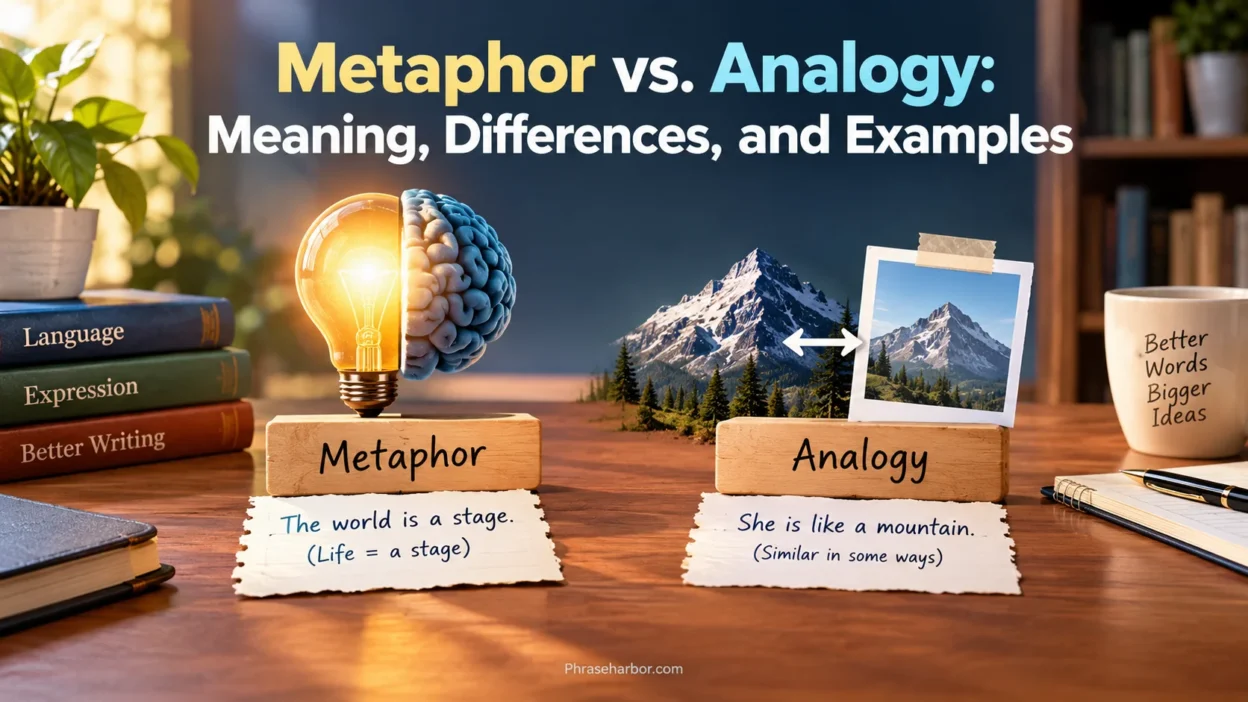
Comparisons can stir a reader’s emotions or explain difficult things in a clearer way. The quick way to understand the differences between a metaphor and an analogy is to look at their purpose. A metaphor describes one thing as another to create a feeling, image, or powerful expression in the mind.
An analogy, however, compares two situations or relationships to provide an explanation. Both literary devices help writers connect familiar concepts with abstract ideas, making their messages more memorable and engaging.
For example, calling someone a shining star is a metaphor because it suggests that the person is special or talented. Comparing a student’s progress to a star gradually becoming brighter can form an analogy because the comparison helps the audience understand how learning and improvement work.
Quick Answer
A metaphor describes one thing as another to express a figurative meaning. An analogy compares two things or relationships to explain an idea, demonstrate a connection, or make something unfamiliar easier to understand.
For example:
- Metaphor: “Time is money.” This metaphor suggests that time is valuable and shouldn’t be wasted.
- Analogy: “Managing your time is like managing your money. Both require you to decide how to spend limited resources.” This analogy explains the relationship between time management and financial management.
The simplest distinction is that a metaphor often expresses an idea through figurative identification, while an analogy explains an idea through a comparison. However, the two devices can overlap because a metaphor can also serve as the starting point for a longer analogy.
Comparison Overview
Metaphors and analogies both rely on similarities, but they emphasize different aspects of comparison. Understanding these differences helps you recognize each device and choose the right one for your purpose.
| Feature | Metaphor | Analogy |
| Definition | Describes one thing as another to suggest a figurative meaning | Compares things or relationships to explain an idea |
| Main purpose | Create imagery, express meaning, or evoke emotion | Clarify concepts, explain processes, or demonstrate relationships |
| Typical structure | Often a short, direct statement | Often a developed comparison with supporting details |
| Focus | A shared quality, image, or characteristic | Similarities between features, functions, or relationships |
| Level of explanation | Often communicates meaning briefly | Often provides more explanation |
| Common settings | Poetry, fiction, speeches, everyday conversation | Education, science, business, reasoning, and everyday explanations |
| Example | “The world is a stage.” | “Life resembles a stage because people take on different roles in different situations.” |
| Main benefit | Makes language vivid and memorable | Makes unfamiliar or complicated ideas easier to understand |
One important distinction deserves attention: length alone doesn’t determine whether a comparison is a metaphor or an analogy. A metaphor can extend across several paragraphs, while an analogy can sometimes fit into one sentence. Their purposes and structures matter more than their word counts.
What Is a Metaphor?
Definition of a Metaphor
A metaphor is a figure of speech that describes one thing in terms of another, even though the two aren’t literally the same. The comparison suggests that they share a meaningful quality, characteristic, or association.
For example, consider the sentence, “Her heart is made of gold.”
The sentence doesn’t mean that her heart consists of a precious metal. Instead, it suggests that she’s generous, kind, and compassionate. The metaphor uses the value associated with gold to communicate something positive about her character.
Metaphors often make abstract ideas easier to picture. Instead of explaining every detail about someone’s kindness, a writer can use a familiar image that communicates the intended meaning immediately.
Consider another example: “The classroom was a zoo.”
A classroom isn’t literally a zoo. The metaphor suggests that the students were noisy, energetic, or difficult to manage. Readers understand the intended comparison without needing a lengthy explanation.
Examples of Metaphors and Their Meanings
Metaphors appear in ordinary conversations, professional communication, literature, and advertising. Here are several examples that demonstrate how they work.
| Metaphor | Intended meaning |
| Time is money. | Time is valuable and shouldn’t be wasted. |
| She has a heart of gold. | She’s generous and kind. |
| His words were daggers. | His words caused emotional pain. |
| The classroom was a zoo. | The classroom was noisy and chaotic. |
| Knowledge is power. | Knowledge can help people make decisions and influence outcomes. |
| He carries the weight of the world. | He feels overwhelmed by responsibilities. |
| Her voice is music to my ears. | Her voice sounds pleasant or comforting. |
| That idea is a gold mine. | The idea has significant value or potential. |
Notice that each metaphor communicates more than its literal wording suggests. The reader interprets the comparison based on familiar associations.
For instance, describing someone’s words as daggers creates a stronger emotional image than simply saying those words were hurtful. The metaphor gives the pain a sharp, physical quality.
Common Types of Metaphors
Metaphors come in several forms. Some make direct comparisons, while others develop an image throughout a passage.
Direct Metaphor
A direct metaphor explicitly identifies one thing with another.
Examples include:
- “My brother is a walking encyclopedia.”
- “The city is a concrete jungle.”
- “Hope is a light in the darkness.”
In each example, the writer directly connects two different things. The comparison communicates a particular quality rather than a literal identity.
A walking encyclopedia suggests extensive knowledge. A concrete jungle suggests a crowded, harsh, or overwhelming urban environment. A light in the darkness represents hope during difficult circumstances.
Implied Metaphor
An implied metaphor suggests a comparison without directly stating that one thing is another.
For example, consider the sentence, “The lawyer attacked the witness’s argument.”
The lawyer probably didn’t use physical force. Instead, the verb attacked suggests an aggressive challenge to the argument.
Other examples include:
- “The company sailed through the crisis.”
- “She clawed her way to the top.”
- “He planted the idea in my mind.”
These expressions use words associated with physical actions to communicate abstract situations. Readers infer the metaphorical meaning from context.
Extended Metaphor
An extended metaphor develops one comparison across several sentences, paragraphs, or even an entire literary work.
For example:
“Life is a journey. Some roads are smooth, while others twist through unfamiliar territory. Along the way, we encounter obstacles, discover unexpected opportunities, and sometimes change direction.”
The passage develops the idea of life as a journey. Roads represent experiences, obstacles represent challenges, and changing direction represents making new choices.
Extended metaphors can help writers explore complex emotions or ideas while maintaining a consistent image. They appear frequently in poetry, novels, speeches, and personal essays.
Mixed Metaphor
A mixed metaphor combines images that don’t fit together naturally.
For example:
“We need to get all our ducks in a row and hit the ground running on the same page.”
This sentence combines several familiar expressions. Each phrase makes sense independently, but the combined imagery becomes confusing.
A clearer version would be:
“We need to organize our plans and get started immediately.”
Mixed metaphors aren’t always deliberate mistakes. Writers sometimes combine expressions accidentally when trying to sound vivid or persuasive. However, they can work intentionally in humor or creative writing when the unusual combination serves a clear purpose.
Why Writers Use Metaphors
Metaphors help writers communicate ideas with fewer words while adding depth and emotion.
Common benefits include:
- Creating vivid imagery: Metaphors help readers visualize abstract ideas through familiar objects or experiences.
- Expressing emotion: A phrase such as “a broken heart” conveys emotional pain more vividly than a neutral description.
- Making ideas memorable: Expressions such as “time is money” are easy to remember because they connect an abstract concept with something concrete.
- Strengthening persuasion: Speakers use metaphors to frame issues in ways that influence how audiences interpret them.
- Improving creative writing: Metaphors give writers fresh ways to describe people, places, feelings, and experiences.
A well-chosen metaphor can transform an ordinary sentence into something readers remember long after finishing the page.
Read More: Follow Up or Follow-Up: Meaning, Differences, and Correct Usage
What Is an Analogy?
Definition of an Analogy
An analogy is a comparison between two things, situations, systems, or relationships that share relevant similarities. Writers use analogies to explain unfamiliar ideas by connecting them to something the audience already understands.
Unlike a metaphor that often creates an image through a direct statement, an analogy usually explains why the comparison makes sense.
For example:
“Learning a language is like building a house. You need a strong foundation of vocabulary and grammar before you can confidently construct more complex sentences.”
This analogy compares language learning with house construction. Vocabulary and grammar function like the foundation, while advanced communication skills resemble the additional structures built on top.
The comparison helps readers understand why basic skills matter before they move on to more difficult material.
Analogies don’t claim that two things are identical. Instead, they identify similarities that make an explanation easier to follow.
Examples of Analogies and Their Meanings
Analogies appear in teaching, business discussions, everyday conversations, and technical explanations. Their value comes from connecting an unfamiliar subject with a familiar experience.
| Analogy | What it explains |
| Learning a language is like building a house. | Strong basic skills support advanced learning. |
| The heart works like a pump. | The heart moves blood through the circulatory system. |
| A computer’s processor is like the brain of the machine. | The processor executes instructions and coordinates computational tasks. |
| Managing a team is like conducting an orchestra. | Different people must coordinate their contributions toward a shared goal. |
| Saving money is like filling a bucket one drop at a time. | Small, consistent contributions can accumulate into substantial savings. |
| Debugging software is like investigating a mystery. | Developers examine evidence to identify the cause of a problem. |
| A company’s departments are like parts of an engine. | Different departments perform connected functions that support the whole organization. |
These examples simplify relationships without claiming that the compared things work in exactly the same way.
For instance, the heart resembles a mechanical pump because both move fluid. However, a living heart is far more complex than an ordinary mechanical pump. The analogy explains one important function rather than every detail of human physiology.
Common Types of Analogies
Analogy is a broad term, and different analogies serve different purposes. The following categories describe common ways writers use comparisons.
Functional Analogy
A functional analogy compares things that perform similar roles.
For example:
“A refrigerator keeps food cool in a kitchen much as an insulated cooler keeps food cold during a picnic.”
The refrigerator and cooler aren’t identical. However, both help maintain a lower temperature and preserve food for a period of time.
Functional analogies work especially well when explaining equipment, technology, organizations, or biological processes.
Relational Analogy
A relational analogy compares the relationship between one pair of things with the relationship between another pair.
For example:
“A key opens a lock just as a password grants access to an account.”
The comparison focuses on the relationship between each pair. A key provides access to a physical space, while a password provides access to a digital account.
Another example is:
“An author is to a book as a composer is to a musical composition.”
The relationships are similar because authors create books and composers create musical works.
Relational analogies frequently appear in educational exercises, logical reasoning, and aptitude tests.
Explanatory Analogy
An explanatory analogy helps readers understand a complicated concept by comparing it with a familiar process.
For example:
“Electric current flowing through a wire can be compared to water flowing through a pipe. Voltage resembles the pressure that drives the flow, while electrical resistance resembles an obstacle that restricts it.”
This analogy offers an accessible introduction to electrical concepts. However, water and electricity behave differently in important ways, so the comparison shouldn’t replace a precise scientific explanation.
Explanatory analogies are useful in classrooms, technical writing, science communication, and professional training.
Figurative Analogy
A figurative analogy uses an imaginative comparison to explain a feeling, experience, or abstract idea.
For example:
“Recovering from disappointment is like walking through fog. You may not see the entire path, but each step can reveal a little more of the way forward.”
The comparison helps readers understand uncertainty during emotional recovery. Walking through fog provides a familiar image for moving forward without knowing exactly what comes next.
Figurative analogies can be persuasive and memorable because they combine explanation with imagery.
FAQs:
1. What is the main difference between a metaphor and an analogy?
A metaphor describes one thing as another to create a strong image or express an idea. An analogy compares two things, situations, or relationships to explain how something works. For example, “Time is a thief” is a metaphor, while comparing time to a thief that quietly takes away precious moments is an analogy.
2. Can a metaphor also be an analogy?
Yes, a metaphor can be part of an analogy. Both use comparisons, but they serve different purposes. A metaphor creates a direct connection between two things, while an analogy develops that connection to explain an idea. The difference depends on how the comparison is used.
3. What is an example of a metaphor?
An example of a metaphor is “Her voice is music to my ears.” This sentence compares her voice to music without using the words “like” or “as.” It suggests that her voice sounds pleasant and brings happiness to the listener.
4. What is an example of an analogy?
An example of an analogy is “Learning a new skill is like building a house because both require a strong foundation and steady effort.” This comparison explains how learning works by connecting it to a familiar activity. It helps readers understand why patience and practice matter.
5. When should you use a metaphor or an analogy?
Use a metaphor when you want to express an emotion, create a vivid image, or make your writing more memorable. Choose an analogy when you need to explain a complex subject, clarify a relationship, or help your audience understand an unfamiliar idea. Both devices can improve creative writing, presentations, and everyday communication when used appropriately.
Conclusion:
Understanding metaphor vs. analogy helps you choose the right comparison for your purpose. A metaphor makes an idea more vivid and expressive, while an analogy explains an idea through a developed comparison. Both techniques can make your writing clearer, more engaging, and easier to remember. Whether you’re writing an assignment, preparing a presentation, or explaining something in conversation, choose the device that best helps your audience understand your message.