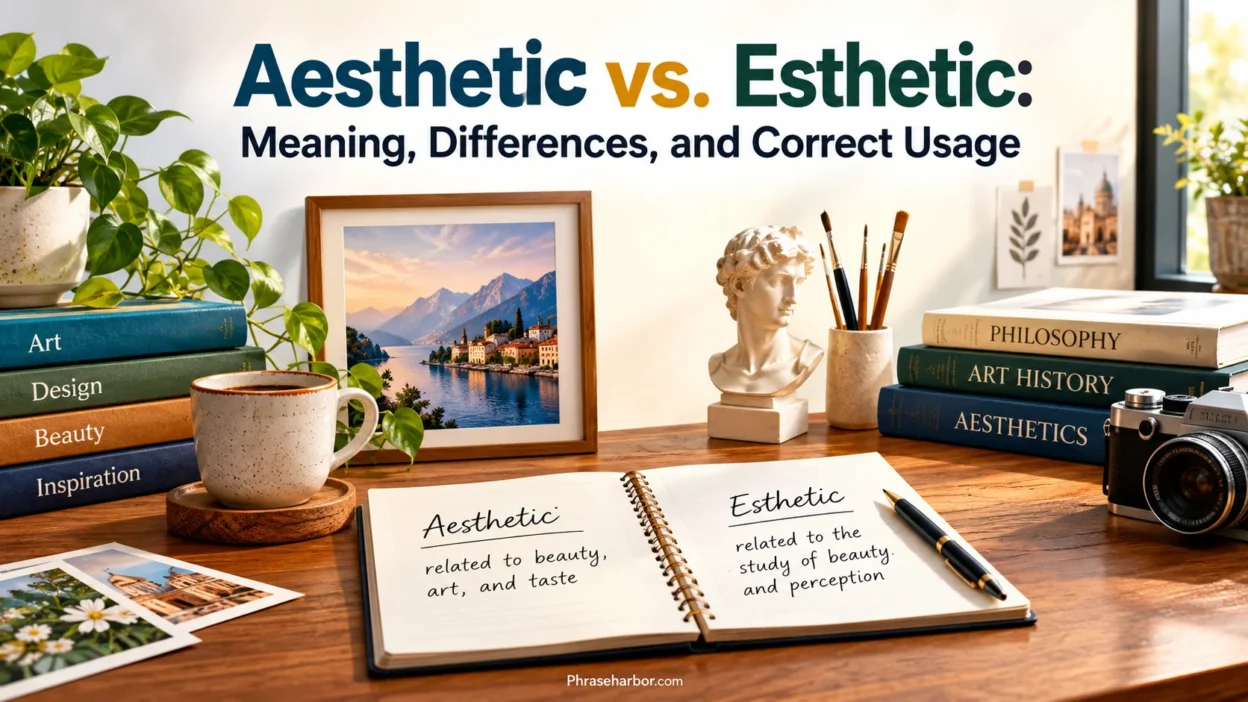
The good news is that aesthetic and esthetic are accepted spellings of the same word, with similar meanings related to beauty, artistic taste, visual style, and appearance. Both words can describe choices that improve appearance, visual qualities, and aesthetic qualities, or serve as nouns for a particular style or set of artistic principles.
In everyday English writing, aesthetic is the standard spelling and more familiar spelling in modern American English. It is also the normal British spelling. Esthetic is a recognized American variant that is less common, appears less often, and may seem unusual to a general audience.
The main difference is preference, not meaning or whether either spelling is correct. Both spellings are correct, and their word usage depends on the context, regional spelling, and writing conventions.When describing room design, interior design, a photographer’s style, photography, art, design, visual design, or a brand’s visual identity, aesthetic is usually the better spelling choice.
Quick Answer:
Aesthetic and esthetic are both correct spellings with essentially the same meaning. They describe beauty, artistic taste, visual appeal, or principles related to art and appearance.
The main difference is spelling and usage frequency. Aesthetic is the more widely recognized form in general English, while esthetic is an accepted variant used particularly in some American contexts.
- Aesthetic: The standard choice for most everyday, academic, creative, and professional writing.
- Esthetic: An accepted alternative that appears in American English, including some beauty-related terminology.
Examples:
- The designer created an aesthetic that combines natural materials with modern furniture.
- The gallery’s esthetic emphasizes simplicity, balance, and understated beauty.
Both sentences communicate the same basic idea. If you’re unsure which spelling to use, choose aesthetic for general writing and follow an established style guide when one applies.
Comparison Overview
The following table summarizes the main similarities and differences between aesthetic and esthetic.
| Feature | Aesthetic | Esthetic |
| Correct spelling | Yes | Yes |
| Core meaning | Beauty, artistic taste, visual appeal | Beauty, artistic taste, visual appeal |
| Part of speech | Noun and adjective | Noun and adjective |
| General usage | More common | Less common |
| American English | Widely used | Accepted alternative |
| British English | Standard, widely recognized form | Less common |
| Pronunciation | Generally the same | Generally the same |
| Related noun | Aesthetics | Esthetics |
| Adverb form | Aesthetically | Esthetically |
| Best general-purpose choice | Recommended | Use when appropriate to context |
The two spellings don’t represent different concepts. Instead, they reflect alternative forms of the same word.
For most readers, aesthetic will look more familiar. It appears frequently in discussions of design, art, fashion, architecture, photography, and personal style.
However, esthetic isn’t automatically incorrect just because it appears less often. You may encounter it in professional terminology, established names, and publications that prefer the shorter spelling.
What Does Aesthetic Mean?
The word aesthetic relates to beauty, artistic appreciation, taste, and the qualities that shape how something looks or feels.
People use it to describe everything from a painting’s visual balance to the overall atmosphere of a carefully designed home. Depending on the sentence, aesthetic can function as either an adjective or a noun.
Aesthetic as an Adjective
As an adjective, aesthetic describes something connected with beauty, artistic taste, or visual appeal.
It often appears when people discuss the appearance of objects, spaces, artwork, and creative projects. However, the word can also describe broader artistic qualities rather than appearance alone.
Consider these examples:
- The architect considered both the aesthetic and practical aspects of the building.
- The restaurant’s aesthetic design combines warm lighting with natural wood.
- She chose an aesthetic color palette for her photography portfolio.
- The sculpture has considerable aesthetic appeal despite its unusual shape.
- The museum preserves the aesthetic qualities of the original artwork.
In each example, aesthetic describes a quality related to appearance or artistic appreciation.
Notice that aesthetic appeal doesn’t necessarily mean something is expensive, fashionable, or popular. A simple wooden chair can have aesthetic value because of its proportions, craftsmanship, and natural texture.
Likewise, an unusual painting might appeal to one viewer but not another. Aesthetic judgments often depend on personal taste, cultural influences, and artistic expectations.
Aesthetic as a Noun
As a noun, aesthetic can refer to a particular style, visual identity, or approach to beauty.
This usage has become especially common in discussions of fashion, interior design, photography, branding, and online culture.
For example:
- Her aesthetic combines vintage clothing with modern accessories.
- The coffee shop has a minimalist aesthetic.
- The photographer’s aesthetic relies on natural light and muted colors.
- Their brand’s aesthetic feels elegant without looking overly formal.
- The film’s aesthetic reflects the director’s interest in symmetry and vivid color.
In these sentences, aesthetic refers to an overall style rather than a single attractive feature.
Imagine entering two different living rooms. One features pale walls, uncluttered furniture, and clean lines. The other uses colorful fabrics, antique furniture, and layered decorations.
Both rooms may look appealing, but they express different aesthetics.
The noun also appears in broader philosophical discussions. In philosophy, aesthetics concerns the nature of beauty, artistic experience, taste, and judgments about art.
Aesthetic in Everyday Language
In casual conversation, people often use aesthetic to describe something that looks attractive or fits a particular visual style.
For instance, someone might say, “This café is so aesthetic,” when they like its lighting, furniture, colors, and overall atmosphere.
This informal use is widely understood, especially in conversations about social media, lifestyle, and design.
In more formal writing, however, a more specific description may communicate your point better.
Instead of saying, “The website is aesthetic,” you could write, “The website has a clean layout, balanced colors, and an uncluttered visual design.”
The second sentence tells readers exactly what makes the website appealing.
What Does Esthetic Mean?
Esthetic is an accepted spelling variant of aesthetic. It carries essentially the same meaning and can function as both a noun and an adjective.
The shorter spelling removes the initial a from aesthetic, but it doesn’t create a new definition.
Although esthetic appears in American English, it is generally less common than aesthetic in everyday writing. Its use may depend on a publication’s preferences, a professional setting, or an established term.
Esthetic as an Adjective
As an adjective, esthetic describes beauty, artistic taste, appearance, or visual appeal.
Its meaning matches the adjective aesthetic.
Examples include:
- The artist explored the esthetic qualities of natural materials.
- The designer balanced esthetic appeal with everyday functionality.
- The gallery’s esthetic choices reflect a preference for simple forms.
- The renovation improved the room’s esthetic appearance.
- The collection demonstrates an esthetic approach rooted in traditional craftsmanship.
Each sentence could use aesthetic without changing its central meaning.
However, the longer spelling will generally feel more familiar to readers across different English-speaking regions. For broad audiences, that familiarity makes aesthetic a practical default.
Esthetic as a Noun
As a noun, esthetic can refer to a particular style or approach to beauty and artistic expression.
For example:
- The designer developed an esthetic built around simplicity and natural textures.
- The artist’s esthetic favors restrained colors and geometric forms.
- The building’s esthetic reflects the architectural preferences of its period.
These examples use esthetic in the same way that other writers might use aesthetic.
The spelling is valid, but it may attract more attention because readers encounter it less frequently. In ordinary articles, choosing the more familiar form can help maintain a smooth reading experience.
Read More: Metaphor vs. Analogy: Meaning, Differences, and Examples
Esthetic in Beauty and Skincare
One place where the shorter spelling deserves particular attention is professional beauty terminology.
In the United States, esthetician is a common term for a skincare professional who provides services such as facials, skin treatments, and certain cosmetic procedures within the scope of their training and license.
The related word aesthetician also exists. However, professional titles and their meanings can vary by workplace, training program, and jurisdiction.
For example:
- She completed her training before applying for an esthetician license.
- The skincare clinic employs licensed estheticians.
- The aesthetician discussed the client’s cosmetic goals during the consultation.
These terms overlap, but you shouldn’t assume that every professional title has identical legal or regulatory meaning. State licensing rules and the exact services offered matter.
This distinction is important because a spelling choice in general prose is different from the official title required for a license or credential.
Main Differences Between Aesthetic and Esthetic
The difference between aesthetic and esthetic comes down primarily to spelling and usage frequency. Their core meanings overlap, and neither spelling automatically makes a sentence more correct than the other.
Spelling and Word Formation
The most obvious difference is the initial a.
- Aesthetic contains the letter sequence ae at the beginning.
- Esthetic begins with e and omits the initial a.
Both forms belong to the same word family and refer to beauty, artistic taste, or appearance.
The longer spelling reflects the word’s historical development through forms associated with Greek aisthētikos, meaning related to perception or sensory experience. English adopted aesthetic through European scholarly usage, while esthetic developed as a simplified spelling variant.
The spelling difference doesn’t create a meaningful distinction in the words’ central definitions.
Usage and Popularity
Although both spellings are correct, they don’t appear equally often.
Aesthetic is the more familiar choice in general English. You’ll commonly see it in articles about interior design, visual art, architecture, fashion, photography, and branding.
Esthetic appears less frequently in general prose. It remains recognizable, however, and occurs in some American publications and specialized terminology.
Consider these examples:
| With aesthetic | With esthetic |
| The room has a modern aesthetic. | The room has a modern esthetic. |
| The painting has aesthetic value. | The painting has esthetic value. |
| The designer considered aesthetic appeal. | The designer considered esthetic appeal. |
All three pairs express essentially the same ideas.
The important distinction is familiarity, not correctness. If you’re writing for a broad audience, aesthetic will usually be the clearest choice.
Meaning and Part of Speech
Both words can function as adjectives and nouns.
As adjectives, they describe something related to beauty, artistic appreciation, or visual qualities.
As nouns, they can describe a particular style or approach to appearance and artistic expression.
Compare these examples:
- Adjective: The building has aesthetic value.
- Adjective: The building has esthetic value.
- Noun: Her aesthetic is simple and modern.
- Noun: Her esthetic is simple and modern.
The meaning stays consistent across each pair.
However, context determines the precise meaning. In a sentence about philosophy, the word might relate to theories of beauty and art. In a sentence about fashion, it might describe a recognizable personal style.
Regional Usage: American vs. British English
It’s tempting to assume that aesthetic belongs exclusively to British English and esthetic belongs exclusively to American English. That distinction is too simple.
American English accepts both spellings. Aesthetic remains widely used in the United States, while esthetic is an established alternative.
British English generally favors aesthetic, making the longer spelling the safer option for British audiences.
The same principle applies when writing for international readers. Since aesthetic is broadly recognized, it helps avoid unnecessary confusion.
Practical rule: Choose aesthetic for general American English unless a style guide, official name, or specialized term calls for another spelling.
Which Spelling Should You Use?
For most writing situations, choose aesthetic. It’s familiar, widely understood, and appropriate for everyday as well as formal writing.
Use esthetic when the context supports it, such as when reproducing an official title or following a publication’s preferred spelling.
Here’s a practical guide:
| Writing situation | Recommended choice | Reason |
| Blog articles | Aesthetic | Familiar to a broad audience |
| Academic essays | Aesthetic, unless specified otherwise | Widely recognized spelling |
| Interior design content | Aesthetic | Common in design discussions |
| Fashion and lifestyle writing | Aesthetic | Familiar in discussions of style |
| British English content | Aesthetic | Standard regional preference |
| Official business names | Exact official spelling | Names should remain unchanged |
| Professional licensing documents | Required official terminology | Accuracy matters more than general preference |
| Publications with a house style | Follow the style guide | Consistency is essential |
You don’t need to avoid esthetic entirely. Simply use it when there’s a clear reason to do so.
Aesthetic vs. Esthetic: Pronunciation
The two spellings generally share the same pronunciation in American English. The spelling difference doesn’t usually change the way speakers say the word.
A common American English pronunciation is approximately es-THET-ik, with the main stress on the middle syllable.
The International Phonetic Alphabet (IPA) represents a common pronunciation as /ɛsˈθɛtɪk/. Pronunciation can vary somewhat by accent and dictionary convention.
To say the word naturally:
- Begin with the short vowel sound heard in bed.
- Pronounce the middle syllable with the th sound heard in think.
- Place the strongest stress on that middle syllable.
- Finish with the unstressed sound heard at the end of basic.
The same general pronunciation applies to esthetic.
Some speakers may pronounce the opening vowel slightly differently because of regional accents. That variation doesn’t establish a difference in meaning between the two spellings.
If you’re learning American English, focus on the middle-syllable stress and the th sound. Those features matter more than whether the written word begins with ae or e.
FAQs:
1. Is aesthetic or esthetic the correct spelling?
Both aesthetic and esthetic are correct spellings. However, aesthetic is more common in American English and is also the standard spelling in British English. Esthetic is an accepted American variant that appears less often.
2. What is the main difference between aesthetic and esthetic?
The main difference is spelling preference, not meaning. Both words relate to beauty, artistic taste, appearance, and visual appeal. In most situations, you can use aesthetic without changing the meaning of your sentence.
3. Is aesthetic American or British English?
Aesthetic is standard in both American and British English. Although some people associate it with British spelling, it is widely used in the United States, too. Esthetic is a less common American variant.
4. Should I use aesthetic or esthetic in professional writing?
Use aesthetic in most professional writing, academic work, articles, and general communication. However, choose esthetic when a business name, official term, or required style guide uses that spelling. For example, some skincare professionals use the term esthetician.
5. What does aesthetic mean in everyday language?
Aesthetic describes the appearance, style, or artistic qualities of something. For example, you might describe a room as having a minimalist aesthetic or praise a photographer’s aesthetic. The word can also refer to a person’s taste in art, design, and beauty.
Conclusion:
Both aesthetic and esthetic are acceptable spellings, and neither changes the word’s basic meaning. However, aesthetic is the safer choice for most writing because it is familiar to American and British readers. Use esthetic when a specific business name, professional term, or style requirement calls for it. When in doubt, choose aesthetic to keep your writing clear, consistent, and natural.