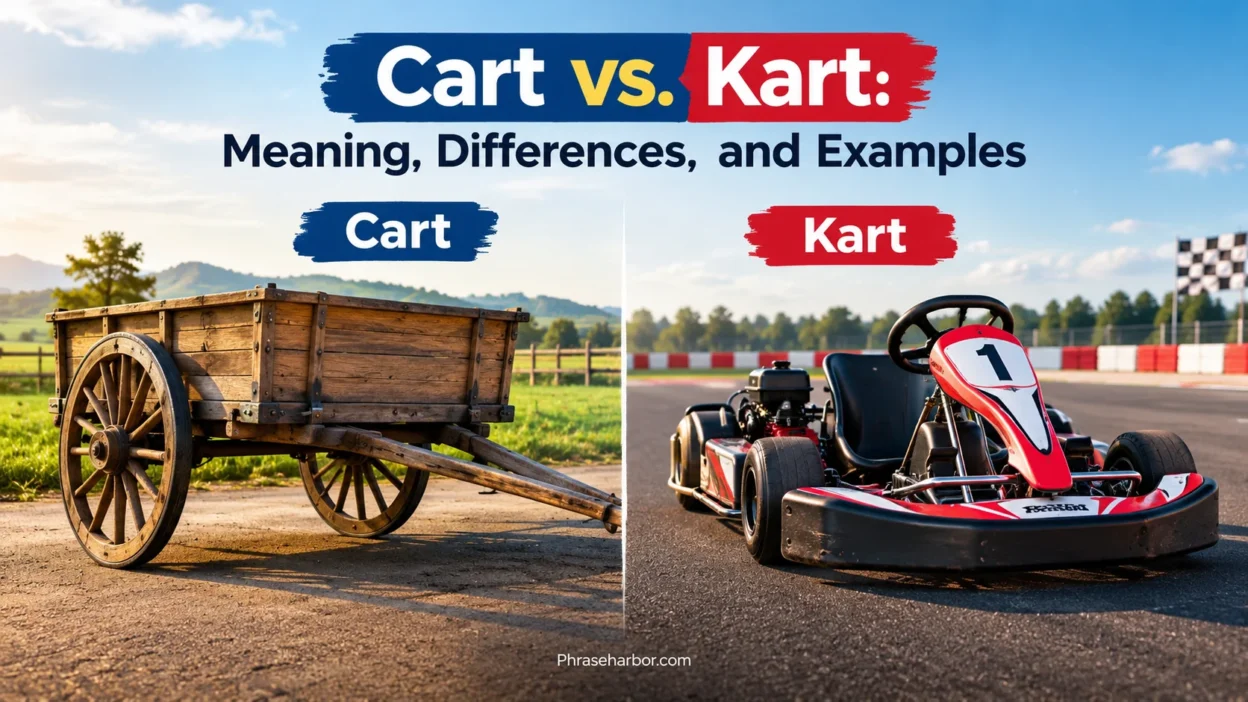
Have you ever wondered whether to write cart or kart? These two words sound exactly alike but have different meanings. Choosing the wrong spelling can change the entire message. Fortunately, remembering the difference doesn’t take much effort.
The word cart generally refers to a wheeled vehicle or container used to transport goods. You might push a shopping cart through a grocery store or use a utility cart to move supplies. On the other hand, kart refers to a small, lightweight vehicle designed primarily for racing. You’ll most often encounter it when discussing go-kart tracks, motorsports, and recreational racing.
Although both spellings are correct, they aren’t interchangeable. Understanding their meanings, grammatical functions, and everyday applications will help you use each word confidently. Let’s explore the differences between cart and kart with practical examples.
Quick Answer: Cart vs. Kart
Cart refers to a wheeled vehicle or container used for carrying and transporting things. It can also function as a verb meaning to carry or move something.
Kart refers to a small, lightweight vehicle commonly used for recreational or competitive racing. It’s especially associated with go-karting.
Here are two examples that make the distinction clear:
- Cart: I placed all my groceries in the shopping cart.
- Kart: My brother drove a go-kart around the racing track.
Easy way to remember: A cart helps you carry things while a kart takes you racing.
Comparison Overview: Cart vs. Kart
Although cart and kart share the same pronunciation, their meanings and applications differ. One belongs primarily to transportation and everyday activities while the other belongs to motorsports.
| Comparison | Cart | Kart |
| Meaning | A wheeled vehicle or container for carrying goods | A small vehicle designed primarily for racing |
| Part of speech | Noun and verb | Primarily a noun |
| Pronunciation | /kɑːrt/ | /kɑːrt/ |
| Main purpose | Carrying or transporting items | Racing and recreational driving |
| Common contexts | Shopping, transportation, storage, and food service | Go-karting and motorsports |
| Common compound | Shopping cart | Go-kart |
| Example | She pushed the cart through the store. | He raced his kart around the track. |
The biggest difference comes down to purpose. A cart transports objects or supplies whereas a kart carries a driver around a racing course.
Both words are legitimate English spellings. Neither is a misspelling of the other.
What Does Cart Mean?
Cart is a noun that describes a wheeled vehicle or movable container used to transport goods, equipment, or other materials. Depending on its design, someone might push it by hand, pull it, or operate it with a motor.
The word has a long history in transportation. Traditional carts carried agricultural products, construction materials, household supplies, and merchandise. Before modern delivery vehicles became common, people relied heavily on carts to move heavy loads over short distances.
Today, carts remain useful in homes, businesses, supermarkets, restaurants, warehouses, and outdoor markets.
For example, a grocery store uses shopping carts to help customers carry their purchases. A restaurant might use a service cart to transport dishes between the kitchen and dining area.
Cart as a Noun
As a noun, cart identifies a physical object designed to carry or move something. Its construction depends on the intended purpose.
Some carts have two wheels while others feature four wheels. Certain models require manual pushing or pulling while motorized versions use an engine or electric motor.
Common examples include:
- Shopping cart: A wheeled basket customers use to collect groceries and other products.
- Handcart: A manually operated cart used to move packages, tools, or heavy objects.
- Utility cart: A multipurpose cart used in offices, workshops, hospitals, and warehouses.
- Food cart: A mobile setup used to prepare or sell food and beverages.
- Golf cart: A small motorized vehicle used to transport golfers and equipment around golf courses.
- Laundry cart: A wheeled container used to move clothing, towels, and linens.
- Platform cart: A flat, wheeled surface designed to transport bulky or heavy objects.
Although these objects serve different purposes, they share one basic characteristic: they help move something from one location to another.
Examples of cart as a noun:
- The grocery store provided a large cart for customers.
- Workers loaded the boxes onto a delivery cart.
- She placed the clean towels inside the laundry cart.
- The restaurant employee pushed a food cart toward the dining area.
- We rented a golf cart to travel around the course.
Cart as a Verb
The word cart can also function as a verb. In this form, it means to carry, move, or transport something, often with considerable effort.
People commonly use this verb when describing the movement of heavy objects or multiple items. It can suggest that someone must make several trips or handle an inconvenient load.
For example, imagine moving into a new apartment. You might need to cart boxes, furniture, and household supplies from your vehicle to the building.
The verb also appears in several familiar expressions.
Common expressions using cart:
- Cart away: To remove or transport something from a location.
- Cart off: To take someone or something away, often suddenly or forcibly.
- Cart around: To carry something from place to place, sometimes unnecessarily.
- Cart out: To move something out of a particular area.
Examples of cart as a verb:
- We had to cart all the furniture upstairs.
- The workers carted away the damaged equipment.
- He spent the afternoon carting around heavy bags.
- The security officers carted off the abandoned equipment.
- They carted out the old furniture before renovating the room.
Notice that the meaning remains connected to transportation. Whether used as a noun or verb, cart relates to moving goods, materials, or people.
Common Expressions and Compounds With Cart
English uses cart in many compound words and familiar expressions. These combinations describe particular types of equipment or transportation activities.
| Expression | Meaning |
| Shopping cart | A wheeled basket used for carrying purchases |
| Grocery cart | A cart designed for shopping at grocery stores |
| Handcart | A manually operated transportation device |
| Food cart | A mobile unit used to sell or serve food |
| Utility cart | A cart used for transporting supplies |
| Cartload | The amount of material a cart can carry |
| Cart away | To remove or transport something |
| Cart off | To take something or someone away |
| Cart around | To carry something from place to place |
One expression worth understanding is put the cart before the horse. This idiom describes doing things in the wrong order.
For example:
“Planning the wedding before choosing a date is putting the cart before the horse.”
The expression emphasizes the importance of following a sensible sequence.
What Does Kart Mean?
Kart refers to a small, lightweight vehicle designed primarily for racing or recreational driving. Unlike an ordinary cart, which transports goods, a kart carries a driver and moves around a designated driving area.
Most karts have a low frame, small wheels, a steering system, and a seat positioned close to the ground. Depending on the model, they may use a gasoline engine or an electric motor.
Karts are especially popular in motorsports because they offer an accessible way to experience competitive driving. Beginners can enjoy recreational karting while experienced drivers can compete in organized racing events.
The word kart most commonly appears in expressions such as go-kart, kart racing, and karting.
Kart as a Noun
As a noun, kart identifies a small racing vehicle. Its primary purpose is to provide transportation for a driver around a track or other suitable driving surface.
Unlike shopping carts and handcarts, karts aren’t designed to carry groceries, packages, or household supplies. They’re built for movement, steering, and speed.
A typical racing kart includes several important components:
- Chassis: The frame that supports the vehicle and its mechanical components.
- Engine or electric motor: Provides the power needed to move the kart.
- Steering system: Allows the driver to control the direction.
- Wheels and tires: Provide traction and maintain contact with the track.
- Seat: Holds the driver in a low, stable position.
- Braking system: Helps the driver slow down or stop safely.
Not every kart has identical equipment. Recreational models often prioritize comfort and durability while competitive racing karts focus on handling, weight, and performance.
Examples of kart as a noun:
- My friends and I rented a kart at the indoor racing center.
- The professional driver inspected his kart before the competition.
- She bought an electric kart for recreational driving.
- The children enjoyed riding their karts around the track.
- His racing kart needs new tires before the weekend.
In each sentence, kart refers to a small vehicle rather than something used to transport goods.
Read More: Metaphor vs. Hyperbole: Meaning, Differences, and Examples
What Is a Go-Kart?
A go-kart is a small, lightweight motorized vehicle designed for recreational or competitive driving. It usually operates on a specially designed track, although some models are suitable for other controlled environments.
Go-karts provide an introduction to motorsports because their basic controls resemble those of larger vehicles. Drivers use a steering wheel, accelerator, and brake to control their movement.
However, go-karts differ significantly from regular passenger cars. Most have an open design, a low seating position, and no traditional enclosed body.
Sports Centers and Fun Action Spots for Houston Kids | Mommy Poppins – Things to Do with Kids
British Prokart Endurance Championship – Endurance Karting Apollo Karts
11
Go-karting generally falls into two main categories:
- Recreational go-karting: Casual driving at entertainment centers, amusement parks, and dedicated racing facilities.
- Competitive go-karting: Organized racing in which drivers compete based on speed, handling, and race performance.
Karting also serves as an important starting point for many professional racing drivers. It helps beginners develop vehicle-control skills, racing awareness, and an understanding of competitive driving.
Example sentences:
- We booked a go-karting session for Saturday afternoon.
- My nephew wants to learn how to drive a go-kart.
- The racing center offers electric go-karts for beginners.
- Professional drivers often develop their skills through karting.
Common Types of Karts
Karts come in several designs. Their construction, power source, and intended use depend on the driving environment.
Here are some common types:
| Type of kart | Description | Common use |
| Recreational kart | A basic kart designed for casual driving | Entertainment centers |
| Racing kart | A performance-focused vehicle built for competition | Organized motorsports |
| Electric kart | A kart powered by an electric motor and battery | Indoor and outdoor tracks |
| Indoor kart | A kart designed for controlled indoor racing facilities | Indoor racing centers |
| Off-road kart | A rugged vehicle designed for suitable unpaved terrain | Recreational off-road driving |
Not every kart is built for racing competitions. Some prioritize beginner-friendly controls while others are engineered for experienced drivers.
The important distinction remains the same: kart refers to the vehicle itself rather than a container for transporting objects.
Main Differences Between Cart and Kart
The main difference between cart and kart involves their meanings and intended purposes. Although they sound identical, their spelling determines which object or activity you’re describing.
A cart helps transport items. A kart provides a driving experience, usually associated with racing.
Let’s examine their differences more closely.
Difference in Meaning: Cart vs. Kart
The word cart describes a wheeled vehicle or container used to carry goods, equipment, or other materials. It can also describe the action of transporting something.
For instance, a supermarket customer uses a cart to collect groceries. Similarly, warehouse employees use utility carts to move packages between storage areas.
The word kart, however, describes a small vehicle designed primarily for recreational or competitive driving.
Consider these examples:
- Cart: The employee pushed the supply cart into the storage room.
- Kart: The employee drove a racing kart around the circuit.
Both sentences describe movement, but the objects serve entirely different purposes.
Difference in Usage: Cart vs. Kart
Although both words have the same pronunciation, their usage depends on the situation.
You should choose cart when discussing shopping, transportation, storage, or carrying materials. The word appears frequently in everyday conversations and commercial settings.
Choose kart when discussing racing vehicles, go-kart tracks, or karting competitions.
The following situations illustrate the distinction:
| Situation | Correct word | Example |
| Buying groceries | Cart | I left my bags in the shopping cart. |
| Moving office supplies | Cart | The assistant loaded the cart with documents. |
| Racing at a track | Kart | We drove a kart around the circuit. |
| Watching a karting competition | Kart | The kart completed another lap. |
| Transporting restaurant dishes | Cart | The waiter pushed the service cart. |
| Discussing electric racing vehicles | Kart | The electric kart accelerated quickly. |
A useful trick is to identify the object’s purpose before choosing its spelling.
If it carries things, cart is usually the correct choice. If someone drives it around a racing track, kart is appropriate.
Difference in Pronunciation: Cart vs. Kart
One interesting feature of cart and kart is that they sound exactly alike in standard American English.
Both words have the same pronunciation:
- Cart: /kɑrt/
- Kart: /kɑrt/
The initial consonant sounds like the K in kite. The remaining sounds are identical.
This makes cart and kart homophones. Homophones are words that share the same pronunciation but have different spellings or meanings.
Other familiar English homophones include:
- Right and write
- Pair and pear
- Brake and break
- Flour and flower
- Sea and see
Because cart and kart sound identical, listeners usually depend on context to understand which word someone means.
For example, if someone says, “I need a cart,” you might assume they’re discussing shopping or transportation. However, “I need a kart for the competition” clearly points toward racing.
Remember: Pronunciation doesn’t distinguish these words. Their spelling and context do.
FAQs:
Is It Cart or Kart?
Both cart and kart are correct spellings, but they have different meanings. A cart carries goods, groceries, or equipment. A kart refers to a small vehicle designed primarily for recreational or competitive racing. Choose the spelling that matches your intended meaning.
What Is the Difference Between a Cart and a Kart?
A cart is a wheeled vehicle or container used to transport objects. A kart is a small vehicle that carries a driver, usually around a racing track. Their pronunciation is identical, but their spelling and purpose differ.
Is a Go-Kart Spelled With a C or a K?
The standard spelling is go-kart, with a K. It describes a small motorized vehicle used for recreational or competitive driving. Although people sometimes write go-cart, that spelling isn’t standard for the racing vehicle.
Are Cart and Kart Pronounced the Same?
Yes. In standard American English, cart and kart share the same pronunciation: /kɑrt/. They’re homophones because they sound alike but have different spellings and meanings. You must rely on context to distinguish them when speaking.
Can Cart and Kart Be Used Interchangeably?
No. Although they sound identical, they describe different things. A cart transports goods or materials while a kart carries a driver. Substituting one word for the other can change the meaning of your sentence.
Conclusion:
Understanding cart vs. kart comes down to recognizing their different purposes. Although these words sound exactly alike, they describe entirely different things. A cart is a wheeled vehicle or container used to transport groceries, equipment, supplies, and other materials. It can also function as a verb meaning to carry or move something. A kart, on the other hand, is a small vehicle primarily associated with recreational driving and competitive racing. You’ll commonly encounter it in expressions such as go-kart, kart racing, and karting.