Words do more than communicate information. They can also create emotions, suggest ideas, and influence how people understand a message. That’s why two words with similar dictionary definitions can produce completely different reactions. Understanding these subtle differences helps you become a better writer, reader, and communicator.
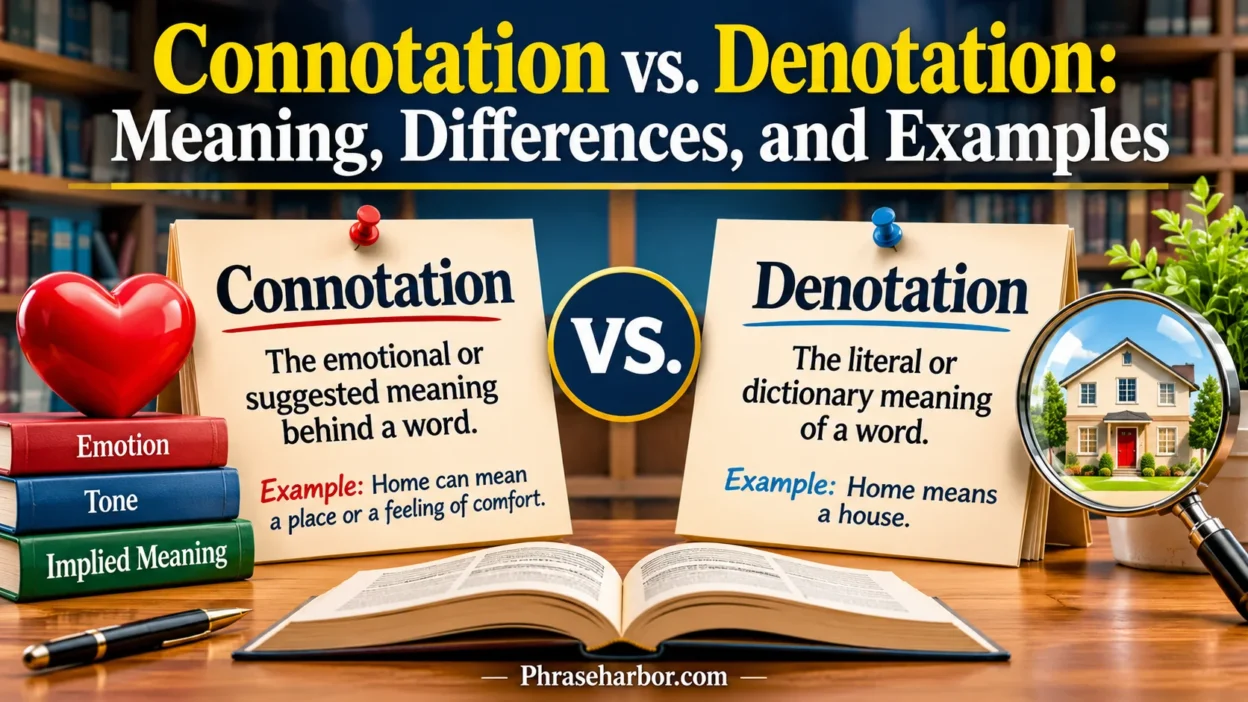
Connotation vs. denotation describes two important ways words carry meaning. Denotation refers to a word’s literal or dictionary definition. Connotation refers to the feelings, associations, or ideas people connect with that word. For example, house and home both describe a place where someone lives. However, home often suggests warmth, comfort, family, and belonging.
Although these terms sound similar, they serve different purposes in language. A dictionary can explain what a word means, but its connotation helps explain how that word makes people feel. Writers, advertisers, teachers, and speakers use both concepts to communicate more effectively.
Quick Answer:
Connotation is the emotional, cultural, or associative meaning connected to a word beyond its literal definition. It can create positive, negative, or neutral impressions depending on the word and context.
Denotation is the direct, literal meaning of a word. It describes what the word actually refers to without considering additional emotional associations.
For example, slim and skinny both describe someone with a relatively thin body. However, slim often carries a positive connotation, while skinny can suggest an unhealthy or unattractive appearance.
Here’s the simplest way to remember the difference:
- Connotation: What a word suggests or makes you feel.
- Denotation: What a word literally means.
In short, denotation explains a word’s direct meaning, while connotation adds another layer of interpretation.
Comparison Overview: Connotation vs. Denotation
Although connotation and denotation work together, they describe different aspects of language. One focuses on literal definitions, while the other considers the associations people attach to words.
| Comparison Point | Connotation | Denotation |
| Definition | Associated or implied meaning | Literal or dictionary meaning |
| Main focus | Feelings and associations | Direct meaning |
| Nature | Often subjective | Generally more objective |
| Emotional influence | May carry emotional significance | Does not inherently express emotion |
| Cultural influence | Strongly influenced by culture | Usually more consistent within a language |
| Personal influence | Can vary between individuals | Generally remains stable |
| Context | Can change with context | Usually maintains its core definition |
| Common examples | Home, cheap, stubborn | House, inexpensive, persistent |
| Main purpose | Creates impressions and emotional effects | Communicates direct information |
| Common applications | Literature, advertising, conversations | Dictionaries, definitions, factual writing |
Example: Consider the word snake.
Its denotation refers to a long, legless reptile. However, its connotation may suggest danger, dishonesty, betrayal, or deceit.
If someone calls another person a snake, they probably aren’t describing an actual reptile. They’re using the word’s negative associations to criticize someone’s behavior.
This example shows how a word’s literal definition and implied meaning can work together without being identical.
Main Differences Between Connotation and Denotation
Connotation and denotation influence how people understand words, but they operate differently. Understanding their individual characteristics makes it easier to recognize the distinction in everyday communication.
Literal Meaning vs. Associated Meaning
The most important difference between connotation and denotation involves what a word directly communicates versus what it suggests.
Denotation identifies the literal meaning of a word. It provides the basic information someone needs to understand what the word represents. For example, the denotation of rose is a flowering plant belonging to the genus Rosa.
However, the word rose can suggest much more than a flower. Its connotations often include love, romance, beauty, affection, and admiration.
Consider another example: school.
- Denotation: An institution where students receive education.
- Connotation: Learning, friendship, childhood, discipline, opportunity, or stress.
Different people may associate school with completely different experiences. Someone who enjoyed their education might connect it with opportunity and friendship. Another person might associate it with pressure or difficult memories.
The literal definition remains the same. The personal associations change.
Objective Definition vs. Subjective Interpretation
Another important distinction concerns how people interpret words.
Denotations generally remain consistent among speakers who share the same language. Although dictionaries sometimes include multiple definitions, the basic meaning doesn’t usually depend on someone’s personal feelings.
Connotations, however, can vary considerably. Your experiences, background, cultural environment, and personal beliefs can influence how you interpret particular words.
For example, consider the word ambitious.
Someone might interpret ambition as a positive quality associated with determination, motivation, and professional growth. Another person might associate it with excessive competition or an unhealthy desire for success.
The word’s basic meaning concerns having a strong desire to achieve something. Its emotional associations depend on the situation and the person interpreting it.
This distinction becomes especially important when communicating across cultures. A word that sounds friendly or respectful in one community might feel inappropriate in another.
Dictionary Meaning vs. Emotional Associations
Dictionaries primarily explain denotative meanings. They identify what words refer to and often provide different definitions based on grammatical usage.
Connotation involves the additional associations that develop through language, culture, and experience.
For example, consider these three words:
- Fragrance: A smell, often associated with something pleasant.
- Aroma: A distinctive smell, commonly associated with food, coffee, or other pleasant substances.
- Odor: A smell that may carry a negative or unpleasant association.
All three words concern the sense of smell. However, they don’t create exactly the same impression.
A bakery might advertise the wonderful aroma of freshly baked bread. Describing that same experience as an unpleasant odor would completely change the reader’s reaction.
This is why writers should consider more than dictionary definitions when selecting vocabulary.
How Context Influences Meaning
Words don’t always carry the same emotional associations in every situation. Context can change how readers interpret them.
Consider the word aggressive.
In a business discussion, an aggressive marketing strategy might suggest confidence, determination, and a willingness to compete. However, describing someone’s behavior as aggressive during an argument usually suggests hostility or intimidation.
The denotation concerns forceful or assertive behavior. The surrounding situation helps determine whether readers interpret that behavior positively or negatively.
Context can also change a word’s apparent emotional strength.
For example:
- An old friend suggests someone you’ve known for many years.
- An old building describes a structure that has existed for a long time.
- Calling someone old-fashioned may suggest outdated attitudes or traditional values.
The word old retains its basic connection to age or time. However, its connotations depend on what it describes.
Types of Connotation
Connotations generally fall into three broad categories: positive, negative, and neutral. These categories help explain the emotional effect a word creates.
However, remember that connotations aren’t always fixed. Context and cultural differences can influence how people interpret them.
Positive Connotation
A positive connotation occurs when a word creates a favorable or pleasant impression. Such words often communicate approval, admiration, confidence, or encouragement.
Writers use positive connotations to make descriptions more appealing and establish a favorable tone.
Consider these examples:
| Word | Meaning | Positive Association |
| Slim | Relatively thin | Attractive or healthy appearance |
| Confident | Sure of oneself | Self-assurance |
| Determined | Firmly committed | Persistence and motivation |
| Economical | Avoiding unnecessary expense | Smart spending |
| Fragrance | A distinctive smell | Pleasant scent |
| Youthful | Having qualities associated with youth | Energy and freshness |
| Generous | Willing to give | Kindness and compassion |
Example sentences:
- Her confident presentation impressed the entire audience.
- The economical vehicle helped the family reduce expenses.
- His determined attitude helped him complete the difficult project.
- The fragrance of fresh flowers filled the room.
Notice how these words communicate information while also creating favorable impressions.
Negative Connotation
A negative connotation occurs when a word suggests something unpleasant, undesirable, or unfavorable.
Such words can communicate criticism, disappointment, disapproval, or negative judgment. Writers sometimes use them to create tension or highlight undesirable behavior.
Consider these examples:
| Word | Meaning | Negative Association |
| Skinny | Very thin | Unhealthy appearance |
| Arrogant | Having an exaggerated sense of importance | Excessive pride |
| Stubborn | Unwilling to change an opinion | Inflexibility |
| Cheap | Low in price or poor in quality | Inferior quality |
| Odor | A smell | Unpleasant scent |
| Childish | Immature behavior | Lack of maturity |
| Pushy | Overly forceful | Disrespect for boundaries |
Example sentences:
- His arrogant attitude made teamwork difficult.
- The cheap material started breaking after several uses.
- Her stubborn refusal prevented the group from reaching an agreement.
- The unpleasant odor spread throughout the kitchen.
These words communicate more than simple descriptions. They also reveal the speaker’s negative judgment.
Neutral Connotation
A neutral connotation occurs when a word carries little obvious positive or negative emotional influence in a particular context.
Neutral words are especially useful when you want to communicate facts without expressing strong personal opinions.
Examples include:
| Word | Basic Meaning | Typical Impression |
| House | A building used as a residence | Neutral |
| Young | Having lived for a relatively short time | Neutral |
| Persistent | Continuing despite difficulties | Context-dependent |
| Inexpensive | Not costing much | Generally neutral |
| Thin | Having little thickness or body fat | Neutral |
| Fragrance | A distinctive smell | Often positive |
| Vehicle | A means of transportation | Neutral |
Example sentences:
- The company purchased a new vehicle.
- The building contains twelve residential apartments.
- The student completed the assignment.
- The product costs less than its competitors.
Neutral vocabulary helps writers maintain an objective tone. However, even apparently neutral words can develop emotional associations in specific situations.
Read More: Writing or Writting: Meaning, Differences, and Correct Usage
Examples of Connotation vs. Denotation
Real-world examples make the difference between connotation and denotation easier to understand. The following word pairs share related meanings but create different impressions.
Home vs. House
Both home and house can refer to a place where someone lives. However, their connotations often differ.
Denotation:
- House: A building designed or used as a place of residence.
- Home: A place where someone lives or feels they belong.
Connotation:
The word house generally emphasizes the physical structure. It brings to mind walls, windows, rooms, and a roof.
In contrast, home often suggests comfort, family, safety, memories, and emotional belonging.
Example:
- They purchased a beautiful house near the lake.
- After months abroad, she finally returned home.
The first sentence emphasizes a property. The second creates a stronger emotional connection.
Slim vs. Skinny
Both words describe someone or something with relatively little body fat or thickness. However, their connotations differ.
Denotation:
- Slim: Relatively thin in shape or build.
- Skinny: Very thin, sometimes suggesting insufficient body fat.
Connotation:
Slim often carries a positive association with attractiveness or fitness. Skinny can suggest weakness, poor health, or an undesirable appearance.
Example:
- She looked slim in her new dress.
- He appeared skinny after several months of illness.
The surrounding context also influences these descriptions. Neither word automatically expresses the same judgment in every situation.
Childlike vs. Childish
These words both describe qualities associated with children. However, they communicate very different judgments.
Denotation:
- Childlike: Having qualities commonly associated with children.
- Childish: Showing behavior considered typical of an immature child.
Connotation:
Childlike often suggests innocence, curiosity, imagination, and wonder. Childish generally suggests immaturity, irresponsibility, or poor judgment.
Example:
- Her childlike curiosity made every museum visit exciting.
- His childish reaction turned a small disagreement into an argument.
The distinction matters because one word praises a quality while the other criticizes behavior.
Economical vs. Cheap
Both words can describe something that costs relatively little. However, they don’t always communicate the same impression.
Denotation:
- Economical: Providing good value or avoiding unnecessary expense.
- Cheap: Available at a low price or costing relatively little.
Connotation:
Economical generally suggests smart spending and reasonable value. Cheap can suggest poor quality, although it can also describe an affordable price without criticism.
Example:
- We purchased an economical car with excellent fuel efficiency.
- The cheap plastic handle broke after two days.
The first sentence highlights value. The second suggests disappointing quality.
FAQs:
What Is the Main Difference Between Connotation and Denotation?
The main difference is that denotation describes a word’s literal meaning, while connotation describes its associated feelings and ideas.
For example, house denotes a residential building. However, home often carries connotations of family, comfort, and belonging.
Denotation tells you what something means. Connotation helps you understand what it suggests.
Can a Word Have Both Positive and Negative Connotations?
Yes. A word can create different impressions depending on its context, tone, and usage.
For example, ambitious generally suggests motivation and determination. However, describing someone as excessively ambitious might suggest selfishness or an unhealthy desire for success.
Similarly, aggressive can describe a determined business strategy or threatening personal behavior.
The surrounding situation helps determine the intended interpretation.
Is Connotation Always Emotional?
Not necessarily. Connotation includes emotional associations, but it can also involve cultural references, social attitudes, and shared ideas.
For example, the word crown literally describes a decorative headpiece associated with royalty. Its connotations may include authority, power, wealth, tradition, or leadership.
These associations aren’t always emotional in the narrow sense. They can also reflect social and cultural meanings.
How Does Context Affect Connotation?
Context influences how people interpret a word beyond its literal definition.
For example, bold can describe someone who shows courage and confidence. In another situation, it might suggest excessive behavior or poor judgment.
The speaker’s intention, surrounding words, and subject matter all influence interpretation.
Why Are Connotation and Denotation Important in Writing?
Understanding both concepts helps writers communicate accurately and create the intended impression.
Denotation ensures that readers understand the literal information. Connotation helps establish tone, express emotions, and influence how readers respond.
These concepts are especially useful in literature, advertising, professional communication, and persuasive writing.
Conclusion:
Understanding connotation vs. denotation helps you recognize the two layers of meaning behind everyday language. Denotation explains what a word literally means, while connotation reveals the feelings, associations, and cultural ideas connected to it. For example, house and home can refer to similar places, but they don’t always create the same impression. Likewise, confident and arrogant describe related qualities while expressing different judgments.