Have you ever paused while typing and wondered whether the correct spelling is writing or writting? You’re not alone. This spelling mistake often occurs because English uses different rules when adding -ing to verbs. Some words double their final consonants while others don’t.
The confusion makes sense. Consider words like sitting, running, and stopping. Each doubles its final consonant before adding -ing. However, the word writing follows a different spelling pattern. Understanding this small difference can help you avoid a common writing mistake.
Whether you’re preparing an email, completing a school assignment, or creating professional content, correct spelling matters. Let’s examine the difference between writing and writting, understand the grammar rule, and explore practical examples.
Quick Answer: Writing or Writting
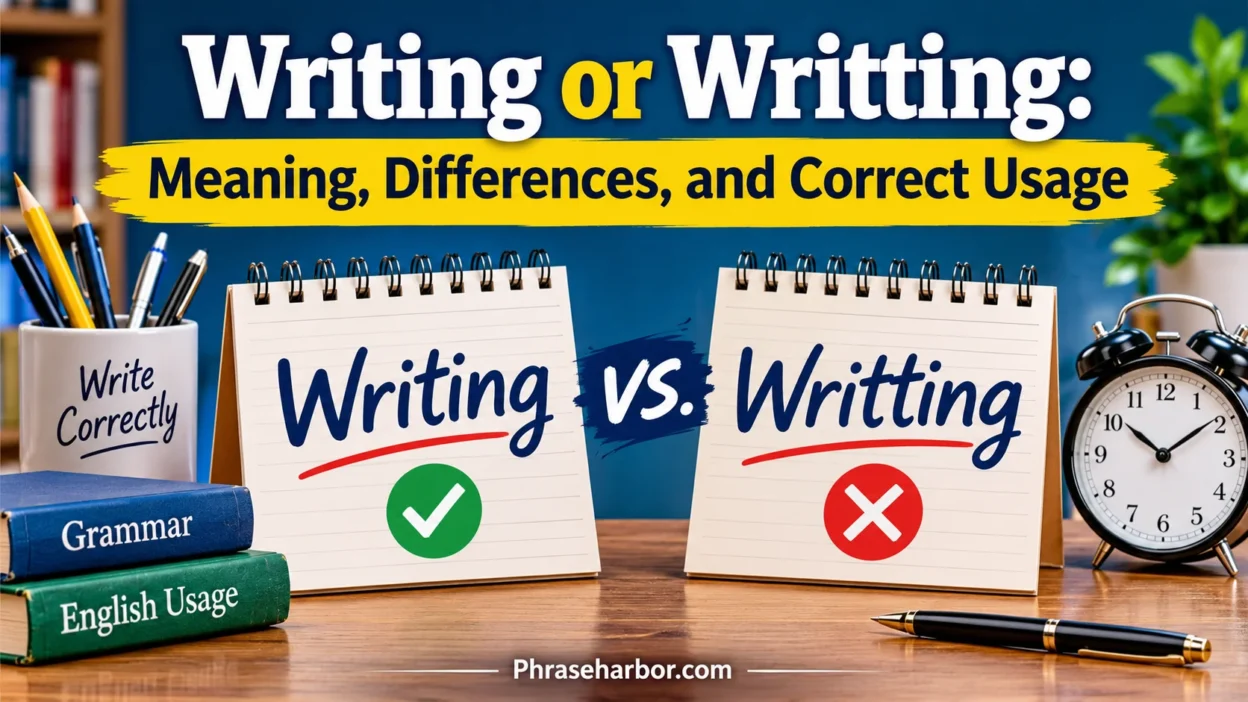
Writing is the correct spelling. Writting is an incorrect spelling and doesn’t appear as a standard English word. The correct form comes from the verb write by removing its silent final e and adding -ing.
For example:
- Correct: She is writing an interesting article.
- Incorrect: She is writting an interesting article.
The spelling rule is straightforward: when a verb ends in a silent e, you generally drop that letter before adding -ing.
| Word | Correct or Incorrect | Explanation |
| Writing | Correct | The correct -ing form of write |
| Writting | Incorrect | Adds an unnecessary second t |
| Write | Correct | The original verb |
| Written | Correct | The past participle of write |
| Wrote | Correct | The simple past tense of write |
Remember this simple relationship: Write → Writing.
You don’t need another t because the original verb already follows the silent-e spelling pattern.
Comparison Overview: Writing vs. Writting
The difference between writing and writting comes down to one extra letter. Although the two spellings look similar, only one follows standard English spelling rules.
Here’s a closer comparison:
| Feature | Writing | Writting |
| Spelling | Writing | Writting |
| Status | Correct | Incorrect |
| Base verb | Write | Write |
| Word formation | Write + ing (drop e) | Incorrect formation |
| Meaning | The act or process of writing | No standard meaning |
| Grammatical use | Noun and verb form | Not standard English |
| Example | I’m writing a letter. | I’m writting a letter. |
| Suitable for formal writing | Yes | No |
Writing works in everyday conversations, academic assignments, business communication, and creative projects. You can use it whenever you discuss the activity of putting words into written form.
On the other hand, writting is simply a spelling mistake. You might encounter it in informal messages, online comments, or poorly edited documents. However, that doesn’t make it an accepted alternative.
Main Differences Between Writing and Writting
The most important difference involves the spelling rule for verbs ending in silent e. Understanding that rule explains why writing contains one t rather than two.
Here are the main distinctions:
- Correct spelling: Writing follows the standard English spelling convention.
- Incorrect spelling: Writting doubles the final consonant without a grammatical reason.
- Word formation: Writing comes from write by dropping the silent e and adding -ing.
- Meaning: Writing refers to the activity, process, or result of written expression.
- Usage: Writing works as both a noun and a verb form.
- Grammar: Writting has no accepted standard grammatical function.
Consider these examples:
- Correct: Mark enjoys writing short stories during weekends.
- Incorrect: Mark enjoys writting short stories during weekends.
The first sentence follows standard English spelling. The second contains an unnecessary extra letter.
Why Is It Spelled Writing Instead of Writting?
English spelling can seem unpredictable until you understand how words change when they take new endings. The difference between writing and writting follows a common rule involving verbs that end in a silent e.
The base verb write contains five letters. Its final e doesn’t produce a separate sound in ordinary pronunciation. When you add the suffix -ing, you remove that silent letter.
The transformation looks like this:
Write → Writ + ing → Writing
Notice that the final t remains unchanged. You don’t double it.
This rule also applies to several familiar English verbs:
| Base Verb | Correct -ing Form |
| Write | Writing |
| Make | Making |
| Take | Taking |
| Drive | Driving |
| Hope | Hoping |
| Dance | Dancing |
| Bake | Baking |
| Smile | Smiling |
| Give | Giving |
| Move | Moving |
These examples demonstrate the same spelling pattern. The silent final e disappears before the suffix -ing.
The Spelling Rule for Adding -ing to Verbs Ending in Silent E
One of the most useful English spelling rules involves verbs that end with a silent e. Generally, you remove the final e before attaching a suffix that begins with a vowel, such as -ing.
For example:
- Make becomes making.
- Take becomes taking.
- Ride becomes riding.
- Love becomes loving.
- Write becomes writing.
Why does English follow this pattern?
The final e often helps establish the pronunciation of the preceding vowel. When you add -ing, the word already has a new ending that changes its structure. Removing the silent e keeps the spelling conventional.
However, spelling rules have exceptions. Some verbs ending in e retain that letter when adding certain suffixes.
For instance:
- See → Seeing
- Agree → Agreeing
- Dye → Dyeing
These words retain the final e to avoid awkward or confusing letter combinations.
Important: Don’t assume every verb follows precisely the same pattern. Learn the general rule first, then recognize common exceptions.
Why Writting Is Incorrect
The spelling writting usually results from applying the consonant-doubling rule to the wrong type of verb.
English sometimes doubles a final consonant before adding -ing. For example, sit becomes sitting, and run becomes running.
However, write doesn’t follow that pattern because it ends in a silent e. You remove the final letter instead of doubling the consonant.
Compare these formations:
| Base Verb | Incorrect Form | Correct Form |
| Write | Writting | Writing |
| Make | Makking | Making |
| Take | Takking | Taking |
| Drive | Drivving | Driving |
| Hope | Hopping | Hoping |
| Dance | Danccing | Dancing |
The incorrect forms in this table illustrate common mistakes rather than acceptable alternatives. Notice how each correct spelling follows its own word-formation rule.
The easiest way to remember the distinction is to look at the original verb. If it ends in a silent e, you generally remove that letter before adding -ing.
What Does Writing Mean?
Writing refers to the activity of expressing thoughts, information, emotions, or ideas through written language. It involves arranging letters, words, and sentences to communicate a message.
People write for countless reasons. Students prepare assignments, journalists report events, businesses communicate with customers, and authors create stories.
The word also describes the written material itself or someone’s particular style of expression.
For example:
- Her writing impressed the entire class.
- I’m writing a report for my manager.
- Creative writing allows people to explore new ideas.
- His writing style is clear and engaging.
Although these sentences use the same word, its grammatical function changes depending on the context.
Writing as a Noun
When used as a noun, writing refers to the activity, practice, or product of written communication.
It can describe the general process of creating written material. It can also refer to someone’s writing style or a particular piece of written work.
For example:
- Writing requires patience and regular practice.
- Her academic writing has improved considerably.
- The teacher praised his writing.
- Professional writing requires clarity and attention to detail.
- Creative writing encourages imagination and original thinking.
In these examples, writing functions as a noun rather than describing an ongoing action.
The word can also appear in expressions such as:
- Business writing
- Academic writing
- Technical writing
- Creative writing
- Journalistic writing
- Persuasive writing
- Professional writing
Each expression describes a different purpose, style, or category of written communication.
For example, business writing focuses on clear workplace communication. Creative writing gives authors more freedom to develop characters, stories, and imaginative ideas.
Read More: Weiner or Wiener: Which Spelling Is Correct?
Writing as a Verb (Present Participle)
Writing also functions as the present participle of the verb write. In this role, it commonly describes an action that continues over a period of time.
You’ll often find it alongside a form of the verb be, including am, is, are, was, and were.
Consider these examples:
- I am writing an important email.
- Sarah is writing her college application.
- They are writing a research paper.
- We were writing when the electricity went out.
- The students have been writing their assignments since morning.
The word can also appear in participial phrases:
- Writing every morning, James improved his vocabulary.
- Writing under pressure, she learned to organize her thoughts quickly.
- Writing for different audiences, the author developed a flexible style.
In these sentences, writing helps describe an activity or provide additional information about the subject.
How to Use Writing in Sentences
Understanding the definition is useful, but seeing the word in everyday situations makes its correct usage easier to remember.
The word writing appears in personal conversations, educational settings, professional communication, and creative work. Its grammatical role depends on how you construct the sentence.
Here are several practical examples.
Examples of Writing in Everyday Sentences
People frequently use writing when discussing messages, personal interests, and everyday activities.
- I’m writing a birthday card for my sister.
- He enjoys writing in his journal every evening.
- She is writing a shopping list.
- My friend spends weekends writing short stories.
- Are you writing something important?
- I started writing down my daily goals.
- The children are writing letters to their grandparents.
These examples show how naturally the word fits into ordinary conversations.
For instance, if someone asks what you’re doing, you might answer, “I’m writing a message.” There’s no need to use the incorrect spelling writting.
Examples of Writing in Academic and Professional Sentences
In schools and workplaces, writing plays an important role in sharing information and explaining complex ideas.
Consider these examples:
- The professor is writing a new research paper.
- Students should practice academic writing regularly.
- Our team is writing a proposal for the client.
- Good business writing saves time and prevents misunderstandings.
- She has experience writing technical documentation.
- The editor is writing feedback for the author.
- Effective writing makes professional communication easier.
The word also appears in job descriptions and professional qualifications.
For example, employers might request experience in report writing, content writing, technical writing, or copywriting.
In each case, writing describes a skill or activity involving written communication.
Examples of Writing in Different Verb Tenses
Although writing remains the same in spelling, it appears in different grammatical constructions.
| Grammatical Structure | Example |
| Present continuous | I am writing an article. |
| Past continuous | She was writing a letter. |
| Future continuous | They will be writing their reports. |
| Present perfect continuous | He has been writing all morning. |
| Past perfect continuous | We had been writing for hours. |
| Gerund | Writing improves communication skills. |
| Participial phrase | Writing carefully, she avoided mistakes. |
Pay attention to the difference between the auxiliary verb and the main verb.
For example, in “She is writing a novel,” the word is helps form the present continuous tense. The word writing carries the main action.
In “Writing takes practice,” however, the same word functions as a noun.
Common Words That Follow the Same Spelling Rule
The spelling transformation from write to writing isn’t unique. Many English verbs lose their silent final e when you add -ing.
Learning these examples makes the rule easier to recognize. It also helps prevent unnecessary consonant doubling.
| Base Verb | Correct -ing Form | Example |
| Write | Writing | She is writing a story. |
| Make | Making | He is making dinner. |
| Take | Taking | I’m taking notes. |
| Drive | Driving | She is driving home. |
| Hope | Hoping | We’re hoping for good news. |
| Dance | Dancing | They are dancing together. |
| Bake | Baking | Mom is baking cookies. |
| Smile | Smiling | The child is smiling. |
| Give | Giving | He’s giving a presentation. |
| Move | Moving | They’re moving tomorrow. |
| Close | Closing | She is closing the window. |
| Save | Saving | I’m saving money. |
What Do These Words Have in Common?
Each verb ends with a silent e. When you add -ing, you generally remove that final letter.
For example:
- Hope + ing = Hoping
- Save + ing = Saving
- Close + ing = Closing
- Give + ing = Giving
The final consonants remain single. That’s why writing doesn’t need an extra t.
However, be careful with verbs such as see and agree. These retain their final e when adding -ing.
FAQs:
Is It Writing or Writting?
Writing is the correct spelling. Writting is a common misspelling that results from incorrectly doubling the final consonant. The verb write loses its silent final e before adding -ing. Therefore, the correct form contains only one t.
Why Doesn’t Writing Have Two Ts?
Writing doesn’t have two ts because the original verb write ends in a silent e. English generally drops this letter before adding -ing. Consonant doubling applies to different verbs, such as sit, run, and stop. That’s why sitting has two ts while writing has one.
Is Writting Ever a Correct Spelling?
No. Writting isn’t an accepted standard spelling in modern English. You may encounter it in informal messages, social media posts, or unedited documents. However, dictionaries and standard grammar conventions recognize writing as the correct form.
What Is the Difference Between Write and Writing?
Write is the base form of the verb. It describes the action of creating written words or communicating through text. Writing is its present participle and gerund form. For example, “I write articles every week” uses the base verb, while “I am writing an article” uses the present participle.
What Is the Plural of Writing?
The word writing is generally an uncountable noun when referring to the activity or practice of writing. You wouldn’t normally say “three writings” when discussing the general skill. However, writings is acceptable when referring to multiple written works or documents. For example, “The author’s early writings reveal his changing ideas.”
Conclusion:
The difference between writing and writting is simple once you understand the spelling rule behind it. Writing is always the correct standard spelling, while writting is an incorrect form. The reason comes down to the silent e in the original verb write. When you add -ing, you remove that final letter instead of doubling the t. That’s why the correct transformation is write → writing.