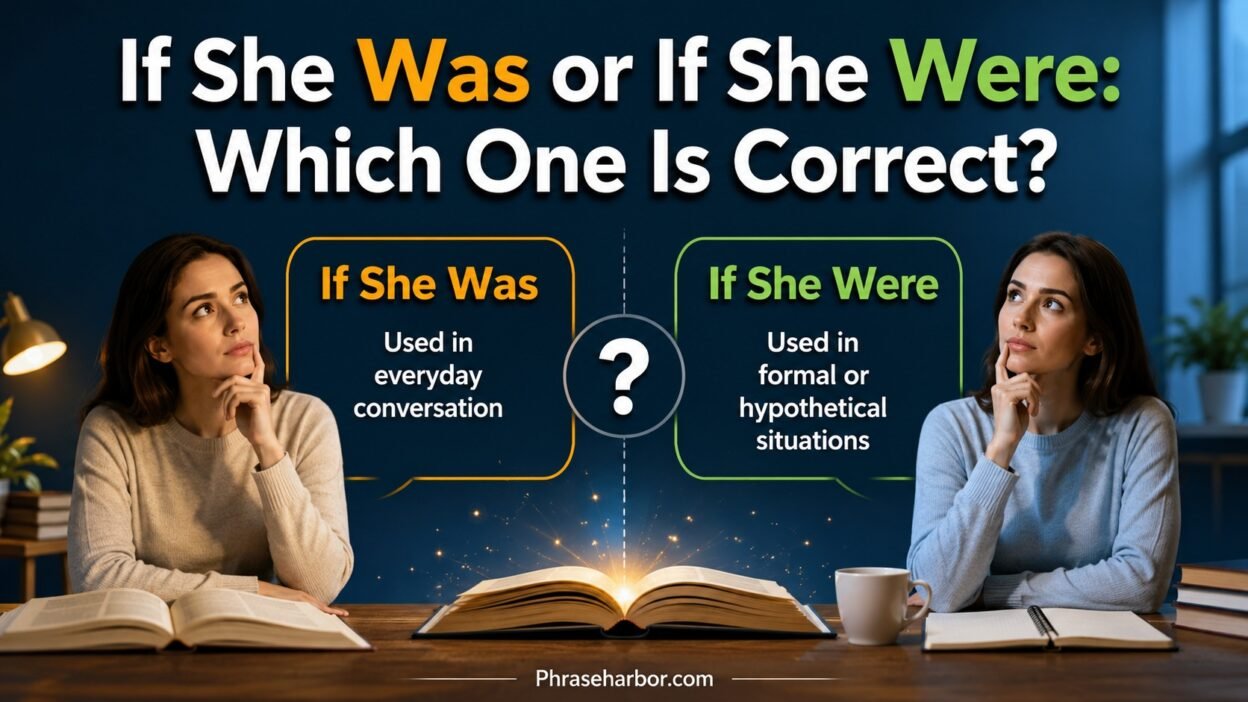
If She Was or If She Were can confuse English learners, but the choice becomes easier when you identify the mood, context, and whether the idea is real or unreal. Use the indicative was for a past event or factual report, such as “If she was at the meeting, I didn’t see her,” while the subjunctive were suits a hypothetical or counterfactual idea, such as “If she were taller, she could reach the shelf.”
In formal English, if she were is often the safer choice when unreality, counterfactuality, politeness, or distancing matters, especially in legal, academic, and editorial contexts. Still, modern colloquial English lets native speakers use both forms interchangeably in everyday speech, which can make the rule seem less fixed.
From my early practice as a coach, I’ve seen many people ask whether to say if she was or if she were, and the answer depends on why, when, and how formal the setting is. A quick guide is to choose was for a plain past-tense report and were for hypotheticals and counterfactuals. This simple rule helps speakers sound confident, avoid common grammar mistakes, and speak more naturally and clearly.
Quick Answer
The short answer is simple:
- Use if she was when you’re talking about something that actually happened or might have happened in the past.
- Use if she were when you’re talking about a hypothetical, imaginary, or unreal situation.
Here are two examples:
- If she was at the meeting, she probably heard the announcement.
- If she were at the meeting, she would know what happened.
The first sentence questions whether she attended the meeting. The second imagines a situation where she attended, even though she didn’t.
Easy rule to remember:
- Real possibility = if she was
- Imaginary situation = if she were
Comparison Overview
| Feature | If She Was | If She Were |
| Grammar mood | Indicative | Subjunctive |
| Refers to | Real or possible situations | Imaginary or unreal situations |
| Time reference | Usually the past | Usually the present or future hypothetically |
| Common in conversation | Very common | Common in formal English |
| Used for uncertainty | Yes | No |
| Used for wishes | No | Yes |
| Used for impossible situations | No | Yes |
| Example | If she was late, traffic caused it. | If she were late, she’d apologize. |
The biggest difference isn’t tense. It’s reality. Ask yourself one question:
Is this situation real or imagined?
That answer determines which form you should choose.
Main Differences Between If She Was or If She Were
Although these phrases look similar, they serve different grammatical purposes.
If She Was Refers to Facts or Real Possibilities
Use if she was when you’re discussing something that could have happened or when you’re unsure whether something happened.
Examples:
- If she was tired yesterday, she probably went home early.
- If she was the person who called, I’ll return her message.
- If she was at work, someone must have seen her.
In each sentence, the speaker isn’t imagining events. They’re talking about genuine possibilities.
If She Were Refers to Hypothetical Situations
Use if she were when the situation isn’t true or exists only in the imagination.
Examples:
- If she were a doctor, she’d understand the diagnosis.
- If she were here, we’d celebrate together.
- If she were older, she’d qualify for the competition.
These situations aren’t presented as facts. They’re possibilities that exist only in theory.
The Difference in One Sentence
Think of it this way:
- Was asks what happened.
- Were asks what would happen.
That simple distinction solves most grammar questions involving these phrases.
Why People Get Confused About If She Was vs. If She Were
Several factors make this grammar rule confusing.
First, native speakers don’t always follow formal grammar in casual conversation. It’s common to hear sentences like:
- If she was here, she’d help us.
Although many people say this naturally, formal grammar recommends:
- If she were here, she’d help us.
Second, English has gradually reduced its use of the subjunctive mood. Many verbs no longer change forms the way they once did. As a result, were remains one of the few noticeable examples.
Finally, many learners assume the choice depends on tense. It doesn’t. Instead, it depends on whether the situation is real or hypothetical.
What Does If She Was Mean?
If She Was Describes Real or Possible Events
The phrase if she was belongs to the indicative mood, which English uses for statements about facts, questions, and real possibilities.
You’re usually uncertain whether something happened.
Examples:
- If she was sick yesterday, she should see a doctor.
- If she was responsible, she’ll explain everything.
- If she was driving, she probably arrived by now.
None of these sentences assume the event is imaginary.
Common Situations Where You Use If She Was
You should normally choose if she was when discussing:
- Possible past events
- Uncertain facts
- Investigations
- Reported information
- Historical discussions
Examples:
- If she was the last person inside, she locked the door.
- If she was unhappy, nobody noticed.
- If she was invited, she didn’t mention it.
These statements leave room for uncertainty while remaining grounded in reality.
What Does If She Were Mean?
If She Were Expresses Unreal or Imaginary Situations
The phrase if she were belongs to the subjunctive mood.
Don’t let the name intimidate you. The idea is straightforward.
The subjunctive helps express:
- Imaginary situations
- Wishes
- Dreams
- Advice
- Conditions contrary to fact
Examples include:
- If she were famous, photographers would follow her.
- If she were my teacher, I’d study harder.
- If she were available, we’d invite her.
The speaker knows these situations aren’t currently true.
Common Situations That Require If She Were
Use if she were for:
- Unreal conditions
- Impossible situations
- Hypothetical questions
- Advice
- Wishes
- Polite suggestions
Examples:
- If she were in your position, she’d apologize.
- If she were president, taxes might change.
- If she were here today, she’d be proud.
Notice how every sentence imagines an alternative reality.
Understanding the Grammar Rule Behind If She Was and If She Were
Many grammar mistakes disappear once you understand two simple concepts.
Indicative Mood
The indicative mood talks about facts or likely events.
Examples:
- She was happy.
- She was late yesterday.
- If she was there, she saw everything.
These sentences describe reality.
Subjunctive Mood
The subjunctive mood describes situations that aren’t real.
Examples:
- If she were taller…
- I wish she were here.
- If she were my sister…
The action exists only as an idea.
Quick Comparison
| Sentence | Real or Imaginary? | Correct Form |
| If she was at home, call her. | Real possibility | If she was |
| If she were at home, she’d answer. | Imaginary | If she were |
| If she was injured, she’ll need help. | Possible fact | If she was |
| If she were injured, we’d stop the game. | Hypothetical | If she were |
When Both If She Was and If She Were Can Be Correct
This surprises many people.
Sometimes both forms are correct, but they communicate different meanings.
Consider these examples.
Example One
If she was rude, she owes you an apology.
The speaker isn’t sure whether she behaved rudely.
Example Two
If she were rude, nobody would like her.
The speaker imagines a situation where she is rude, even though she isn’t.
Both sentences are correct because they express different ideas.
Everyday Examples of If She Was vs. If She Were
At School
- If she was absent yesterday, she’ll need today’s notes.
- If she were the class president, she’d organize the event differently.
At Work
- If she was working late, she’ll answer tomorrow.
- If she were the manager, she’d approve the proposal.
At Home
- If she was cooking dinner, the kitchen is probably clean.
- If she were home right now, we’d watch a movie together.
In Conversation
- If she was joking, I didn’t understand.
- If she were joking, everyone would be laughing.
These examples highlight how context changes the correct choice.
Common Mistakes to Avoid
Even experienced writers make these errors.
Using Was for Clearly Imaginary Situations
Incorrect:
- If she was a millionaire, she’d travel the world.
Correct:
- If she were a millionaire, she’d travel the world.
Using Were for Confirmed Past Events
Incorrect:
- If she were at the office yesterday, she attended the meeting.
Correct:
- If she was at the office yesterday, she attended the meeting.
Confusing Formal Grammar With Casual Speech
Many native speakers say:
- If she was here…
Formal writing prefers:
- If she were here…
Knowing your audience matters.
Formal English vs. Everyday English
Modern English doesn’t always follow textbook grammar.
Formal Writing
Academic papers, business reports, legal documents, and professional publications usually follow traditional grammar.
Examples:
- If she were available…
- If she were eligible…
These constructions sound polished and professional.
Informal Conversation
Casual speech often replaces were with was.
Examples:
- If she was here, she’d know.
- If she was taller, she’d play volleyball.
Although common, these examples aren’t considered the best choice in formal writing.
Read More: Is Used vs Has Been Used vs Was Used: What’s the Difference?
Similar Grammar Pairs You Should Know
Learning one grammar pattern often helps you master others.
If I Was vs. If I Were
- If I was late, I’m sorry.
- If I were you, I’d apologize.
Was vs. Were
- She was excited.
- They were excited.
I Wish She Was vs. I Wish She Were
Formal English prefers:
- I wish she were here.
As If She Was vs. As If She Were
Compare these:
- She looked as if she was tired.
- She acted as if she were the owner.
Again, reality determines the correct choice.
Quick Memory Trick
Here’s an easy trick you can remember.
Ask yourself:
“Is this real or imagined?”
If it’s real or possibly true:
If she was
If it’s imaginary or contrary to reality:
If she were
Another helpful phrase is:
Facts use was. Fantasies use were.
Although it’s a simplification, it works in most situations.
Practice Sentences
Choose the correct word.
- If she ___ home yesterday, she heard the news.
- If she ___ president, she’d change the law.
- If she ___ responsible, she’ll admit it.
- If she ___ available tomorrow, we’d meet.
- If she ___ sick yesterday, she stayed home.
- If she ___ my neighbor, we’d talk more often.
- If she ___ at the station, she caught the train.
- If she ___ famous, she’d have millions of fans.
- If she ___ telling the truth, we’ll find out.
- If she ___ here today, she’d enjoy this event.
Answers
| Question | Correct Answer |
| 1 | was |
| 2 | were |
| 3 | was |
| 4 | were |
| 5 | was |
| 6 | were |
| 7 | was |
| 8 | were |
| 9 | was |
| 10 | were |
Practice like this helps you recognize the pattern naturally.
FAQs:
Is “If she was” grammatically correct?
Yes. If she was is correct when you’re talking about a real past possibility or something that may have actually happened. For example, “If she was at the office, I didn’t see her.” Here, was works as the normal past-tense form.
When should I use “If she were”?
Use if she were for an unreal, hypothetical, or counterfactual situation. For example, “If she were taller, she could reach the shelf.” The situation isn’t presented as a fact; it’s an imagined possibility.
Is “If she were” more formal than “If she was”?
Generally, yes. If she were is traditionally preferred in formal English, especially when the situation is clearly hypothetical or counterfactual. However, if she was is common in everyday speech when the speaker refers to a possible real situation.
Can native speakers use “if she was” and “if she were” interchangeably?
Sometimes, especially in colloquial English. Native speakers often use if she was in situations where traditional grammar might suggest if she were. However, when writing formally, choosing if she were for an unreal condition is usually the clearer option.
How can I remember the difference between “if she was” and “if she were”?
Think about whether the situation is real or imagined. Use if she was for a possible past fact and if she were for an unreal or hypothetical situation. This simple rule can make your writing and speaking much clearer.
Conclusion:
Understanding If She Was or If She Were becomes easier when you focus on meaning rather than memorizing complicated grammar rules. Use was for real or possible past situations, and use were when describing an unreal, hypothetical, or counterfactual situation. With regular practice, you’ll recognize the difference more naturally and choose the correct form with confidence.