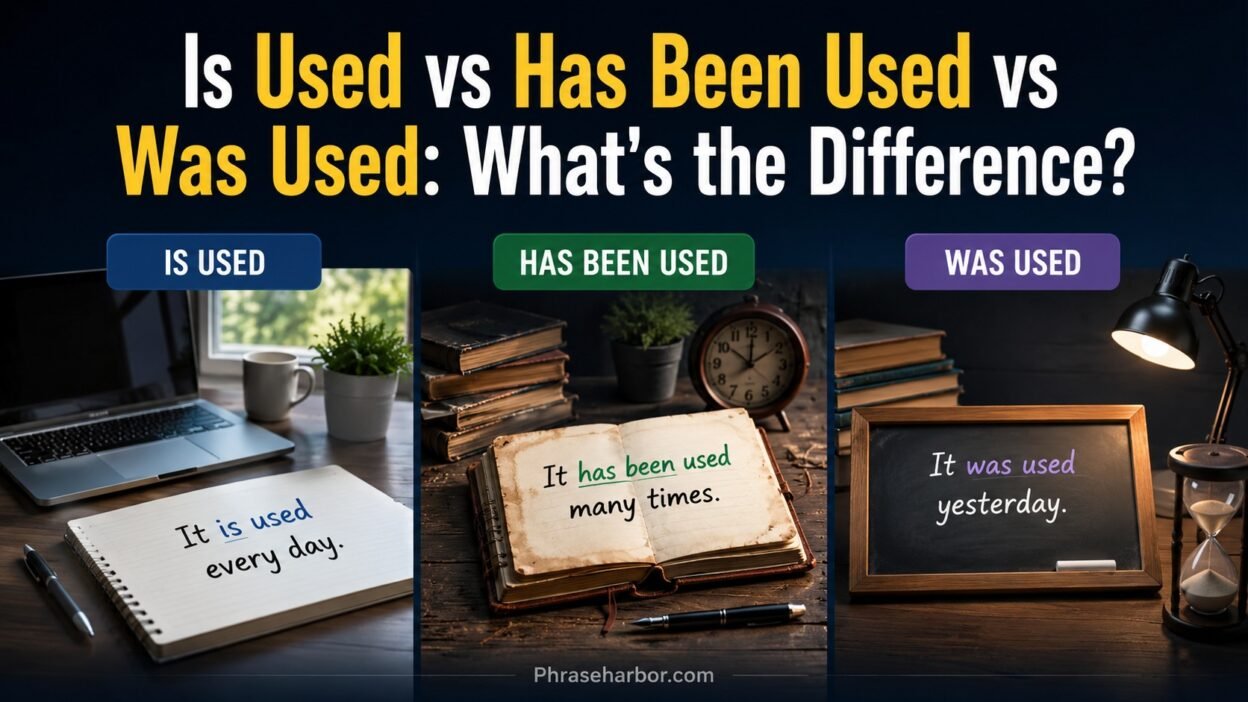
Is Used vs Has Been Used vs Was Used shows how aspect, time markers, and meaning guide each passive form in English grammar. Is Used marks a current state, habitual function, or general facts, while Has Been Used links a past action to a result now.
Was Used places an action at a definite time in the past, while time reference, specific time markers, and context clarify it. Parts of speech checks include the subject, noun, pronoun, auxiliary, is, has, was, and prepositions. Modifiers, tense, subject–verb agreement, sentences, aloud, substitution, and auxiliary checks help reveal the right form.
These forms create common grammar challenges because writers at every level may mix up the auxiliary verb, which shifts the entire timeline. This can change meaning, mislead a reader, weaken a report, or muddle academic writing and professional writing in real contexts.
Quick Answer
The main difference between is used, has been used, and was used lies in time and context.
- Is used describes something that is generally true or currently happens.
- Has been used describes something that happened in the past but still has a connection to the present.
- Was used describes an action that happened at a specific time in the past and is now complete.
Here’s a quick overview.
| Phrase | Tense | Meaning | Best Used For | Example |
| Is used | Present Simple Passive | Describes a current fact or general truth | Habits, processes, definitions, instructions | This software is used by millions of people. |
| Has been used | Present Perfect Passive | Describes a past action that still matters now | Recent events, ongoing relevance, experience | This method has been used for many years. |
| Was used | Simple Past Passive | Describes a finished action in the past | Historical events, completed actions, specific past times | The bridge was used during the war. |
Quick Tip: Ask yourself one simple question: When did the action happen? The answer usually tells you which phrase to choose.
Comparison Overview
Although all three phrases use the passive voice, they do not express the same idea. Understanding their differences will help you write more naturally and avoid common grammar mistakes.
| Feature | Is Used | Has Been Used | Was Used |
| Grammar Tense | Present Simple Passive | Present Perfect Passive | Simple Past Passive |
| Time Reference | Present or general | Past connected to the present | Finished past |
| Current Relevance | Yes | Yes | No |
| Specific Past Time | No | No | Yes |
| Common Signal Words | Usually, generally, every day | Already, recently, ever, yet, so far | Yesterday, last week, in 2022, ago |
| Describes General Facts | |||
| Describes Completed Past Events | Sometimes | ||
| Used in Definitions | Rarely | ||
| Used in Historical Writing | Rarely | Sometimes |
At a Glance
Think of these three expressions as points on a timeline.
| Phrase | Timeline |
| Is used | Happening now or true in general |
| Has been used | Happened before now and still matters |
| Was used | Happened and finished in the past |
For example:
- English is used in over 100 countries. (General fact)
- English has been used as an international language for decades. (Started in the past and continues to be relevant.)
- English was used during the conference yesterday. (Specific event in the past.)
Notice how the meaning changes even though the verb used stays the same.
Main Differences Between Is Used vs Has Been Used vs Was Used
Many learners confuse these phrases because they all contain the verb used in the passive voice. The real difference comes from the helping verbs is, has been, and was. These helping verbs determine the tense and the meaning of the sentence.
Let’s look at the biggest differences.
Is Used Describes Present Facts
Use is used when you talk about something that is generally true or currently happens.
Examples:
- Paper is used to make books.
- Email is used for business communication.
- This machine is used every day.
These sentences describe facts rather than specific events.
Has Been Used Connects the Past to the Present
Use has been used when something happened before now but remains important today.
Examples:
- This medicine has been used for more than fifty years.
- The building has been used as a museum since 2018.
- Artificial intelligence has been used in healthcare for many years.
The exact time isn’t important. What matters is that the action still affects the present.
Was Used Refers to a Finished Past Event
Use was used when the action happened at a definite time that is already over.
Examples:
- The stadium was used during the Olympics.
- This password was used yesterday.
- The old logo was used until 2019.
These actions are complete and no longer connected to the present.
Here’s an Easy Way to Remember
| If your sentence… | Use |
| States a general truth | Is used |
| Connects the past with the present | Has been used |
| Refers to a finished time in the past | Was used |
Think about these three sentences:
- A pencil is used for writing.
- This pencil has been used several times today.
- This pencil was used during yesterday’s exam.
The object stays the same. Only the time changes.
Grammar Insight: The helping verb carries the tense. The word used remains the past participle in all three phrases. Understanding the helping verb is the key to choosing the correct expression.
What Does “Is Used” Mean?
The phrase is used is the present simple passive form of the verb use. It describes something that happens regularly, is generally true, or serves a particular purpose. Instead of focusing on the person performing the action, the sentence highlights the object receiving the action.
For example, consider the sentence:
A microscope is used in science laboratories.
The sentence doesn’t tell you who uses the microscope because that information isn’t important. Instead, it emphasizes the microscope’s purpose.
Structure of “Is Used”
The present simple passive follows this pattern:
Subject + am / is / are + past participle (used)
Examples:
- This application is used by thousands of businesses.
- Glass is used to make windows.
- Cotton is used in clothing production.
- Solar energy is used to generate electricity.
- Water is used in almost every manufacturing process.
Notice that am, is, or are changes depending on the subject.
| Subject | Correct Form |
| I | am used |
| He | is used |
| She | is used |
| It | is used |
| We | are used |
| You | are used |
| They | are used |
When Should You Use “Is Used”?
Use is used in these situations.
General Facts
These statements remain true over time.
Examples:
- English is used as an international language.
- Steel is used in construction.
- The internet is used around the world.
Scientific Facts
Scientific writing often relies on the present simple passive because facts remain consistent.
Examples:
- Oxygen is used during respiration.
- Salt is used to preserve food.
- DNA is used in genetic research.
Instructions and Manuals
Technical documents commonly use is used because they explain the function of an object.
Examples:
- This button is used to restart the system.
- The handle is used to open the valve.
- This feature is used for data backup.
Processes and Manufacturing
Passive voice is especially common when describing processes.
Examples:
- Milk is used to make cheese.
- Clay is used to produce pottery.
- Silicon is used in computer chips.
Real-Life Examples
Imagine you’re describing common objects around your home.
- A refrigerator is used to keep food fresh.
- A washing machine is used to clean clothes.
- A smartphone is used for communication, banking, shopping, and entertainment.
Each sentence explains the purpose of the object rather than a specific event.
Common Mistakes with “Is Used”
Many learners accidentally use is used with a completed past time.
This classroom is used yesterday.
This classroom was used yesterday.
The word yesterday signals a completed past action. Therefore, the simple past passive is required.
Another common mistake is using is used when discussing an action that began in the past and continues to matter today.
This technique is used for more than 100 years.
This technique has been used for more than 100 years.
The phrase for more than 100 years connects the past to the present, so the present perfect passive is the correct choice.
What Does “Has Been Used” Mean?
The phrase has been used is the present perfect passive form of the verb use. It describes an action that happened at an unspecified time before now and still has a connection to the present.
Unlike was used, this form doesn’t focus on when the action happened. Instead, it emphasizes that the action is still relevant today.
For example:
This software has been used by thousands of businesses.
The sentence doesn’t tell you exactly when businesses started using the software. What matters is that the software has been used before and that fact remains relevant now.
Structure of “Has Been Used”
The present perfect passive follows this pattern:
Subject + has/have + been + past participle (used)
Examples:
- The system has been used successfully.
- This method has been used for decades.
- The equipment has been used several times today.
- The document has been used as evidence.
- Artificial intelligence has been used in medicine for many years.
Remember:
- Use has with singular subjects.
- Use have with plural subjects and I and you.
| Subject | Correct Form |
| He | has been used |
| She | has been used |
| It | has been used |
| The computer | has been used |
| They | have been used |
| We | have been used |
| You | have been used |
When Should You Use “Has Been Used”?
Use has been used when the action happened in the past but still matters now.
Actions With Present Relevance
The action is complete, but its result or importance continues.
Examples:
- This password has been used before.
- The report has been used to improve company policies.
- The evidence has been used in the investigation.
Although the action occurred earlier, it still affects the present.
Read More: Unalienable vs. Inalienable: What’s the Difference?
Experiences Without a Specific Time
The exact time isn’t important.
Examples:
- This technique has been used in many industries.
- The software has been used by millions of users.
- This strategy has been used successfully around the world.
Notice that none of these sentences mention yesterday, last year, or another finished time.
Actions Continuing Until Now
Sometimes the present perfect passive shows that something started in the past and continues today.
Examples:
- Solar panels have been used for decades.
- This bridge has been used since 1985.
- The laboratory has been used continuously for research.
Words such as since and for often appear with the present perfect.
Recent Events
Use this tense when talking about recent actions that still matter.
Examples:
- The room has been used already.
- The machine has been used today.
- The document has been used several times this week.
These actions are close to the present, so the connection remains.
Common Time Expressions
You’ll often see these words with has been used:
- Already
- Yet
- Recently
- Ever
- Never
- So far
- Since
- For
- This week
- Today
- Lately
Examples:
- This feature has been used recently.
- The account has been used today.
- The method has been used for over twenty years.
Common Mistakes with “Has Been Used”
A frequent mistake is combining the present perfect with a finished past time.
The computer has been used yesterday.
The computer was used yesterday.
Why?
The word yesterday refers to a completed time period. The present perfect doesn’t work with completed past time expressions.
Here’s another example.
The stadium has been used in 2016.
The stadium was used in 2016.
Since 2016 is a finished point in time, the simple past is correct.
Real-Life Examples
Imagine you’re managing an office.
You might say:
- This conference room has been used several times today.
- The printer has been used by every department this week.
- The security card has been used to enter the building.
These examples focus on actions that still matter because the day or week hasn’t ended.
Grammar Tip: If you can naturally add still matters now after the sentence, has been used is often the right choice.
For example:
- This method has been used for centuries and it still matters today.
- The software has been used worldwide and people continue to rely on it.
That continuing relevance is what makes the present perfect passive unique.
FAQs:
What is the difference between Is Used, Has Been Used, and Was Used?
Is Used describes a current state, regular practice, or habitual function. Has Been Used describes a completed action with a connection to the present, while Was Used refers to an action completed at a specific time in the past.
When should I use Is Used?
Use Is Used for general facts, regular activities, or situations that are true now. For example, “This software is used by many professionals” describes a current and continuing practice.
When should I use Has Been Used?
Use Has Been Used when an action happened before now and its result or relevance still matters. For example, “The new system has been used successfully” connects the past action with the present result.
When should I use Was Used?
Use Was Used when you’re talking about a completed action at a definite past time. For example, “The old system was used last year” clearly places the action in the past.
How can I choose the correct passive form?
Focus on the time relationship. Use Is Used for current or habitual situations, Has Been Used for past actions connected to the present, and Was Used for completed actions at a definite past time.
Conclusion:
Understanding Is Used vs Has Been Used vs Was Used becomes easier when you focus on time and context rather than memorizing isolated rules. Is Used works for current or habitual situations, Has Been Used connects a past action to the present, and Was Used places a completed action firmly in the past.
Once you recognize these differences, you can choose the right form with greater confidence in academic writing, business reports, emails, and everyday English.