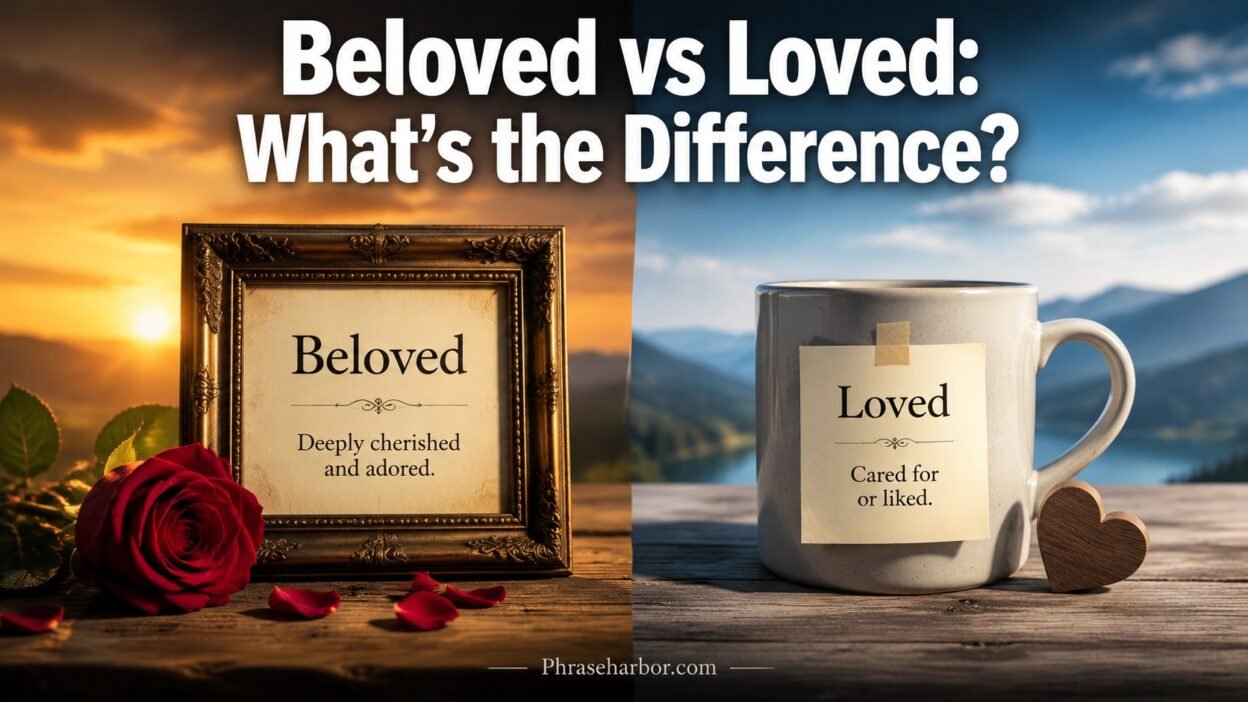
Beloved vs Loved can confuse writers, speakers, and learners because both are English words linked to love, yet they carry different emotional weight. Beloved suggests strong feelings, deep, lasting affection for someone special, such as a family member or close friend. It can show gentle care, respect, and an honest, true sense of powerful emotions that means a lot to the person you speak about.
In my experience, I’ve seen beloved work especially well in poems, songs, and kind memories, where its formal, poetic, reverent, heavier, and more enduring tone adds elevated emphasis. As an adjective or noun, it can appear in phrases such as beloved friend, giving the meaning entirely different shades from normal expressions.
Loved has a broader range and usually sounds warm, simple, common, direct, and conversational. It fits daily talk, letters, short notes, and casual stories, helping people express their hearts in an easy, friendly way without sounding serious or heavy. As a past participle, it can describe something cared for, liked, or the result of having been loved, as in loved family member or she has been loved.
Quick Answer
The difference between beloved vs loved comes down to meaning, intensity, and usage.
- Loved describes the feeling of loving someone or something. It often functions as the past tense of love or as an adjective.
- Beloved describes someone or something that is deeply cherished, treasured, and admired, often by many people rather than just one individual.
Examples
- I loved the concert.
- Our beloved grandfather will always remain in our hearts.
In the first sentence, loved expresses a personal feeling.
In the second sentence, beloved emphasizes lasting admiration and deep emotional value.
Quick Tip: If you’re talking about your own feelings, loved is usually the better choice. If you’re describing someone who is treasured or held in high regard, beloved often fits better.
Comparison Overview
| Feature | Beloved | Loved |
| Meaning | Deeply cherished or treasured | Felt affection for someone or something |
| Emotional Strength | Very strong | Moderate to very strong depending on context |
| Common Use | Tributes, literature, memorials, formal writing | Everyday conversation, storytelling, reviews |
| Part of Speech | Adjective, sometimes noun | Verb, adjective |
| Tone | Formal, respectful, affectionate | Neutral, conversational |
| Refers To | The person’s valued status | The act or feeling of love |
| Examples | Beloved grandmother, beloved author | Loved my family, loved the meal |
Main Differences Between Beloved vs Loved
Although both words relate to affection, they highlight different ideas.
Beloved Describes Status
When someone is beloved, they are widely cherished or deeply valued. The word focuses on how others regard that person or thing.
Examples include:
- a beloved teacher
- a beloved pet
- a beloved actor
- a beloved community leader
The emphasis isn’t just on love. It also suggests respect, admiration, and emotional importance.
Loved Describes Feelings
The word loved focuses on the emotion or action of loving.
Examples include:
- I loved the vacation.
- She loved her children.
- We loved spending time together.
Here, the focus is on what someone felt.
Beloved Is Usually More Formal
You’ll often find beloved in:
- Memorial speeches
- Religious texts
- Wedding ceremonies
- Literature
- Historical writing
- Public tributes
By contrast, loved appears naturally in everyday speech.
For example:
- “I loved your presentation.”
- “Everyone loved the new restaurant.”
Grammar Differs
Loved works as:
- the past tense of love
- a past participle
- an adjective
Examples:
- She loved reading.
- The children were loved by everyone.
- He felt loved.
Beloved mainly functions as an adjective.
Examples:
- beloved daughter
- beloved city
- beloved friend
It can occasionally function as a noun in literary or religious contexts, such as “my beloved.”
What Does “Loved” Mean?
The word loved comes from the verb love, meaning to feel deep affection, care, or strong enjoyment.
It appears constantly in everyday English because it fits many situations.
You can use loved when talking about:
- Family
- Friends
- Romantic partners
- Hobbies
- Food
- Movies
- Books
- Places
- Experiences
Examples
- We loved our vacation in Hawaii.
- She loved helping others.
- They loved every minute of the concert.
- I loved your presentation.
- The children loved playing outside.
Notice how each sentence describes someone’s feelings rather than someone’s reputation.
Loved Can Express Different Levels of Emotion
One interesting feature of loved is its flexibility.
It may describe:
- Romantic love
- Family affection
- Friendship
- Appreciation
- Enjoyment
For example:
“I loved the chocolate cake.”
This doesn’t mean emotional attachment. It simply means you enjoyed it very much.
What Does “Beloved” Mean?
The adjective beloved means dearly loved, cherished, treasured, or admired.
Unlike loved, this word suggests lasting emotional importance.
People often use it to describe someone whose influence extends beyond personal relationships.
Examples include:
- beloved grandfather
- beloved professor
- beloved national hero
- beloved childhood home
The word carries warmth and respect.
Why Does Beloved Feel More Emotional?
The prefix be- historically adds emphasis.
Although modern speakers don’t consciously think about the prefix, beloved has developed into a word that implies more than affection.
It suggests:
- admiration
- appreciation
- respect
- emotional attachment
- lasting significance
That’s why newspapers frequently write:
“The beloved actor passed away peacefully.”
Instead of:
“The loved actor passed away peacefully.”
The second version sounds awkward because English naturally favors beloved in formal tributes.
When Should You Use Beloved?
Use beloved when someone or something holds a special place in people’s hearts.
Memorials
Examples:
- our beloved father
- beloved grandmother
- beloved friend
These expressions communicate lasting affection.
Wedding Ceremonies
Many traditional wedding vows include:
“My beloved husband.”
or
“My beloved wife.”
The word sounds timeless and deeply affectionate.
Religious Writing
Many religious texts use beloved.
Examples:
- Beloved brothers and sisters
- Beloved children of God
The word conveys warmth and spiritual closeness.
Literature
Novelists frequently use beloved to create emotional depth.
Example:
“He searched for his beloved across the kingdom.”
The wording sounds poetic and meaningful.
Public Tributes
When honoring respected figures, writers often choose beloved.
Examples include:
- beloved coach
- beloved community leader
- beloved musician
When Should You Use Loved?
Use loved in everyday conversation whenever you’re talking about emotions or experiences.
Daily Conversation
Examples:
- I loved your idea.
- We loved the museum.
- She loved her birthday gift.
Reviews
People naturally write:
- I loved the movie.
- We loved the hotel.
- Everyone loved the restaurant.
Personal Stories
Examples:
- My grandmother loved gardening.
- Dad loved fishing.
- My sister loved reading fantasy novels.
School Writing
Students frequently write:
- I loved reading this book.
- We loved learning about space.
These sentences sound natural because they express personal feelings.
Beloved vs Loved in Real-Life Examples
| Situation | Best Choice | Reason |
| Family obituary | Beloved | Shows lasting admiration |
| Movie review | Loved | Expresses personal opinion |
| Wedding speech | Beloved | Formal and heartfelt |
| Text message | Loved | Natural conversation |
| Memorial plaque | Beloved | Traditional wording |
| Product review | Loved | Describes enjoyment |
| Children’s story | Either | Depends on tone |
Side-by-Side Sentence Comparison
| Beloved | Loved |
| She was our beloved teacher. | We loved our teacher. |
| His beloved dog followed him everywhere. | He loved his dog deeply. |
| Their beloved hometown welcomed them home. | They loved visiting their hometown. |
| The beloved author inspired generations. | Millions loved the author’s books. |
| Our beloved grandmother never stopped smiling. | We loved our grandmother every day. |
Notice the subtle difference.
The beloved examples describe identity or status.
The loved examples describe actions or feelings.
Can Beloved and Loved Be Used Interchangeably?
Sometimes.
However, changing one word often changes the tone.
Example One
- She was a beloved teacher.
- She was a loved teacher.
The first sounds natural.
The second sounds unusual because English speakers rarely phrase it this way.
Example Two
- I loved the concert.
- I beloved the concert.
The second sentence is incorrect because beloved isn’t a verb.
Example Three
- He was greatly loved.
- He was beloved.
Both are grammatically correct.
However:
- greatly loved emphasizes the feelings people had.
- beloved emphasizes the person’s cherished status.
Read More: Proved or Proven: Which Word Is Correct?
Common Mistakes People Make
Using Beloved in Casual Conversation
This sounds overly formal.
Instead of:
My beloved pizza.
Say:
I loved the pizza.
Using Loved in Memorial Writing
Although correct, it often lacks emotional depth.
Compare:
- our loved father
- our beloved father
The second feels more natural in English.
Thinking Beloved Means “Loved More”
Not exactly.
Beloved isn’t simply a stronger version of loved.
Instead, it highlights that someone is treasured, respected, and cherished.
Using Beloved as a Verb
Incorrect:
I beloved my parents.
Correct:
I loved my parents.
Common Expressions With Beloved
These phrases appear frequently because they sound natural.
- beloved wife
- beloved husband
- beloved friend
- beloved son
- beloved daughter
- beloved grandmother
- beloved teacher
- beloved author
- beloved hometown
- beloved pet
These combinations have become standard English expressions over centuries.
Synonyms of Beloved
Different situations call for different words.
| Word | Best Use |
| Cherished | Personal relationships |
| Treasured | Emotional keepsakes |
| Adored | Strong affection |
| Dear | Friendly writing |
| Esteemed | Professional respect |
| Revered | Historical or religious contexts |
| Precious | Family and close relationships |
Synonyms of Loved
| Word | Meaning |
| Adored | Loved intensely |
| Appreciated | Valued |
| Cared for | Showed kindness |
| Enjoyed | Found pleasure in |
| Valued | Considered important |
| Favored | Preferred |
Each synonym carries a slightly different shade of meaning, so choose the one that best matches your context.
Beloved vs Loved in Literature and Everyday English
Writers often choose beloved because it creates emotional depth in fewer words.
Consider this sentence:
“He returned to his beloved homeland.”
The phrase immediately evokes nostalgia, loyalty, and affection.
Now compare:
“He returned to his loved homeland.”
Although understandable, it sounds unnatural to most native speakers.
In everyday English, people naturally say:
- I loved the book.
- We loved our vacation.
- Everyone loved the performance.
That’s because loved fits ordinary conversation better.
Memory Trick to Remember the Difference
Here’s a simple way to remember the distinction.
Think of loved as the feeling.
Think of beloved as the person or thing that receives lasting admiration.
Another easy reminder:
- Loved = Emotion
- Beloved = Cherished Identity
If you can replace the word with deeply cherished, then beloved is probably the right choice.
FAQs:
Is beloved stronger than loved?
Yes, beloved usually carries a deeper and more lasting emotional meaning than loved. It suggests someone or something is deeply cherished, treasured, or held with special affection. Loved is broader and more common in everyday English, so the best choice depends on the tone and context.
Can beloved and loved be used interchangeably?
Sometimes they can describe a similar feeling, but they aren’t always interchangeable. Loved works naturally in ordinary conversations, while beloved often adds a sense of depth, warmth, ceremony, or lasting affection. Replacing one with the other can change the emotional tone of a sentence.
Is beloved formal or informal?
Beloved is generally more formal, poetic, or emotionally expressive. You’ll often see it in literature, poems, memorial writing, speeches, and descriptions of people who are deeply cherished. However, it can also appear in everyday expressions when someone wants to emphasize strong affection.
What is the difference between a beloved person and a loved person?
A beloved person is someone who is deeply cherished and especially valued. A loved person is someone who receives affection or care. For example, “She was a beloved teacher” suggests strong admiration and lasting affection, while “She was a loved teacher” simply states that people cared about her.
Which word should I use: beloved or loved?
Use beloved when you want to express deep, special, or lasting affection. Choose loved when you want simple, natural, and conversational wording. Think about your audience, sentence, and intended tone before making your choice.
Conclusion:
Beloved and loved both express affection, but they aren’t identical in tone or emotional weight. Beloved feels deeper, more enduring, and sometimes more formal or poetic, while loved is simple, common, and natural in everyday communication. Understanding this difference can help you choose the word that best matches your meaning and makes your writing sound clear and natural.