Have you ever compared someone’s smile to sunshine or explained a complicated idea by comparing it to something familiar? Both techniques make communication more interesting, but they don’t serve exactly the same purpose. This is where understanding analogy vs. simile becomes important.
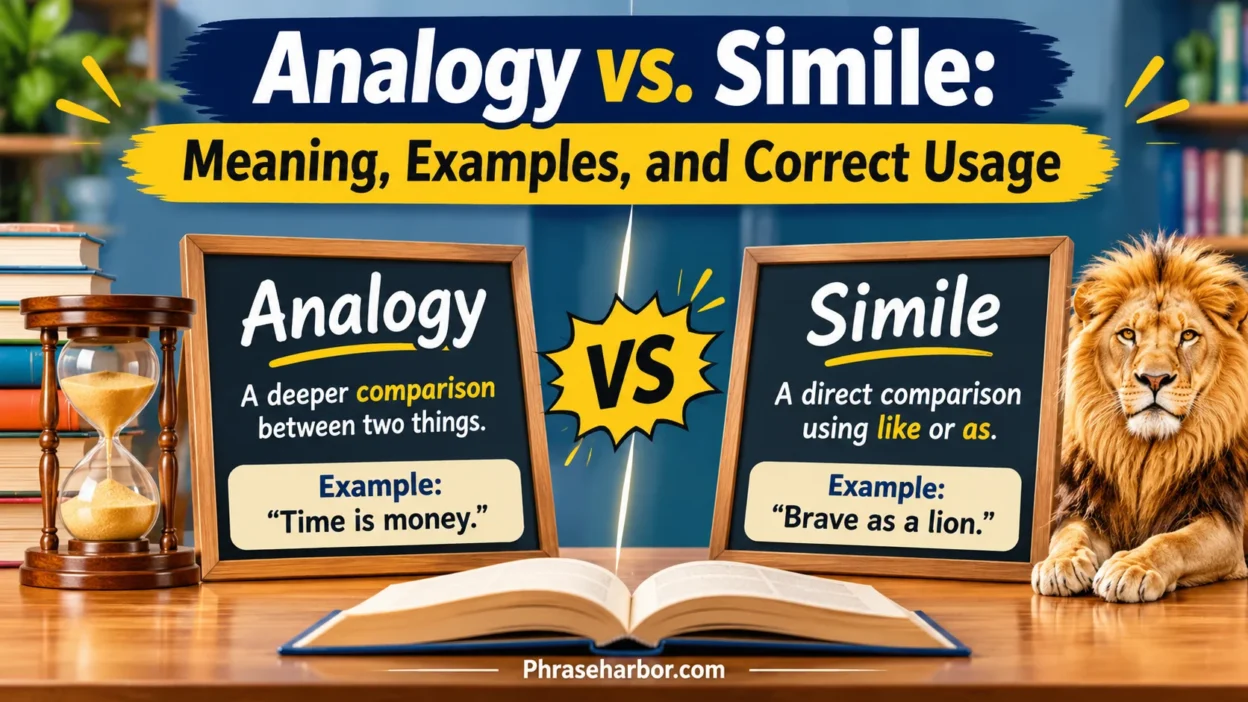
An analogy and a simile both establish comparisons between different things. However, they differ in structure, purpose, and the way they communicate meaning. A simile creates a direct comparison to make a description more vivid. An analogy explains an idea or relationship by connecting it to something easier to understand.
For example, saying “Her eyes sparkled like stars” creates a visual image through a simile. However, comparing the human brain to a computer helps explain how the brain processes and stores information. That’s an analogy.
Although these devices sometimes overlap, knowing when to use each one can improve your writing, conversations, storytelling, and explanations. Let’s explore their meanings, differences, examples, and practical uses.
Quick Answer
An analogy compares two things based on a shared relationship or characteristic to explain an idea or make something easier to understand. A simile directly compares two different things using words such as “like” or “as” to create a vivid description.
For example:
- Simile: Her voice sounds like music.
- Analogy: A teacher is to a student what a coach is to an athlete because both guide others toward improvement.
The main difference is their purpose. A simile generally creates imagery while an analogy explains similarities between ideas, situations, or relationships.
Comparison Overview
Analogy and simile both rely on comparison, but their structures and functions aren’t identical. A simile usually highlights one noticeable similarity. An analogy can explain several connected similarities to make an unfamiliar subject easier to understand.
The following table highlights their main differences.
| Comparison Point | Analogy | Simile |
| Definition | A comparison that explains similarities between things or relationships | A direct comparison between two unlike things |
| Main purpose | To explain or clarify an idea | To create a vivid description |
| Structure | Can involve simple or extended comparisons | Usually uses “like” or “as” |
| Length | Can extend across several sentences | Often short and direct |
| Focus | Shared characteristics or relationships | A particular quality or resemblance |
| Common use | Teaching, reasoning, explanations, and arguments | Poetry, storytelling, and everyday speech |
| Literary role | Can support explanations and figurative language | A recognized figure of speech |
| Example | Learning a language is like building a house | Her smile shines like the sun |
One important detail deserves attention: an analogy isn’t necessarily a literary device in the same way a simile is. Writers and speakers also use analogies to explain logical relationships, scientific processes, and everyday situations.
For instance, comparing a heart to a pump helps explain its function. The comparison isn’t simply decorative. It communicates how one system works through another familiar system.
What Is a Simile?
A simile is a figure of speech that compares two different things using words such as “like” or “as.” It highlights a shared quality to help readers imagine something more clearly.
Instead of describing something directly, a simile connects it to a familiar object, person, experience, or natural phenomenon.
For example, consider this sentence:
“Her voice was as soft as a whisper.”
The sentence compares someone’s voice to a whisper. Both share the quality of softness. This comparison helps readers understand the sound without requiring a lengthy explanation.
Similes appear in everyday conversations, novels, poems, songs, and descriptive writing. They’re particularly useful when ordinary descriptions don’t create a strong enough impression.
Definition of Simile
A simile uses an explicit comparison to show that two different things share a particular characteristic.
The word simile comes from the Latin word similis, meaning similar or like. Its purpose is to highlight resemblance rather than suggest that two things are literally identical.
Consider these examples:
- The baby slept like an angel.
- His hands were as cold as ice.
- The children ran like wild horses.
- Her laughter sounded like bells.
- The classroom was as quiet as a library.
Each example compares two different things through a recognizable characteristic.
For instance, a child’s laughter doesn’t literally resemble bells in every way. However, the comparison suggests a pleasant, bright, or musical sound.
A simile doesn’t claim that two things are the same. It simply highlights something they have in common.
Examples of Similes in Everyday English
People use similes more often than they realize. Many familiar expressions have become part of ordinary American English.
Here are some common examples:
| Simile | Meaning |
| As busy as a bee | Extremely busy or active |
| Brave like a lion | Showing great courage |
| As cold as ice | Very cold |
| Like a fish out of water | Feeling uncomfortable in an unfamiliar situation |
| As light as a feather | Extremely lightweight |
| Sells like hotcakes | Sells very quickly |
| Sleeps like a baby | Sleeps peacefully or deeply |
| Like two peas in a pod | Two people who are very similar or close |
Some similes are conventional expressions that people recognize immediately. Others are original comparisons that writers create to express a particular feeling or image.
For example:
“His thoughts moved like restless waves during the storm.”
This original simile connects someone’s thoughts to moving waves. It communicates confusion, movement, and emotional disturbance in one sentence.
How Similes Work in Writing and Speech
A good simile can turn an ordinary sentence into something memorable. Instead of simply telling readers what something looks or feels like, it gives them a familiar image.
Consider these two sentences:
- The road was very long.
- The road stretched like a ribbon across the endless countryside.
The first sentence communicates basic information. The second creates a clearer mental picture.
Similes serve several important purposes in communication.
Creating visual imagery: Writers use similes to help readers picture people, places, and objects.
Expressing emotions: A comparison can communicate feelings that ordinary descriptions struggle to capture.
Making descriptions memorable: Familiar comparisons give readers something recognizable to remember.
Adding personality: Creative similes can make writing sound more expressive and engaging.
For example, a novelist might describe a nervous character’s heartbeat as “a drum pounding inside his chest.” This comparison makes the character’s anxiety easier to imagine.
Common Types and Patterns of Similes
Although similes can take different forms, most follow recognizable patterns.
Similes using “like”
These comparisons connect two things through the word “like.”
Examples:
- The stars looked like diamonds.
- He eats like a horse.
- The baby clung to her mother like a koala.
Similes using “as…as”
This structure compares two things through a shared quality.
Examples:
- As strong as an ox.
- As white as snow.
- As gentle as a lamb.
Conventional similes
These are familiar expressions that have become common in everyday language.
Examples include:
- As busy as a bee.
- As blind as a bat.
- Like a needle in a haystack.
Creative similes
Writers develop original comparisons to communicate specific feelings, descriptions, or experiences.
Example:
“Her ideas scattered like leaves in a sudden autumn wind.”
This comparison creates a particular image instead of relying on a familiar expression.
Read More: Juxtaposition vs. Paradox: Meaning, Differences, and Correct Usage
What Is an Analogy?
An analogy is a comparison between two things that share a meaningful characteristic, function, structure, or relationship. Its primary purpose is often to explain something unfamiliar through something people already understand.
Unlike a simple descriptive comparison, an analogy can explore how different parts of two situations relate to each other.
For example, consider this statement:
“The brain is like a computer because both receive information, process it, and store information.”
This analogy helps explain certain aspects of how the brain works. It connects a complex biological system to a familiar technological device.
However, the comparison doesn’t mean the brain and computer function identically. A human brain has biological processes and abilities that a computer doesn’t possess.
That’s an important feature of analogies: they explain selected similarities without requiring two things to be identical.
Definition of Analogy
An analogy is a comparison that demonstrates a relationship or similarity between two different things.
It often helps people understand unfamiliar subjects by connecting them to familiar experiences.
For example:
“A school is like a garden because students need care, encouragement, and opportunities to grow.”
This analogy compares education to gardening. Students represent growing plants while teachers provide guidance and support.
The comparison explains an abstract idea through a familiar process.
Analogies can compare:
- Objects and their functions.
- People and their responsibilities.
- Processes and systems.
- Relationships between different ideas.
- Familiar and unfamiliar experiences.
Unlike similes, analogies don’t require the words “like” or “as.” They can use complete statements, parallel relationships, or extended explanations.
Examples of Analogies in Everyday English
Analogies appear in classrooms, workplaces, conversations, and professional explanations.
Here are some practical examples:
| Analogy | What It Explains |
| The heart is like a pump. | How the heart moves blood through the body |
| A teacher is to a student as a coach is to an athlete. | Similar guidance and development roles |
| A business without a plan is like a ship without a compass. | The importance of direction and planning |
| Learning a language is like building a house. | Why foundational skills matter |
| Managing money is like maintaining a garden. | Why regular attention and planning are necessary |
| A computer network is like a road system. | How connected pathways allow information to move |
Notice that these examples don’t all follow one grammatical pattern.
Some use direct comparisons while others connect two relationships. Nevertheless, each analogy helps explain a particular idea.
How Analogies Work in Communication
Analogies make complicated subjects easier to understand by connecting unfamiliar information to familiar experiences.
Imagine explaining how electricity travels through a wire to someone without a scientific background.
You could introduce electrical current through the analogy of water flowing through a pipe.
In this comparison:
- Electrical current resembles flowing water.
- Voltage resembles water pressure.
- A wire resembles a pipe.
- Electrical resistance resembles an obstacle that restricts flow.
This analogy provides a starting point for understanding electricity without introducing every scientific detail immediately.
However, the comparison has limitations. Electricity involves moving electrical charge rather than water molecules flowing through a pipe.
Good analogies make complex subjects accessible while acknowledging that comparisons aren’t perfect.
They serve several purposes:
Simplifying difficult concepts: Analogies turn unfamiliar information into recognizable ideas.
Supporting explanations: Teachers and professionals use them to explain complicated processes.
Strengthening arguments: A carefully chosen analogy can help an audience understand why an argument makes sense.
Improving learning: Familiar comparisons help students connect new information with existing knowledge.
Encouraging critical thinking: Examining similarities and differences helps people understand relationships between concepts.
Common Types of Analogies
Analogies appear in several forms depending on what they compare.
Literal and Figurative Analogies
A literal analogy compares things that share actual functional or structural similarities.
Example:
“A bicycle and a motorcycle both use wheels and handlebars for transportation.”
A figurative analogy connects ideas through a nonliteral comparison.
Example:
“Life is a journey filled with unexpected turns.”
The second comparison uses a journey to represent the experiences and challenges of life.
Relationship-Based Analogies
Relationship-based analogies compare connections between pairs of things.
Example:
“Teacher is to student as doctor is to patient.”
The relationship involves one person providing professional guidance or assistance to another.
Other examples include:
- Bird is to nest as bee is to hive.
- Author is to book as composer is to music.
- Captain is to ship as pilot is to airplane.
These examples are especially common in educational exercises and verbal reasoning questions.
Functional Analogies
Functional analogies compare things that perform similar roles.
Example:
“The human heart works like a pump because both move fluid through a system.”
Other examples include:
- A thermostat regulates temperature like a controller manages a system.
- A filter cleans water like a sieve separates unwanted materials.
- A calendar organizes dates like a schedule organizes activities.
Structural Analogies
Structural analogies compare the organization or arrangement of different systems.
Example:
“A company’s departments work like different organs in a body because each performs a specific function while supporting the whole system.”
This comparison explains how separate parts contribute to a larger structure.
Frequently Asked Questions
What Is the Main Difference Between an Analogy and a Simile?
The main difference is their purpose. A simile directly compares two unlike things using “like” or “as” to create a vivid description. An analogy compares similarities between things or relationships to explain an idea. A simile is a specific figure of speech while an analogy is a broader comparison technique.
Is an Analogy a Type of Simile?
No. An analogy isn’t a type of simile. However, an analogy can use simile-like language. For example, comparing language learning to building a house uses a direct comparison and develops a broader explanation. The two concepts can overlap without becoming interchangeable.
Can a Simile Also Be an Analogy?
Yes, depending on its purpose and development. A simile can also function as an analogy when it explains a broader idea through shared characteristics. For example, saying “Learning is like climbing a mountain because each step brings you closer to your goal” uses a simile-like structure to explain the learning process.
What Are Three Examples of Analogies and Similes?
Here are three examples of each:
Analogies:
- A teacher is to a student as a coach is to an athlete.
- The heart works like a pump because it moves blood through the body.
- Learning a language is like building a house because both require a strong foundation.
Similes:
- Her smile shines like the sun.
- He is as brave as a lion.
- The water was as cold as ice.
Which Is More Effective in Writing: Analogy or Simile?
Neither is universally better. A simile works well when you want to create vivid descriptions or emotional imagery. An analogy works better when you need to explain unfamiliar concepts or relationships. Effective writers choose the technique that best supports their message and audience.
Conclusion:
Understanding analogy vs. simile helps you communicate ideas more clearly and creatively. Although both techniques rely on comparisons, they serve different purposes in writing and everyday communication.
A simile uses words such as “like” or “as” to compare two unlike things and create vivid descriptions. An analogy goes further by explaining similarities between ideas, relationships, or processes. It often makes complicated information easier to understand.