Have you ever wondered whether to write ageing or aging? Both spellings appear in English, and neither is inherently wrong. However, choosing the right one depends largely on your audience and the variety of English you’re using.
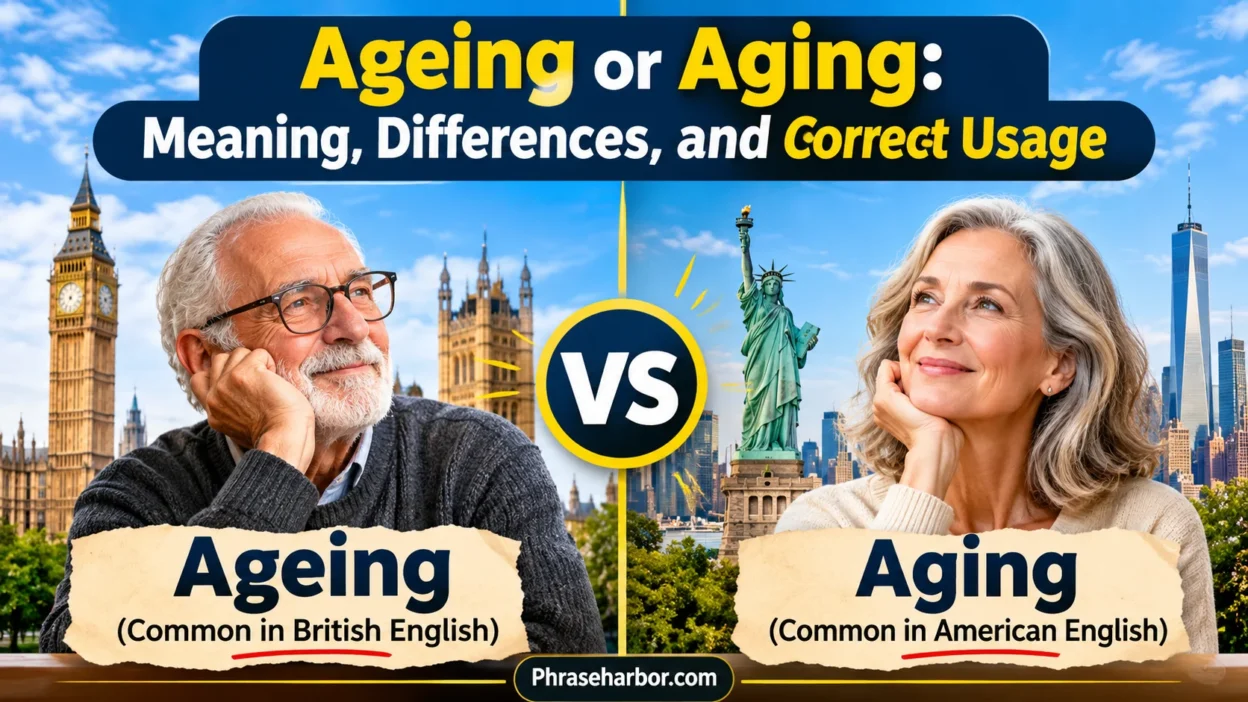
The difference is simple: aging is the preferred spelling in American English, while ageing is the standard spelling in British English. Both words describe the same process of growing older or changing with time.
Although the difference involves just one letter, it can matter in professional writing, academic papers, business documents, and everyday communication. Using the appropriate spelling helps your writing look consistent and natural to readers.
In this guide, you’ll learn what ageing and aging mean, why their spellings differ, how to use them in sentences, and which version works best in different English-speaking countries.
Quick Answer
Aging is the correct and preferred spelling in American English, whereas ageing is the standard spelling in British English.
Both words have exactly the same meaning. They describe the natural process of becoming older or the gradual changes that happen over time.
Here are two examples:
- American English: The aging population needs better healthcare services.
- British English: The ageing population needs better healthcare services.
Neither spelling is universally incorrect. Your choice should depend on your target audience and the spelling convention you follow.
Comparison Overview
Although ageing and aging look slightly different, they serve the same grammatical purposes and communicate the same idea.
The following table highlights their main similarities and differences.
| Feature | Aging | Ageing |
| Meaning | Growing older | Growing older |
| Preferred English variety | American English | British English |
| Part of speech | Noun, verb form, adjective | Noun, verb form, adjective |
| Pronunciation | AY-jing | AY-jing |
| Spelling difference | Drops the final e | Retains the final e |
| Common expression | Aging process | Ageing process |
| Health-related expression | Healthy aging | Healthy ageing |
| Correctness | Correct | Correct |
The main takeaway: Aging and ageing aren’t different words with separate definitions. They’re regional spelling variations of the same word.
Main Differences Between Ageing and Aging
Understanding the differences between these spellings requires looking at regional English conventions, grammar, and word formation. Let’s examine each aspect.
American English: Why Aging Is Correct
In American English, aging is the standard spelling. American dictionaries and publications generally use this version without the final letter e.
The spelling follows a common word-formation pattern in which the final silent e disappears before certain suffixes.
For example:
- Age becomes aging.
- Hope becomes hoping.
- Write becomes writing.
- Dance becomes dancing.
- Move becomes moving.
The final e usually disappears when a word takes a suffix beginning with a vowel, such as -ing. This keeps the spelling consistent with common American English conventions.
You’ll frequently encounter aging in American newspapers, medical publications, research papers, and educational materials.
Examples:
- The aging process affects everyone differently.
- Scientists study the effects of aging on the human brain.
- Regular exercise supports healthy aging.
- The company develops products for aging skin.
- Aging infrastructure requires regular maintenance.
If you’re writing for an American audience, choose aging throughout your article.
British English: Why Ageing Is Correct
British English generally prefers ageing, which retains the final letter e from the original word age.
This spelling follows a convention used in several British English words. Although many British words drop their final silent e before adding -ing, some retain it.
For example, British English commonly uses:
- Ageing
- Dyeing
- Singeing
These spellings help distinguish certain word forms and preserve established spelling conventions.
In British publications, academic writing, and everyday communication, ageing is widely accepted and preferred.
Examples:
- Ageing is a natural part of human life.
- The government introduced new policies for an ageing population.
- Researchers are investigating the effects of ageing on memory.
- She follows a healthy lifestyle to support graceful ageing.
- The ageing building needs extensive repairs.
When writing for readers in the United Kingdom, ageing is generally the better choice.
Ageing vs. Aging in Canadian, Australian, and Other English Varieties
American and British English aren’t the only varieties that influence spelling choices. Canada, Australia, and New Zealand also have established English conventions.
However, their preferences don’t always match British or American usage in every situation.
Canadian English
Canadian English combines features of British and American spelling. Its conventions vary by word and publishing authority.
Both aging and ageing appear in Canadian writing. However, aging is commonly used in Canadian government, health, and scientific contexts.
If you’re writing for a Canadian publication, follow its preferred style guide.
Australian English
Australian English generally follows British spelling conventions. Therefore, ageing is the traditional and widely preferred form.
You’ll commonly see expressions such as:
- Ageing population
- Healthy ageing
- Ageing process
- Ageing research
New Zealand English
New Zealand English also generally follows British spelling conventions. Consequently, ageing is the familiar spelling in many local publications and formal documents.
International English
International organizations and publications may use either version depending on their editorial standards.
The most important rule is consistency. Avoid switching between aging and ageing without a clear reason.
Grammar and Parts of Speech: How to Use Aging and Ageing
Both spellings can function as different parts of speech. Their grammatical roles depend on how they appear in a sentence.
Understanding these uses makes it easier to choose the correct form.
Aging or Ageing as a Present Participle
Aging and ageing are present participles of the verb age.
They describe an action or process that happens over time. They can appear in continuous verb tenses.
Examples:
- My grandparents are aging gracefully.
- The population is ageing rapidly.
- The wooden furniture is aging naturally.
- The wine is ageing in oak barrels.
In these sentences, the words describe an ongoing process.
Aging or Ageing as a Gerund
A gerund is a verb form ending in -ing that functions as a noun.
Both spellings can describe the process of becoming older when used this way.
Examples:
- Aging is a natural biological process.
- Healthy ageing requires attention to physical and mental well-being.
- Researchers spend years studying aging.
- Ageing affects different people in different ways.
Here, aging and ageing act as the subjects or objects of sentences.
Aging or Ageing as an Adjective
These words can also describe nouns.
For example, an aging building is one that has become old or shows signs of deterioration.
Examples:
- The aging population needs additional healthcare support.
- She uses products designed for ageing skin.
- The city plans to replace its aging roads.
- The company specializes in repairing ageing machinery.
In each example, the word describes the condition or characteristics of another noun.
Read More: Of Course or Ofcourse: Meaning, Differences, and Correct Usage
Ageing or Aging in Different Contexts
The spelling difference remains the same regardless of the subject. However, both forms appear in several fields, including healthcare, science, business, and everyday conversation.
Let’s explore their common applications.
Aging or Ageing Population
An aging or ageing population refers to a population with an increasing proportion of older people.
This trend often results from longer life expectancy and declining birth rates.
For example:
- The aging population is increasing demand for healthcare services.
- The ageing population presents new challenges for pension systems.
- Governments must prepare for changing demographic needs.
The phrase appears frequently in economics, public policy, sociology, and healthcare research.
Aging or Ageing Process
The aging process describes the biological and physical changes that occur as organisms grow older.
In humans, these changes can affect several body systems.
Common examples include:
- Changes in skin elasticity.
- Reduced muscle mass.
- Changes in vision and hearing.
- Gradual changes in bone density.
- Alterations in sleep patterns.
- Changes in memory and cognitive function.
However, aging doesn’t happen at exactly the same rate for everyone. Genetics, lifestyle, environmental conditions, and overall health all influence how people experience it.
Aging or Ageing Skin
Aging skin refers to skin that experiences natural changes over time.
These changes may include wrinkles, reduced elasticity, dryness, and changes in skin texture.
For example:
- Aging skin often loses some natural elasticity.
- The skincare company develops products for ageing skin.
- Sun exposure can contribute to premature skin aging.
Both spellings are correct. The preferred version depends on your English variety.
Aging or Ageing Wine
Wine aging describes the process through which wine develops over time.
Depending on its characteristics and storage conditions, wine may develop changes in aroma, flavor, and texture.
For example:
- The winemaker is aging the wine in oak barrels.
- Proper ageing can influence a wine’s flavor profile.
- Some wines develop greater complexity during bottle aging.
The spelling doesn’t change the winemaking process or its meaning.
Aging or Ageing Infrastructure
Infrastructure aging describes the deterioration or gradual decline of structures and systems over time.
It can affect roads, bridges, water pipes, electrical networks, and public buildings.
For example:
- The city needs to replace its aging water pipes.
- Ageing bridges require regular inspections.
- Infrastructure aging can increase maintenance costs.
This expression frequently appears in engineering, urban planning, and government reports.
Healthy Aging or Healthy Ageing
Healthy aging refers to maintaining physical, mental, and social well-being as you grow older.
It doesn’t necessarily mean avoiding every health problem. Instead, it focuses on maintaining the ability to perform meaningful daily activities and enjoy a good quality of life.
Examples include:
- Regular physical activity.
- Balanced nutrition.
- Sufficient sleep.
- Meaningful social connections.
- Preventive healthcare.
- Mental stimulation.
American publications generally use healthy aging, while British publications commonly prefer healthy ageing.
Why Does Aging Drop the Letter E?
One reason people confuse ageing and aging is the spelling rule involving silent final letters.
In English, many verbs drop their final silent e before adding -ing.
For example:
| Base Word | Common -ing Form |
| Age | Aging |
| Hope | Hoping |
| Write | Writing |
| Dance | Dancing |
| Bake | Baking |
| Smile | Smiling |
| Drive | Driving |
This convention explains the American spelling aging.
However, English spelling rules contain exceptions and variations. Some words retain their final e to avoid confusion or preserve pronunciation.
For example:
- Dye becomes dyeing.
- Singe becomes singeing.
These forms help distinguish them from other words, such as dying and singing.
British English also retains the e in ageing as an established regional spelling convention.
Therefore, the difference between ageing and aging isn’t a matter of pronunciation or meaning. It’s a matter of accepted spelling standards.
Common Mistakes to Avoid When Using Aging or Ageing
Even though both spellings are correct, writers sometimes use them incorrectly or inconsistently.
Here are some common mistakes worth avoiding.
Mistake 1: Treating ageing as incorrect American English in every context
Aging is the preferred American spelling. However, ageing remains a valid English spelling used in other varieties.
Mistake 2: Assuming both words have different meanings
Aging and ageing describe the same process. Neither spelling refers to a separate biological or scientific concept.
Mistake 3: Mixing spelling conventions
Consider this sentence:
“The aging population needs better healthcare while the ageing workforce requires additional support.”
The sentence mixes American and British spellings without a clear editorial reason.
A consistent American version would be:
“The aging population needs better healthcare while the aging workforce requires additional support.”
A consistent British version would be:
“The ageing population needs better healthcare while the ageing workforce requires additional support.”
Mistake 4: Confusing aging with aged
Although both words relate to the verb age, they don’t always serve the same grammatical purpose.
- Aging describes an ongoing process.
- Aged commonly describes something that has reached a particular age or undergone maturation.
For example:
- The aging building needs repairs.
- The aged wine has developed a complex flavor.
Mistake 5: Changing spelling based on the subject
Some writers mistakenly believe that aging applies to people while ageing applies to objects.
That’s incorrect. The spelling depends on regional conventions, not the subject being discussed.
Examples of Aging and Ageing in Sentences
Examples make spelling differences easier to understand. The following sentences show how both forms work in everyday and professional writing.
Everyday Examples Using Aging
- My parents are aging gracefully.
- Aging is a natural part of life.
- The aging dog needs extra attention.
- She enjoys reading about healthy aging.
- The aging furniture gives the room a vintage appearance.
- Regular exercise supports healthy aging.
Academic and Scientific Examples Using Aging
- Scientists continue studying the effects of aging on the human brain.
- Aging affects several biological systems.
- Researchers examined the relationship between aging and memory.
- The study explores cellular changes associated with aging.
- Biological aging doesn’t always match chronological age.
Health and Wellness Examples Using Aging
- A balanced diet may support healthy aging.
- Aging can bring changes in muscle strength.
- Skin aging is influenced by genetics and environmental exposure.
- Regular medical checkups become increasingly important with age.
- Healthy aging involves physical and mental well-being.
Frequently Asked Questions
Is Aging or Ageing Correct?
Both aging and ageing are correct English spellings. Aging is the preferred form in American English, while ageing is the standard form in British English. They have the same meaning and pronunciation. Your choice should depend on your target audience and preferred spelling convention.
Is Aging American or British English?
Aging is primarily the American English spelling. American writers generally drop the final e when adding -ing to the verb age. British English traditionally retains the letter and uses ageing instead.
Why Do British People Spell It Ageing?
British English commonly uses ageing because it retains the final e in the original word. This spelling has become an established regional convention. Although many English words drop their final e before adding -ing, spelling patterns sometimes vary between English varieties.
Do Aging and Ageing Have the Same Meaning?
Yes, aging and ageing have exactly the same meaning. Both describe the process of growing older or undergoing gradual changes over time. The difference is purely regional spelling, not meaning, pronunciation, or grammatical function.
Is It Healthy Aging or Healthy Ageing?
Both expressions are correct. Healthy aging is the preferred American English spelling, while healthy ageing is generally preferred in British English. Both refer to maintaining physical, mental, and social well-being as people grow older.
How Do You Spell Aging in Canada and Australia?
Australian English generally prefers ageing, following traditional British spelling conventions. Canadian English uses both forms, although aging is common in many Canadian publications. Always check the spelling preferences of your intended publication.
Conclusion:
The difference between ageing or aging comes down to regional spelling preferences. Both words describe the same natural process of growing older and have identical pronunciation and grammatical functions. If you’re writing for an American audience, choose aging. For British readers, use ageing. Most importantly, maintain consistency throughout your writing.