Have you ever wondered whether to write of course or ofcourse? You’re not alone. Many English speakers make this spelling mistake because both forms sound almost identical when spoken. However, only one spelling follows standard English rules.
The confusion often appears in emails, text messages, social media posts, and professional documents. Since people use this expression so frequently, it’s easy to overlook its correct spelling. A small space makes all the difference.
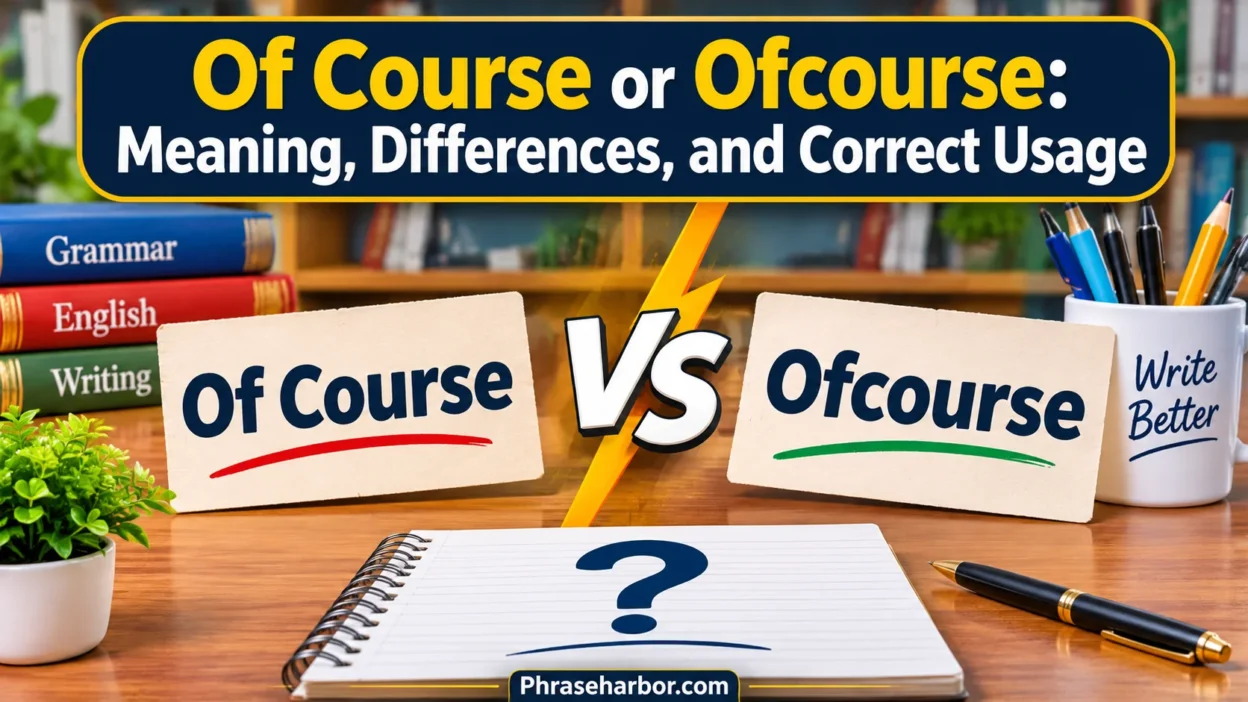
The correct form is of course, written as two separate words. The one-word spelling ofcourse is incorrect in standard English. Although readers can usually understand what someone means, combining the words creates a spelling error.
In this guide, you’ll learn the difference between of course and ofcourse, understand the expression’s meaning, and discover how to use it naturally. You’ll also find practical examples, common mistakes, useful alternatives, and answers to frequently asked questions.
Quick Answer
Of course is the correct spelling, while ofcourse is a common misspelling. Always write the expression as two separate words.
The phrase of course generally means certainly, naturally, or without doubt. People use it to express agreement, confirm information, show willingness, or describe something expected.
Consider these examples:
- Correct: Of course, I’ll help you with your homework.
- Incorrect: Ofcourse, I’ll help you with your homework.
- Correct: You can borrow my notebook, of course.
- Incorrect: You can borrow my notebook, ofcourse.
Remember this simple rule: Of + Course = Of Course.
Keep the two words separate whenever you use this expression in writing.
Comparison Overview
Although of course and ofcourse look almost identical, their spelling status differs completely. One is a recognized English expression, while the other is a spelling mistake.
The following table highlights their main differences.
| Feature | Of Course | Ofcourse |
| Spelling | Correct | Incorrect |
| Word structure | Two separate words | One combined word |
| Grammatical status | Standard English expression | Nonstandard spelling |
| Meaning | Certainly or naturally | No separate standard meaning |
| Dictionary recognition | Recognized expression | Not a standard English entry |
| Formal writing | Acceptable | Incorrect |
| Informal writing | Acceptable | Still incorrect |
| Example | Of course, you’re welcome. | Ofcourse, you’re welcome. |
The distinction is straightforward. Of course works in everyday conversations, business emails, academic writing, and formal communication.
By contrast, ofcourse doesn’t become correct simply because someone uses it in a casual message. Standard spelling rules remain the same across different writing styles.
Main Differences Between Of Course and Ofcourse
The most important difference between these expressions involves spelling. However, understanding their structure and everyday usage can help you avoid similar mistakes.
Of Course Is the Correct Spelling
Of course is the standard English expression. It contains two independent words that work together to communicate certainty, agreement, or something expected.
The word of functions as a preposition, while course is a noun. Together, they form an established expression with meanings that depend on context.
For example:
- Of course, I’ll attend your birthday party.
- You can ask me anything, of course.
- Of course, she knows the answer.
- We should finish the project today, of course.
In each sentence, the expression communicates agreement, confidence, or an expected situation.
You’ll encounter of course in almost every type of English communication. It’s common in conversations, novels, workplace discussions, interviews, and written correspondence.
Ofcourse Is a Misspelling
Ofcourse is an incorrect combination of of and course. Standard English doesn’t recognize it as the accepted spelling of this expression.
People sometimes combine the words because they hear them as one continuous sound. However, pronunciation doesn’t determine whether two words should appear together.
For example, English speakers often connect words while speaking. This natural speech pattern can make separate words sound like a single unit.
Consider these examples:
- Incorrect: Ofcourse, I remember your name.
- Correct: Of course, I remember your name.
- Incorrect: She will ofcourse understand.
- Correct: She will, of course, understand.
The intended meaning remains understandable in the incorrect examples. Nevertheless, the spelling needs correction.
Why Do People Confuse Of Course and Ofcourse?
The confusion usually comes from pronunciation, typing habits, and misunderstandings about compound expressions.
Several factors contribute to this mistake:
- Connected speech: Speakers often pronounce neighboring words without a noticeable pause.
- Typing quickly: People sometimes combine words accidentally when writing messages.
- Autocorrect habits: Some users rely on spelling suggestions without checking the final text.
- Visual familiarity: Repeated exposure to incorrect online spellings can make them appear acceptable.
- Compound-word confusion: English contains many combined words, which can confuse learners about spacing.
For example, every day and everyday are both correct, but they have different grammatical functions. This may lead some writers to assume that of course also has an accepted one-word variation.
It doesn’t.
The safest approach is to learn the expression as a fixed two-word phrase.
What Does Of Course Mean?
The expression of course has several related meanings. Its exact interpretation depends on the situation, the speaker’s intention, and the surrounding words.
Most commonly, it expresses certainty, agreement, willingness, or something considered obvious.
Of Course Means Certainly or Definitely
One of the most common uses of of course is to communicate strong agreement or certainty.
When someone asks a question and you respond with this expression, you’re essentially saying yes without hesitation.
For example:
- “Can you help me prepare for the exam?”
“Of course!” - “Will you attend the meeting tomorrow?”
“Of course, I’ll be there.” - “Do you remember our first conversation?”
“Of course I do.”
In these situations, the expression makes your response sound confident and positive.
It’s often warmer than a simple yes because it communicates enthusiasm or reassurance.
Of Course Means Naturally or As Expected
Sometimes, of course describes something that seems natural, obvious, or reasonably expected.
For instance:
- Of course, plants need water to grow.
- She was nervous before her first interview, of course.
- Of course, regular practice improves your writing skills.
- Children need proper guidance as they learn new things.
Here, the expression suggests that the information shouldn’t surprise the reader.
However, context matters. Something that seems obvious to one person might not be obvious to another.
Of Course Can Express Politeness or Willingness
Another common use involves responding positively to requests.
When someone asks for assistance, of course can make your answer sound friendly, cooperative, and welcoming.
Consider these examples:
- “Could you send me the report?”
“Of course. I’ll send it shortly.” - “Would you mind explaining this question?”
“Of course, I’d be happy to.” - “Can I sit here?”
“Of course. Go ahead.”
This usage appears frequently in customer service, professional communication, and everyday conversations.
It’s particularly useful when you want to sound helpful without making your response unnecessarily formal.
Of Course Can Express Surprise or Sarcasm
Although of course often sounds positive, it can also communicate frustration, sarcasm, or disappointment.
The speaker’s tone and the surrounding context determine its meaning.
For example:
- Of course, it started raining just as we left.
- Of course, the printer stopped working before the deadline.
- Of course, he forgot to bring the documents again.
These statements may express annoyance rather than genuine agreement.
Notice how the expression changes when someone uses it sarcastically. The words remain the same, but the intended message becomes different.
A useful tip: Don’t judge the meaning of of course by its spelling alone. Pay attention to the speaker’s tone and situation.
How to Use Of Course in a Sentence
Knowing the correct spelling is only the beginning. You should also understand where the expression belongs in a sentence and how punctuation affects readability.
Fortunately, of course works in several positions.
Of Course at the Beginning of a Sentence
You can place of course at the beginning when introducing agreement, confirmation, or an obvious statement.
When it functions as an introductory expression, a comma usually follows it.
Examples:
- Of course, I’ll help you with your assignment.
- Of course, everyone deserves a fair opportunity.
- Of course, we should check the details before signing.
- Of course, she accepted the invitation.
- Of course, you can join us for dinner.
The comma creates a natural pause between the introductory expression and the main statement.
However, punctuation can depend on the sentence’s structure and intended emphasis.
Of Course in the Middle of a Sentence
You can also place of course in the middle of a sentence to add emphasis or provide an aside.
When the phrase interrupts the main sentence, commas generally separate it from the surrounding words.
Examples:
- Our manager, of course, approved the proposal.
- The answer is, of course, quite simple.
- She knew, of course, that the deadline was approaching.
- The team will, of course, review your application.
In these examples, the main sentence remains understandable even if you remove of course.
For instance:
“Our manager approved the proposal.”
Adding the expression provides extra emphasis without changing the basic statement.
Read More: Trash vs. Garbage: Meaning, Differences, and Correct Usage
Of Course at the End of a Sentence
Placing of course at the end can reinforce an idea or add a conversational touch.
Examples:
- You’re welcome to attend, of course.
- I remember that day, of course.
- We can discuss the matter tomorrow, of course.
- You already know the answer, of course.
- I’ll bring the documents with me, of course.
This placement often sounds natural in spoken English and informal writing.
Depending on the sentence, a comma before the expression can help separate the additional comment.
Of Course in Questions and Answers
People frequently use of course when responding to questions. It can make a conversation sound more natural and engaging.
Here are some realistic examples:
Example 1: Asking for help
“Can you explain this grammar rule?”
“Of course! Let me show you an example.”
Example 2: Asking permission
“May I use your computer?”
“Of course. Just let me finish this first.”
Example 3: Confirming information
“Are you coming to the wedding?”
“Of course. I wouldn’t miss it.”
Example 4: Workplace communication
“Could you review this document before the meeting?”
“Of course. I’ll check it this afternoon.”
These examples show why the expression remains popular in everyday communication.
Of Course vs. Ofcourse: Common Mistakes to Avoid
Even experienced writers sometimes make small spelling and punctuation mistakes. Understanding the most common problems can help you write more accurately.
Writing Ofcourse as One Word
This is the biggest mistake associated with the expression.
Incorrect: Ofcourse, I understand your concern.
Correct: Of course, I understand your concern.
Always preserve the space between the two words.
Using Unnecessary Punctuation
Some writers place commas in awkward positions or separate the phrase unnecessarily.
Incorrect: Of, course, I’ll attend the event.
Correct: Of course, I’ll attend the event.
The comma doesn’t belong between of and course.
Confusing Of Course With Ofcourse in Professional Emails
A spelling mistake in a professional email can make an otherwise polished message look careless.
For example:
Incorrect: Ofcourse, we can arrange another meeting.
Correct: Of course, we can arrange another meeting.
Before sending workplace communication, check commonly mistyped expressions. A quick proofreading session can prevent avoidable errors.
Overusing Of Course
Although the expression is correct, repeating it too frequently can make your writing sound monotonous.
Consider this example:
“Of course, I’ll review the report. Of course, I’ll contact the manager. Of course, I’ll finish everything today.”
The repeated phrase adds little value.
A more natural version would be:
“Absolutely, I’ll review the report. I’ll also contact the manager and finish everything today.”
Varying your vocabulary makes communication smoother and more engaging.
Of Course Synonyms and Alternatives
Sometimes, you need another expression that communicates the same general idea. Choosing an appropriate alternative depends on your audience, tone, and situation.
Here are several useful options.
Formal Alternatives to Of Course
Formal alternatives work well in business correspondence, academic discussions, and professional conversations.
| Alternative | Meaning | Example |
| Certainly | Definitely or without hesitation | Certainly, I’ll review your request. |
| Absolutely | Completely or unquestionably | Absolutely, your proposal makes sense. |
| Without a doubt | With complete certainty | Without a doubt, she is qualified. |
| Naturally | As expected or reasonably understood | Naturally, we considered every option. |
| Indeed | Certainly or truly | Indeed, the results are impressive. |
Best choice: Use certainly when you want a polite and professional response without sounding overly enthusiastic.
Frequently Asked Questions
Is It Of Course or Ofcourse?
Of course is the correct spelling. It’s written as two separate words in standard English. Ofcourse is a misspelling and shouldn’t appear in formal or informal writing.
Is Ofcourse Ever Correct?
No. Ofcourse isn’t an accepted standard spelling of the expression. Although people sometimes use it in text messages or online conversations, the correct form remains of course.
Why Is Of Course Written as Two Words?
The expression contains two separate words: of and course. Together, they form an established English expression meaning certainly, naturally, or without doubt. Their combined meaning doesn’t make them one word.
Does Of Course Need a Comma?
It depends on its position and function. When of course introduces a sentence, a comma usually follows it. When it interrupts a sentence as an aside, commas often surround it. At the end, a preceding comma may help separate the expression.
Examples:
- Of course, I’ll help you.
- I’ll, of course, help you.
- I’ll help you, of course.
Is Of Course Formal or Informal?
Of course works in both formal and informal communication. You can use it in professional emails, everyday conversations, and polite responses. However, consider the context because it can sometimes sound sarcastic or overly obvious.
Conclusion:
The difference between of course and ofcourse is simple but important. The correct spelling always uses two separate words: of course. The combined form ofcourse is a common spelling mistake and isn’t accepted in standard English. You can use of course to express agreement, certainty, willingness, or something expected. It fits naturally into everyday conversations, professional emails, and many other writing situations.