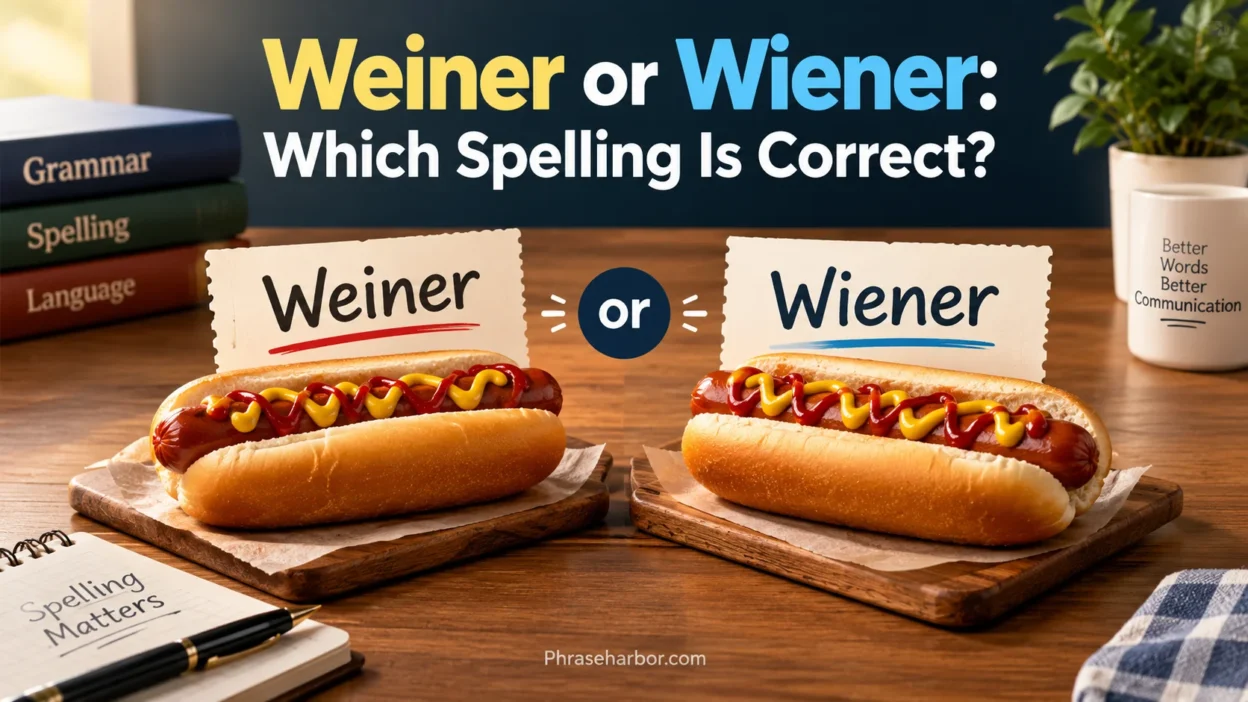
Have you ever wondered whether the correct spelling is Weiner or Wiener? You’re not alone. These two words look almost identical and sound the same in many American English conversations. However, their spelling, usage, and background aren’t exactly the same.
The confusion often appears when people write about hot dogs, Vienna sausages, or dachshunds commonly called wiener dogs. Some people also encounter Weiner as a family name, which makes the distinction even less obvious. Both spellings appear in written English, but they don’t have the same status in standard usage.
The main difference comes down to context. Wiener is the standard spelling for a sausage and its related informal meanings. Weiner is a less common spelling variant and an established surname. Understanding this distinction helps you avoid spelling mistakes without incorrectly changing someone’s name.
Quick Answer: Weiner or Wiener?
Wiener is the correct and preferred spelling when referring to a frankfurter, hot dog sausage, or dachshund nickname. It also has an informal slang meaning for the penis.
Weiner is a less common spelling variant that appears in some dictionaries. It is also a legitimate family name. Therefore, it isn’t automatically incorrect in every situation.
Here’s the easiest way to remember the difference:
- Wiener: The standard spelling for the food and related expressions.
- Weiner: A less common spelling variant and an established surname.
- Wiener dog: The conventional spelling for a dachshund.
- Wieners: The standard plural form of Wiener.
If you’re writing about food, choose Wiener. If you’re referring to someone whose last name is Weiner, preserve that exact spelling.
Weiner vs. Wiener: Comparison Overview
Although Weiner and Wiener look similar, their spelling conventions and common applications differ. The following table highlights the important distinctions.
| Feature | Wiener | Weiner |
| Standard spelling | Yes | Less common variant |
| Primary meaning | A type of sausage or frankfurter | Variant spelling of Wiener |
| Food-related usage | Common | Less common |
| Informal slang | Yes | Sometimes used as a variant |
| Family name | Yes | Yes |
| Pronunciation | Usually WEE-ner | Usually WEE-ner |
| Plural form | Wieners | Weiners as a variant |
| Wiener dog | Standard spelling | Nonstandard spelling |
| Recommended usage | Standard English writing | Proper names or specific contexts |
The most important point is that Wiener is the preferred dictionary spelling for the ordinary noun. However, Weiner has legitimate uses that depend on context.
For example, writing about a family named Weiner doesn’t require changing its spelling. Personal names follow their established spelling rather than ordinary dictionary conventions.
Main Differences Between Weiner and Wiener
The difference between Weiner and Wiener becomes easier to understand when you examine their meanings, spelling conventions, and everyday applications.
Wiener Is the Standard Spelling
The word Wiener commonly refers to a type of sausage, especially a frankfurter associated with Vienna, Austria. In American English, people often use it when discussing hot dogs and similar sausages.
You might encounter this word at grocery stores, restaurants, summer barbecues, and family gatherings. It appears in both everyday conversations and food-related writing.
For example, someone might say:
- We grilled several wieners at the family barbecue.
- She ordered a wiener with mustard and onions.
- The children enjoyed roasting wieners over the campfire.
- He bought a package of wieners for the weekend picnic.
Notice that each sentence uses the same spelling. That’s because Wiener is the conventional form for this meaning.
Although people sometimes write Weiner, standard edited American English generally favors Wiener. Choosing the conventional spelling makes your writing clearer and more consistent.
Weiner Is a Less Common Spelling Variant
Weiner appears as an alternative spelling of Wiener in some English-language dictionaries and informal writing. However, it isn’t the preferred spelling for the ordinary food-related noun.
The confusion makes sense because English readers often encounter words with different vowel combinations that produce similar sounds. When someone hears the word without seeing it written, choosing between ie and ei can become difficult.
For example:
- We grilled some weiners at the picnic.
- He bought several wieners for dinner.
Both sentences communicate the same general idea. However, the second uses the standard spelling.
In professional writing, restaurant menus, recipes, and educational articles, Wiener remains the safer choice.
Weiner Can Be a Proper Surname
One important distinction separates ordinary vocabulary from personal names.
Weiner is an established family name. It appears in surnames, public records, biographies, and other personal references. You shouldn’t automatically correct it to Wiener.
For example:
- Mr. Weiner will attend the meeting tomorrow.
- The Weiner family hosted a neighborhood celebration.
- Sarah Weiner published an article about American literature.
In these sentences, Weiner identifies a person or family. Changing it would alter the actual name.
Remember this simple rule: Dictionary spelling determines ordinary word usage, but a person’s established name determines how you spell their surname.
What Does Wiener Mean?
The word Wiener has several meanings in English. Its most familiar meaning relates to food, although it also appears in informal expressions and nicknames.
Wiener as a Type of Sausage
A Wiener is a type of sausage traditionally associated with Vienna, Austria. The term comes from the German language and has become familiar in American food culture.
In everyday American English, people often associate wieners with hot dogs. However, the words don’t always describe precisely the same thing.
A hot dog usually refers to the prepared sausage served in a split bun. A wiener refers to the sausage itself, although people frequently use both expressions interchangeably.
Wieners commonly appear in several meals and food preparations:
- Hot dogs: Sausages served inside sliced buns.
- Barbecue meals: Grilled sausages topped with condiments.
- Campfire snacks: Sausages cooked over an open fire.
- Quick lunches: Prepared sausages served with bread or side dishes.
- Family gatherings: Convenient foods prepared for picnics and outdoor celebrations.
For example, consider these sentences:
- My brother bought fresh wieners for the barbecue.
- The restaurant serves grilled wieners with homemade mustard.
- We prepared several wieners for the neighborhood picnic.
In each example, Wiener refers to food rather than a person or an informal expression.
Wiener as an Informal Slang Term
Wiener also has an informal slang meaning. It can refer to the penis, usually in a childish, humorous, or playful way.
People sometimes use this expression when speaking with children or making lighthearted jokes. However, it isn’t appropriate for every audience or situation.
For example:
- The little boy giggled when someone mentioned the word wiener.
- His friends used the expression as a silly playground joke.
The intended meaning depends heavily on context. A sentence about grilling wieners clearly concerns food, while a childish joke might use the same word differently.
If you’re writing professionally, it’s usually better to choose a more appropriate anatomical term when discussing the subject seriously.
Wiener as a Nickname for a Dachshund
Have you ever heard someone call a dachshund a wiener dog? This popular nickname comes from the dog’s long body and short legs.
Dachshunds have a distinctive appearance that makes the comparison easy to understand. Their elongated bodies resemble the shape of traditional sausages.
The nickname has become especially common in American English. Dog owners, pet stores, social media users, and families frequently use it in casual conversation.
Examples include:
- Our wiener dog loves sleeping under the blankets.
- The neighbors adopted two adorable wiener dogs.
- My daughter wants a miniature wiener dog for her birthday.
The conventional spelling is wiener dog, not weiner dog.
Although people sometimes misspell the expression, Wiener remains the standard written form.
What Does Weiner Mean?
Weiner has two important uses that readers should understand. It can appear as a less common variant of Wiener or as a proper surname.
Weiner as an Alternative Spelling
Some dictionaries recognize Weiner as a variant spelling of Wiener. This explains why the word occasionally appears in informal writing, online conversations, and older publications.
However, recognizing a variant doesn’t mean every spelling has equal status. In standard American English, Wiener remains the preferred form for the sausage and related meanings.
Consider these examples:
- Weiner is sometimes used as an alternative spelling of Wiener.
- The standard food-related spelling is Wiener.
- Some informal writers use weiner when discussing hot dogs.
If you’re preparing an article, academic assignment, restaurant menu, or professional document, stick with Wiener.
It offers the clearest and most widely accepted spelling.
Weiner as a Family Name
Unlike an ordinary spelling mistake, Weiner can be a perfectly correct surname.
Family names often have different historical spellings. Their forms may reflect immigration records, regional traditions, family preferences, and changes made across generations.
For this reason, you should never assume that a surname needs correction simply because it resembles another word.
For example:
| Sentence | Why Weiner Is Correct |
| David Weiner joined the company. | Weiner is a person’s surname. |
| The Weiner family moved to Chicago. | The spelling identifies a family name. |
| Ms. Weiner teaches English. | The established surname must remain unchanged. |
This distinction is especially important in journalism, business communication, and formal correspondence.
A person’s name deserves the same spelling accuracy as any other proper noun.
Why Do People Confuse Weiner and Wiener?
The confusion between Weiner and Wiener isn’t surprising. Both spellings contain the same letters, arranged in a different order. Their pronunciation can also be identical.
Several factors contribute to the mix-up.
Similar Pronunciation
In common American English usage, both spellings can represent the same pronunciation.
The usual pronunciation of Wiener is:
WEE-ner — /ˈwiːnər/
The first syllable carries the primary stress. The second syllable contains a relaxed vowel sound.
Because the two spellings can sound identical, people sometimes struggle to identify the correct written form.
For instance, imagine someone ordering food at a restaurant. The server says the word aloud, but the customer has never seen it written. Without knowing the conventional spelling, the customer might choose Weiner.
This is a common challenge with English homophones and near-homophones. Hearing a word doesn’t always tell you which letters belong in its spelling.
The Different Letter Order
The most visible difference involves the vowels ie and ei.
| Spelling | Vowel Order | Standard Food-Related Form |
| Wiener | ie | Yes |
| Weiner | ei | No, less common variant |
English contains many words with these letter combinations. Unfortunately, they don’t follow one simple pronunciation pattern.
Consider these familiar examples:
- Believe: Contains ie.
- Receive: Contains ei.
- Friend: Contains ie.
- Ceiling: Contains ei.
The familiar spelling patterns can make both Wiener and Weiner appear reasonable to someone unfamiliar with the word’s origin.
However, the German connection provides a helpful clue for remembering the conventional spelling.
Read More: Cart vs. Kart: Meaning, Differences, and Examples
Familiarity With the Surname Weiner
Another reason for this confusion is the presence of Weiner as a family name.
People may encounter the surname in newspapers, biographies, workplace directories, or everyday conversations. After seeing it repeatedly, they may assume that the same spelling works for the food-related noun.
That’s where context matters.
A surname doesn’t need to follow the spelling of an ordinary dictionary word. Both spellings can be correct in their respective situations.
Where Does the Word Wiener Come From?
Understanding the history of Wiener makes its spelling easier to remember. Its roots connect the English word to Vienna and traditional German food terminology.
German Origins
Wiener comes from the German word Wienerwurst, which refers to a Vienna sausage.
The German word Wien means Vienna, the capital of Austria. The suffix -er commonly indicates a connection with a particular place or origin.
Therefore, Wiener essentially means something associated with Vienna.
This connection explains why the conventional spelling contains ie rather than ei.
Here are a few related terms:
| German Term | English Meaning |
| Wien | Vienna |
| Wiener | Viennese or associated with Vienna |
| Wienerwurst | Vienna sausage |
| Wiener Würstchen | Vienna-style little sausage |
These related expressions show how geography influenced the word’s development.
How Wiener Entered English
The word entered English through German food terminology and became increasingly familiar as European food traditions spread.
German-speaking immigrants also helped introduce Central European food customs to the United States. Over time, American consumers became familiar with different sausage styles and names.
The word Wiener eventually became an established term in American English.
Today, you’ll find it in food advertisements, restaurant descriptions, recipes, grocery packaging, and casual conversation.
Although Americans commonly use hot dog for the finished food, Wiener remains a familiar name for the sausage itself.
Why the Original Spelling Matters
The German connection offers a simple way to remember the correct spelling.
Think about the relationship:
Wien → Vienna → Wiener
Once you connect Wiener with Wien, remembering the letters becomes easier.
This method also explains why Weiner isn’t the preferred spelling for the traditional food-related meaning.
Instead of memorizing an arbitrary spelling rule, you can remember the word’s geographical origin.
Is It Wiener Dog or Weiner Dog?
The correct conventional expression is wiener dog.
A wiener dog is another name for a dachshund, a breed known for its elongated body and short legs.
Longhaired Vanilla Dachshund With Curly Crimped Locks Performs Sweetest Trick With Mom – Parade Pets
Wire Haired Dachshund: Get Expert Advice and Tips!
Dachshunds come in different coat varieties and sizes. Their distinctive body shape explains the playful nickname.
The expression also appears in American children’s books, pet-related conversations, merchandise, and popular culture.
Examples:
- My wiener dog follows me around the house.
- The children took their wiener dog to the park.
- We adopted a playful wiener dog from a local shelter.
Although weiner dog appears in online searches and informal messages, it isn’t the conventional spelling.
Remember: When writing about the dog breed, use wiener dog.
FAQs:
Is Wiener or Weiner the correct spelling?
Wiener is the standard spelling when referring to a sausage, frankfurter, or related informal expression. Weiner is a less common spelling variant and an established surname. The correct choice depends on context.
Is Weiner an actual word?
Yes. Weiner appears as a less common spelling variant of Wiener and as a legitimate family name. Although it isn’t the preferred spelling for the food-related noun, it isn’t universally incorrect.
Is Wiener another word for hot dog?
Yes, Wiener can refer to the sausage commonly used in hot dogs. However, a hot dog usually describes the prepared food served inside a bun. Wiener more specifically identifies the sausage itself.
How do you pronounce Wiener and Weiner?
Wiener is commonly pronounced WEE-ner in American English, with the IPA transcription /ˈwiːnər/. Weiner is usually pronounced similarly when used as a spelling variant. Individual family names may have their own established pronunciations.
Is it spelled wiener dog or weiner dog?
The conventional spelling is wiener dog. This informal expression refers to a dachshund, a dog breed recognized for its long body and short legs.
Conclusion:
The difference between Weiner and Wiener mainly comes down to spelling conventions and context. Although both forms appear in English, they don’t have equal standing in standard usage. Wiener is the preferred spelling for a sausage, frankfurter, and related expressions such as wiener dog. It also has an informal slang meaning. Its German origin connects it to Wien, the name for Vienna, Austria.