Have you ever described someone as having a heart of gold or said you’ve waited a thousand years for something? Both expressions communicate more than their literal words suggest. However, they use different literary techniques to create their effects.
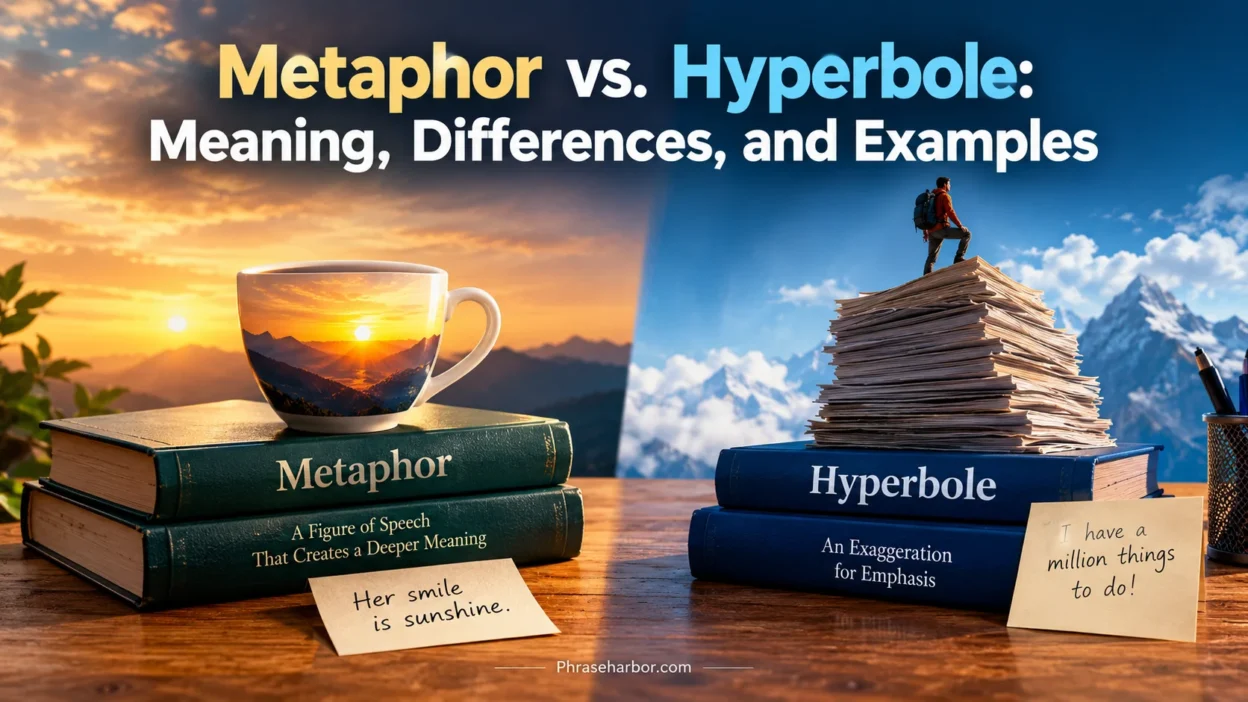
A metaphor compares two different things by describing one as another. A hyperbole deliberately exaggerates something to make a point, express emotion, or create humor. Although both belong to the world of figurative language, they don’t serve exactly the same purpose.
Understanding metaphor vs. hyperbole helps you recognize how writers make ordinary sentences more vivid and memorable. You’ll encounter these devices in novels, poems, advertisements, speeches, movies, and everyday conversations. Once you understand their differences, you’ll also find it easier to use them in your own writing.
Quick Answer: Metaphor vs. Hyperbole
A metaphor describes one thing as another to suggest a shared quality or connection. For example, “Time is money” compares time to money because both are valuable resources.
A hyperbole uses intentional exaggeration to emphasize an idea or feeling. For example, “I’ve told you a million times” exaggerates the number of times someone has repeated something.
The main difference is that a metaphor creates an implied comparison, while a hyperbole makes an exaggerated statement. A metaphor helps readers picture or understand something differently. A hyperbole makes an ordinary experience sound more dramatic, emotional, or humorous.
Comparison Overview: Metaphor vs. Hyperbole
Although metaphors and hyperboles both communicate figurative meanings, their techniques and purposes differ. The following table highlights their main characteristics.
| Feature | Metaphor | Hyperbole |
| Definition | An implied comparison between two different things | An intentional exaggeration |
| Main purpose | To create imagery or explain an idea | To emphasize a feeling or situation |
| Technique | Describes one thing as another | Overstates something beyond reality |
| Comparison | Essential to its structure | Not required |
| Exaggeration | Not always present | Always present |
| Literal meaning | Usually figurative | Deliberately unrealistic |
| Common effect | Creates imagery and deeper meaning | Creates emphasis, humor, or drama |
| Common usage | Poetry, storytelling, speeches, and conversations | Everyday speech, comedy, advertising, and storytelling |
| Example | Her smile is sunshine. | I’ve waited forever. |
Simple way to remember:
- Metaphor: Think of one thing as another.
- Hyperbole: Make something sound much bigger, smaller, longer, or stronger than it really is.
For instance, calling a difficult exam a “nightmare” uses a metaphor. Saying “That exam lasted a hundred years” uses hyperbole. Both expressions communicate frustration, but they approach it differently.
What Is a Metaphor?
A metaphor is a figure of speech that describes one person, object, place, or idea as something else. It creates an implied comparison between two things that share a particular quality. Rather than explaining the similarity directly, a metaphor lets readers discover the connection.
For example, consider the sentence, “The world is a stage.” The world isn’t literally a theater, and people aren’t actually actors performing on a stage. Instead, this metaphor suggests that people play different roles throughout their lives. It compares human experiences to a theatrical performance.
Metaphors make language more expressive because they help readers understand abstract ideas through familiar images. Instead of describing someone as kind and generous, you might call that person a ray of sunshine. The expression creates a warmer and more memorable impression.
Definition of Metaphor
A metaphor is a literary device that identifies one thing with another to communicate a figurative meaning. It doesn’t use comparison words such as “like” or “as.” Instead, it directly connects two different things.
For example:
- Life is a journey: Life involves different experiences, challenges, and destinations.
- He has a heart of stone: He appears emotionally cold or unkind.
- Knowledge is power: Learning gives people the ability to make informed decisions and influence situations.
- Her words were a double-edged sword: Her comments had both helpful and harmful effects.
In each example, the words communicate something beyond their literal definitions. Readers understand the intended meaning by recognizing the shared qualities between the two subjects.
A metaphor usually contains two important elements:
- Tenor: The actual subject being described.
- Vehicle: The image or concept used to describe that subject.
In “Life is a journey,” life is the tenor and journey is the vehicle. The metaphor connects life’s experiences with the stages and challenges of traveling.
Examples of Metaphors in Everyday Language
Metaphors appear frequently in ordinary conversations. People often use them without realizing they’re using figurative language.
Here are some familiar examples and their meanings:
| Metaphor | Intended Meaning |
| Time is money. | Time is valuable and shouldn’t be wasted. |
| Her voice is music to my ears. | Her voice sounds pleasant and comforting. |
| He has a heart of stone. | He seems unkind or emotionally distant. |
| The classroom was a zoo. | The classroom was noisy and chaotic. |
| Life is a journey. | Life involves different stages and experiences. |
| You are my sunshine. | You bring happiness into my life. |
| Books are windows to the world. | Books introduce readers to new ideas and experiences. |
| His mind is a computer. | He remembers and processes information quickly. |
| The news was a bombshell. | The news was extremely surprising or shocking. |
| Her home is a palace. | Her home is exceptionally beautiful or luxurious. |
These expressions work because they connect unfamiliar or abstract ideas with recognizable images. For example, describing books as windows suggests that reading allows people to explore experiences beyond their immediate surroundings.
Types of Metaphors
Metaphors come in several forms. Each type creates comparisons differently and serves particular writing purposes.
Conventional Metaphors
Conventional metaphors are familiar expressions that people use regularly. Their figurative meanings have become widely understood through everyday communication.
Examples include:
- Breaking someone’s heart.
- Wasting time.
- A warm welcome.
- The foundation of an argument.
- A bright future.
These expressions rarely surprise readers because they’ve become part of ordinary language.
Implied Metaphors
An implied metaphor suggests a comparison without directly naming both subjects. Readers must recognize the connection through descriptive words or context.
For example: “The lawyer attacked the witness’s argument.”
The lawyer doesn’t physically attack anything. The verb “attacked” suggests that the lawyer challenged the argument aggressively.
Another example is “The children crawled through their homework.” The verb “crawled” creates an image of slow movement and suggests that the children struggled to complete their assignments.
Extended Metaphors
An extended metaphor develops one comparison across several sentences, paragraphs, or even an entire literary work.
For example, a writer might compare life to a journey throughout an entire story. Characters encounter obstacles, choose different paths, reach milestones, and discover unexpected destinations.
Instead of using the comparison once, the writer develops it through related descriptions. This creates a consistent image that connects different parts of the writing.
Mixed Metaphors
A mixed metaphor combines two or more comparisons that don’t naturally fit together.
For example: “Let’s grab the bull by the horns and get this ball rolling.”
The sentence combines two unrelated images: controlling a bull and starting a ball’s movement. Although readers can understand the intended message, the combination may sound awkward.
Writers should generally avoid accidental mixed metaphors because they can distract readers from the main point.
Dead Metaphors
A dead metaphor is an expression that originally carried figurative meaning but has become so common that people rarely recognize its original comparison.
Examples include:
- The leg of a table.
- The foot of a mountain.
- The hands of a clock.
- The head of a department.
People understand these expressions as ordinary language. Their figurative origins usually don’t attract attention.
When to Use a Metaphor
Metaphors work particularly well when you want to explain an idea, create imagery, or communicate emotions more effectively.
Consider using metaphors in these situations:
- Creative writing: Describe characters, settings, emotions, and experiences vividly.
- Poetry: Communicate complex feelings through symbolic comparisons.
- Speeches: Make abstract arguments easier to understand and remember.
- Everyday conversations: Explain experiences using familiar images.
- Persuasive writing: Connect ideas with concepts that readers already understand.
- Storytelling: Develop themes and give different parts of a story a shared meaning.
For example, a teacher might describe education as “a bridge to opportunity.” This metaphor suggests that learning helps students move toward better possibilities.
Read More: Aesthetic vs. Esthetic: Meaning, Differences, and Correct Usage
What Is Hyperbole?
Hyperbole is a figure of speech that uses deliberate and obvious exaggeration to emphasize something. It makes a statement sound more extreme than reality to communicate strong feelings, create humor, or attract attention.
For example, someone might say, “I’m so hungry I could eat a horse.” Obviously, the speaker doesn’t intend to eat an entire horse. The exaggeration simply communicates extreme hunger.
Hyperbole appears in casual conversations, comedy, advertisements, literature, and dramatic storytelling. People use it because an exaggerated statement can sometimes communicate an emotion more effectively than a straightforward description.
Imagine saying, “The suitcase is heavy.” That sentence communicates a simple fact. However, saying, “This suitcase weighs a ton” makes the same experience sound much more dramatic.
The second expression creates a stronger impression even though the suitcase doesn’t actually weigh thousands of pounds.
Definition of Hyperbole
Hyperbole is an intentional exaggeration that goes beyond ordinary facts or realistic possibilities. Writers and speakers use it to make their messages more noticeable or emotionally powerful.
Unlike factual statements, hyperboles aren’t meant to be interpreted literally. Their exaggerated nature helps readers understand the speaker’s intended emotion or emphasis.
For example:
- I’ve told you a million times: The speaker has repeated something many times.
- This bag weighs a ton: The bag feels extremely heavy.
- I’m freezing to death: The speaker feels very cold.
- She cried a river: She cried a great deal.
- I’ve been waiting forever: The speaker has waited longer than expected.
The exaggeration makes each statement more expressive. However, context matters because the same words can have different effects depending on the situation.
A friend might use hyperbole humorously when describing a long wait. In a serious emergency report, however, exaggerated language could create confusion.
Examples of Hyperbole in Everyday Language
Hyperbole is especially common in informal English. People use it to express excitement, frustration, surprise, disappointment, and other emotions.
Here are several examples:
| Hyperbole | Actual Meaning |
| I’ve told you a million times. | I’ve repeated this many times. |
| I’m so hungry I could eat a horse. | I’m extremely hungry. |
| This bag weighs a ton. | This bag is very heavy. |
| I’ve been waiting forever. | I’ve been waiting a long time. |
| She cried a river of tears. | She cried excessively. |
| I’m dying of laughter. | Something is extremely funny. |
| He runs faster than lightning. | He runs incredibly fast. |
| My phone has been ringing all day. | My phone has rung repeatedly. |
| This room is hotter than the sun. | This room feels extremely hot. |
| I have a mountain of work. | I have a very large amount of work. |
Notice how each example stretches reality to create a stronger impression. The listener understands the intended meaning without expecting the statement to be factually accurate.
Types and Common Forms of Hyperbole
Hyperbole doesn’t have a strict set of formal categories. However, writers and speakers commonly exaggerate numbers, physical qualities, time, distance, and emotions.
Numerical Exaggeration
This form uses unusually large numbers to emphasize quantity or frequency.
Examples:
- I’ve called you a thousand times.
- There were a million people at the concert.
- She has read that book a hundred times.
The numbers aren’t necessarily accurate. They emphasize how frequently something happened or how large something seemed.
Exaggeration of Size or Quantity
This form makes an object, amount, or situation sound much bigger than reality.
Examples:
- That building touches the clouds.
- I’ve got tons of homework.
- His suitcase is bigger than a house.
The expressions communicate size or quantity through dramatic overstatement.
Exaggeration of Time or Distance
People often exaggerate how long something takes or how far away something seems.
Examples:
- I’ve been working here forever.
- The store is a million miles away.
- It took ages to finish the assignment.
These statements communicate frustration, inconvenience, or a sense of distance rather than actual measurements.
Emotional Exaggeration
Emotional hyperbole makes feelings sound more intense to express excitement, sadness, anger, or disappointment.
Examples:
- My heart is going to explode with happiness.
- I’m so embarrassed I could disappear.
- This is the worst day in human history.
Such expressions help communicate strong reactions in an entertaining or dramatic way.
Physical Exaggeration
This form overstates physical conditions or abilities.
Examples:
- My feet are killing me.
- He’s as strong as a hundred men.
- I’m freezing to death.
- Her smile could light up the entire city.
These expressions create vivid impressions without requiring literal interpretation.
FAQs:
What Is the Main Difference Between Metaphor and Hyperbole?
A metaphor creates an implied comparison between two different things. Hyperbole deliberately exaggerates something to emphasize an idea or emotion. For example, “He is a lion” is a metaphor, while “He is strong enough to lift a mountain” is hyperbole.
Is a Metaphor a Form of Exaggeration?
Not necessarily. A metaphor compares two different things based on a shared quality. Although some metaphors contain exaggerated descriptions, exaggeration isn’t required. For example, “Knowledge is power” is a metaphor without necessarily exaggerating anything.
Can a Sentence Contain Both Metaphor and Hyperbole?
Yes. A sentence can combine both literary devices. For example, “My stomach is a bottomless pit that could swallow an entire restaurant” uses a metaphor to compare the stomach to a pit and hyperbole to exaggerate its capacity.
What Is a Simple Example of Metaphor?
“Time is money” is a simple and widely recognized metaphor. It compares time to money because both are valuable resources. The expression reminds people that wasting time can mean losing valuable opportunities.
What Is a Simple Example of Hyperbole?
“I’ve told you a million times” is a common example of hyperbole. The speaker exaggerates the number of repetitions to communicate frustration or emphasize how often they’ve repeated something.
Conclusion:
Understanding metaphor vs. hyperbole becomes much easier when you focus on how each expression works. A metaphor describes one thing as another to highlight a shared quality. Hyperbole deliberately exaggerates something to create emphasis, humor, or emotional impact.
For example, calling someone “a shining star” uses a metaphor because it compares that person to something bright and impressive. Saying “That person shines brighter than a million stars” uses hyperbole because it exaggerates the person’s qualities.