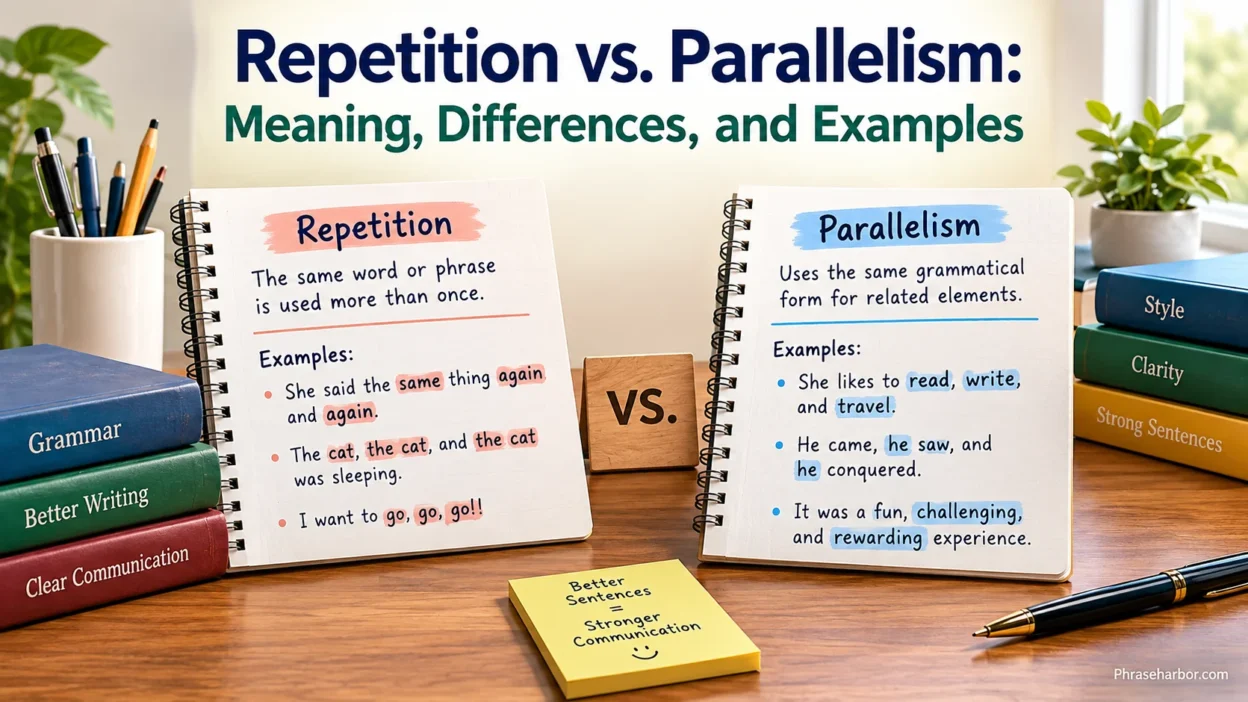
Repetition and parallelism are two powerful techniques that make writing clearer, stronger, and more memorable. Although they often appear together, each serves a different purpose. Understanding the difference helps you choose the right technique for essays, speeches, poetry, and everyday communication.
Repetition involves using the same words, phrases, sounds, or ideas more than once. Writers use it to emphasize important points, create rhythm, and make messages stick in readers’ minds. Parallelism, on the other hand, involves using similar grammatical structures to express related ideas in a balanced way.
Both techniques improve communication, but they work differently. Repetition draws attention to particular words or ideas, while parallelism creates consistency between related elements. Once you understand how they function, you’ll find it easier to recognize them and use them effectively in your own writing.
Quick Answer:
Repetition is the deliberate reuse of a word, phrase, sound, or idea for emphasis or effect. Parallelism is the use of similar grammatical structures to express related ideas clearly and evenly.
For example:
- Repetition: “Never give up, never lose hope, and never stop trying.” The repeated phrase never strengthens the message.
- Parallelism: “He likes swimming, running, and cycling.” The three activities use the same grammatical form.
The main difference is that repetition focuses on recurring elements, whereas parallelism focuses on matching structures. A sentence can use repetition, parallelism, or both at the same time.
Comparison Overview
The following table highlights the most important differences between repetition and parallelism.
| Feature | Repetition | Parallelism |
| Definition | Reusing words, phrases, sounds, or ideas | Using similar grammatical structures |
| Main purpose | Emphasis and reinforcement | Balance, clarity, and rhythm |
| Primary focus | Repeated elements | Structural consistency |
| Word choice | Often repeats exact words or phrases | May use different words |
| Grammar | Does not require matching structures | Requires corresponding grammatical patterns |
| Common uses | Speeches, poetry, slogans, storytelling | Essays, lists, speeches, comparisons |
| Typical effect | Makes a message memorable | Makes ideas easier to compare |
| Can the techniques overlap? | Yes | Yes |
Here’s a simple way to remember the distinction: repetition brings an element back, while parallelism makes related elements follow a similar pattern.
For instance, a writer can repeat a single word in sentences with different structures. Similarly, a writer can create parallelism using different words without repeating any of them.
What Is Repetition?
Repetition is a literary and rhetorical device in which a writer or speaker deliberately uses a word, phrase, sound, or idea more than once. The repeated element draws attention to a message and helps the audience recognize its importance.
You encounter repetition in everyday conversations, advertisements, political speeches, poems, and stories. A teacher might say, “Practice makes progress,” while a campaign slogan might repeat a short phrase to make it easier to remember.
However, repetition isn’t automatically effective. Writers use it with a purpose rather than repeating words simply to fill space.
Definition of Repetition
In writing, repetition reinforces a particular element through recurrence. That element might be a single word, an entire phrase, a sound, or a broader idea.
Consider this example:
“Her goal was simple: to learn, to improve, and to succeed.”
The word to appears three times. This repetition emphasizes the three actions and gives the sentence a steady rhythm. The sentence also contains parallelism because each item follows the same grammatical structure.
Now consider a different example:
“Rain fell on the rooftops. Rain filled the streets. Rain changed the entire town.”
The repeated word rain connects the sentences and emphasizes the storm’s growing impact.
Repetition can be intentional or accidental. Intentional repetition strengthens meaning, while accidental repetition may make writing sound redundant.
For example:
- Effective: “The deadline is approaching. Act now, act decisively, and act together.”
- Redundant: “The final outcome was the end result of the process.”
The first example uses repetition to create urgency. The second repeats a meaning that the sentence could express more directly.
Examples of Repetition in Sentences
The following examples demonstrate how repetition works in different situations.
| Example | Repeated element | Purpose |
| “Practice, practice, and more practice builds confidence.” | Practice | Emphasizes consistent effort |
| “We will listen, we will learn, and we will lead.” | We will | Creates rhythm and determination |
| “The night was cold, cold enough to freeze the lake.” | Cold | Intensifies the description |
| “Every voice matters. Every vote matters.” | Every and matters | Reinforces equal importance |
| “She searched the desk, searched the drawers, and searched the entire room.” | Searched | Emphasizes a thorough search |
Notice that repetition doesn’t always mean copying an entire sentence. Sometimes a single word creates the desired effect. In other cases, repeating a complete phrase establishes rhythm or builds emotional intensity.
Common Types of Repetition
Writers use several forms of repetition, and each creates a slightly different effect.
Anaphora
Anaphora occurs when a writer repeats a word or phrase at the beginning of successive clauses or sentences.
Example: “We need better schools. We need safer streets. We need stronger communities.”
The repeated opening phrase creates rhythm and connects the three demands. This technique often appears in persuasive speeches because it helps audiences follow and remember a central message.
Epistrophe
Epistrophe repeats a word or phrase at the end of successive clauses or sentences.
Example: “We work for our families, we sacrifice for our families, and we build a future for our families.”
The recurring ending emphasizes the reason behind each action. Epistrophe can create a strong sense of unity or emotional weight.
Epizeuxis
Epizeuxis involves repeating a word immediately, without other words between repetitions.
Example: “Run, run, run!”
This form communicates urgency, excitement, fear, or intense emotion. A novelist might use it during a chase scene, while someone cheering at a race might use the same pattern naturally.
Refrain
A refrain is a recurring line or phrase that appears at intervals in a poem, song, or speech.
Example: A poem might return to the line “Tomorrow brings another chance” at the end of several stanzas.
The repeated line connects different parts of the work and reinforces its central theme. Unlike immediate repetition, a refrain returns after other material has appeared.
Alliteration and Sound Repetition
Writers may repeat consonant or vowel sounds to create a noticeable sound pattern.
Example: “Bright birds burst beyond the branches.”
The repeated initial b sound creates alliteration. More broadly, sound repetition can give language a musical quality and make phrases more memorable.
Not every repeated sound is a separate rhetorical device, however. The label depends on the sound pattern and how the writer uses it.
Why Writers Use Repetition
Repetition has several practical purposes beyond making writing sound interesting.
- Emphasis: Repeating a key word signals that readers should pay attention.
- Memory: Familiar wording can make slogans, instructions, and important messages easier to recall.
- Emotion: Repetition can communicate excitement, grief, frustration, determination, or hope.
- Rhythm: Recurring words create patterns that make speeches and poetry more engaging.
- Persuasion: Repeating a central claim helps keep an argument focused.
- Connection: Repeated phrases can link separate paragraphs, scenes, or sections.
For example, an instructor might repeat the phrase “check your work” throughout a lesson. The repetition reinforces an important habit without requiring a complicated explanation.
The key is restraint. If every sentence repeats the same idea, the technique loses its impact. Strong repetition highlights what matters most while allowing the rest of the writing to move forward.
What Is Parallelism?
Parallelism is a writing technique that places related words, phrases, or clauses in similar grammatical forms. It creates balance and helps readers understand how different ideas relate to one another.
Parallelism appears in everyday lists, professional presentations, academic essays, advertisements, and literary works. You use it whenever you write a series of items with matching grammatical structures.
Consider this sentence:
“Jordan enjoys hiking, swimming, and cycling.”
Each item is a gerund, a verb form ending in -ing that functions as a noun. The matching structure makes the list easy to read.
Now compare it with this version:
“Jordan enjoys hiking, swimming, and to cycle.”
The final item breaks the grammatical pattern. Although readers can understand the meaning, the sentence sounds awkward because it mixes gerunds with an infinitive.
A parallel revision would read:
“Jordan enjoys hiking, swimming, and cycling.”
Parallelism doesn’t require identical words. It requires a consistent structure among elements that serve comparable functions.
Definition of Parallelism
In grammar and rhetoric, parallelism means presenting related elements using corresponding grammatical patterns. Those elements may be individual words, phrases, clauses, or complete sentences.
For example:
“She wanted to travel, to explore, and to discover new cultures.”
The three actions use matching infinitive phrases. This structure makes the sentence balanced and easy to follow.
Parallelism also works when the words differ:
“Good leaders listen carefully, communicate clearly, and make thoughtful decisions.”
The three elements use consistent verb-based constructions. Their wording differs, but their grammatical roles align.
Parallelism can also emphasize contrasts:
“Some people save for tomorrow, while others spend for today.”
The two clauses use comparable structures to present contrasting habits.
The central principle: When you present related ideas in a series or comparison, use grammatical forms that match.
Read More: Artist vs. Artisan: Meaning, Differences, and Examples
Examples of Parallelism in Sentences
These examples show parallelism at different grammatical levels.
| Grammatical level | Example | Parallel elements |
| Words | “She is honest, patient, and reliable.” | Three adjectives |
| Gerunds | “He enjoys cooking, gardening, and reading.” | Three gerunds |
| Infinitives | “They plan to study, to practice, and to compete.” | Three infinitive phrases |
| Phrases | “The package is on the table, under the chair, and beside the door.” | Three prepositional phrases |
| Clauses | “She wanted to leave, he wanted to stay, and they wanted to compromise.” | Three independent clauses |
| Contrasting clauses | “You can accept the challenge, or you can avoid the risk.” | Two matching alternatives |
Parallelism makes these examples easier to process because readers can recognize the grammatical pattern. Once the pattern becomes clear, they can focus on the information itself.
Common Types of Parallelism
Parallelism can operate at several levels, from individual words to complete clauses.
Word-Level Parallelism
Word-level parallelism uses words with the same grammatical function.
Example: “The new manager is confident, organized, and approachable.”
The three adjectives describe the manager. Their matching forms make the description feel complete and balanced.
Phrase-Level Parallelism
Phrase-level parallelism uses phrases with corresponding grammatical structures.
Example: “The team succeeded by planning carefully, communicating openly, and responding quickly.”
Each item begins with an adverb ending in -ly and modifies an action expressed through an -ing form. This repeated construction gives the list a consistent rhythm.
Clause-Level Parallelism
Clause-level parallelism uses clauses with similar structures.
Example: “She prepared the presentation, he organized the data, and they reviewed the results.”
Each clause follows a subject-verb-object pattern. The consistent structure makes the division of responsibilities clear.
Antithetical Parallelism
Antithetical parallelism places contrasting ideas in balanced structures. It appears frequently in proverbs, speeches, and literature.
Example: “A wise person learns from mistakes, while a careless person repeats them.”
The two clauses follow similar grammatical patterns while expressing different behaviors. The contrast becomes easier to recognize because the structures match.
Parallelism in Lists
Parallelism is especially important when writing lists, instructions, or sets of recommendations.
For example:
Inconsistent list
- Planning the schedule
- Assign tasks
- Reviewing the results
Parallel list
- Plan the schedule.
- Assign tasks.
- Review the results.
The revised list uses the same imperative verb form throughout. This consistency makes the instructions easier to scan and follow.
Why Writers Use Parallelism
Parallelism serves both grammatical and rhetorical purposes.
- Clarity: Matching structures help readers understand complicated sentences.
- Consistency: Parallel lists make instructions and recommendations easier to follow.
- Rhythm: Balanced phrases create a smooth reading experience.
- Comparison: Similar structures help readers evaluate related or contrasting ideas.
- Persuasion: Carefully balanced statements can make arguments more memorable.
- Professionalism: Parallel wording improves the presentation of reports, résumés, and business documents.
Consider a résumé bullet that reads, “Managed customer accounts, improving service, and reports were prepared.”
The sentence mixes grammatical structures, making the responsibilities feel disconnected. A cleaner version would be:
“Managed customer accounts, improved customer service, and prepared monthly reports.”
The revised version uses consistent past-tense verbs. The result sounds more direct and presents the accomplishments as a coherent set.
Main Differences Between Repetition and Parallelism
Repetition and parallelism can produce similar effects, but their underlying principles differ. Repetition relies on recurrence, while parallelism relies on structural similarity.
Difference in Meaning
Repetition means using a linguistic element again. Parallelism means arranging related elements in matching grammatical forms.
For example:
- Repetition: “The room was quiet, quiet enough to hear a pin drop.” The word quiet appears twice.
- Parallelism: “The room was quiet, peaceful, and comfortable.” Three adjectives describe the room in a consistent structure.
The first example repeats a word to intensify the description. The second uses parallel adjectives to present related qualities.
Difference in Purpose
Repetition usually emphasizes a particular word, phrase, sound, or idea. Parallelism usually clarifies relationships between ideas and creates balance.
Consider these examples:
Repetition: “Try again, try harder, and try once more.”
The repeated word try stresses persistence.
Parallelism: “She works carefully, speaks politely, and listens attentively.”
The three matching constructions highlight different behaviors in a balanced way.
Of course, writers may use either technique for several purposes. Repetition can create rhythm, while parallelism can strengthen persuasion. The distinction concerns how each technique works, not an exclusive list of effects.
FAQs:
Is Repetition the Same as Parallelism?
No. Repetition involves reusing words, phrases, sounds, or ideas, while parallelism involves matching grammatical structures. The two techniques can appear together, but neither requires the other.
What Is the Main Difference Between Repetition and Parallelism?
The main difference is their focus. Repetition emphasizes recurrence, while parallelism emphasizes structural consistency. Repetition brings an element back into the sentence or passage. Parallelism makes related elements follow a similar grammatical pattern.
Can a Sentence Have Both Repetition and Parallelism?
Yes. For example, “We will plan carefully, we will work diligently, and we will finish confidently.” The phrase we will repeats, while the three clauses follow a matching grammatical pattern.
Is Parallelism a Type of Repetition?
Parallelism is generally treated as a distinct grammatical and rhetorical technique. Although it can involve repeated structures, it doesn’t require the same words to recur. For example, “She sings beautifully, dances gracefully, and speaks confidently” uses parallelism without repeating the main verbs.
What Is an Example of Repetition?
“Never stop learning, never stop questioning, and never stop improving.”
The phrase never stop repeats at the beginning of three clauses. This repetition reinforces the importance of continuous learning and growth.
Conclusion:
Repetition and parallelism may look similar, but they serve different functions in effective writing. Repetition brings words, phrases, sounds, or ideas back into focus. Parallelism creates balance by giving related elements matching grammatical structures. The two techniques can also work together. A repeated phrase can establish emphasis, while parallel clauses organize the message and make it easier to follow.