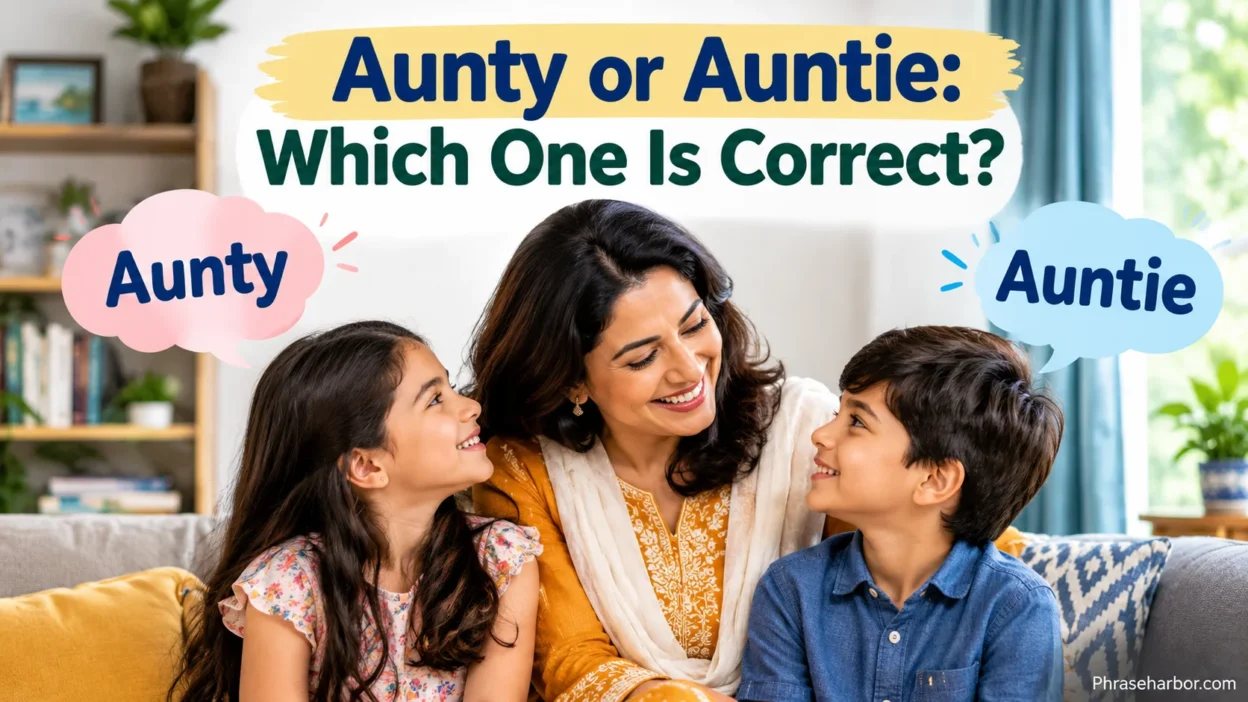
Have you ever wondered whether to write aunty or auntie in a message, a story, or a conversation? Both spellings appear in everyday English, and choosing between them can feel confusing. You might see aunty in a family message and auntie in a book or social media post. So, which spelling should you use?
The good news is that both aunty and auntie are correct spellings. They share the same basic meaning and serve as informal, often affectionate alternatives to aunt. However, spelling preferences can vary by region, family tradition, and personal choice.
In American English, auntie is a familiar spelling, while aunty is especially common in British and South Asian English. These patterns aren’t strict rules, though. Both forms appear across different English-speaking communities.
Understanding their meanings, regional preferences, and grammatical uses will help you choose the right spelling for your audience. Let’s look at the differences and explore how to use each word naturally.
Quick Answer:
Both aunty and auntie are correct. They are informal variants of aunt and generally have the same meaning. Neither spelling is universally more correct than the other.
- Aunty: An informal spelling commonly used in British and South Asian English.
- Auntie: Another informal spelling that is familiar in American English and many other English-speaking communities.
- Aunt: The standard term for a parent’s sister or the wife of an uncle.
For example:
- “My aunty is visiting us this weekend.”
- “My auntie is visiting us this weekend.”
- “My aunt is visiting us this weekend.”
All three sentences are correct. The first two sound more familiar or affectionate, while the third is a neutral choice suitable for a wide range of contexts.
Quick tip: If you’re writing for a specific person, follow their preferred spelling. If you’re writing a formal document, aunt is usually the safest option.
Comparison Overview
Although aunty and auntie look different, they generally serve the same purpose. The main distinction involves spelling preferences rather than meaning or grammar.
| Feature | Aunty | Auntie | Aunt |
| Correct spelling | Yes | Yes | Yes |
| Meaning | Informal form of aunt | Informal form of aunt | Standard family term |
| Formality | Informal | Informal | Neutral and standard |
| American English | Used, but preference varies | Familiar and widely used | Standard |
| British English | Commonly used | Also commonly used | Standard |
| South Asian English | Especially common | Also used | Standard |
| Pronunciation | Usually the same as auntie in the same accent | Usually the same as aunty in the same accent | Varies by accent |
| Best use | Casual speech and writing | Casual speech and writing | General and formal references |
The table shows that the words are largely interchangeable when referring to the same person. However, the best choice may depend on regional conventions or a person’s established preference.
For instance, if your family has always written Aunty Sara, changing it to Auntie Sara might look unfamiliar even though both forms are acceptable.
What Does Aunty Mean?
Aunty is an informal variant of aunt. People use it to refer to a female relative or address someone with affection and familiarity.
In the traditional family sense, an aunt is usually your mother’s or father’s sister. The term can also refer to an uncle’s wife. In everyday conversation, however, aunty may describe a trusted family friend or a familiar older woman.
Consider this example:
“My aunty lives in Lahore, and we visit her every summer.”
Here, aunty refers to a family member. The spelling makes the sentence sound personal and conversational.
How Aunty Is Used in Everyday English
The word appears in several common situations.
Within families: Children may call a parent’s sister Aunty rather than use her first name alone.
Example: “Aunty Nadia brought us homemade cookies.”
When addressing familiar older women: In some communities, people use aunty as a respectful or friendly form of address for women who aren’t related to them.
Example: “Thank you, Aunty, for helping me with my homework.”
In informal messages: The spelling often appears in birthday wishes, invitations, family group chats, and personal letters.
Example: “Happy birthday, Aunty! I hope your day is full of happiness.”
Is Aunty Common in British and South Asian English?
Aunty is a familiar spelling in British English, although auntie is also widely accepted. Neither spelling belongs exclusively to one country.
The spelling is particularly familiar in South Asian English, including English used in India and Pakistan. In these settings, aunty can refer to a relative, a family friend, a neighbor, or an older woman known to the family.
For example, someone might say, “Our next-door aunty invited us for tea.”
The woman may have no biological connection to the speaker. The term communicates familiarity and a degree of social respect.
Still, this usage depends on the community and relationship. Some women welcome the term, while others prefer their names or another form of address.
What Does Auntie Mean?
Auntie is another informal variant of aunt. It generally carries the same meaning as aunty and can express affection, warmth, or familiarity.
For example:
“My auntie taught me how to bake a chocolate cake.”
The word suggests a personal relationship, although it doesn’t always indicate a biological family connection.
Like aunty, auntie can refer to a parent’s sister, an uncle’s wife, or a familiar older woman. Its precise meaning depends on the context.
How Auntie Is Used in Everyday English
The word fits naturally into casual conversations and personal writing.
When speaking to a relative: A child might call a beloved family member Auntie Rose.
Example: “Auntie Rose is taking us to the park tomorrow.”
When expressing affection: Adults may continue using auntie because it reflects a long-standing family habit.
Example: “I’ll always remember my auntie’s wonderful stories.”
When addressing a family friend: In some cultures, auntie is a familiar title for an older woman who plays a supportive role in a child’s life.
Example: “Auntie, would you like another cup of tea?”
These examples show that auntie isn’t limited to children or close relatives. Adults use it, too, particularly when the term has a special place in their family or community.
Is Auntie More Common in American English?
Auntie is a familiar informal spelling in American English. You may encounter it in children’s books, family conversations, affectionate nicknames, and dialogue.
However, it’s important not to turn this tendency into an absolute rule. American writers also use aunty, and preferences differ between individuals and families.
For example, one American family might write “Auntie May” on a birthday card, while another consistently writes “Aunty May.”
Neither choice is inherently incorrect. In both cases, the spelling reflects a preferred form of address.
Read More: In Person or In-Person: Meaning, Differences, and Usage
Main Differences Between Aunty and Auntie
The difference between aunty and auntie is mainly visual. Both words usually carry the same meaning, perform the same grammatical role, and appear in similar situations.
Let’s examine the most important distinctions.
Spelling: Aunty vs. Auntie
The most obvious difference is the final part of each word.
- Aunty: A-U-N-T-Y
- Auntie: A-U-N-T-I-E
Aunty ends in -y, while auntie ends in -ie. Both spellings are established English variants.
English contains other words with similar spelling variations, although the patterns don’t always follow one consistent rule. For aunty and auntie, you don’t need to apply a complicated spelling formula. Simply recognize both as accepted forms.
Meaning: Do Aunty and Auntie Mean the Same Thing?
Yes. In ordinary usage, aunty and auntie mean the same thing.
Both may refer to a family member or serve as an affectionate title for a familiar older woman. Neither spelling automatically indicates a closer relationship, greater respect, or a different family role.
Compare these sentences:
- “My aunty gave me a book.”
- “My auntie gave me a book.”
The sentences communicate the same basic information. The spelling alone doesn’t tell you whether the woman is the speaker’s mother’s sister, father’s sister, uncle’s wife, or family friend.
The surrounding context provides that information.
Pronunciation: Are Aunty and Auntie Pronounced the Same?
In most accents, aunty and auntie have the same pronunciation. The spelling difference generally doesn’t create a difference in spoken meaning.
However, the pronunciation of aunt varies across English accents. Some speakers use a vowel similar to the one in ant, while others use a vowel like the one in father. These regional differences may carry over to aunty and auntie.
For example, two speakers from different parts of the English-speaking world might pronounce auntie differently even though they spell it identically.
The key point is that the final spelling -y or -ie doesn’t usually determine the pronunciation. Regional accent and personal speech habits matter more.
Regional Preferences: Is One Spelling Better?
Regional patterns can help you choose between the two forms, but they don’t establish a universal rule.
Aunty is particularly familiar in British and South Asian English. Auntie is also well established in British English and is a familiar informal spelling in American English.
These preferences overlap. A writer shouldn’t assume that everyone in a particular country uses one spelling exclusively.
If you’re writing for a broad audience, either form can work. If your audience follows a particular publication’s style guide or a family’s established convention, follow that preference instead.
Tone and Context: Which Sounds More Affectionate?
Both spellings can sound warm and affectionate. Neither is automatically more loving or respectful than the other.
Consider a birthday message:
“Happy birthday, Auntie! Thank you for always making me smile.”
Now compare:
“Happy birthday, Aunty! Thank you for always making me smile.”
The messages express the same affection. The writer’s words and relationship with the recipient create the emotional tone, not the spelling alone.
That said, personal preferences matter. If someone has always used Aunty as part of her name or title, respecting that choice can make your message feel more personal.
Aunty vs. Auntie: Regional Usage
English changes across regions, and familiar family terms often reflect local customs. Understanding these patterns can help you choose a spelling that feels natural to your readers.
Aunty or Auntie in American English
American English commonly uses aunt as the standard family term. Auntie is also familiar in informal speech and writing.
For example:
- “My aunt lives in Chicago.”
- “My auntie is coming over for dinner.”
- “I’ll ask Auntie Jane to help us.”
The first sentence uses the neutral family term. The other examples use a more familiar form.
Although auntie is a recognizable spelling in the United States, aunty isn’t automatically wrong. Writers should consider their audience and the spelling preferred by the person they’re addressing.
Aunty or Auntie in British English
Both aunty and auntie appear in British English. A writer may choose either spelling for informal conversation, family correspondence, or dialogue.
For example:
- “My aunty lives near Manchester.”
- “My auntie is visiting next week.”
Both sentences are acceptable. Neither spelling is reserved exclusively for a particular British region.
In formal writing, aunt remains a straightforward choice when you simply want to identify a family relationship.
Aunty or Auntie in South Asian English
In South Asian English, especially in India and Pakistan, aunty is widely familiar as a term of address. People may use it for a relative or a woman who belongs to their family or neighborhood circle.
For example:
- “Aunty Farah invited us for dinner.”
- “I’ll ask the aunty next door if she received our package.”
- “My aunty is coming to visit us during the holidays.”
These examples illustrate different uses. The first addresses a woman by a familiar title and name. The second refers to a neighbor, while the third refers to a family member.
In this context, aunty can communicate both familiarity and social respect. However, expectations vary across families, ages, and communities. Some people prefer to be addressed by their names or another title.
Auntie is also used in South Asia. The spelling choice may depend on personal preference, education, family convention, or the style of English a person uses.
Aunty or Auntie in Other English-Speaking Communities
In many English-speaking communities, terms such as auntie have meanings that extend beyond a narrow biological family relationship.
An older woman may be called auntie because she helps care for children, supports a family, or holds a valued place in a community. In some cultures, the term also reflects longstanding traditions of kinship and respect.
The precise meaning depends on the community. It’s best not to assume that everyone uses the term in the same way.
The spelling may vary, too. Some people use auntie, others use aunty, and some prefer a different title entirely.
Is Aunty or Auntie More Formal?
Neither aunty nor auntie is generally more formal than the other. Both are informal variants of aunt.
The standard word aunt is usually the better choice when you need neutral or formal language. However, an informal form may be perfectly appropriate in a personal letter, a family invitation, or a piece of dialogue.
When to Use Aunt
Choose aunt when you want a standard term without an especially familiar tone.
Examples:
- “My aunt works as a teacher.”
- “We visited my aunt during the summer.”
- “Her aunt attended the wedding.”
This spelling works well in essays, reports, biographies, and ordinary prose. It’s also useful when you don’t know which informal form the person prefers.
FAQs:
Is Aunty Grammatically Correct?
Yes. Aunty is an accepted informal variant of aunt. It appears in everyday speech and writing, particularly in British and South Asian English. Use it when it suits your audience or the person’s preferred form of address.
Is Auntie Grammatically Correct?
Yes. Auntie is also an accepted informal variant of aunt. It appears in family conversations, children’s books, personal messages, and other informal contexts. It’s not more grammatically correct than aunty.
Is Aunty British or American English?
Aunty is familiar in British English and widely used in South Asian English. American English also uses the spelling, although auntie is a familiar alternative. These regional preferences overlap, so neither form belongs exclusively to one variety of English.
Do Aunty and Auntie Mean the Same Thing?
Yes. Both usually refer to an aunt or serve as affectionate forms of address for familiar older women. Their core meanings are the same, although a particular family or community may have its own spelling preference.
Which Spelling Is More Common in the United States?
Auntie is a familiar spelling in the United States, particularly in informal writing and affectionate forms of address. However, usage varies by family and individual. Aunty is also understood and can be correct.
Conclusion:
The choice between aunty or auntie is simpler than it first appears. Both spellings are correct informal variants of aunt, and they generally carry the same meaning. The difference lies mainly in spelling preferences, regional habits, and personal choice. Aunty is particularly familiar in British and South Asian English, while auntie is a familiar form in American English and many other communities. Neither spelling is universally correct over the other.