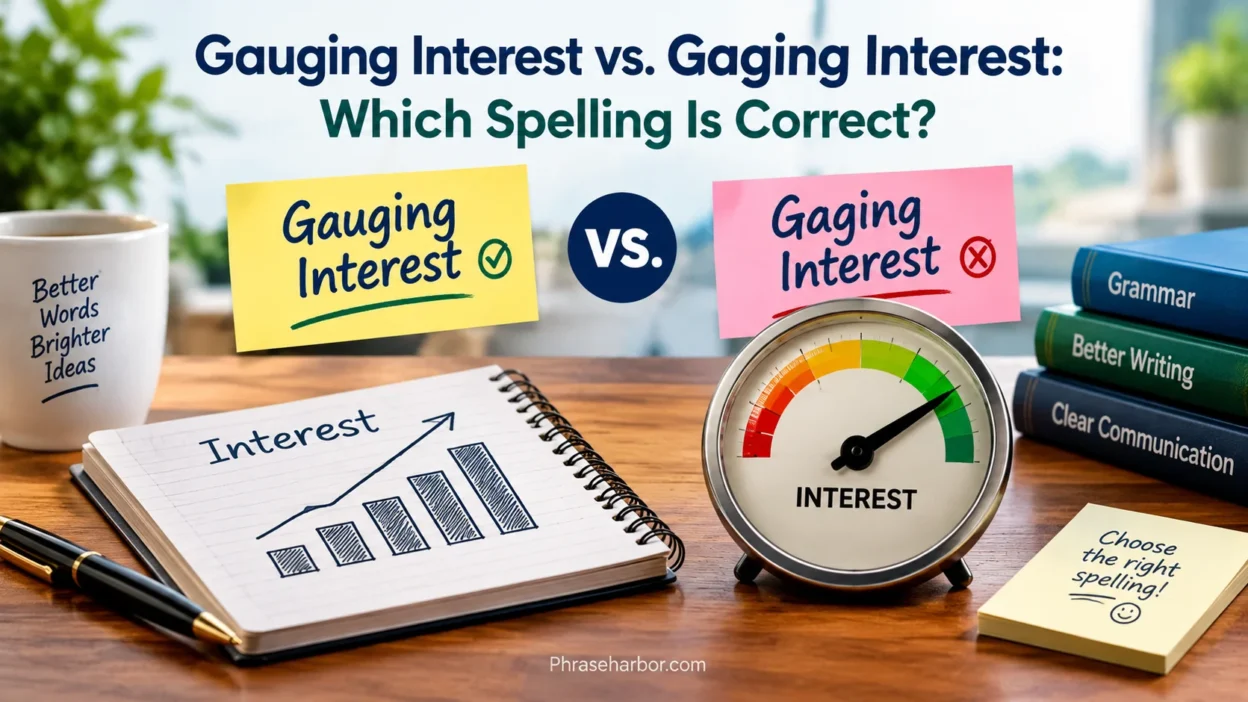
If you’re trying to find out whether people care about an idea, product, event, or proposal, you might write that you’re gauging interest. But when you type the phrase, another spelling can cause hesitation: gaging interest.
The confusion makes sense. The verb gauge has an unusual spelling, and its pronunciation doesn’t clearly reveal how the word should look when you add -ing. As a result, writers sometimes produce forms such as gaging or even gaugeing.
The good news is that the choice becomes much easier once you understand the relationship between gauge, gauging, and gage. In standard American English, gauging interest is the spelling most readers expect and the form to use in general writing.
Gauging interest means trying to assess how interested people are in something. You might gauge interest before launching a product, planning an event, publishing a book, or introducing a new service.
Quick Answer
Gauging interest is the standard and preferred form in general American English. It means assessing, estimating, or measuring the level of interest in something.
Gaging is also a real spelling because gage exists as a variant of gauge. However, it is much less common in ordinary modern writing. For business communication, articles, emails, marketing material, academic work, and everyday English, gauging interest is the safer choice.
Here is the basic distinction:
- Gauge → the standard spelling of the verb.
- Gauging → the standard -ing form of gauge.
- Gage → a less common variant of gauge.
- Gaging → the -ing form associated with gage.
- Gaugeing → incorrect.
So, if you’re writing a sentence such as We’re gauging interest in the new service, gauging is the form to choose.
Comparison Overview
| Expression | Status | Meaning | Best Use |
| Gauging interest | Standard | Assessing someone’s level of interest | General and professional writing |
| Gaging interest | Variant | Essentially the same idea | Specialized or variant usage |
| Gauge interest | Standard | Assess interest | General English |
| Gage interest | Variant | Assess interest | Less common usage |
| Gaugeing interest | Incorrect | — | Avoid |
The important point is that gauging and gaging don’t normally represent two different ideas. The difference primarily comes from spelling and the choice between the related forms gauge and gage.
For most readers, gauging interest will look familiar immediately. Gaging interest, by comparison, can look like a spelling mistake even though gage is a recognized variant.
Main Differences Between Gauging Interest vs. Gaging Interest
The biggest difference between gauging interest and gaging interest is their spelling and frequency of use. Both connect to the idea of assessing or estimating something, but gauging is the conventional form in general English.
Gauging Interest Is the Standard Choice
When you use gauge as the verb, its present participle is gauging.
For example:
The company is gauging interest in its new subscription plan.
Here, the company isn’t necessarily obtaining an exact numerical measurement. Instead, it’s trying to determine whether enough people are interested to justify moving forward.
That distinction matters because gauge often describes an assessment rather than a perfectly precise measurement.
You can gauge:
- Interest
- Demand
- Support
- Reaction
- Public opinion
- Enthusiasm
- Sentiment
- Response
- Customer satisfaction
- Expectations
The phrase gauging interest fits naturally into all kinds of modern writing.
Gaging Interest Is a Variant Form
Gaging isn’t simply a random misspelling. It can be formed from gage, which is an established variant spelling of gauge.
That doesn’t mean the two forms have equal popularity.
In ordinary American English, gauge is overwhelmingly more familiar. Consequently, gauging interest is generally the better choice when your goal is clear, conventional communication.
Think of it like choosing between a familiar road and a legitimate alternate route. Both may lead to the same destination, but one is much more recognizable to most travelers.
Gaugeing Interest Is Not Correct
A particularly common spelling mistake is gaugeing.
The logic behind the error is understandable. A writer sees gauge and assumes that adding -ing simply produces gaugeing. English doesn’t work that way here.
The correct form is:
gauge → gauging
Not:
gauge → gaugeing
The final e disappears before the -ing ending.
What Does “Gauging Interest” Mean?
Gauging interest means trying to determine how interested people are in something.
Imagine that a restaurant owner is considering adding a new weekend brunch menu. Before spending money on ingredients, advertising, and extra staff, the owner might ask customers whether they’d come.
That process is gauging interest.
The owner might use:
- A customer survey
- Social media polls
- Email responses
- Sign-up forms
- Informal conversations
- Preorders
- Website engagement
- Event registrations
The goal isn’t always to obtain a mathematically exact answer. Instead, the goal is to gather enough evidence to make a sensible decision.
Examples of Gauging Interest
Business:
The startup is gauging interest in its new budgeting app before expanding the service.
Events:
We’re gauging interest in a fall writing workshop.
Marketing:
The team conducted a short survey to gauge interest in the new product.
Education:
The teacher asked several questions to gauge interest in an advanced course.
Publishing:
The author is gauging interest in the book before approaching publishers.
Notice how naturally gauge interest and gauging interest fit into these sentences.
Why Is “Gauging” Spelled With a U?
The spelling becomes clearer when you start with the base word gauge.
When -ing is added, the final e is dropped:
gauge + ing → gauging
This follows a broader English spelling pattern. Many verbs ending in a silent e drop that letter before a suffix beginning with a vowel.
For example:
- make → making
- write → writing
- use → using
- move → moving
- create → creating
Gauge follows the same general pattern:
- gauge → gauging
The unusual part is the word’s existing letter combination. The spelling gauging may look strange at first, but it is the established form.
Why “Gaugeing” Looks Tempting
The pronunciation of gauge doesn’t make its spelling obvious. A writer may think the entire base word should remain intact before adding -ing.
That produces:
gauge + ing = gaugeing
However, standard spelling removes the final e:
gauge + ing = gauging
A useful memory trick is simple: if you know the verb is gauge, remember that its -ing form is gauging.
What Does “Gaging” Mean?
Gaging is the present participle of gage, a variant spelling of gauge.
The word gage has legitimate historical and modern uses. Depending on the context, it can refer to a measure, a standard, or the act of measuring or assessing something.
Because gage exists as a variant, gaging can appear in dictionaries and specialized writing.
However, that doesn’t make it the usual spelling for everyday expressions.
Consider these two sentences:
The company is gauging interest in the new product.
The company is gaging interest in the new product.
The second sentence isn’t necessarily meaningless. Yet many readers will find the first version much more familiar.
That’s why standard usage matters.
Gauging vs. Gaging: The Main Difference
The distinction can be summarized in one table.
| Feature | Gauging | Gaging |
| Base word | Gauge | Gage |
| Basic meaning | Assess or measure | Assess or measure |
| Standard general spelling | Yes | No |
| Common in everyday American English | Yes | Much less common |
| Suitable for professional general writing | Yes | Usually avoid |
| Can be a legitimate spelling | Yes | Yes |
The crucial point is that gaging isn’t automatically a nonsense word. Its relationship with gage gives it a legitimate basis.
Still, writers generally don’t choose words based only on whether a spelling can be defended. They also consider familiarity, clarity, audience expectations, and standard usage.
For that reason, gauging interest remains the practical choice.
Read More: Mold vs Mould: Which Spelling Is Correct?
Why “Gauging Interest” Is More Common
One reason gauging feels so natural is that gauge appears in many familiar expressions.
You might:
- gauge interest
- gauge demand
- gauge reaction
- gauge support
- gauge sentiment
- gauge enthusiasm
- gauge public opinion
- gauge customer response
- gauge effectiveness
- gauge expectations
Once readers become accustomed to gauge, the spelling gauging follows naturally.
The phrase also appears across many fields. Marketers gauge customer interest. Teachers gauge student engagement. Researchers gauge public sentiment. Managers gauge employee reactions.
This broad usage reinforces gauging as the familiar form.
Why Familiarity Matters
Imagine reading this sentence:
We’re gaging interest before investing in the project.
You may understand it immediately. However, there’s a decent chance you’ll pause and wonder whether the writer meant gauging.
Now compare:
We’re gauging interest before investing in the project.
The second version requires no such mental detour.
Good writing should remove unnecessary friction. When two forms convey the same idea, the familiar standard is usually the smarter choice.
When to Use “Gauging Interest”
Use gauging interest whenever you’re describing an attempt to determine how interested people are.
In Business
Companies often test interest before committing resources.
The company is gauging interest in a lower-priced subscription.
This could involve customer surveys, interviews, landing pages, sales inquiries, or preorders.
In Marketing
Marketers routinely gauge interest before launching campaigns.
The marketing team is gauging interest in the new campaign concept.
The information can help determine whether an idea deserves further development.
In Product Development
Product teams may gauge interest before building a feature.
The developers are gauging interest in a dark-mode feature.
This approach can prevent teams from spending substantial time on something customers don’t actually want.
In Event Planning
Event organizers frequently need to estimate attendance.
We’re gauging interest in a Saturday workshop.
A simple registration form can provide a useful early signal.
In Everyday Communication
The phrase doesn’t belong exclusively to business.
You could say:
I’m just gauging interest before I make the reservation.
That’s perfectly natural.
When Might “Gaging” Appear?
There are situations where gaging may appear because the writer uses gage rather than gauge.
This is more likely in specialized contexts, historical material, or writing that follows a particular terminology tradition.
For example, technical fields sometimes use gage in compounds and specialized terms. You may encounter expressions involving a gage as a measuring instrument or standard.
That context differs from everyday phrases such as gauging interest.
The practical lesson is straightforward: don’t assume every appearance of gaging is a typographical error, but don’t choose it merely because it exists.
If you’re writing for a broad audience, gauging is generally the clearer option.
Gauging Interest in a Sentence
Seeing the phrase in context makes the difference easier to remember.
Formal Example
The organization is gauging interest in a nationwide training program.
Business Example
Before expanding the service, the company is gauging interest among existing customers.
Casual Example
I’m gauging interest before I book a larger venue.
Marketing Example
The brand launched a survey to gauge interest in its upcoming product line.
Workplace Example
The manager is gauging interest in flexible Friday hours.
Academic Example
Researchers surveyed participants to gauge interest in future studies.
The phrase works because interest is something that can vary in degree. Someone can show little interest, moderate interest, strong interest, or intense interest.
Common Mistakes With “Gauging Interest”
Several spelling errors tend to appear around this expression.
“Gaging Interest” in General Writing
Because gage is a real word, this version isn’t as straightforward as an ordinary typo.
Nevertheless, gaging interest isn’t the preferred form for most general American English writing.
If you’re writing a business email or article, stick with gauging interest.
“Gaugeing Interest”
This form is incorrect.
The correct spelling is:
gauging interest
Not:
gaugeing interest
The final e in gauge is dropped before -ing.
“Gauging Interests”
This isn’t always wrong, but it can change the meaning.
Gauging interest usually refers to the overall level of enthusiasm or attention toward something.
Gauging interests can refer to assessing several distinct interests.
For example:
The survey is designed to gauge interest in the new course.
This means measuring how interested people are in that particular course.
By contrast:
The counselor is gauging students’ interests.
Here, the counselor is identifying the different subjects, activities, or career areas students like.
The singular and plural forms therefore deserve attention.
Gauging Interest vs. Gauging a Reaction
Although both expressions use gauge, they aren’t identical.
When you gauge interest, you assess someone’s level of desire, curiosity, or enthusiasm.
When you gauge a reaction, you assess how someone responds to an event, statement, product, or situation.
Compare:
The company is gauging interest in the new service.
The company wants to know whether people want the service.
The company is gauging reactions to the new service.
The company wants to know how people respond after hearing about it.
One focuses on interest. The other focuses on response.
FAQs:
Is “gauging interest” or “gaging interest” correct?
Gauging interest is the standard and preferred form in general American English. Gaging is a variant associated with the less common spelling gage.
Is “gaging” a real word?
Yes. Gaging can be the present participle of gage, which is a variant spelling of gauge. However, it isn’t the usual choice in everyday general English.
Why is “gauging” spelled without the “e”?
The final e in gauge is dropped before the -ing ending. Therefore, gauge + ing becomes gauging, not gaugeing.
Is “gaging interest” acceptable in American English?
It can occur because gage is a legitimate variant spelling. Still, gauging interest is much more familiar and is the better choice for most American English writing.
What does “gauging interest” mean?
Gauging interest means assessing or estimating how interested people are in something. For example, a business might gauge interest before launching a new product.
Conclusion:
When you’re writing for a general American English audience, choose gauging interest. The phrase is clear, familiar, and standard. It means assessing how interested people are in an idea, product, event, service, or opportunity.
Gaging has a legitimate connection to the variant spelling gage, so it shouldn’t automatically be treated as meaningless. However, it’s much less familiar in ordinary writing. That difference makes gauging interest the stronger practical choice.