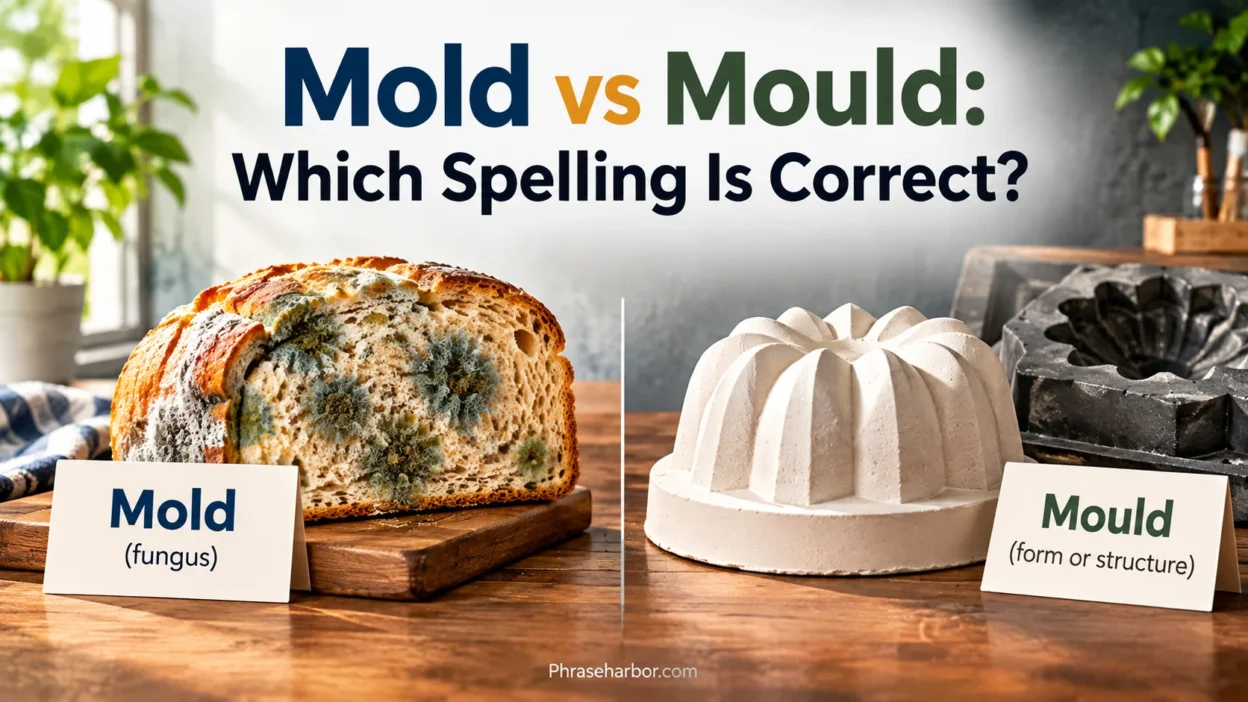
If you’ve ever wondered whether mold or mould is the correct spelling, you’re dealing with one of the most common American and British English spelling differences. At first glance, the extra u in mould makes the two words look different. In practice, however, they usually mean exactly the same thing.
The main difference comes down to regional English. Mold is the standard spelling in American English, while mould is the traditional spelling used in British English. Both forms can describe the fuzzy fungus that grows on damp food or surfaces. They can also describe a container or form used to shape materials.
For example, an American writer might say, “There is mold growing on the bathroom wall.” A British writer would normally write, “There is mould growing on the bathroom wall.” Neither writer has changed the meaning. They’ve simply followed a different spelling convention.
The distinction becomes even more interesting because mold and mould work as both nouns and verbs. They can describe fungal growth, a shaping form, or the process of shaping something. Related words follow similar regional patterns, including molded/moulded, molding/moulding, and moldy/mouldy.
Quick Answer
Mold and mould are both correct spellings. The difference is primarily regional.
- Mold is the standard spelling in American English.
- Mould is the standard spelling in British English.
- Both words can mean a fungus that grows on food or damp surfaces.
- Both can also mean a form or container used to shape material.
- Both can function as a verb meaning to shape or form something.
- The two spellings generally have the same pronunciation.
- The related forms are usually molded/moulded, molding/moulding, and moldy/mouldy.
For example:
American English: The bread has mold on it.
British English: The bread has mould on it.
The difference is spelling, not meaning.
Comparison Overview
| Feature | Mold | Mould |
| Standard American English | Yes | No |
| Standard British English | Less common | Yes |
| Refers to fungal growth | Yes | Yes |
| Refers to a shaping form | Yes | Yes |
| Can be used as a verb | Yes | Yes |
| Basic pronunciation | Same | Same |
| Related adjective | Moldy | Mouldy |
| Past-tense form | Molded | Moulded |
| -ing form | Molding | Moulding |
| Main distinction | American spelling | British spelling |
The easiest way to remember the difference is simple: mold is American, mould is British.
That rule won’t cover every English-speaking region perfectly. Canadian, Australian, New Zealand, and other varieties of English can show their own preferences depending on context and style. Still, the American-versus-British distinction gives you the most useful starting point.
Main Differences Between Mold vs Mould
Mold Is the American English Spelling
In American English, mold is the normal spelling. You’ll see it in everyday writing, school materials, newspapers, technical documents, product descriptions, and scientific contexts.
For example:
- The bread developed mold after several days.
- Clean the bathroom before the mold spreads.
- The manufacturer created a plastic mold.
- Childhood experiences can mold a person’s character.
American English generally prefers the shorter spelling mold rather than mould. This fits a broader pattern in American spelling, although the history of each word isn’t identical.
You can see similar differences in pairs such as color/colour, favor/favour, and honor/honour. American spelling often drops the u found in traditional British forms.
Mould Is the British English Spelling
In British English, mould is the usual spelling.
For example:
- There was mould on the bathroom ceiling.
- Throw away the bread if you see mould.
- Pour the mixture into a mould.
- Experiences can mould a person’s character.
The extra u doesn’t normally change the pronunciation. It’s simply part of the conventional British spelling.
If you’re writing for a British audience, using mould throughout the article will generally look more natural. If you’re writing for American readers, mold will usually feel more familiar.
Mold and Mould Usually Have the Same Meaning
One of the biggest misconceptions is that mold and mould represent two different things.
Usually, they don’t.
Consider this sentence:
The cheese developed mold.
Now change the spelling:
The cheese developed mould.
The meaning remains the same. The second version simply follows British spelling conventions.
The same principle applies to the shaping sense:
Pour the wax into the mold.
Pour the wax into the mould.
Again, the underlying meaning doesn’t change.
The important point is that regional spelling determines the written form. Context determines the meaning.
What Does Mold or Mould Mean?
The word has several related meanings. Understanding them makes the spelling distinction much easier to handle.
Mold or Mould as a Fungus
The most familiar meaning refers to a group of fungi that can grow on organic material, food, walls, fabrics, and other surfaces under suitable conditions.
Mold commonly appears where there is:
- Moisture
- Poor ventilation
- High humidity
- Organic material
- Warm or damp conditions
For example, a forgotten slice of bread may eventually develop visible patches of mold. In British English, that sentence would normally use mould instead.
The word can describe the visible growth as well as the general fungal material.
Examples include:
- Mold can grow on old bread.
- Damp rooms may develop mold.
- The cheese has a layer of mould.
- Moisture can encourage mould growth.
The spelling changes according to regional convention. The underlying concept does not.
Mold or Mould as a Shaping Form
The word has another completely different everyday meaning.
A mold or mould can be a hollow form into which a material is poured, pressed, or placed so that it takes a particular shape.
For example, manufacturers can use molds to create:
- Plastic components
- Metal parts
- Candles
- Chocolate
- Decorative objects
- Concrete pieces
- Industrial components
Imagine pouring melted chocolate into a heart-shaped container. Once the chocolate cools, it takes the shape of that container. That container is a mold in American English and a mould in British English.
Mold or Mould as a Verb
The word also works as a verb.
To mold or mould something means to shape, form, or influence it.
For example:
- The artist molded the clay by hand.
- Experience molded his personality.
- Teachers can help mould young minds.
- The machine molds plastic into precise shapes.
The verb can describe both physical shaping and figurative influence.
That’s an important distinction because the figurative meaning appears frequently in formal writing.
Mold vs Mould Examples
Examples of Mold in American English
Here are several natural examples:
- The old bread was covered in mold.
- Moisture caused mold to grow behind the cabinet.
- The factory uses a metal mold to produce the parts.
- Pour the melted wax into the mold.
- Early experiences can mold a child’s personality.
- The designer created a new mold for the product.
- Remove the food as soon as you notice mold.
Notice that the same spelling works for both the fungus and the shaping form.
Examples of Mould in British English
The British equivalents are:
- The old bread was covered in mould.
- Moisture caused mould to grow behind the cabinet.
- The factory uses a metal mould to produce the parts.
- Pour the melted wax into the mould.
- Early experiences can mould a child’s personality.
- The designer created a new mould for the product.
- Remove the food as soon as you notice mould.
The meaning hasn’t changed. Only the spelling has.
Mold vs Mould in Side-by-Side Sentences
| American English | British English |
| The bread has mold on it. | The bread has mould on it. |
| We found mold near the window. | We found mould near the window. |
| Use this mold for the chocolate. | Use this mould for the chocolate. |
| The experience helped mold her character. | The experience helped mould her character. |
| The factory created a new mold. | The factory created a new mould. |
This side-by-side comparison shows the central rule clearly: the spelling follows the variety of English.
Read More: Knaw or Gnaw: Which Spelling Is Correct?
Mold vs Mould Pronunciation
Despite the different spellings, mold and mould are generally pronounced the same way.
The extra u in mould doesn’t normally add another syllable or create a separate vowel sound. Both forms are commonly pronounced with one syllable.
This makes the pair especially interesting because the difference is visible on the page but usually disappears when spoken.
That also means you generally can’t hear whether someone intends to spell the word mold or mould. You need the context of the speaker or the written form.
For example, if someone says the word in conversation, you won’t normally know whether they would write:
mold
or:
mould
The pronunciation alone doesn’t settle the spelling.
Why Does British English Spell It “Mould”?
The spelling mould reflects older English spelling traditions and historical influences on the language.
English spelling developed over many centuries. It absorbed patterns from Old English, French, Latin, and other languages. As English spread and changed, different regions gradually developed different spelling preferences.
British English retained many traditional spellings that later became less common in American English.
That’s why British English has forms such as:
- colour
- favour
- honour
- labour
- mould
American English commonly uses:
- color
- favor
- honor
- labor
- mold
These differences aren’t random. They reflect different stages and traditions in the development of English spelling.
Why Does American English Spell It “Mold”?
American English adopted and popularized several simplified spelling forms, particularly during the development of a distinct American written standard.
The shorter spelling mold became established in American usage. It eventually became the expected form across most American writing.
This doesn’t mean Americans changed the pronunciation. They changed the conventional written form.
That distinction matters. English spelling isn’t a mathematical formula where every extra letter must represent an additional sound.
Sometimes a spelling difference is simply historical.
Mold vs Mould in Different English-Speaking Countries
The American and British distinction is useful, but English around the world isn’t divided into two perfectly sealed boxes.
United States
Mold is the standard spelling.
American dictionaries, schools, publications, and businesses overwhelmingly use mold in ordinary American English.
United Kingdom
Mould is the standard spelling.
British writers generally use mould, including in scientific, technical, manufacturing, and everyday contexts.
Canada
Canadian English can show variation because it sits between American and British English traditions.
You’ll encounter mould in Canadian writing, particularly because Canadian English retains several British-style spellings. At the same time, American influence is strong, especially in informal and commercial contexts.
The safest approach is to follow the spelling convention used by the publication or organization you’re writing for.
Australia and New Zealand
Australian and New Zealand English generally follow British spelling conventions in many areas. As a result, mould is commonly used.
However, individual style guides and technical contexts can introduce variation.
The Practical Rule
If you’re writing for an international audience, consistency matters more than trying to force one spelling on everyone.
Choose the spelling that matches your target audience and use it consistently.
Mold vs Mould in Formal Writing
Your choice matters most when you’re producing polished professional content.
School Assignments
If you’re studying in the United States, use mold. If your educational system follows British English, use mould.
Academic Writing
Academic writing should follow the spelling conventions required by the institution, journal, publisher, or style guide.
If the publication uses American English, write mold. If it uses British English, write mould.
Business Writing
Businesses should consider their audience.
An American company serving US customers will normally use mold. A British manufacturer writing for UK customers will normally use mould.
Website Content
Website writers should also consider the intended readership.
A US-focused website should generally use mold. A UK-focused website should generally use mould.
The key isn’t to declare one spelling universally correct. The key is matching the language variety your audience expects.
Common Mistakes With Mold and Mould
Mistake: Thinking One Spelling Is Always Wrong
This is the most common error.
Mold isn’t wrong. Mould isn’t wrong.
Each belongs to a different spelling tradition.
Calling mould a spelling mistake in a British article would be misleading. Likewise, correcting mold to mould in standard American writing would create an unnecessary change.
Mistake: Switching Between Mold and Mould
Consistency is important.
Suppose an article begins with mold and later switches to mould. Readers may wonder whether the writer is referring to two different concepts.
Unless you’re specifically discussing the spelling difference, stick with one regional form.
Mistake: Assuming Mould Has a Different Pronunciation
The extra u doesn’t normally create a different pronunciation.
The two spellings represent the same basic word in their respective varieties of English.
Mistake: Treating Mold and Mould as Different Concepts
The word can have multiple meanings, but those meanings aren’t caused by the spelling difference.
The context tells you whether the word refers to fungal growth, a shaping form, or the process of shaping.
Mold vs Mould Related Words
The spelling difference continues into several related words.
| American English | British English | Meaning |
| mold | mould | fungus or shaping form |
| molded | moulded | shaped or formed |
| molding | moulding | shaping or decorative material |
| moldy | mouldy | affected by mold |
| moldable | mouldable | capable of being shaped |
These forms follow the same broad regional pattern.
Molded vs Moulded
Molded is the usual American spelling, while moulded is the usual British spelling.
Examples:
- The plastic was molded into a new shape.
- The plastic was moulded into a new shape.
The figurative sense works too:
- Her experiences molded her worldview.
- Her experiences moulded her worldview.
FAQs:
Is mold or mould correct?
Both are correct. Mold is the standard American English spelling, while mould is the standard British English spelling.
Is mold American or British?
Mold is primarily the standard American English spelling. British English generally uses mould.
Is mould British or American?
Mould is the traditional and standard British English spelling. It is also used in several other English varieties influenced by British spelling conventions.
Do mold and mould mean the same thing?
Yes. They generally have the same meanings. Both can refer to fungal growth, a shaping form, or the act of shaping something.
Is mold pronounced differently from mould?
Generally, no. The two spellings are normally pronounced the same way. The extra u in mould doesn’t ordinarily create another syllable or a different basic pronunciation.
Final Takeaway
The mold vs mould debate is much simpler once you recognize the regional spelling pattern. Mold is the standard American English spelling. Mould is the standard British English spelling. Both forms can describe fungal growth, a shaping form, or the process of shaping something. Neither spelling is universally “more correct.” The right choice depends on the English variety you’re using. If you’re writing for readers in the United States, choose mold. If you’re writing for a British audience, choose mould. For other English-speaking regions, follow the local convention or the relevant style guide.