Trawling vs. trolling can be confusing because both words relate to fishing and differ by only a few letters. Yet their meanings can move in very different directions. Trawling can describe dragging a net through water or searching widely through information. Trolling can describe fishing with a baited line or deliberately provoking people online.
That small spelling difference matters. If you write that a researcher was “trolling through historical records,” readers may understand something very different from what you intended. Likewise, saying a fishing boat was “trawling” when it was actually pulling baited lines can describe the wrong method.
The good news is that you don’t need to memorize a complicated rule. Once you understand the basic ideas behind each word, the distinction becomes much easier.
Quick Answer
Trawling usually refers to dragging a net through water to catch fish or searching extensively through a large amount of information.
Trolling can refer to drawing a baited fishing line or lure through water. In modern internet language, it also means deliberately provoking or baiting people to get a reaction.
The simplest way to remember the difference is:
Trawling = a net or a broad search.
Trolling = a lure or deliberate provocation.
For example:
- The fishing vessel was trawling for cod.
- The journalist spent hours trawling through old records.
- The crew was trolling for tuna.
- Someone was trolling users in the comment section.
Both words are legitimate English words. The issue isn’t spelling correctness. The issue is choosing the word that matches the meaning you want.
Comparison Overview
| Feature | Trawling | Trolling |
| Base verb | Trawl | Troll |
| Fishing meaning | Dragging a trawl net through water | Pulling bait or a lure through water |
| Information meaning | Searching extensively through material | Not normally used for ordinary searching |
| Internet meaning | Searching or collecting information in some contexts | Deliberately provoking people online |
| Main fishing equipment | Trawl net | Fishing line, rod, reel, bait, or lure |
| Common phrase | Trawling through records | Trolling for fish |
| Online phrase | Data trawling | Internet trolling |
| Core idea | Sweeping or searching broadly | Luring or provoking |
| Example | She was trawling through archives. | He was trolling the comments. |
The distinction becomes clearer when you look at the action itself. Trawling covers a broad sweep, whether that sweep involves a fishing net or a large collection of information. Trolling centers on drawing something along with bait or deliberately baiting someone into a reaction.
Main Differences Between Trawling vs. Trolling
The most important difference between trawling vs. trolling is the action each word describes. Although both words have fishing-related meanings, they refer to different fishing techniques.
Trawling Means Dragging a Net
In its traditional fishing sense, trawling involves pulling a large net through the water. The net, called a trawl, collects fish and other marine organisms as the vessel moves.
The method can involve different types of trawls and different operating depths. Some trawling operations work near the seabed while others operate in the water column.
The key idea is the net.
For example:
- The vessel was trawling offshore.
- The fishermen spent the morning trawling for cod.
- The boat uses a large trawl net to catch fish.
You don’t need to know the exact type of net to understand the basic meaning. If the action involves dragging a trawl net through the water, trawling is the appropriate term.
Trolling Means Pulling a Baited Line
Fishing trolling uses a different approach. Instead of dragging a large trawl net, a person or boat pulls one or more fishing lines through the water with bait or artificial lures.
The moving bait or lure attracts fish.
For example:
- They were trolling for tuna.
- The boat continued trolling along the coastline.
- The anglers used several lines while trolling.
Here, the crucial image is not a net sweeping through the water. It’s a baited line moving behind a boat or through the water.
That distinction makes the fishing meanings much easier to remember.
Trawling Can Also Mean Searching
English often takes a concrete action and gives it a figurative meaning. Trawling is a good example.
When someone says they are trawling through archives, they aren’t dragging a physical fishing net through a library. They’re searching through a large amount of material to find something useful.
Consider this sentence:
The researcher spent several days trawling through government records.
The researcher is systematically searching a large collection of records. The metaphor works because the person is figuratively sweeping through a large body of material, much like a trawl net moves through water.
You may encounter this usage in contexts involving:
- historical archives
- databases
- newspapers
- public records
- research material
- job listings
- websites
- financial documents
- large datasets
- old correspondence
Trolling Has a Modern Internet Meaning
Trolling gained a major additional meaning through internet culture.
An online troll deliberately says or posts something provocative to encourage anger, arguments, confusion, or other reactions. The person may not genuinely believe the statement. The goal can be the reaction itself.
For example:
- Someone was trolling the forum members.
- The account appeared to be trolling people in the comments.
- Don’t feed the trolls.
However, not every rude or controversial comment qualifies as trolling. Intent matters.
Someone can disagree with you sincerely without trying to provoke you. A harsh opinion isn’t automatically trolling. A criticism can be genuine criticism.
Trolling generally involves some element of deliberate baiting or provocation.
What Does Trawling Mean?
Trawling is the present participle or gerund form of trawl. Its meanings depend heavily on context.
Trawling in Fishing
In fishing, trawling involves pulling a trawl through the water.
A trawl is a type of fishing net designed to collect marine life as it moves through the water. Commercial fishing operations may use substantial trawling equipment.
The method can be highly specialized. Factors such as target species, water depth, vessel design, and local fishing practices can affect how trawling takes place.
A simple example is:
The vessel was trawling for shrimp.
The sentence tells you that the vessel was using a trawling method rather than fishing with a single baited line.
Trawling Through Information
The figurative sense is especially common in journalism, research, and everyday descriptions of searching.
You might hear:
- trawling through archives
- trawling through documents
- trawling through databases
- trawling for information
- trawling through old newspapers
The expression suggests a wide-ranging search.
Imagine a historian looking through thousands of newspaper pages for one mention of a forgotten event. Calling that process trawling through newspapers emphasizes the scale and persistence of the search.
This usage isn’t accidental. It draws directly on the image of a fishing trawl sweeping through a large area.
Trawling in Data and Technology
The same metaphor appears in data-related language.
For example:
Analysts spent weeks trawling through the dataset for unusual patterns.
Here, trawling doesn’t necessarily describe a sophisticated technical process. It simply conveys the idea of searching through a substantial body of information.
The word can work well when the writer wants to emphasize the breadth of the search rather than a single targeted query.
What Does Trolling Mean?
Like trawling, trolling has more than one established meaning.
Trolling in Fishing
The fishing meaning of trolling involves drawing bait or lures through the water.
This technique is common in recreational and commercial fishing. The angler or crew moves the bait or lure through the water to attract fish.
For example:
The anglers were trolling for tuna near the offshore reef.
The word trolling in this sentence has nothing to do with social media or online arguments. It describes a fishing technique.
Trolling on the Internet
The internet meaning is now extremely familiar.
An online troll may post something inflammatory, deliberately misunderstand another person, insult participants, or introduce an outrageous claim simply to generate reactions.
The behavior can appear on:
- social media platforms
- online forums
- gaming communities
- video platforms
- discussion boards
- comment sections
For example:
The user kept trolling the discussion group by posting deliberately provocative comments.
The important element is provocation.
Read More: Nighttime or Night-Time: Which Spelling Is Correct?
Trolling Isn’t the Same as Disagreeing
This distinction deserves attention because the word gets used too loosely.
Suppose someone says:
I disagree with this policy because I think it will cost too much.
That’s disagreement.
Now imagine someone repeatedly enters a discussion solely to irritate participants, posts deliberately inflammatory claims, and continues after people react.
That behavior is much closer to trolling.
The difference isn’t simply whether people become angry. It concerns the apparent purpose behind the behavior.
Trawling vs. Trolling in Fishing
The fishing meanings provide the clearest way to understand the distinction.
| Fishing Method | Trawling | Trolling |
| Main equipment | Trawl net | Fishing line and lure or bait |
| Basic action | Drag a net through water | Pull bait or a lure through water |
| Targeting style | Often sweeps an area | Attracts fish to moving bait |
| Typical association | Commercial fishing | Recreational and commercial fishing |
| Key memory word | Net | Lure |
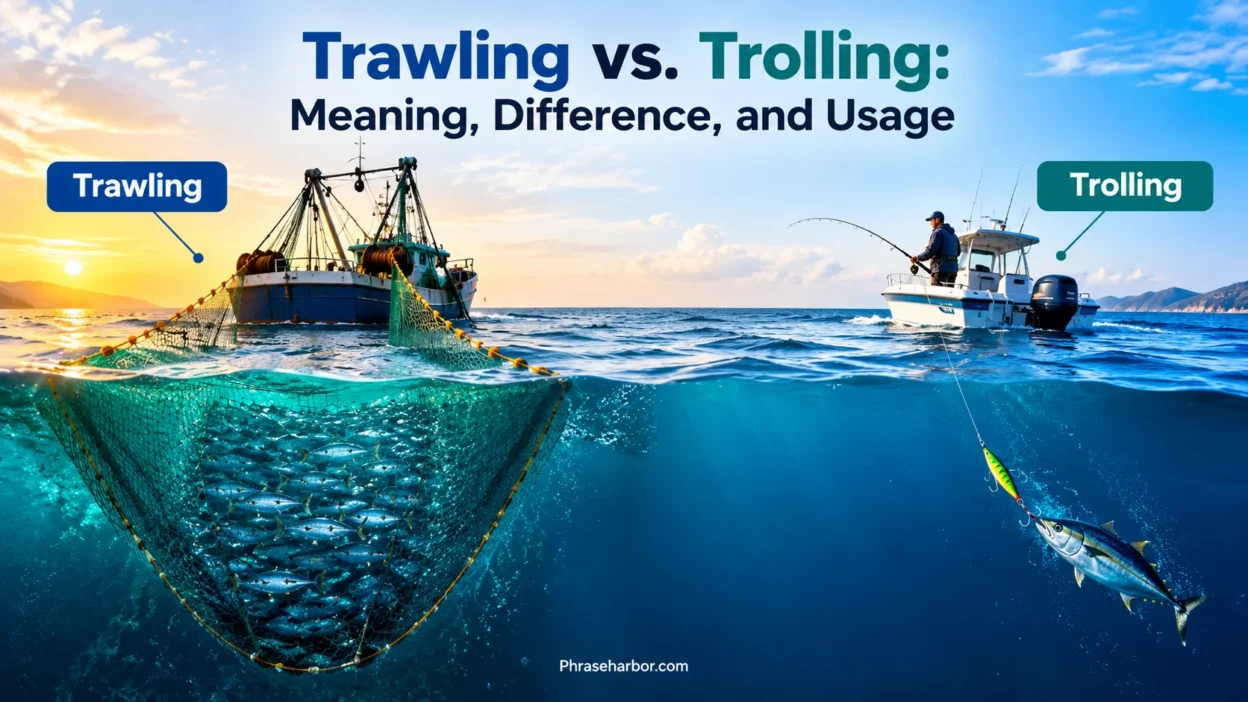
Think of two boats moving across the ocean.
The first boat pulls a large net behind it. That’s trawling.
The second boat moves with fishing lines trailing behind it. The lines carry bait or artificial lures. That’s trolling.
Same ocean. Different method.
Trawling vs. Trolling in Everyday English
The difference becomes especially useful when these words appear outside fishing.
When Trawling Is the Right Word
Use trawling when you mean searching widely through a substantial amount of information or material.
Natural examples include:
- The reporter was trawling through court records.
- Researchers spent months trawling through historical archives.
- She was trawling the internet for information about the old company.
- The team spent the afternoon trawling through customer data.
- He was trawling through job listings for suitable positions.
The common thread is extensive searching.
When Trolling Is the Right Word
Use trolling when you mean deliberate online provocation or the fishing technique involving bait or lures.
Examples include:
- Someone was trolling the discussion board.
- The account kept trolling other users.
- They went trolling for tuna before sunrise.
- The fishermen spent the afternoon trolling offshore.
Context does most of the work.
If you’re talking about a database, trawling makes sense. If you’re talking about provoking people online, trolling is the established choice.
Why Are Trawling and Trolling So Easy to Confuse?
The confusion has several genuine linguistic causes.
First, the words look remarkably similar:
trawl → trawling
troll → trolling
Second, both words have fishing meanings. That creates a genuine semantic overlap.
Third, both fishing methods involve something being drawn through water.
Fourth, modern English adds another meaning to trolling through internet culture. Meanwhile, trawling developed a useful metaphorical sense for searching through information.
So you have two words that look alike, sound related, and share a fishing connection. It’s no surprise that writers occasionally mix them up.
Trawling and Trolling as Verb Forms
Both words come from verbs:
- trawl → trawling
- troll → trolling
The -ing form can function in several grammatical ways.
Progressive Verb Use
- The vessel is trawling offshore.
- The crew is trolling for fish.
- The journalist is trawling through records.
- The user is trolling other participants.
Here, the words describe ongoing actions.
Gerund Use
They can also function as nouns:
- Trawling can affect marine ecosystems.
- Trolling can disrupt online discussions.
The grammatical form changes according to the sentence, but the underlying meanings remain connected to their respective base verbs.
Trawling vs. Trolling: Correct and Incorrect Examples
| Sentence | Correct Word | Why |
| The researcher was ___ through old newspapers. | Trawling | She was searching extensively. |
| The boat was ___ with a large net. | Trawling | The method uses a trawl net. |
| They were ___ for tuna. | Trolling | The fishing method uses bait or lures. |
| He was ___ the comments section. | Trolling | He was deliberately provoking users. |
| The historian spent weeks ___ through archives. | Trawling | The action involves broad searching. |
| The fishermen were ___ several lines behind the boat. | Trolling | Lines and lures were being drawn through water. |
| The vessel was ___ the seabed for fish. | Trawling | A trawl net is involved. |
| The account kept ___ people online. | Trolling | The behavior involves deliberate provocation. |
These examples reveal a useful pattern. The object and context often tell you which word belongs in the sentence.
Common Mistakes With Trawling and Trolling
Using Trolling for General Searching
One common mistake is choosing trolling when the intended meaning is simply searching.
For example:
The journalist was trolling through the archives.
If the intended meaning is that the journalist searched extensively through archival material, trawling is the clearer choice.
Using trolling may make readers think about online provocation instead.
Using Trawling for Online Provocation
The opposite mistake happens when writers use trawling for internet baiting.
For example:
He was trawling users in the comments.
That doesn’t communicate the established idea of deliberately provoking users.
The natural expression is:
He was trolling users in the comments.
Assuming the Fishing Methods Are Identical
The fishing meanings aren’t interchangeable.
Trawling uses a trawl net.
Trolling uses bait or lures attached to fishing lines that are drawn through the water.
That’s a practical distinction rather than merely a spelling rule.
Calling Every Provocative Comment Trolling
Another common mistake involves the modern internet meaning.
A person can make an offensive statement without necessarily engaging in trolling. Likewise, someone can criticize an idea sharply without trying to provoke anyone.
Trolling generally implies deliberate baiting or provocation.
That nuance matters in journalism, moderation policies, social-media discussions, and everyday conversation.
FAQs:
What is the difference between trawling and trolling?
Trawling usually means dragging a fishing net through water or searching extensively through information. Trolling can mean fishing with bait or lures, and it also means deliberately provoking people online.
Is it trawling or trolling when searching through information?
Trawling is generally the appropriate word when you mean searching extensively through information.
For example:
The journalist was trawling through old court records.
The word works because the search covers a broad collection of material.
Is trolling a type of fishing?
Yes. Trolling is a fishing technique in which bait or artificial lures are drawn through the water to attract fish.
It differs from trawling because trawling involves a trawl net.
Is trawling only used for fishing?
No. Trawling also has an established figurative use for searching through a large amount of information.
You can trawl through archives, databases, records, newspapers, and other collections.
Is online trolling always intentional?
The term generally refers to behavior involving deliberate provocation or baiting. However, another person’s exact intention can be difficult to establish from a single online comment.
That’s why it’s useful to distinguish obvious trolling from simple disagreement, criticism, sarcasm, or an unpopular opinion.
Conclusion:
The difference between trawling vs. trolling becomes straightforward once you focus on the action. Trawling involves a trawl net in fishing and often describes a broad search through information. Trolling involves bait or a lure in fishing and commonly describes deliberate provocation on the internet. Think of the two words as two different kinds of fishing. One casts a net across a broad area. The other uses a lure to attract something specific.