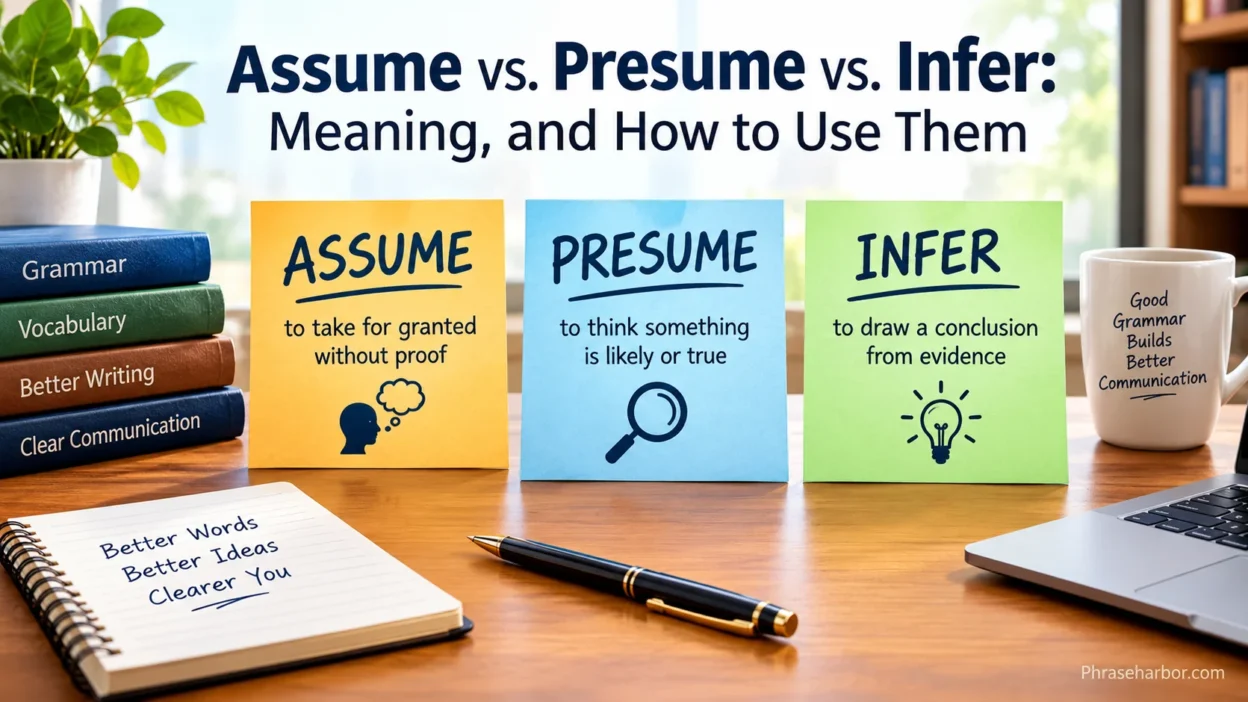
Assume vs. presume vs. infer can be confusing because all three words deal with what you believe, expect, or conclude. However, they describe different ways of arriving at an idea. The distinction becomes much easier once you focus on the source of your belief.
When you assume something, you accept it as true without confirming it. When you presume something, you generally consider it true because there are reasonable grounds for doing so. When you infer something, you reach a conclusion from evidence, clues, or information.
Consider a simple example. You see that your friend’s car is parked outside, so you presume your friend is home. You hear no response when you knock, so you infer that your friend may be asleep or away from the door. If you simply decide your friend is home without considering any evidence, you assume it.
That small difference explains why these words aren’t always interchangeable. Each one describes a different relationship between belief and evidence.
Quick Answer
The easiest way to understand assume vs. presume vs. infer is to look at how the conclusion develops.
- Assume means to accept something as true without checking or having sufficient proof.
- Presume means to believe something is probably true because circumstances or available information support that belief.
- Infer means to reach a conclusion from evidence, clues, facts, or statements.
- Assume and presume describe accepting a proposition.
- Infer describes drawing a conclusion from information.
- Presume often sounds more formal than assume.
- Infer emphasizes reasoning and evidence more strongly than either assume or presume.
A useful shortcut is:
Assume: “I accept it as true.”
Presume: “It seems reasonable to believe it.”
Infer: “The evidence leads me to this conclusion.”
For example:
| Sentence | What it means |
| “I assumed Maria was at work.” | I accepted that idea without confirming it. |
| “I presumed Maria was at work because her car was there.” | I had a reasonable basis for expecting her to be there. |
| “I inferred that Maria had left after seeing her empty desk.” | I reached a conclusion from available evidence. |
Comparison Overview
The three words overlap in meaning, but their usual emphasis differs. Assume focuses on accepting something. Presume adds an element of reasonable expectation. Infer focuses on reasoning from evidence.
| Word | Basic meaning | Evidence required? | Main idea | Common tone |
| Assume | Accept as true without confirmation | Not necessarily | Acceptance | Everyday |
| Presume | Accept as probably true | Usually some reasonable basis | Expectation | Formal or neutral |
| Infer | Draw a conclusion from evidence | Yes, normally | Deduction | Neutral, academic, analytical |
| Assumption | An accepted but unverified idea | Not necessarily | Starting belief | Everyday/formal |
| Presumption | A belief accepted as likely or established unless challenged | Often | Reasonable expectation | Formal/legal |
| Inference | A conclusion drawn from evidence | Yes | Result of reasoning | Academic/analytical |
The most important distinction is this: assumptions and presumptions generally provide a starting belief, while an inference is a conclusion reached through reasoning.
Imagine walking into a restaurant and seeing several tables filled with customers. You might presume the restaurant serves good food because its popularity gives you a reasonable reason to think so. If you decide it must have excellent food without considering anything else, you assume it. After reading reviews, examining the menu, and noticing that customers keep returning, you might infer that the restaurant has a strong reputation for quality.
Main Differences Between Assume vs. Presume vs. Infer
The clearest way to separate assume vs. presume vs. infer is to examine the role of evidence, reasoning, certainty, and context.
Assume: Accept Something Without Confirmation
Assume means to accept something as true or likely true without verifying it. The assumption might turn out to be correct. It might also turn out to be completely wrong.
For example:
“I assumed the store was open because the lights were on.”
The speaker accepted a conclusion without checking the store’s actual opening status. The lights provide some context, but they don’t necessarily prove that customers can enter.
You make assumptions constantly in ordinary life. If someone doesn’t answer your phone call, you might assume they’re busy. If your coworker doesn’t attend a meeting, you might assume they forgot. If a website doesn’t load, you might assume the server is down.
None of those conclusions necessarily has to be correct.
Presume: Believe Something Based on Reasonable Grounds
Presume also means to accept something as true, but it often suggests a reasonable basis for that belief.
For example:
“I presume the manager has approved the request.”
This sentence suggests that the speaker has some reason to expect approval. Perhaps the manager normally approves similar requests, or perhaps someone indicated that approval was likely.
The distinction isn’t absolute. In many everyday situations, assume and presume can overlap. The difference usually comes from the degree of justification or the tone.
Compare these sentences:
- “I assume you’ll be there.”
- “I presume you’ll be there.”
The first can sound like an expectation made without much thought. The second can sound more deliberate or formal.
Infer: Reach a Conclusion From Evidence
Infer works differently.
When you infer something, you examine information and arrive at a conclusion that isn’t directly stated.
For example:
“The roads are wet, so I infer that it rained recently.”
Nobody necessarily told you that it rained. You looked at an observable clue and drew a conclusion.
Inference appears frequently in academic research, journalism, science, investigations, and everyday reasoning.
Suppose someone walks into a room carrying an umbrella covered in raindrops. You might infer that they have recently been outside in wet weather. The umbrella doesn’t explicitly announce what happened. The evidence allows you to reach a reasonable conclusion.
Assume vs. Presume
The difference between assume and presume can be subtle because dictionaries often define each word partly in terms of the other.
In general, assume has a broader and more neutral meaning. It can describe accepting something without proof, confirmation, or sufficient evidence.
Presume, meanwhile, often suggests that the belief has some reasonable foundation. It can also carry a stronger sense of expectation.
Compare These Examples
Assume:
“I assumed the meeting was canceled.”
The speaker didn’t necessarily have evidence. Perhaps nobody sent a reminder, so the speaker simply took the meeting’s cancellation for granted.
Presume:
“I presumed the meeting was canceled because the organizer sent a cancellation notice.”
Here, the belief has a clear basis.
However, the word presume doesn’t guarantee that the evidence is strong. A presumption can still be wrong. It simply tends to present the belief as reasonable under the circumstances.
Read More: Trawling vs. Trolling: Meaning, Difference, and Usage
Is Assume More Casual Than Presume?
Usually, yes.
Assume is extremely common in everyday speech:
- “I assumed you knew.”
- “Don’t assume anything.”
- “I assumed she’d call.”
- “We can’t assume that’s true.”
Presume appears frequently in formal, professional, legal, and carefully worded contexts:
- “We may presume that the results are accurate.”
- “The court must presume innocence unless the evidence establishes guilt.”
- “I presume you’ve reviewed the document.”
Still, presume isn’t exclusively formal. People use it in ordinary conversation as well.
Assume vs. Infer
The difference between assume and infer is usually easier to see.
An assumption accepts an idea without requiring enough evidence to establish it. An inference starts with evidence and uses that information to reach a conclusion.
Consider this situation:
Your coworker arrives late with wet clothes.
You assume they overslept.
You infer that they were caught in the rain because their clothes are wet and they are carrying a wet umbrella.
The assumption may have no solid basis. The inference has observable clues behind it.
A Common Mistake With Infer
People sometimes use infer when they really mean assume.
For example:
“I inferred that you would attend because you didn’t say no.”
This isn’t necessarily wrong, but the reasoning matters. If the absence of a refusal genuinely provides a basis for the conclusion, infer can work. If the speaker simply expected attendance without meaningful evidence, assume is more accurate.
The key question is simple:
What information led you to the conclusion?
If there is no meaningful evidence, you’re probably dealing with an assumption.
Presume vs. Infer
Presume and infer can also overlap, but they describe different stages of reasoning.
When you presume, you accept something as likely true. When you infer, you draw a conclusion from evidence.
For example:
“I presumed that James would attend because he accepted the invitation.”
The speaker formed an expectation from a known fact.
Now consider:
“James didn’t arrive, so I inferred that something had prevented him from coming.”
The speaker has moved from observation to conclusion.
This difference can be summarized as:
Presume = reasonable expectation
Infer = evidence-based conclusion
That distinction becomes particularly useful in analytical writing.
Evidence and Certainty: Assume vs. Presume vs. Infer
Evidence plays a different role in each word.
Assume
An assumption can exist with little or no evidence.
“I assumed the package would arrive today.”
The speaker may simply have expected delivery.
Presume
A presumption normally has some reasonable foundation.
“I presumed the package would arrive today because the tracking information showed it was out for delivery.”
The tracking information supports the expectation.
Infer
An inference directly connects evidence with a conclusion.
“The package wasn’t delivered, and the tracking page showed an attempted delivery. I inferred that nobody was home.”
The conclusion comes from specific information.
This doesn’t mean every inference is correct. Evidence can be incomplete, misleading, or misunderstood.
Assume vs. Presume vs. Infer in Real-World Situations
The distinction becomes much clearer when you see these words working in realistic scenarios.
Workplace Example
Imagine that your manager schedules a meeting for Friday.
You assume the meeting will happen at the usual time.
Later, your manager sends a calendar invitation showing the meeting at 2 p.m. You presume that 2 p.m. is the correct time because the official invitation confirms it.
During the meeting, your manager says, “Let’s move the next meeting to Monday,” but doesn’t give a time. You notice that everyone opens their calendars and starts checking Monday morning. You infer that the next meeting will probably happen in the morning.
Each verb reflects a different kind of reasoning.
Everyday Example
Suppose your neighbor’s house is dark.
You might assume nobody is home.
Then you see the neighbor’s car in the driveway and presume they are inside.
You knock on the door several times and receive no response. You notice that the lights are off and the curtains are closed. From these clues, you infer that they may be asleep.
Notice that the situation develops over time. Your belief changes as new evidence appears.
Academic Example
In research, infer is especially important because researchers often work with evidence rather than direct access to every fact.
A researcher might observe a pattern in survey responses and infer that respondents share a particular tendency.
That doesn’t mean the researcher has directly observed every person’s behavior. The conclusion comes from the available evidence.
By contrast, researchers usually try to identify and control their assumptions because hidden assumptions can influence results.
Assume, Presume, and Infer in Formal Writing
The three words can all appear in formal writing, but they serve different purposes.
Assume often appears when discussing conditions, models, or hypothetical situations.
For example:
“The analysis assumes that all participants answered honestly.”
Here, assumes identifies a condition underlying the analysis.
Presume often appears when something is accepted as likely or valid unless evidence shows otherwise.
“For the purposes of this analysis, we may presume that the reported figures are accurate.”
Infer commonly appears when discussing conclusions drawn from evidence.
“The findings allow researchers to infer a relationship between the two variables.”
This distinction is particularly useful in academic writing because precision matters. Saying that researchers assumed a relationship existed isn’t the same as saying they inferred one from their findings.
Presume in Legal Contexts
The word presume has an especially important role in legal language.
The phrase “presumed innocent” provides a familiar example. A person accused of a crime is treated as innocent unless the legal process establishes guilt under the applicable standard.
Here, presume doesn’t simply mean “guess.” It describes a formal principle governing how a matter is treated unless sufficient evidence changes that position.
Other formal expressions include:
- presumed innocent
- presumed competent
- presumed valid
- presumed to have knowledge
- presumed to be acting in good faith
Legal presumptions can have specific rules and consequences. Therefore, their meaning can be more technical than the everyday use of presume.
FAQs:
Is it better to say “assume” or “presume”?
Neither word is always better. Assume works well when you mean accepting something without confirmation. Presume often works better when you want to suggest a reasonable expectation or use a more formal tone.
What is the difference between assume and infer?
Assume means accepting something as true without necessarily having enough evidence. Infer means reaching a conclusion from available evidence or clues.
For example, if you think someone is angry without knowing why, you might assume they are angry. If you notice their tense expression, sharp responses, and silence, you might infer that they are angry from those clues.
What is the difference between presume and infer?
Presume usually means believing something is likely true based on reasonable circumstances. Infer means drawing a conclusion from evidence.
You might presume that a guest will attend because they accepted an invitation. After seeing their empty seat and receiving a message saying they were delayed, you might infer that they won’t arrive on time.
Does presume mean more certain than assume?
Not necessarily. Presume can suggest that you have stronger or more reasonable grounds for your belief, but it doesn’t make the belief certain.
A presumption can still prove incorrect when new information appears.
Is infer the opposite of assume?
No. Infer and assume describe different reasoning processes rather than strict opposites.
An assumption accepts an idea without confirmation. An inference draws a conclusion from evidence. A person can even make an assumption while interpreting evidence incorrectly.
Conclusion:
The difference between assume vs. presume vs. infer comes down to how you form a belief. You assume something when you accept it as true without confirming it. You presume something when you consider it likely true based on reasonable circumstances or expectations. You infer something when evidence or clues lead you to a conclusion. The boundaries can overlap. English isn’t always divided into neat little boxes. Still, the distinction becomes useful when precision matters.