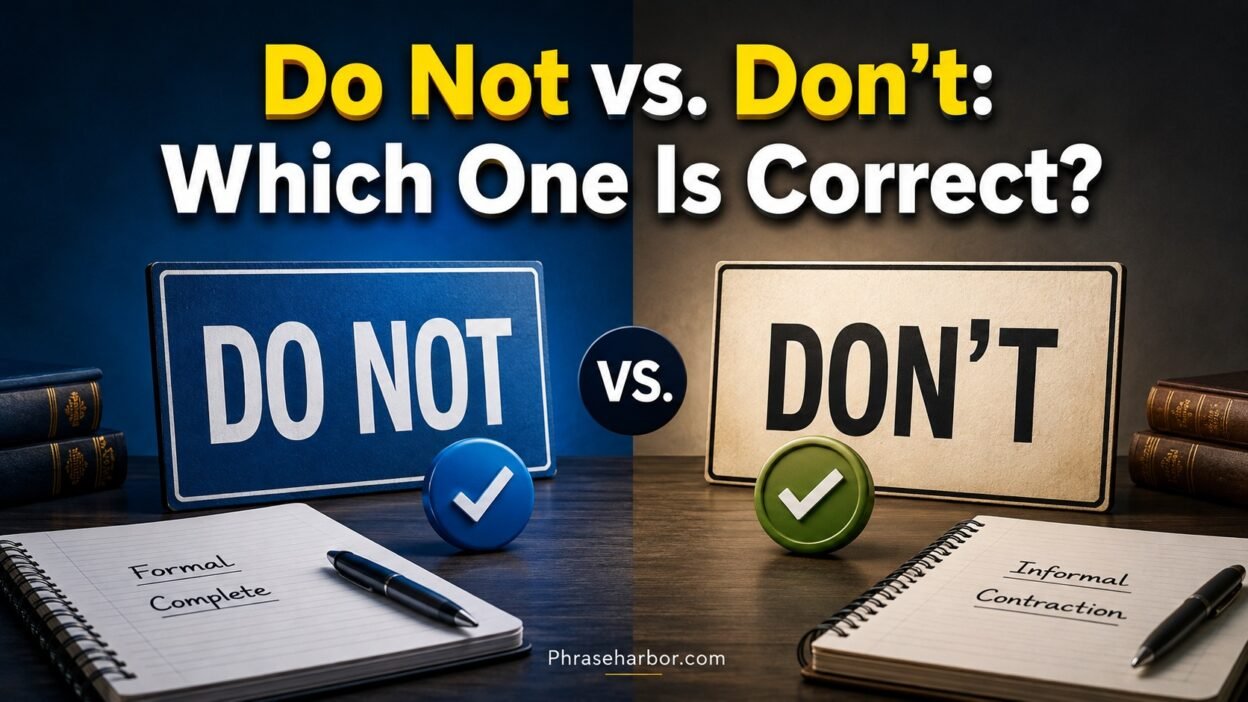
Do Not vs. Don’t shows a subtle difference in everyday writing, where tone, grammar, and meaning can change how learners choose between the two forms. In informal writing and speech, don’t is a contraction formed by combining do and not, while do not is the uncontracted full form and can give stronger emphasis or greater formality.
The subject–verb agreement rule matters: use do not with I, you, we, and they, but use does not with he, she, and it. In my experience helping writers, this clear rule makes choosing the right negative form easier. In formal settings, such as academic papers, a business email, or an essay, the full form can provide clarity and a professional tone.
By contrast, don’t works naturally in casual conversation, digital messages, and relaxed emails. The apostrophe is important because it marks the short form. Understanding usage, context, and how a message is received helps you avoid common mistakes and choose the form that matches your intended audience, purpose, and real-world situations.
Quick Answer
Both do not and don’t are correct English expressions. The only real difference is style and tone.
- Use do not in formal writing, official documents, academic papers, instructions, or when you want to emphasize a statement.
- Use don’t in everyday conversations, personal emails, blogs, social media posts, and informal writing.
Here’s a quick comparison:
| Situation | Best Choice |
| Talking with friends | Don’t |
| Academic essay | Do not |
| Business report | Do not |
| Text message | Don’t |
| Blog article | Usually Don’t |
| Company policy | Do not |
| Safety warning | Do not |
| Social media post | Don’t |
Quick takeaway: Neither form is more correct than the other. Choose the one that matches your audience and purpose.
Comparison Overview
| Feature | Do Not | Don’t |
| Grammar | Correct | Correct |
| Meaning | Negative form of do | Contraction of do not |
| Formality | Formal | Informal |
| Common in Speech | Less common | Very common |
| Common in Writing | Formal documents and academic writing | Emails, blogs, conversations |
| Tone | Serious, authoritative, emphatic | Friendly, relaxed, conversational |
| Best For | Policies, manuals, research papers, legal writing | Everyday communication, creative writing, casual content |
Main Differences Between Do Not vs. Don’t
Although do not and don’t share the same meaning, they create different impressions. Choosing the right one depends on your audience, the setting, and the message you want to convey.
Formality
The biggest difference is the level of formality.
Do not sounds formal and professional. It fits situations where precision and authority matter.
Examples:
- Do not copy this document without permission.
- Do not operate the machine without safety equipment.
By comparison, don’t sounds friendly and conversational.
Examples:
- Don’t worry about it.
- Don’t forget your umbrella.
If you’re writing an academic paper or official document, the full form usually works better. If you’re talking to friends or writing a casual blog, the contraction feels more natural.
Tone
The tone of your writing changes depending on which form you choose.
Do not creates a serious tone.
Example:
Do not leave children unattended.
This sentence feels like a firm instruction.
Now compare it with:
Don’t leave the kids alone.
The meaning stays the same, yet the tone becomes warmer and more conversational.
Emphasis
Writers often choose do not when they want readers to pay special attention.
For example:
- Do not ignore these warning signs.
- Do not share your password with anyone.
Using the full form naturally adds weight to the statement.
Everyday Usage
Native English speakers overwhelmingly use don’t in daily conversation.
You’ll hear sentences like:
- Don’t be late.
- Don’t forget to call.
- Don’t make that mistake again.
Using do not in these situations sounds unusually formal unless the speaker wants to stress an important point.
Readability
Modern writing values clarity and natural flow.
Many websites, blogs, and marketing materials use contractions because they sound more human.
Compare these two sentences:
- Do not hesitate to contact us if you have questions.
- Don’t hesitate to contact us if you have questions.
The second version feels more approachable while keeping the same meaning.
Quick Comparison
| Feature | Do Not | Don’t |
| Formal | ||
| Informal | ||
| Adds emphasis | Sometimes | |
| Sounds conversational | ||
| Common in speech | Rare | Very common |
| Best for official writing | Usually avoided |
The key takeaway is simple: the grammar never changes, but the tone does.
What Does “Do Not” Mean?
Do not is the full negative form of the auxiliary verb do. It tells someone not to perform an action or emphasizes that something should not happen.
Because it uses the complete wording instead of a contraction, it often sounds more deliberate and authoritative.
When Is “Do Not” Commonly Used?
You’ll frequently see do not in:
- Academic writing
- Legal agreements
- Government notices
- Company policies
- Safety instructions
- User manuals
- Formal emails
- Research papers
These situations value precision and professionalism over conversational language.
Examples of “Do Not”
- Do not open the package until instructed.
- Do not disclose confidential information.
- Do not use this medicine after the expiration date.
- Do not park in front of the emergency exit.
- Do not interrupt the speaker during the presentation.
Each sentence communicates a clear instruction without sounding casual.
Why Writers Choose “Do Not”
Writers often prefer do not because it:
- Creates a professional tone.
- Makes warnings stand out.
- Adds emphasis.
- Maintains consistency in formal documents.
- Reduces ambiguity in legal and technical writing.
For this reason, you’ll rarely find official warning signs that say Don’t Enter. Most display Do Not Enter, which immediately conveys authority and seriousness.
What Does “Don’t” Mean?
Don’t is the contracted form of do not. An apostrophe replaces the missing letters in not, making the phrase shorter and easier to say.
Contractions are a natural part of modern English. They make speech flow smoothly and help writing feel less formal.
Why Do We Use Contractions?
English speakers naturally shorten words during conversation.
Instead of saying:
I do not know.
Most people say:
I don’t know.
The second version sounds relaxed and reflects how people actually speak.
Where Is “Don’t” Commonly Used?
You’ll see don’t in:
- Everyday conversations
- Text messages
- Blog posts
- Social media
- Friendly emails
- Creative writing
- Dialogue in novels
- Marketing content
Businesses also use contractions in customer-focused content because they make brands sound more approachable.
Examples of “Don’t”
- Don’t forget your appointment.
- Don’t worry about the deadline.
- Don’t leave your phone unattended.
- Don’t skip breakfast.
- Don’t believe every rumor you hear.
These examples feel warm, conversational, and easy to read.
Why Writers Prefer “Don’t”
Many modern writers choose contractions because they:
- Improve readability.
- Sound more natural.
- Build a friendly tone.
- Keep sentences concise.
- Match everyday speech.
If your audience expects approachable, conversational writing, don’t is often the better choice.
Do Not vs. Don’t: What’s the Difference?
Although do not and don’t express the same idea, they serve different writing styles. The words themselves never change the meaning. Instead, they change how readers perceive your message.
Imagine receiving these two emails:
Do not hesitate to contact our office with any questions.
Now compare it with:
Don’t hesitate to contact us if you have any questions.
Both invite you to ask for help. However, the first sounds formal and corporate, while the second feels warmer and more personal.
That’s why professional writers don’t choose between do not and don’t based on grammar. They choose based on tone, audience, and purpose.
Read More: If She Was or If She Were: Which One Is Correct?
When to Use Do Not
Although don’t appears more often in everyday English, there are many situations where do not is the better choice. The full form creates a formal tone, adds emphasis, and leaves little room for misunderstanding.
If your goal is to sound authoritative, professional, or precise, do not usually fits best.
Use Do Not in Academic Writing
Most schools, colleges, and universities expect a formal writing style. While some instructors allow contractions, many academic papers avoid them because the full forms create a more objective tone.
Examples:
- Students do not always agree with the research findings.
- The results do not support the original hypothesis.
- Researchers do not recommend drawing conclusions from a small sample size.
Tip: Always follow your instructor’s or institution’s style guide. Some modern academic styles permit contractions in limited situations, but consistency matters most.
Use Do Not in Business Documents
Formal reports, contracts, proposals, and company policies often use do not because clarity takes priority over conversational language.
Examples:
- Employees do not have permission to access restricted files.
- Clients do not need to pay additional processing fees.
- Vendors do not receive payment until the project is complete.
Using the full form helps maintain a professional tone throughout the document.
Use Do Not in Legal Writing
Legal language values precision above everything else. Even a small change in wording can affect interpretation.
You’ll often find phrases such as:
- Do not disclose confidential information.
- Do not alter this agreement without written approval.
- Do not distribute this document without authorization.
The full form reduces ambiguity and reinforces the seriousness of the instruction.
Use Do Not in Rules and Policies
Rules should be direct and unmistakable. That’s why schools, workplaces, and public spaces usually use do not instead of don’t.
Examples:
- Do not smoke inside the building.
- Do not feed the animals.
- Do not use mobile phones during the examination.
- Do not enter without permission.
These statements sound clear, firm, and authoritative.
Use Do Not in Safety Warnings
Safety messages need immediate attention. The full form naturally feels stronger, making it the preferred choice for warnings.
Examples:
- Do not touch hot surfaces.
- Do not operate heavy machinery without training.
- Do not remove the protective cover.
- Do not use this product near open flames.
Because safety instructions often protect lives, writers avoid language that might sound too casual.
Use Do Not When You Need Extra Emphasis
Sometimes the full form simply makes a statement more powerful.
Compare these sentences:
- Don’t underestimate your competition.
- Do not underestimate your competition.
The second sentence carries more weight and urgency.
Here are a few more examples:
- Do not ignore early warning signs.
- Do not give up after your first failure.
- Do not share your passwords with anyone.
In each case, the full form highlights the importance of the message.
Common Situations Where Do Not Works Best
| Situation | Recommended Choice | Why |
| Academic essay | Do not | Formal style |
| Legal contract | Do not | Precise language |
| Government notice | Do not | Authoritative tone |
| Company policy | Do not | Professional writing |
| User manual | Do not | Clear instructions |
| Safety sign | Do not | Strong warning |
| Research paper | Do not | Objective language |
FAQs:
Is do not more formal than don’t?
Yes. Do not is the full form and usually sounds more formal, serious, or emphatic. You’ll often see it in academic writing, professional documents, instructions, and other formal contexts. Don’t is a contraction and is more common in everyday speech, casual conversation, and informal writing.
Is don’t grammatically correct?
Yes, don’t is grammatically correct. It is the contraction of do not. For example, “I don’t understand the question” and “They don’t agree with the decision” are both correct. The choice mainly depends on the context, tone, and level of formality.
When should I use do not instead of don’t?
Use do not when you want to add emphasis or maintain a more formal tone. For example, “Do not touch the equipment” sounds more firm and official than “Don’t touch the equipment.” It’s especially useful in formal instructions and professional or academic writing.
Can I use do not and don’t with the same subjects?
Yes, but remember the subject–verb agreement rule. Use do not or don’t with I, you, we, and they. For he, she, and it, use does not or doesn’t. For example, “They don’t work here” is correct, while “She doesn’t work here” is correct.
What is the main difference between do not and don’t?
The main difference is their form and tone, not their basic meaning. Do not is the full, uncontracted form, while don’t is the contracted form. Both are used to make a verb negative, but do not can sound more formal or emphatic, whereas don’t usually sounds more natural and conversational.
Conclusion:
Do not and don’t have the same basic meaning, but they create slightly different effects in communication. Do not is the full form and works well when you need formality, clarity, or stronger emphasis. Don’t is the contraction and fits naturally into everyday speech and informal writing.
The most important thing is to consider your audience, context, and tone. Once you understand the subject–verb agreement rules and know when each form is appropriate, choosing between do not and don’t becomes simple and natural.