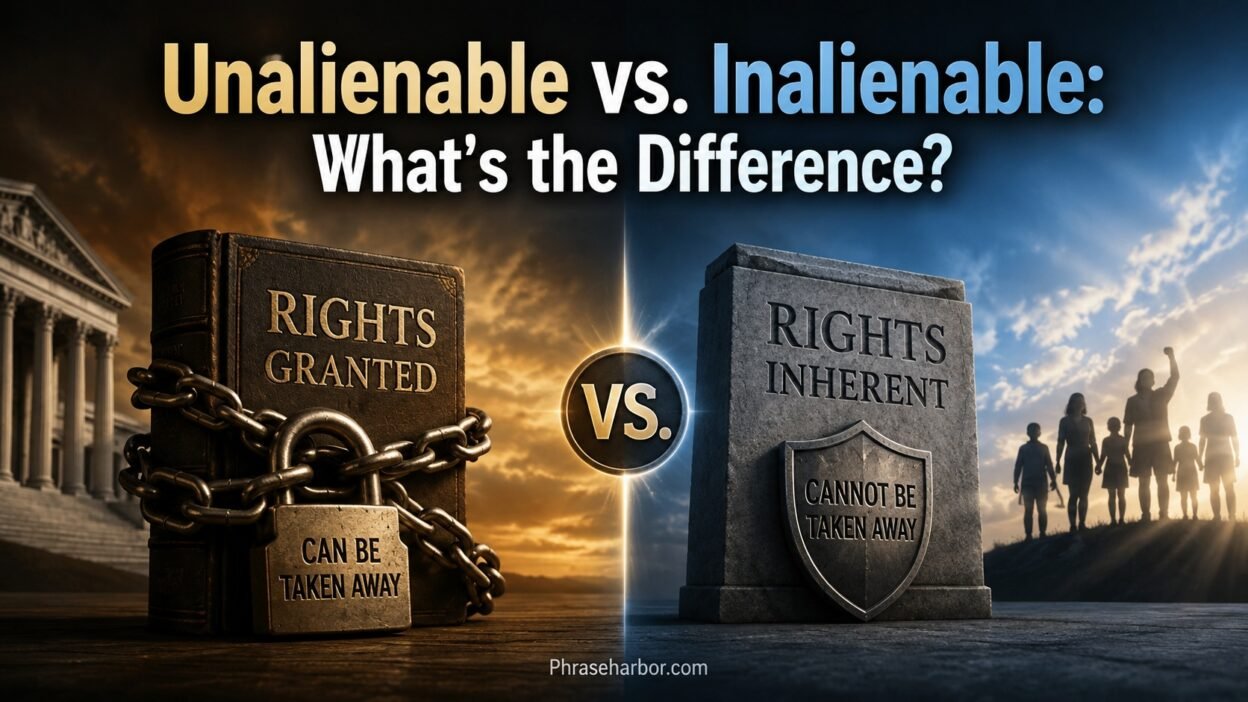
If you have ever paused mid-sentence, wondering which word to write, unalienable or inalienable, you are not alone. These words are closely related adjectives that sound nearly identical, are almost identical in appearance, and are nearly the same in meaning.
They are similar words that are often used interchangeably, so the subtle differences can be easy to miss. Both describe rights that cannot be taken away, meaning they are incapable of being transferred, surrendered, or removed. The same core meaning appears in unalienable rights and inalienable rights, and both forms can modify nouns such as liberty and freedom.
Both words trace back to the verb alienate, meaning to transfer ownership. As an English teacher, I often hear this question from students studying the Declaration of Independence, especially when reading important documents, legal documents, or human rights documents. The good news is that once people understand where these forms came from, their meanings, and their use in the English language, they can use them more confidently.
Quick Answer
Unalienable and inalienable mean essentially the same thing. Both describe something that cannot be transferred, surrendered, sold, or taken away. The difference lies in usage rather than meaning.
- Inalienable is the preferred spelling in modern English.
- Unalienable survives mainly in historical, philosophical, and constitutional contexts.
- The famous phrase “unalienable Rights” comes directly from the United States Declaration of Independence.
- If you’re writing an essay, legal paper, article, or business document today, inalienable is usually the better choice unless you’re quoting a historical source.
Simply put, the meanings are identical, but the context determines which spelling fits best.
Comparison Overview
| Feature | Unalienable | Inalienable |
| Meaning | Cannot be given away, transferred, or taken away | Cannot be given away, transferred, or taken away |
| Modern Usage | Rare | Very common |
| Historical Usage | Very common in older English | Continues in modern English |
| Legal Writing | Mostly historical references | Standard legal terminology |
| Academic Writing | Occasionally used in historical discussions | Preferred choice |
| Dictionary Status | Correct spelling | Correct spelling |
| Best Used For | Historical quotations and political philosophy | Everyday, legal, and academic writing |
| Famous Example | “Unalienable Rights” in the Declaration of Independence | Human rights, constitutional law, legal literature |
Although both words remain correct, inalienable has become the standard spelling in modern English.
Main Differences Between Unalienable vs. Inalienable
Many people assume these words have different definitions because they begin with different prefixes. In reality, the distinction is much smaller than it appears.
The Meaning Is the Same
Both words describe something that cannot legally or morally be taken away, transferred, or surrendered.
For example:
- Every person has inalienable human rights.
- The Declaration refers to unalienable rights.
Despite the spelling difference, both sentences express the same idea.
Modern English Prefers “Inalienable”
Language evolves over time. While unalienable appeared frequently in earlier English, modern dictionaries, universities, legal organizations, and publishers overwhelmingly favor inalienable.
You’ll commonly see inalienable in:
- Human rights documents
- Legal contracts
- Constitutional law
- Academic journals
- Government publications
- News articles
Because of its widespread acceptance, most style guides recommend using inalienable unless historical accuracy requires otherwise.
“Unalienable” Has Historical Importance
The spelling unalienable remains famous because of one of history’s most influential political documents—the United States Declaration of Independence.
Its opening declares that people possess certain “unalienable Rights.”
Those rights include:
- Life
- Liberty
- The pursuit of Happiness
The wording has never been modernized because preserving the original language maintains the document’s historical authenticity.
Frequency of Use
Modern English strongly favors inalienable.
A quick comparison shows the trend:
| Context | Preferred Word |
| Modern journalism | Inalienable |
| University writing | Inalienable |
| Legal publications | Inalienable |
| Human rights organizations | Inalienable |
| Historical quotations | Unalienable |
| American founding documents | Unalienable |
If your goal is clear and contemporary communication, inalienable is almost always the safer option.
When the Difference Matters
In everyday writing, the distinction rarely changes the meaning. Instead, it changes the tone.
For example:
Historical context
Governments exist to protect people’s unalienable rights.
Modern context
Every citizen deserves inalienable rights under the law.
Both statements express the same principle. The first echoes eighteenth-century language, while the second sounds natural to today’s readers.
What Does “Inalienable” Mean?
The word inalienable describes something that cannot legally, morally, or permanently be transferred to another person. It often refers to rights, freedoms, or qualities that belong to someone simply because they exist.
Unlike property that can be bought or sold, an inalienable right remains with its owner regardless of circumstances. No government, institution, or individual has the legitimate authority to remove it completely.
Definition
A simple definition is:
Inalienable means incapable of being taken away, surrendered, transferred, or sold.
The word appears most often in discussions involving:
- Human rights
- Constitutional law
- Ethics
- Political philosophy
- Civil liberties
- International law
Origin of the Word
The word comes from the Latin root alienare, which means to transfer ownership to another person. English later adopted the verb alienate, originally meaning to transfer property or legal rights rather than to make someone feel isolated.
Adding the prefix in- creates inalienable, meaning not capable of being transferred.
Over time, the word expanded beyond property law. Philosophers began using it to describe rights that belong naturally to every human being.
This broader meaning became especially important during the Enlightenment, when thinkers argued that certain freedoms exist independently of governments.
Where You’ll See “Inalienable”
Today, inalienable appears across many fields.
Human Rights
International organizations often describe basic freedoms as inalienable rights because they belong to every individual without exception.
Examples include:
- Freedom of speech
- Freedom of religion
- Equal treatment under the law
- Personal liberty
Legal Writing
Lawyers and judges use inalienable when discussing rights that cannot legally be transferred or waived.
For instance:
- Constitutional protections
- Civil liberties
- Certain property interests
- Fundamental legal principles
Academic Writing
Researchers prefer inalienable because it reflects modern standard English.
You’ll frequently encounter it in subjects such as:
- History
- Political science
- Sociology
- Philosophy
- Law
- Ethics
Examples of “Inalienable” in Sentences
Here are a few natural examples:
- Every individual possesses inalienable rights regardless of nationality.
- Freedom of conscience is considered an inalienable human right.
- The constitution protects several inalienable liberties.
- Human dignity is often described as inalienable because it cannot be lost.
- Many legal scholars argue that justice depends on protecting inalienable freedoms.
Each sentence highlights something that remains with a person and cannot legitimately be removed.
What Does “Unalienable” Mean?
The word unalienable carries exactly the same meaning as inalienable. It describes rights, freedoms, or possessions that cannot be transferred, surrendered, or taken away.
Although modern writers rarely choose this spelling, it remains an important part of English because of its historical role in political philosophy and American history.
Definition
Unalienable means:
Not capable of being transferred, surrendered, or removed from its rightful owner.
The definition matches that of inalienable almost word for word.
Historical Importance
The enduring fame of unalienable comes from its appearance in the Declaration of Independence, adopted on July 4, 1776.
The document states that all people are endowed with certain “unalienable Rights.”
This phrase became one of the most influential expressions in democratic history. It helped shape later discussions about liberty, equality, and human rights around the world.
Because historians preserve original wording, the spelling unalienable continues to appear whenever the Declaration is quoted.
Why the Word Is Rare Today
English spelling gradually became more standardized during the nineteenth century. As dictionaries and publishers settled on preferred forms, inalienable emerged as the dominant spelling.
That doesn’t make unalienable incorrect. Instead, it became a specialized form used mainly in:
- Historical documents
- Constitutional discussions
- Political philosophy
- Academic analysis of early American history
- Direct quotations from eighteenth-century texts
For most modern readers, inalienable feels more familiar because they encounter it far more often.
Examples of “Unalienable” in Sentences
These examples show how the word appears naturally in historical contexts.
- The Declaration of Independence refers to unalienable rights granted to all people.
- Historians often preserve the original spelling unalienable when quoting eighteenth-century texts.
- The founders argued that liberty was an unalienable right rather than a privilege granted by government.
- Political philosophers debated whether certain freedoms were truly unalienable.
- The museum displayed an original copy containing the phrase “unalienable Rights.”
Why Does the Declaration of Independence Say “Unalienable Rights”?
One of the most common questions about unalienable vs. inalienable is why the United States Declaration of Independence uses unalienable instead of the more familiar inalienable.
The answer lies in the history of the English language rather than in a difference in meaning.
During the eighteenth century, English spelling was far less standardized than it is today. Writers often used different spellings for the same word, and dictionaries had not yet established the consistent conventions we follow now. As a result, both unalienable and inalienable appeared in books, legal documents, and philosophical writings of the period.
When Thomas Jefferson drafted the Declaration of Independence in 1776, he chose the spelling unalienable. That wording became permanently associated with one of the world’s most influential political documents.
The Famous Passage
The Declaration includes this well-known statement:
“We hold these truths to be self-evident, that all men are created equal, that they are endowed by their Creator with certain unalienable Rights, that among these are Life, Liberty and the pursuit of Happiness.”
The phrase has remained unchanged for more than two centuries because historical documents preserve their original wording.
Did “Unalienable” Mean Something Different in 1776?
No.
Despite many myths online, unalienable and inalienable meant the same thing even in the eighteenth century. Scholars generally agree that Jefferson’s choice reflected a spelling preference rather than a legal distinction.
Both words referred to rights that no government could legitimately remove from an individual.
These rights included principles such as:
- Life
- Liberty
- Freedom
- Equality
- Personal dignity
The wording emphasized that governments exist to protect these rights rather than create them.
Why Hasn’t the Spelling Been Updated?
Historical documents aren’t rewritten to match modern spelling.
Imagine changing Shakespeare’s language into today’s English. While it might become easier to read, it would no longer represent the original work. The same principle applies to the Declaration of Independence.
Keeping the original spelling preserves:
- Historical accuracy
- Authentic language
- Cultural significance
- Academic integrity
That’s why you’ll still see unalienable Rights in museums, history books, and official reproductions.
What Modern Dictionaries Say
Most leading dictionaries recognize both spellings.
However, they also note that:
- Inalienable is the standard modern form.
- Unalienable survives mainly as a historical variant.
So if you’re writing about constitutional history, quoting the Declaration, or discussing eighteenth-century political philosophy, unalienable is the appropriate choice.
For almost every other situation, inalienable is preferred.
Which Word Should You Use Today?
Choosing between unalienable and inalienable is easier than many people think.
Since both words carry the same meaning, your decision depends entirely on the context.
In most situations, inalienable is the better option because it reflects current English usage.
Use Inalienable in Modern Writing
If you’re writing for today’s audience, choose inalienable.
It appears naturally in:
- Academic essays
- Legal documents
- Government publications
- News articles
- Business writing
- Research papers
- Human rights discussions
- Professional communication
Readers recognize this spelling immediately, which improves clarity and consistency.
Examples:
- Every citizen possesses inalienable rights under the constitution.
- Human dignity remains an inalienable principle of international law.
- Freedom of expression is an inalienable right in many democratic societies.
Read More: Beloved vs Loved: What’s the Difference?
Use Unalienable for Historical Accuracy
Although rare, unalienable still has an important place in English.
Use it when:
- Quoting the Declaration of Independence.
- Writing about American history.
- Discussing Enlightenment philosophy.
- Analyzing eighteenth-century political thought.
- Preserving the original wording of historical documents.
For example:
The Declaration refers to unalienable Rights, not inalienable Rights.
Changing the spelling in a quotation would reduce its historical accuracy.
A Simple Rule to Remember
If your writing is modern, choose inalienable.
If your writing is historical, especially when discussing the Declaration of Independence, use unalienable.
That simple guideline works in nearly every situation.
Quick Decision Table
| Situation | Best Choice |
| School essay | Inalienable |
| Legal article | Inalienable |
| Newspaper article | Inalienable |
| Academic research | Inalienable |
| Human rights discussion | Inalienable |
| Quoting the Declaration of Independence | Unalienable |
| American Revolution history | Unalienable |
| Historical documents | Unalienable |
Examples in Sentences
Seeing words in context is one of the fastest ways to understand how they’re used.
Examples Using Inalienable
These examples reflect modern English.
- Every person is born with inalienable rights that deserve protection.
- Freedom of religion is considered an inalienable human right.
- Many constitutions recognize certain inalienable liberties.
- The organization works to defend inalienable freedoms across the world.
- Human dignity is an inalienable value that governments should respect.
Examples Using Unalienable
These examples fit historical or philosophical contexts.
- The Declaration speaks of unalienable Rights granted to every individual.
- Jefferson described liberty as an unalienable gift rather than a government privilege.
- Historians preserve the original phrase unalienable Rights in their publications.
- Enlightenment thinkers believed people possessed unalienable freedoms by nature.
- The exhibit explored how the concept of unalienable rights influenced democratic governments.
Side-by-Side Comparison
| Modern Usage | Historical Usage |
| Every citizen has inalienable rights. | The founders wrote about unalienable Rights. |
| Human dignity is inalienable. | Liberty was described as unalienable. |
| Courts protect inalienable freedoms. | Philosophers debated unalienable rights. |
Notice that the meaning never changes. Only the preferred spelling changes with the context.
FAQs:
What does unalienable mean?
Unalienable means something that cannot be taken away, transferred, surrendered, or removed. It is commonly used when talking about basic human rights, liberty, and freedom.
What does inalienable mean?
Inalienable has essentially the same meaning as unalienable. It describes a right or freedom that cannot legally or naturally be given away or taken from a person.
Is unalienable or inalienable more common?
Inalienable is generally more common in modern English, especially in contemporary legal, academic, and formal writing. Unalienable is often seen in historical contexts.
Why does the Declaration of Independence use unalienable?
The Declaration of Independence uses the spelling unalienable in its original wording. Because of this, the word has a strong historical connection with the document and its discussion of fundamental rights.
Can unalienable and inalienable be used interchangeably?
Yes. In most modern contexts, unalienable and inalienable carry the same core meaning. Your choice mainly depends on context, audience, and whether you want a modern or historical tone.
Conclusion:
Unalienable and inalienable are closely related words with almost the same meaning. Both describe rights that cannot be taken away, surrendered, or transferred. Inalienable is usually the better choice for modern formal and academic writing, while unalienable works well when discussing historical documents or preserving original wording. Understanding this small difference can help you choose the right word with confidence.