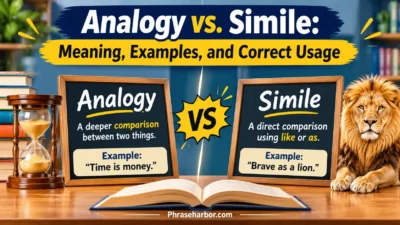
Simile vs. Metaphor becomes easier to understand when you compare how each device connects two different ideas in everyday language and writing. A simile uses familiar expressions such as brave as a lion to explain an idea through a direct comparison. In contrast, a metaphor uses time is money to show a relationship by describing one thing as another.
These figures of speech, literary devices, and figurative expressions give ordinary language a more expressive quality. Although their comparison structure and literary meaning differ, both help readers understand unfamiliar ideas through familiar examples.
The meaning of simile depends on comparison words such as like and as, while the meaning of metaphor creates indirect imagery through direct identification. Recognizing these key differences, simile structure, and metaphor structure makes it easier to understand different types of comparisons and their effects in writing.
Quick Answer:
A simile compares two different things using words such as like or as. For example, “Her voice is as sweet as honey” compares someone’s voice to honey.
A metaphor directly describes one thing as another without using comparison words. For example, “Her voice is music” compares someone’s voice to music.
The main difference is how each literary device presents its comparison. A simile makes the comparison explicit, while a metaphor presents it directly.
| Feature | Simile | Metaphor |
| Definition | Compares two different things | Describes one thing as another |
| Structure | Usually uses like or as | Uses direct identification |
| Comparison | Explicit | Direct or implied |
| Language | Often more descriptive | Often more imaginative |
| Purpose | Makes descriptions easier to visualize | Creates stronger associations |
| Example | He runs like the wind. | He is a racing machine. |
Remember: A simile says something is like another thing. A metaphor says something is another thing in a figurative sense.
Comparison Overview: Simile vs. Metaphor
Similes and metaphors belong to a broader category called figurative language. Writers use figurative language to communicate ideas beyond their literal meanings.
Both devices help readers understand unfamiliar concepts through familiar comparisons. However, they approach this goal differently.
Consider these two sentences:
- Simile: Her eyes sparkled like diamonds.
- Metaphor: Her eyes were diamonds.
Both sentences suggest that someone’s eyes are beautiful, bright, or attractive. However, the simile explicitly compares the eyes to diamonds. The metaphor directly identifies them as diamonds for a stronger imaginative effect.
Here is a closer comparison:
| Comparison Point | Simile | Metaphor |
| Basic approach | Makes an explicit comparison | Creates a direct comparison |
| Common signals | Like, as | Is, are, was, were, or implied relationships |
| Meaning | Highlights a shared quality | Transfers qualities from one concept to another |
| Expression | Often straightforward | Often more suggestive |
| Imagery | Creates a recognizable picture | Creates a figurative association |
| Example | The baby slept like an angel. | The baby was an angel. |
Neither device is automatically better. Your choice depends on the meaning, tone, and effect you want to create.
What Is a Simile?
A simile is a figure of speech that compares two different things using like or as. The comparison highlights a shared characteristic between them.
Writers use similes to make descriptions more vivid and understandable. Instead of simply saying someone is fast, you might say, “She runs like the wind.”
This comparison gives readers a clearer impression of speed. It creates an image that a simple adjective might not communicate as effectively.
For example:
- His hands were as cold as ice.
- The children scattered like birds.
- Her smile was as bright as sunshine.
- The old man moved like a turtle.
Each sentence compares two different things through a recognizable quality.
Definition of a Simile
The word simile comes from the Latin word similis, meaning similar or like.
A simile identifies a resemblance between two things without suggesting they’re literally the same. It helps readers understand one subject through the qualities of another.
For instance, consider this sentence:
“Her skin was as smooth as silk.”
The sentence compares someone’s skin with silk. Both share the quality of smoothness, which makes the description easier to imagine.
A simile generally contains three important elements:
- Subject: The person, object, or idea being described.
- Comparison word: Usually like or as.
- Comparison image: The second thing that helps explain the subject.
Not every simile follows precisely the same grammatical structure. However, these three elements provide a useful way to recognize many common examples.
Examples of Similes
Similes appear frequently in ordinary speech because they make descriptions easier to understand.
Here are some familiar examples:
| Simile | Meaning |
| As brave as a lion | Extremely courageous |
| As busy as a bee | Very active or occupied |
| Like two peas in a pod | Very similar or closely connected |
| As cold as ice | Extremely cold |
| Runs like the wind | Runs very quickly |
| Sleeps like a log | Sleeps deeply |
| As light as a feather | Very lightweight |
| Fights like a tiger | Fights fiercely |
| Like a fish out of water | Feels uncomfortable in an unfamiliar situation |
| As clear as crystal | Extremely clear or understandable |
These comparisons work because readers already understand the qualities associated with lions, bees, ice, feathers, and other familiar objects.
How Similes Work in a Sentence
Most traditional similes use two common structures: comparisons with like and comparisons with as.
Similes Using “Like”
A simile using like compares two things by showing that they share a particular quality.
Examples:
- The clouds floated like cotton balls.
- He eats like a horse.
- The stars shone like tiny diamonds.
- Her laughter sounded like music.
- The water moved like a flowing ribbon.
In each example, like introduces the comparison. The reader then connects the subject with the image that follows.
Similes Using “As”
Similes using as often follow the structure “as + adjective + as.”
Examples:
- She is as gentle as a lamb.
- The room was as quiet as a library.
- His face turned as red as a tomato.
- The road was as straight as an arrow.
- The mountain was as tall as a giant.
This structure emphasizes a particular quality shared by both subjects.
However, remember that the words like and as don’t automatically indicate similes. Their grammatical function matters.
For example:
- “She looks like her mother.” This is a literal comparison of appearance.
- “She looks like a walking encyclopedia.” This uses figurative comparison.
Context determines whether an expression functions as figurative language.
Purpose of Using Similes
Similes do more than decorate sentences. They help writers communicate specific qualities in a familiar and memorable way.
Making Descriptions More Vivid
A sentence such as “The room was very messy” communicates basic information. However, “The room looked like a tornado had passed through it” creates a much stronger picture.
Explaining Unfamiliar Ideas
A teacher might explain a complicated concept by comparing it with something students already understand.
For example, describing the brain as being “like a computer” gives readers a familiar starting point for understanding information processing.
Creating Emotional Connections
Similes can communicate feelings that ordinary descriptions struggle to capture.
For example, “Her heart felt as heavy as stone” suggests deep sadness or emotional distress.
Improving Creative Writing
Writers use similes to make characters, places, and events more memorable.
A description such as “The wind howled like a hungry wolf” creates atmosphere and gives a scene more emotional intensity.
What Is a Metaphor?
A metaphor is a figure of speech that describes one thing as another to suggest a shared quality, relationship, or characteristic.
Unlike a simile, a metaphor generally doesn’t use like or as to introduce its comparison.
For example:
“Time is money.”
Time and money aren’t literally the same thing. However, the metaphor suggests that time has value and that people should use it wisely.
Metaphors help writers express complicated ideas through simple, powerful images. They can also communicate emotions, experiences, and abstract concepts in memorable ways.
Read More: Metonymy vs. Synecdoche: Meaning, Differences, and Examples
Definition of a Metaphor
The word metaphor comes from the Greek word metaphora, meaning transfer or carrying across.
In figurative language, a metaphor transfers qualities from one subject to another. This creates a connection that encourages readers to interpret the intended meaning.
Consider this example:
“The classroom was a zoo.”
A classroom isn’t literally a zoo. The writer uses the image of a zoo to suggest that the classroom was noisy, crowded, or difficult to control.
The metaphor communicates several possible details through just a few words.
Metaphors generally contain two important elements:
- Target: The subject being described.
- Source: The image or concept whose qualities transfer to the subject.
In “The classroom was a zoo,” the classroom is the target and the zoo is the source.
Examples of Metaphors
Metaphors appear in everyday expressions, professional communication, literature, and creative writing.
Here are some common examples:
| Metaphor | Figurative Meaning |
| Time is money. | Time is valuable. |
| Life is a journey. | Life involves experiences and changes. |
| He is a lion. | He is brave or courageous. |
| Her voice is music. | Her voice is beautiful. |
| The world is a stage. | People perform different roles in life. |
| My brother is a walking dictionary. | He knows many words and facts. |
| His words were daggers. | His words caused emotional pain. |
| The classroom was a zoo. | The classroom was chaotic and noisy. |
| She has a heart of gold. | She is kind and generous. |
| The internet is an information highway. | The internet provides access to large amounts of information. |
These examples show how metaphors communicate meaning beyond literal definitions.
How Metaphors Work in a Sentence
Metaphors can appear in several forms. Some directly identify one thing as another, while others develop a comparison across multiple sentences.
Direct Metaphors
A direct metaphor explicitly identifies one subject with another.
Examples:
- My father is my rock.
- Her eyes are stars.
- The city is a jungle.
- His mind is a treasure chest.
- The office is a pressure cooker.
These sentences don’t mean that people or places literally become rocks, stars, or jungles. Instead, they transfer recognizable qualities from one image to another.
Implied Metaphors
An implied metaphor suggests a comparison without directly stating that one thing is another.
Examples:
- She barked orders at everyone.
- He clawed his way to the top.
- The manager bulldozed through every objection.
- The politician planted ideas in people’s minds.
The first example compares someone’s behavior with a dog’s bark. However, it never directly says that the person is a dog.
Implied metaphors often make writing more subtle because readers must recognize the underlying comparison.
Extended Metaphors
An extended metaphor develops one comparison throughout a sentence, paragraph, poem, or longer piece of writing.
For example:
“Life is a journey. Every decision takes you down a different road. Some paths lead to unexpected opportunities while others teach valuable lessons.”
This passage develops the idea of life as a journey through related images of roads, paths, and destinations.
Extended metaphors help writers explore complicated themes while maintaining a consistent central image.
Purpose of Using Metaphors
Metaphors allow writers to communicate ideas with depth and emotional force.
Communicating Complex Ideas
Abstract concepts can be difficult to explain. Metaphors provide familiar images that make them easier to understand.
For example, describing a complicated organization as “a machine with many moving parts” helps readers imagine how its different departments work together.
Creating Strong Imagery
Metaphors allow readers to visualize descriptions without lengthy explanations.
Consider “The sun was a golden coin in the sky.” This image creates a clear visual impression of the sun’s round shape and golden color.
Expressing Emotions
Metaphors can communicate feelings indirectly while adding depth.
For example, “He carried a mountain of regret” suggests a heavy emotional burden.
Making Language Memorable
A strong metaphor can make an ordinary message more meaningful.
“Knowledge is power” is memorable because it connects an abstract concept with something people readily understand.
Frequently Asked Questions
What is the main difference between a simile and a metaphor?
A simile compares two different things using words such as like or as. A metaphor directly describes one thing as another. For example, “She is as busy as a bee” is a simile, while “She is a busy bee” is a metaphor.
What are 5 examples of similes?
Here are five common simile examples:
- Brave as a lion.
- Busy as a bee.
- As cold as ice.
- Like a fish out of water.
- As light as a feather.
Each example uses like or as to compare two different things.
What are 5 examples of metaphors?
Here are five simple metaphor examples:
- Time is money.
- Life is a journey.
- The classroom was a zoo.
- Her voice is music.
- He has a heart of stone.
These expressions describe something by identifying it with something else.
Can a sentence contain both a simile and a metaphor?
Yes. A sentence can contain both literary devices. For example, “Her smile was sunshine, and it shone like a bright star.” In this sentence, “her smile was sunshine” is a metaphor, while “like a bright star” creates a simile.
Why do writers use similes and metaphors?
Writers use similes and metaphors to make descriptions more interesting, memorable, and expressive. These figures of speech help readers imagine situations, understand emotions, and connect with ideas. They also make creative writing, poetry, and everyday communication more engaging.
Conclusion:
Understanding simile vs. metaphor helps you become a more confident reader and writer. Although both literary devices create comparisons, they use different structures to express ideas. A simile uses like or as to make a comparison, while a metaphor describes one thing as another. Learning to recognize these differences makes it easier to understand figurative language and use both devices correctly. Whether you’re writing a poem, telling a story, or having an everyday conversation, similes and metaphors can make your language clearer, richer, and more memorable.