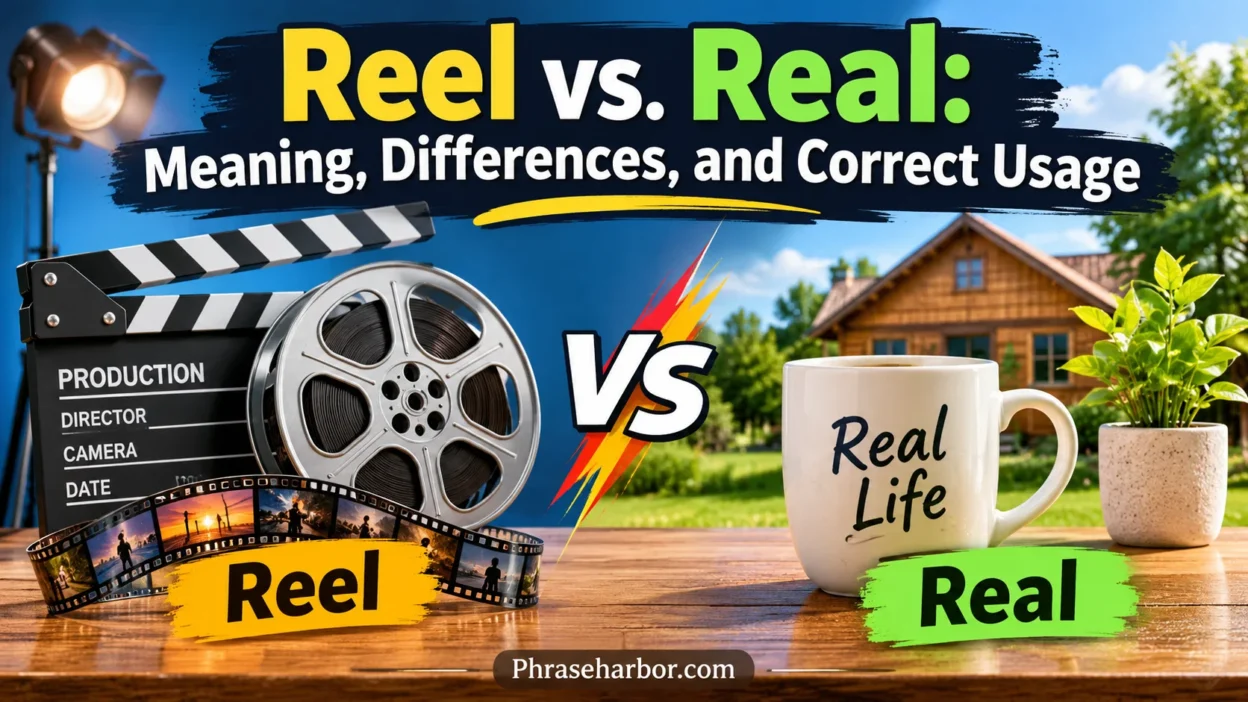
Have you ever wondered whether to write reel or real? These two words sound exactly alike, but their meanings and uses are completely different. One relates to winding, fishing equipment, and videos. The other describes something genuine, authentic, or actually existing.
The confusion often appears in everyday writing, social media posts, conversations, and professional communication. For example, you might watch an Instagram Reel about a real-life experience. Although both words appear in the same sentence, neither can replace the other.
Understanding reel vs. real becomes easier when you learn their definitions, grammatical roles, and common expressions. Once you recognize what each word describes, choosing the correct spelling takes little effort.
Quick Answer:
Reel refers to a cylindrical object used to wind, store, or dispense something. It can also describe winding something around a spool, moving unsteadily, or reacting to a shocking experience. In modern entertainment, a reel can also mean a short video.
Real is an adjective that describes something genuine, actual, authentic, or not imaginary. It refers to things that exist in reality rather than fiction or imagination.
Here are two simple examples:
- Reel: I watched a funny Instagram reel during lunch.
- Real: Her story is based on a real experience.
The easiest way to remember the difference is:
- Reel = A spool, winding action, or short video.
- Real = Something genuine or actually existing.
Both words have the same pronunciation but different spellings and meanings. Therefore, context determines which word you should use.
Comparison Overview: Reel vs. Real
Although reel and real sound alike, they perform different grammatical functions and communicate different ideas.
| Feature | Reel | Real |
| Part of speech | Noun and verb | Primarily an adjective |
| Pronunciation | /riːl/ | /riːl/ |
| Main meaning | A spool, winding action, or short video | Genuine, actual, or authentic |
| Common contexts | Fishing, filming, social media, movement | Reality, truth, authenticity |
| Example | She bought a new fishing reel. | This is a real diamond. |
| Word family | Reeling, reeled | Reality, really, realism |
Reel describes a physical object, an action, or certain types of recorded entertainment. Meanwhile, real describes the nature or authenticity of something.
Both are examples of homophones. Homophones are words that share the same pronunciation but have different spellings or meanings.
For instance, consider these sentences:
- The fisherman replaced his broken reel.
- The fisherman caught a real shark.
The pronunciation remains identical. However, the first sentence describes fishing equipment while the second emphasizes the actual existence of something.
What Does Reel Mean?
The word reel has several meanings depending on how you use it. It commonly appears as a noun or verb in conversations about fishing, filmmaking, entertainment, and physical movement.
Understanding these meanings helps you recognize the word in different situations.
Reel as a Noun
As a noun, a reel generally refers to a cylindrical device designed to wind, hold, or dispense flexible materials.
Think of something that wraps around a spool. That object is often called a reel.
Common examples include:
- Fishing reel: A mechanical device attached to a fishing rod that stores and releases fishing line.
- Film reel: A circular spool used to hold motion-picture film.
- Cable reel: A cylindrical device that stores electrical cables or wires.
- Hose reel: Equipment that keeps garden hoses or industrial hoses organized.
- Thread reel: A spool that holds sewing thread or similar materials.
For example:
- My fishing reel needs a little maintenance.
- The electrician brought a large cable reel.
- She placed the film reel inside its storage case.
- I bought a new reel of sewing thread.
In modern entertainment, the word has another familiar meaning.
A reel can refer to a short video, particularly one published through social media platforms such as Instagram and Facebook.
For example:
- She posted a cooking reel yesterday.
- That travel reel received thousands of views.
- I watched several educational reels this morning.
The term also refers to a traditional Scottish or Irish folk dance, along with the music associated with that dance.
Therefore, the meaning of reel depends heavily on its surrounding words and context.
Reel as a Verb
When used as a verb, reel describes several actions, including winding something, moving unsteadily, or reacting strongly to an unexpected event.
Here are its main uses.
Winding something around a spool
This meaning commonly appears in fishing, manufacturing, and other activities involving flexible materials.
Examples:
- Please reel in the fishing line.
- He reeled the cable onto its storage spool.
- She reeled the thread back onto the reel.
Moving unsteadily or staggering
Someone may reel when they lose balance or struggle to walk steadily.
This can happen after receiving a physical blow, experiencing dizziness, or losing their balance.
Examples:
- He reeled backward after slipping on the wet floor.
- The boxer reeled from the unexpected punch.
- She reeled across the room after standing up too quickly.
Reacting to shock or surprise
The verb can also describe an emotional reaction to disturbing or surprising information.
For example:
- The entire family reeled from the unexpected news.
- Investors reeled after the company’s sudden announcement.
- She was still reeling from the shocking discovery.
In these sentences, nobody is winding anything around a spool. Instead, reeling describes a strong emotional or mental reaction.
Common Phrasal Verbs and Expressions with Reel
The word reel appears in several useful expressions. Their meanings can change depending on the particle that follows the verb.
| Expression | Meaning | Example |
| Reel in | Pull something inward or attract someone | He reeled in a large fish. |
| Reel off | Say or produce something quickly | She reeled off several examples. |
| Reel out | Unwind or release something gradually | He reeled out the fishing line. |
| Reel from | React strongly to something shocking | The community reeled from the tragedy. |
Reel in can also have a figurative meaning. A business might reel in new customers through an attractive marketing campaign.
Similarly, someone can reel off a list of names without much effort.
These expressions demonstrate why understanding the entire phrase matters more than memorizing one isolated definition.
Reel in Everyday and Modern Usage
Although reel has existed for centuries, its use in digital entertainment has become especially familiar.
Today, you might encounter the word in several situations.
Social media: Instagram Reels are short-form videos that users create, edit, and share.
Fishing: Anglers use fishing reels to control fishing lines and retrieve catches.
Filmmaking: Film reels historically stored strips of photographic film used in motion-picture projection.
Electrical work: Cable reels help workers transport and organize long electrical cables.
Everyday conversation: People use reeling to describe staggering, confusion, or emotional shock.
The important point is that these meanings belong to the same word. You must use the surrounding context to understand which meaning applies.
Examples of Reel in Sentences
Here are eight examples showing how reel works in different situations.
- The fisherman purchased a new reel for his fishing rod.
- I watched an entertaining cooking reel on Instagram.
- She carefully reeled the thread onto its spool.
- The boxer began to reel after receiving a powerful punch.
- He reeled off the names of every team member.
- The company was still reeling from its unexpected financial losses.
- Please reel in the fishing line before packing your equipment.
- The electrician stored the unused wire on a large reel.
Notice that the meaning changes with the sentence. Sometimes reel identifies an object. In other situations, it describes an action or reaction.
What Does Real Mean?
The word real describes something that genuinely exists or has an authentic nature. It distinguishes actual things from imaginary, fictional, artificial, or false ones.
For example, a real diamond comes from nature rather than being an imitation. Similarly, a real friendship involves genuine care rather than pretending to be someone’s friend.
The word appears frequently in everyday conversations, academic writing, business communication, and descriptions of personal experiences.
Real as an Adjective
Real primarily functions as an adjective. It modifies nouns by describing their authenticity, existence, or genuine nature.
Here are its main meanings.
Genuine or authentic
When something is real, it isn’t fake, artificial, or counterfeit.
Examples:
- This necklace contains real gold.
- She bought a real leather jacket.
- The museum displays a real historical artifact.
Actually existing
Real can describe something that exists rather than something imagined or invented.
Examples:
- Dragons aren’t real animals.
- The building is a real place in New York.
- Scientists discovered evidence of a real phenomenon.
Factual rather than fictional
The word can distinguish actual events from stories, entertainment, and imaginary situations.
Examples:
- The movie tells a real story.
- This documentary explores real historical events.
- The character was inspired by a real person.
Sincere or genuine
Real can also describe emotions, relationships, and personal behavior.
Examples:
- She showed real kindness toward everyone.
- Their friendship is built on real trust.
- His apology sounded real and sincere.
Significant or substantial
In some contexts, real emphasizes that something matters or has a meaningful effect.
Examples:
- The new policy created real opportunities.
- Climate change presents real challenges.
- Regular exercise can make a real difference.
These examples show that real describes more than physical objects. It can also communicate authenticity, sincerity, and importance.
Common Expressions Using Real
English contains several familiar expressions that use the word real.
Understanding these phrases helps you use the word naturally in conversations and writing.
| Expression | Meaning | Example |
| Real life | Actual everyday existence | Social media doesn’t always reflect real life. |
| Real world | Practical, everyday reality | You’ll need these skills in the real world. |
| Real deal | Something genuinely good or authentic | This restaurant is the real deal. |
| Real estate | Property consisting of land and buildings | She works in real estate. |
| Real-time | Happening or processed immediately | The app provides real-time updates. |
| For real | Seriously or genuinely | Are you moving abroad for real? |
| Keep it real | Remain honest and authentic | Always keep it real with your friends. |
| Real McCoy | The genuine article | This vintage watch is the real McCoy. |
One important detail: real estate is a fixed expression referring to land and property. Its meaning has nothing to do with something being imaginary or fictional.
Likewise, real-time commonly describes processes or information that operate or update as events happen.
Real vs. Really: Understanding the Difference
Although they share the same word family, real and really have different grammatical functions.
Real is an adjective that describes a noun.
Really is usually an adverb that modifies an adjective, verb, or another adverb. It can also add emphasis to a statement.
Compare these examples:
- This is a real problem.
- This problem is really difficult.
- I really appreciate your help.
- Is that a real diamond?
A simple way to remember the difference is to examine the word that follows.
If you’re describing a noun, you probably need real. If you’re modifying an action or description, really may be the correct choice.
Examples of Real in Sentences
Here are eight practical examples demonstrating different uses of real.
- She wants to experience real adventure instead of watching television.
- This painting is a real masterpiece.
- The documentary explores a real historical event.
- Their friendship is based on real trust.
- You need real evidence before making that accusation.
- The company offers real-time customer support.
- Is this a real diamond or an imitation?
- Learning practical skills makes a real difference in your career.
Each example uses real to describe authenticity, actual existence, or significance.
Main Differences Between Reel and Real
The biggest difference between reel and real involves their meanings and grammatical functions. Although their pronunciation matches, their spelling and usage never become interchangeable.
Let’s examine their differences more closely.
Difference in Meaning: Reel vs. Real
Reel relates to a spool, winding action, video content, or unsteady movement. Its meaning depends on the situation.
Real describes something genuine, factual, authentic, or actually existing.
Consider these examples:
- The fisherman replaced his damaged reel.
- The fisherman caught a real trophy-sized fish.
In the first sentence, reel identifies a piece of fishing equipment. In the second, real emphasizes that the fish genuinely exists.
Another comparison makes the distinction clearer:
- She uploaded a funny reel.
- She shared a real story about her childhood.
The first sentence refers to a video. The second describes an authentic personal experience.
Difference in Parts of Speech
Another important distinction involves grammar.
Reel can function as both a noun and a verb.
As a noun:
- The camera operator loaded a new film reel.
- My fishing reel needs repair.
As a verb:
- He began to reel in the fishing line.
- The audience reeled from the unexpected announcement.
Real primarily functions as an adjective.
Examples:
- This is a real opportunity.
- She wants a real relationship.
- We need real information before deciding.
This grammatical difference provides a useful clue when you’re unsure which spelling to choose.
Frequently Asked Questions
Are Reel and Real Homophones?
Yes, reel and real are homophones because they share the same pronunciation but have different spellings and meanings.
Reel refers to a spool, winding action, or short video. Real describes something genuine, authentic, or actually existing.
For example, you might watch a reel about a real historical event.
Is It Reel Life or Real Life?
Real life is the correct expression when referring to actual experiences and everyday existence.
For example:
- Correct: Social media doesn’t always reflect real life.
- Incorrect: Social media doesn’t always reflect reel life.
The word real describes something that exists outside fiction or imagination.
Is It Reel or Real on Instagram?
The correct term is Instagram Reels.
Reels are short-form videos that users can create and share on the platform. Real has a different meaning and describes something genuine or authentic.
For example, “She posted a reel about her real-life travel experience” uses both words correctly.
What Does Reeling Mean in Everyday English?
Reeling has several meanings depending on context.
It can describe winding something around a spool, moving unsteadily, or reacting strongly to shocking information.
Examples:
- He was reeling in the fishing line.
- The boxer was reeling after the punch.
- The family was reeling from the unexpected news.
What Is the Difference Between Real and Reality?
Real is primarily an adjective that describes something genuine or actually existing. Reality is a noun referring to the state or condition of things as they actually exist.
Examples:
- Real: She wants a real friendship.
- Reality: Reality can sometimes differ from expectations.
Both words relate to actual existence but perform different grammatical functions.
Conclusion:
Understanding reel vs. real is simple once you recognize their different meanings and grammatical roles. Reel refers to a cylindrical spool, winding action, unsteady movement, or short-form video. You might encounter it while fishing, watching social media content, or discussing filmmaking. Real, on the other hand, describes something genuine, authentic, factual, or actually existing. It appears in expressions such as real life, real world, and the real deal.