Choosing between much and many seems simple until you start using them in everyday sentences. Both words describe large quantities, but they don’t work with the same types of nouns. Using the wrong one can make an otherwise clear sentence sound grammatically incorrect.
The good news? You only need to understand one important grammatical distinction to use them correctly: countable and uncountable nouns. Once you recognize whether a noun represents individual items or an overall amount, choosing between much and many becomes much easier.
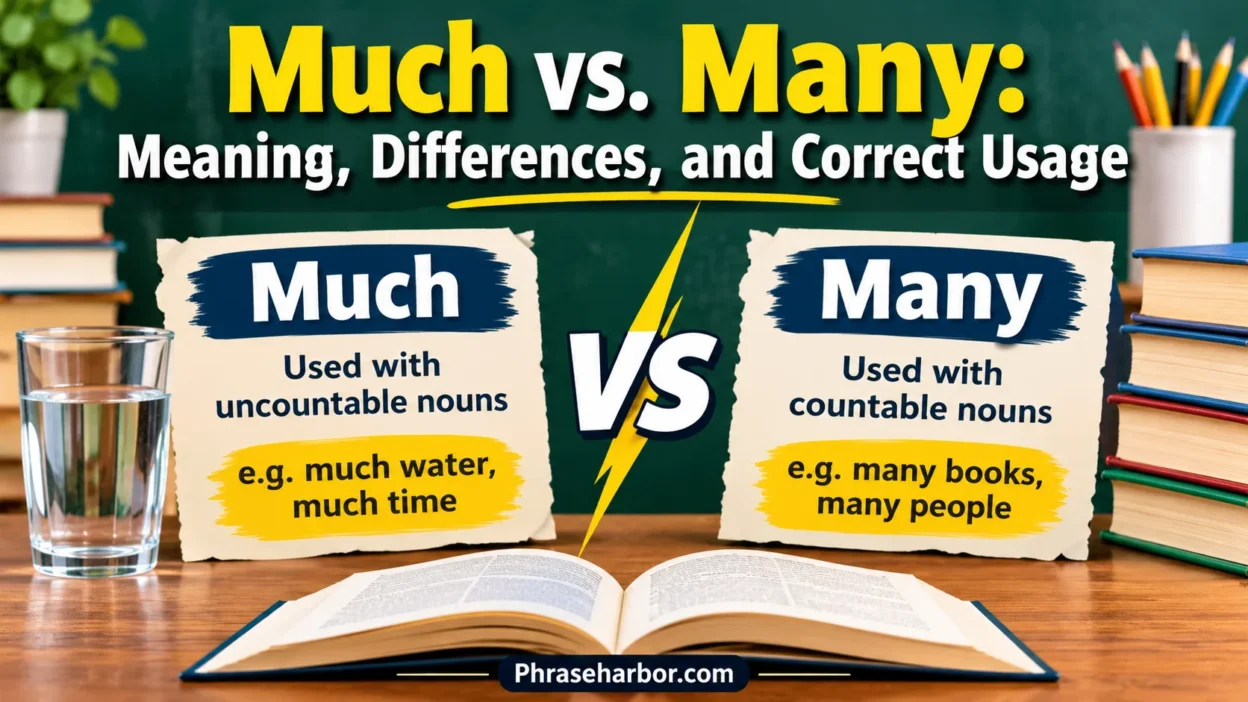
For example, you can say “many books” because you can count individual books. However, you say “much water” because water is generally treated as an uncountable substance. Both expressions communicate quantity, but each follows a different grammatical pattern.
Let’s explore the meanings, differences, sentence structures, common mistakes, and practical examples of much vs. many so you can use both confidently.
Quick Answer:
Much refers to a large amount of something and generally appears with uncountable nouns. Many refers to a large number of individual things or people and appears with countable plural nouns.
Here is the simplest way to remember the difference:
- Much + uncountable noun: Much water, much money, much time, much information.
- Many + countable plural noun: Many books, many people, many students, many questions.
Consider these examples:
- How much money do you need?
- How many dollars do you need?
- We don’t have much time.
- We don’t have many opportunities.
The key distinction is that much measures an amount while many counts separate items.
Comparison Overview: Much vs. Many
Although much and many have similar meanings, their grammatical functions differ depending on the nouns they describe. Understanding this distinction helps you avoid common mistakes in speaking and writing.
| Feature | Much | Many |
| Basic meaning | A large amount | A large number |
| Noun type | Uncountable nouns | Countable plural nouns |
| Noun form | Usually singular in form | Plural |
| Used with | Water, money, time | Books, people, cars |
| Common questions | How much? | How many? |
| Negative sentences | I don’t have much time. | I don’t have many friends. |
| Positive expressions | So much work | So many tasks |
| With too | Too much sugar | Too many mistakes |
| With so | So much information | So many questions |
| With as | As much money as possible | As many books as possible |
The easiest rule: If you can count something individually, use many. If you measure it as an amount rather than counting separate units, use much.
For example, you can count five apples, twelve chairs, or twenty employees. These nouns work with many. However, you generally measure water in liters, sugar in cups, and time in hours. These uncountable nouns work with much.
What Does Much Mean?
Much is a quantifier that describes a large amount or degree of something. It typically appears before uncountable nouns that don’t normally have plural forms in their usual meanings.
For example, you can have much patience, much experience, or much confidence. These things exist in varying amounts, but you don’t normally count them as separate individual units.
Much also functions as a pronoun when the noun it represents is already understood.
Consider these examples:
- I don’t have much money.
- She didn’t spend much.
- There isn’t much information available.
- How much time do we have?
In each example, much refers to an amount rather than a specific number of individual objects.
Definition and Meaning of Much
In English grammar, much expresses quantity, degree, or extent. It helps describe how large an amount is without identifying an exact measurement.
For example, consider this sentence:
“There’s much work to do before Friday.”
Here, much describes the amount of work. It doesn’t tell you how many individual tasks exist.
Much commonly appears with nouns such as:
- Water
- Money
- Time
- Energy
- Knowledge
- Advice
- Information
- Patience
- Equipment
- Research
These nouns generally represent substances, abstract ideas, or collective amounts rather than individually counted objects.
Much can also function as a determiner or pronoun.
As a determiner, it appears before a noun:
- We don’t have much food.
- He hasn’t shown much interest.
As a pronoun, it replaces a previously understood noun:
- How much did you spend?
- Much remains to be done.
This flexibility makes much useful in questions, negative statements, comparisons, and several common expressions.
When to Use Much
You should use much when discussing the quantity of an uncountable noun. However, sentence structure also influences how naturally it sounds.
Use much in questions.
Questions frequently use much when someone wants to know the amount of something.
Examples:
- How much money do you earn?
- How much milk should I add?
- How much time does the journey take?
- How much information do you need?
- How much sugar is in this recipe?
The expression how much asks about an amount rather than a number of individual objects.
Use much in negative sentences.
Much sounds natural in many negative constructions, particularly when describing a limited quantity.
Examples:
- I don’t have much free time.
- She doesn’t drink much coffee.
- We didn’t receive much help.
- There isn’t much food left.
- He hasn’t made much progress.
These sentences communicate that the amount is small or insufficient.
Use much in affirmative sentences with modifiers.
Although much is less common in ordinary positive statements, it works naturally with words such as so, too, and as.
Examples:
- There is too much noise outside.
- We have so much work today.
- She has as much experience as her manager.
- Thank you so much for your support.
These expressions are standard English constructions. The presence of a modifier makes much sound natural in affirmative sentences.
Examples of Much in Sentences
The following examples demonstrate how much works with different uncountable nouns and sentence structures.
| Sentence | Uncountable noun |
| I don’t have much money. | Money |
| How much water do you drink? | Water |
| We haven’t got much time. | Time |
| She doesn’t need much advice. | Advice |
| There isn’t much traffic today. | Traffic |
| He didn’t show much interest. | Interest |
| How much information is available? | Information |
| This machine doesn’t require much energy. | Energy |
| We didn’t conduct much research. | Research |
| There isn’t much furniture in the room. | Furniture |
Notice that the nouns remain in their usual uncountable forms. You wouldn’t normally write “much informations” or “much advices” in standard English.
What Does Many Mean?
Many is a quantifier that describes a large number of individual people, objects, or things. Unlike much, it works with countable plural nouns.
You can count books, employees, houses, questions, and opportunities individually. That’s why many works naturally with these nouns.
For example:
- Many students attended the lecture.
- She has many interesting books.
- We received many applications.
- How many people are coming?
In each sentence, many identifies a number of separate items or individuals.
Definition and Meaning of Many
Many means a large number of countable things or people. It indicates quantity by referring to individual units rather than an overall amount.
For example:
“Many customers visited the store today.”
This sentence tells you that numerous individual customers visited the store. Although it doesn’t provide an exact number, it clearly indicates a substantial quantity.
Many generally appears with plural countable nouns, including:
- Students
- Teachers
- Employees
- Children
- Books
- Computers
- Questions
- Ideas
- Problems
- Opportunities
Many can also function as a pronoun when the noun is already clear from context.
For example:
- Many were invited to the celebration.
- Many have already completed the assignment.
- Not many agreed with the decision.
In these examples, the noun doesn’t need to appear again because readers can understand what many represents.
When to Use Many
Use many whenever you’re referring to a number of countable items or people.
Use many in questions.
Many frequently appears in questions that ask about the number of individual objects or people.
Examples:
- How many students are in your class?
- How many books have you read?
- How many employees work here?
- How many questions are on the test?
- How many days will you stay?
The expression how many asks for a countable number.
Use many in negative sentences.
Many works naturally in negative statements when explaining that the number of something is limited.
Examples:
- I don’t have many friends in this city.
- She hasn’t visited many countries.
- We didn’t receive many applications.
- There aren’t many restaurants nearby.
- He doesn’t make many mistakes.
These examples describe a relatively small number of people, places, or things.
Use many in affirmative sentences.
Unlike much, many commonly appears in ordinary positive statements.
Examples:
- Many people enjoy traveling.
- She has many responsibilities.
- Our company serves many customers.
- Many students prefer online learning.
- The project offers many opportunities.
These constructions sound natural in everyday English and formal writing.
Examples of Many in Sentences
Here are additional examples showing how many works with different plural countable nouns.
| Sentence | Countable plural noun |
| Many people attended the event. | People |
| She owns many books. | Books |
| We have many questions. | Questions |
| Many students passed the exam. | Students |
| He made many mistakes. | Mistakes |
| There are many cars outside. | Cars |
| They explored many countries. | Countries |
| Many opportunities are available. | Opportunities |
| The teacher assigned many exercises. | Exercises |
| We received many invitations. | Invitations |
The important point is that each noun represents something you can count individually.
Read More: Conjunction vs. Contraction: Meaning, and Correct Usage
Main Differences Between Much and Many
The biggest difference between much and many comes down to the type of noun following each word. However, their usage also differs across questions, negative statements, and affirmative constructions.
Much Is Used With Uncountable Nouns
Uncountable nouns represent substances, materials, concepts, or quantities that English speakers don’t usually count as separate individual units.
For example, water is uncountable in its ordinary meaning. You can measure it in glasses, bottles, or liters, but you don’t normally count water itself as individual pieces.
That’s why these expressions are correct:
- Much water
- Much milk
- Much information
- Much knowledge
- Much patience
- Much work
However, these constructions are incorrect in their intended standard meanings:
- Much waters
- Much milks
- Much informations
- Much knowledges
- Much patiences
Some uncountable nouns can have specialized plural forms in particular contexts. For example, waters can refer to particular bodies or areas of water. However, that doesn’t change their usual uncountable usage.
Remember: Use much when you’re discussing an overall amount rather than counting individual units.
Many Is Used With Countable Plural Nouns
Countable nouns represent separate objects, people, or units. You can identify them individually and assign them numbers.
For example, you can have one chair, two chairs, or ten chairs. Therefore, many works with the plural form.
Correct examples:
- Many chairs
- Many students
- Many employees
- Many ideas
- Many questions
- Many opportunities
Incorrect examples:
- Many chair
- Many student
- Many employee
- Many idea
The noun following many must normally appear in its plural form.
Consider these sentences:
- Many students attended the meeting.
- Many employees requested additional training.
- Many houses were damaged during the storm.
Each sentence refers to multiple countable individuals or objects.
Difference in Questions and Negative Sentences
Both words appear frequently in questions and negative statements. The difference depends on what you’re asking about.
Use how much when asking about an amount:
- How much coffee do you drink?
- How much money did you spend?
- How much time is left?
- How much information do we need?
Use how many when asking about a number:
- How many cups of coffee did you drink?
- How many dollars did you spend?
- How many minutes are left?
- How many documents do we need?
Notice something interesting: the same general subject can use either expression depending on the noun.
Coffee is uncountable, but cups are countable. Money is generally uncountable, but dollars are countable.
Negative sentences follow the same principle:
- I don’t have much coffee.
- I don’t have many coffee beans.
- She doesn’t have much work.
- She doesn’t have many assignments.
The grammatical distinction remains consistent regardless of whether the sentence is positive, negative, or interrogative.
Difference in Positive Sentences
One noticeable difference between much and many involves ordinary affirmative statements.
Many sounds natural in positive sentences:
- Many people attended the conference.
- She has many responsibilities.
- We received many emails.
Much can also appear in positive sentences, but it often needs a modifier or a particular grammatical construction.
Natural examples include:
- There is too much noise.
- We have so much information.
- He has as much experience as his colleague.
- Thank you very much.
Compare these sentences:
| Less natural in ordinary conversation | More natural alternative |
| I have much work today. | I have a lot of work today. |
| She has much money. | She has a lot of money. |
| We have much time. | We have a lot of time. |
The first column isn’t automatically ungrammatical in every context. However, the alternatives in the second column generally sound more conversational in everyday American English.
Frequently Asked Questions
Is Much Used for Countable or Uncountable Nouns?
Much is generally used with uncountable nouns. These nouns represent amounts rather than separate individual items.
Examples include much water, much money, much time, and much information.
For countable plural nouns, use many instead.
Is Many Used for Singular or Plural Nouns?
Many is used with countable plural nouns. It refers to multiple individual people, objects, or things.
For example, you can say “many books,” “many students,” and “many opportunities.”
Don’t use many directly before a singular countable noun. “Many book” is incorrect because book needs its plural form.
Can You Use Much in Positive Sentences?
Yes. Much can appear in affirmative sentences, especially with modifiers such as so, too, and as.
Examples:
- We have so much work.
- There is too much noise.
- She has as much experience as her colleague.
However, a lot of usually sounds more natural in ordinary positive statements.
Is A Lot Of the Same as Much and Many?
A lot of has a similar meaning but works with both countable and uncountable nouns.
Examples:
- A lot of water
- A lot of people
- A lot of money
- A lot of books
Much and many have more specific grammatical requirements. Much takes uncountable nouns while many takes countable plural nouns.
Which Is Correct: How Much People or How Many People?
How many people is correct.
People is a plural countable noun, so it requires many rather than much.
For example: “How many people are attending the meeting?”
Conclusion:
Understanding much vs. many comes down to recognizing the difference between uncountable and countable nouns. Use much when describing an amount of something that English generally treats as uncountable. Examples include water, money, time, information, and advice. Use many when referring to a number of individual people, objects, or things. Examples include books, students, questions, employees, and opportunities.